Showing posts with label inspirational. Show all posts

Wednesday, March 24, 2010

"Heart of Stone," by Jill Marie Landis

The Chick: Lovie Lane, a.k.a. "Lovie Lamonte," a.k.a. "Mrs. Laura Foster." Sold to a brothel at age eleven, she eventually earned enough money on her back to escape that wretched life and open a boardinghouse as a respectable "widow."
The Rub: While the small Texas town of Glory thinks she's genteel lady, she knows they could never understand her past, especially Brand, a kind-hearted preacher who deserves better.
Dream Casting: Reese Witherspoon.

The Dude: Reverend Brand McCormick. He thinks good Widow Foster is the bee's knees, and knows she likes him back despite her bizarre reluctance.
The Rub: Unfortunately, when the son he never knew he'd had decides to show up, leaving his reputation in tatters. Will the good widow still have him?
Dream Casting: Simon Baker.

The Plot:

Evil Uncle: What am I supposed to do with my orphaned, non-denominational Irish nieces?

Brothel: We'll take two!

Evil Uncle: SOLD!

Lovie/Laura: 0_0

Several Years Later

Laura: I am a refined widow. I run a respectable boarding house. I love children and animals. I'm totally not a seasoned prostitute. Did I mention my excellent taste in home decorating? I'm so not a whore.

Brand: I'm a charming, pious preacher. I have two adorably mischievous kids. I think I love you. You're totally not a seasoned prostitute. Did I mention I'm a widower? You're so not a whore. Wanna date?

Laura: No!

Brand's Kids: *sad eyes* Please date our dad!

Laura: Fine, I will.

Brand's Secret Love Child: Did someone order a Plot Device?

Brand: 0_0

Laura: Well I'll be damned.

Brand: We could still date!

Laura: Too bad I'm still a dirty, dirty whore! *flees*

Brand's Secret Love Child: *sad eyes* Please marry my dad!

Laura: Oh, FINE. I will.

Brand: HOORAY!

Romance Convention Checklist

1 Fake Widow with a Dark Past

2 Inconveniently Dead Parents

1 Understanding Widower Preacher

1 Nasty Politician

1 Secret Baby

3 Missing Siblings

1 Bible

Several Black Eyes

1 Shady Former Partner-In-Crime

The Word: First off, I would like to thank Jill Marie Landis and her publicist for offering me a free copy of her Inspirational romance Heart of Stone, the first in her Irish Angels series. I have to say I was a little nonplussed by the title of the series. I don't really understand the focus on the characters being Irish - it doesn't really affect the protagonist's outlook, religion, or behaviour.

That's just a quibble, however. Heart of Stone is not a terrible romance. I may be damning it with faint praise, but it does have a lot of good things going for it and avoids a lot of the pitfalls I was expecting (especially after reading A Bride in the Bargain). However, it just didn't manage to be interesting.

Life dealt Lovie Lane a crappy hand. There's really no other way to say it. Orphaned at the age of eleven in the disease-ridden Irish Channel of New Orleans with her three younger sisters, her cold-hearted uncle dumped her two youngest sisters in an orphanage while Lovie and her sister Megan went someplace entirely different: a brothel. A day later, Megan too vanished, leaving Lovie utterly alone.

Years later, Lovie now goes by the name Laura Foster and owns a luxurious boardinghouse in the small town of Glory, Texas. To the townsfolk, she's a respectable and incredibly wealthy widow, but Laura feels like a fraud. Jill Marie Landis, to her infinite credit, doesn't whitewash Laura's past: she wasn't some idealized noble prostitute who only did it a few times to keep the barest of crusts in her belly, but an accomplished veteran and survivor who earned the majority of her fortune from it.

While she holds a high standing the community, Laura shuns social contact. Inside, she considers herself fallen and inferior and dirty, unworthy of association with the decent, moral people of Glory. To her, even starting a friendship is akin to deception, for surely no one would want to befriend her if they knew the truth. However, she hasn't given up on looking for her three lost sisters (presumably the heroines of future books in the series), and she keeps up her respectable front and her boardinghouse in order to provide a refuge for them once she tracks them down.

The fine balance of her life is rattled when Brand McCormick, the widowed preacher of Glory, takes a romantic interest in her. Although she likes him, very much in fact, she can't afford a relationship with him. Sooner or later the truth about her past is bound to get out, and Brand's reputation will go down in flames if it does.

However, in a delightful twist, good ol' Fate trashes Brand's reputation first when a young man claiming to be Brand's son shows up during his service and accuses his father of abandonment. In a nice narrative parallel, Laura finds herself defending Brand as the citizens of Glory fight over whether their preacher should be forgiven for an 18-year-old sin or tarred and feathered. This smaller, more manageable Big Dirty Secret strengthens the equality of the protagonists and makes the release of Laura's pent-up guilt and shame more believable, so that she's better able to handle the fallout from her own Big Dirty Secret.

Another thing I liked was the depiction of religion. Naturally, it's very important to Brand, and this comes through well, but I especially appreciated the notion of religion as it relates to the heroine, who is an atheist. Yup - she doesn't believe in God. Thankfully, she's not treated to a preachy sermon (although probably because she doesn't make her atheism well known), and neither is she given a giant Road-To-Damascus revelation about God's existence either. Her introduction to God is subtly played and quite personal - her admiration for Brand is part of why she makes an attempt, but mainly it's thanks to her own quiet exploration and curiosity. And even then - she's not an enthusiastic, scripture-quoting convert by the end of the novel, merely someone who's more willing to accept God into her life.

While the realism and the narrative plot parallels were quite good, this novel wasn't perfect. One of the flaws, I felt, was the reason for Laura's atheism. Part of it is due to her tormented childhood and how understandably difficult it is for Laura to reconcile the idea of a benevolent deity with the trauma she suffered - I get that. I do. But the novel also suggests that a large part of her atheism is just plain ignorance, and the fact that she'd never even picked up a Bible or heard a single Bible story growing up. Laura doesn't even know the story of Noah's Arc.

Hello, if she was raised until the age of eleven by lower-class Irish parents in 1840s Ireland, she would have picked up some religion, she would have heard Bible stories. She might not have believed it or understood it, but religion would have been in her life - it just would have been Catholic. It's okay to have Catholic-raised characters lose their faith and then convert to Protestantism, Jill Marie Landis. I don't find that offensive - but I do find subverting historical accuracy in order to keep Catholicism out of a religious narrative offensive.

Another flaw was the writing style. Jill Marie Landis definitely belongs to the Tell-Instead-of-Show School of Flawed Writing and she demonstrates this fairly early on page 25 when Laura notes Brand's "hands were not the hands of a man who shied away from hard work." Meaning? Show, don't tell! It gets worse, when, at the end, Landis decides to Tell instead of Show Brand's Big Moralizing Speech, under the excuse that Brand is so impassioned he doesn't remember what he said, only that it was awesome and about love and forgiveness and stuff and people in the audience cried. Lame.

Lastly, our hero. I liked Laura, our heroine. True, I felt that for a survivor of her calibre she could have shown a bit more grit and been a little less "This is why I can't have nice things," but her character seemed genuine and her past wasn't watered down. Brand, on the other hand - he's too nice. Too nice and too understanding and too forgiving. In other words: boring. Other than a told-instead-of-shown "carousing past," a half-Cherokee love child (whom he instantly accepts with open arms), and a tendency to use his adorable and emotionally-fragile motherless children to score dates with chicks, he didn't have any flaws. He doesn't have a temper, he doesn't misunderstand things, he doesn't lash out or get frustrated.

You can be a genuinely good, religious man and still make mistakes, but Brand just makes all the right moves and as a result has about as much spark as one of those Japanese body-pillows with a face on it. As a result, the development of the romance is pretty one-sided, as Brand is so perfectly forgiving, understanding and accepting (and totally in love with Laura) that Laura's personal development is the only real obstacle to the HEA. This lopsided development made a lot of the book pretty tedious and as a I result I didn't really enjoy it as much as I might have if Brand had had a little more life to him.

That being said, this novel has good narrative drama, an intriguing heroine, and a gentle but no less genuine take on religion. Except for the one or two points I mentioned, the story is realistic and doesn't ask for a lot of suspension of disbelief.
B-

Monday, February 01, 2010

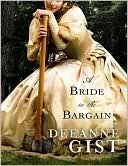
"A Bride in the Bargain," by Deeanne Gist


The Chick: Anna Ivey. Orphaned and looking to escape a violent suitor, she takes up Asa Mercer's offer to travel by boat to Seattle and seek a position as a domestic.
The Rub: Asa Mercer may have offered women positions as cooks, nannies and teachers - but in Seattle he's promised the men suitable wives. Anna, however, believes her tragic history has rendered her incapable of marriage.
Dream Casting: Return to Cranford's Jodie Whittaker.

The Dude: Joe Denton. Having received 640 hectares of land in a Land Grant, he stands to lose half of that if he doesn't marry by the judge's deadline. Too bad the bride he bought has no interest in marriage.
The Rub: He keeps Anna on as a cook for his lumber crew, hoping in the meantime to woo her into changing her mind. However, if he can't manage it within six weeks, then he can kiss his land and his livelihood goodbye.
Dream Casting: Simon Baker.

The Plot:

Asa Mercer: Wives, here - get your fresh, hot wives!

Joe: I'll take one!

Asa Mercer: Jobs here - get your nice, easy jobs!

Anna: I'll take one!

Joe: Great! Now that we're getting married, my lumberjacks will be safe!

Anna: Wait, HOLD UP. I can't marry!

Joe: Why not?

Anna: I kill people. With my mind. I think bad thoughts and then they die.

Joe: Holy crap! You're Jean Grey?

Anna: No - I mean my family all died in a tragic fashion because I was petulant and insubordinate.

Joe: ...Were you dropped on your head as a child? Wait, don't answer that question. Marry me!
Anna: But you only care about your land! *suspicious cough*

Joe: Aaaagh! My beloved has consumption! We're moving to Texas!

Anna: Guess that solves my problem. Too bad I have consumption.

Random Doctor: It's not consumption!

Anna and Joe: HOORAY!

Romance Convention Checklist

1 Big Misunderstanding

1 TSTL Martyr Heroine

Several Burly Lumberjacks

1 Case of *Cough, Cough* Fake Convenient Consumption

Several Semi-Poisonous Mushrooms

2 Pairs of Flimsy, Obsessed-Over Undergarments
1 Romantically Lacklustre Rival

1 Surprise Allergy

1 Alluringly-Displayed Watchpin

The Word:
I picked this book up at the library because I'd attended Deeanne Gist's panel at RWA 2009 and really, really liked the covers of her books. Inspirational (Christian) romances, as a rule, tend to have pretty awesome covers precisely because they tend not to rely on sex in their narrative, and thereby do not want to advertise sex on the cover with an oh-so-tiresome Naked Male Torso image, or the increasingly popular Beautiful Woman In Gorgeous Dress that Gapes Open At the Back image. Anyway, I come from a religious family and am religious myself so I thought it was high time to try an Inspirational Romance and see what I thought.

What I got: a mixed bag. A really mixed bag - some parts of this story surprised me with how much I appreciated them, while others were so bone-headed I wanted to throw this book against a wall.

The story starts in 1860s Seattle. A wild, gorgeous and untamed land, the Washington territory is still a disappointing sausagefest of lumberjacks and gold-diggers, with nary an unmarried woman in sight. Real-life historical figure Asa Mercer promises the men Eastern brides of good character in return for a measly $300. On the other side of the continent in New York, however, he offers young women (orphans and widows of the Civil War, mostly) positions as domestics, cooks, and schoolteachers in the great unexplored West - in return for a fee, of course.

Joe Denton has no intention of buying a bride - until his very livelihood depends on it. Ten years ago, he was given 640 hectares of forest in a Land Grant that required all recipients to be married men. His young wife died after he received the Grant but before she could make the trip to Seattle, and now a competitor's suing for half his land on the basis that Joe is a bachelor. Joe can't prove his marriage to the ornery judge - his wife's death certificate went up in smoke along with the courthouse and the judge (who's distantly related to the competitor) says Joe's marriage certificate isn't enough proof. He gives Joe an ultimatum - either come up with that death certificate, marry by a certain deadline, or lose half his property.

Back on the East Coast, Anna works as a cook while fending off the very unwelcome advances of an abusive suitor. When his overtures become violent, she flees to New York and takes up Asa Mercer's offer of employment in the West. She can't pay for her passage, though, but Asa (rightfully suspecting a pretty girl who can read, write and cook is Lonely Lumberjack catnip) agrees to let her come on the grounds that her new employer will pay the $50 for her passage once they arrive.

So Anna thinks she's going to be a cook and Joe thinks he's getting a bride. Needless to say, their meeting doesn't go very well. Anna, for personal problems of her own, flat-out refuses to marry and Joe, in a fit of desperation, proposes instead to another one of "Mercer's Girls" - a 60-year-old widow whose intended cried off when he discovered she'd vomited her sole pair of false teeth into the ocean during the voyage. Of course, their happy nuptials will have to wait until another pair of teeth are made.

Anna, meanwhile, consents to be Joe's cook and housekeeper in order to work off the $50 debt of her passage, thinking she's safe because Joe's already affianced himself to Seattle's First Cougar. Unfortunately, when Toothless McGee's husband turns out to be alive, Joe's engagement comes to an end, leaving Anna as his only option. However, he knows that if he tells her his engagement's off she won't continue on as his cook, so he continues to let her believe he's betrothed - hoping he'll be able to woo her into wedding him before the deadline.

Okay, so let's start with the good, shall we? A Bride in the Bargain takes place in a relatively unusual setting for an historical romance - 1860s Seattle - and Gist does a good job of creating the atmosphere of a burgeoning town, the rough-and-tumble camaraderie of the logging crew, as well as the clothing and lifestyles of the characters. While Joe is well-off, there are no Dukes or Lords or kowtowing footmen in the Washington Territory and most people have to do things themselves. I enjoyed how Gist mentions that Anna has to sew all of her own clothes and the massive amount of work she does preparing hearty meals for Joe's lumberjacks.

As well, I appreciated the depiction of Joe's love of the land - how he came to depend upon it while he was separated from his wife, to the point that when she died back in Maine, he didn't feel as much grief as he thinks he should have. The prospect of losing his land terrifies him, and, near the end of the story when Joe decides he has to let it go for Anna's sake, it's not a "hang the obstacles! I love you, darlin'" moment, but a genuinely painful decision that cuts him very deeply.

This being an Inspirational Romance, there are no sex scenes but that doesn't mean that lust and physical attraction are absent from the story. They're definitely present, if downplayed - one of the ways in which Joe woos Anna is his insistence on washing up and shaving in the kitchen while she cooks, giving her ample opportunity to ogle his muscular goodies. He's not immune to her physical charms, either - throughout the novel he's singularly fascinated with her watchpin, which always happens to be conveniently pinned just above her right breast. After accidentally catching her in her underwear, he's often possessed by thoughts of those threadbare unmentionables. Gist does an excellent job demonstrating that Joe and Anna find each other very sexy, without tiresome and repetitive mentions of throbbing manhoods and pebbling nipples.

However, these Good aspects of the novel wage a pitched battle with the almost overwhelming forces of the Bad, namely - the heroine and the pacing. Our heroine, Anna Ivey, well - let's just say she probably took the short horse-drawn buggy to the schoolhouse. To put it bluntly: she's a moron. An idiot. TSTL (TooStupidToLive). She feels she can't marry anyone or be a good mother because she was responsible for her entire family's death when she was 15. How responsible, you might ask?

1) She knocked over her 10-year-old brother's paper soldiers, which apparently enraged him enough to run away and join the Union troops as a drummer boy, where he subsequently died of disease.

2) Her mother dies of a broken heart thanks to her son's flight, which (are you following?) Anna caused because of her cruel prejudice against paper soldiers - but before passing, Mommie Dearest blames Anna for everything wrong in the world ever

3) Her father's last letter to her said that every fight she picks with her brother brings the rebel bullets closer to his heart, and guess which day he dies on?

Okay, so I guess you could say that her parents are partially responsible for her beliefs, being manipulative and foolish to the point of cruelty, but really. It's bad enough she blames herself for her mother's depression and her brother's stupidity, but it's her conviction that she's directly responsible for her father's death in the Civil War A THOUSAND MILES AWAY that makes me wonder why the space between her ears doesn't whistle in a high wind. If she'd received that letter, say, when she was six or seven years old, I might have bought that she carried an embedded belief that she was responsible for what happened. But she was told when she was fifteen and running the household - she should have known by then that bullets don't work that way. Does she figure that Civil War snipers don't even aim, they just fire off bullets willy-nilly knowing that Fathers with Rotten Children will attract them like magnets?

What makes this worse is that this is pretty much Anna's sole reason for refusing marriage, which means the plot is drawn out thanks to the unbelievable stupidity on Anna's part. It also doesn't help the believability of the plot when ONE page of conversation with a person with common sense completely cures this conviction of hers two thirds into the novel. While she continues to do other dimwitted, martyrish things (like when, upon discovering Seattle's damp climate's given her TB, Anna refuses the offer of a ride home in favour of walking home in the rain), this is her Big Deal and it completely undermines her as a realistic character.

Which brings us to the flimsy pacing. Most of the story is propelled by contrived and unbelievable circumstances rather than the actions of the characters. We have the first two-thirds of the book where the only thing keeping Anna and Joe apart is Anna's misguided notion she's that creepy kid from the infamous Twilight Zone episode who can kill people with her mind. However, both that, Joe's falsehood about his engagement, and the missing death certificate are dealt with and out of the way with 80 pages remaining. Even though Joe's already proven he loves Anna more than his land by proposing after his land is already safe, we're treated to a protracted, needless health-scare plotline at the 11th hour where Anna contracts tuberculosis and has to move to Texas. By this point, it's all so much excruciatingly boring padding.

So while this novel didn't achieve depths of wall-banging badness (although Anna certainly tried her hardest), it never managed to be completely enjoyable. There was some excellent world-building and research, an endearingly straightforward hero, nice description and secondary characters - but hampered by an unrealistically boneheaded heroine and uneven, contrived pacing. Averaging the good with the bad, I'd say it rates somewhere in the middle.
B-