Showing posts with label high fantasy. Show all posts

Monday, December 29, 2014

Video Game Review: "Dragon Age II"

Well lookee here! Another videogame review! Don't worry - I'll go back to reviewing books relatively soon (including Ashes to Ashes and my reread of Prince of Midnight).

So remember when I fangirled all over Dragon Age: Origins? Well, there's a sequel!

And it's ... different. Still good! But very different, and different in a way that made some fans of the previous game pretty angry. However, I still really enjoyed it.

The game's narrative is built around a storytelling framework: the cataclysmic events of the game have already happened, and one of your party members, a roguish teller-of-tales named Varric, has been captured by the authorities who want to find out what happened and the depth of your character's involvement. He essentially "narrates" the game.

In a change that disappointed a lot of fans, you can only create your character to an extent. You can no longer choose your race or your backstory - instead, you are Hawke, a human whose family fled from Ferelden due to the Blight from the previous game (you can still choose your appearance, gender, class, and general personality, though).

Your family washes up on the shores of Kirkwall, an independent city-state in the Free Marches. You escape being confined to the slums with the other refugees, but only by indenturing yourself in servitude to either a band of mercenaries or a band of smugglers (one of your first choices in the game). Before long your prowess as a problem solver gains you a reputation and more people in Kirkwall start coming to you for help and trusting your decisions. As you gain power and prestige, the problems you're expected to solve get understandably bigger.

The Setting
One aspect of the game that really rubbed some fans the wrong way was the setting - in the last game, your adventurers were able to traipse all over the nation of Ferelden - through forests and mountains and castles and caves. In Dragon Age: II, you're confined to the city of Kirkwall and a few locations immediately outside it.

However, Kirkwall is no ordinary city. It's more like Sunnydale/the Hellmouth from Buffy the Vampire Slayer: a town whose grisly history of slavery and blood magic has made it a breeding ground for demons, corruption, and insanity. So Dragon Age: II has more of a noir feel to it, where even though the focus lies in one location, it's one with a lot of layers and context.

That being said, I can understand how people got frustrated with retreading their steps through all the same places in the city, over and over again, or going to the same (or same-looking) caves again and again while completing different quests. While the setting we get is beautifully designed and rendered, that's really it. There's no sense of exploration or travel that there is with Dragon Age: Origins or Dragon Age: Inquisition.

The Politics
What Dragon Age II lacks in exploration, it makes up for in drama. Your Hawke and her family arrive in a city on the verge of a war from within. As explained in the previous game, mages in this world are able to tap into the magical power of the Fade (the otherworld), but it leaves them vulnerable to manipulation and possession by demons.

Because of this, the Chantry (this world's version of the Catholic Church) decreed that all individuals with magical talents need to be taught in church-sanctioned Circles and guarded by Templars who are trained to take down any mage who looks too demony. Templars are also trained to hunt down apostates - mages who refuse the Circle system.

But in Kirkwall, the system is broken, with mages and Templars at each others' throats. The mages say the Templars are magic-hating, civil-rights-violating religious zealots whose brutal tactics are driving mages to desperation. The Templars say that more mages are summoning demons and using blood magic than ever before, requiring stricter vigilance. Which side is right? Which side is the greater threat? There are a lot of different stories in the game as your pursue different quests, but the main conflict at the centre of Dragon Age: II is the growing Mage-Templar conflict and which side your character will eventually have to chose.

The Characters
Nowhere is the mage-versus-Templar debate more important than if you are a female Hawke! If you choose to play a female Hawke, your love interests lie on the polar opposite ends of the spectrum. On the one end is Fenris, a runaway elven slave with no memory of his former life thanks to the magical experimentation his mage owner subjected him to. He's very much a believer in "power corrupts" and that mages need to be kept on a leash for the greater good. On the other end is Anders, who believes Circles are prisons punishing innocent magic users for the crimes of a few. And whichever dude you choose, you can bet the other will have a few choice words regarding your decision.

In fact, almost every one of the characters in your party will have a beef with one of the others. Your characters interact not only with you, but with each other, and not always in a friendly way. There are friendships, enmities, and awkward situations between the people in your party - and, as always, these reactions and situations are determined by the decisions that you make. I actually think Dragon Age: II's characters are far more memorable than a lot of the characters in Origins - I'm a particular fan of Captain Aveline, an arrow-straight warrior who grows into a capable authority figure, and Varric, a rakish dwarf-of-all-trades who starts chronicling your adventures.

Also, Dragon Age: II improves on Origins' simplistic Approval friendship system by creating a Friend/Rival system - where, in certain situations, there's actually an advantage to certain characters disagreeing with you.

Ultimately, while the setting leaves much to be desired, and certain aspects of the game feel rushed - the storytelling and the characters are top notch and still very enjoyable. If you're a fan of Origins' combat and exploration, Dragon Age: II might not be the game for you. However, if it's the story, the cinematics and the fantastic character interactions that drew you to Origins, Dragon Age: II more than delivers.
A-

Friday, December 26, 2014

AnimeJune's First Ever Video Game Review: Dragon Age Origins

You didn't think I was much of a gamer, did you? Neither did I, to be honest. As a kid, I howled at my parents for a Nintendo 64 after spending several semi-interesting afternoons with my sisters in our neighbour's basement playing MarioKart and Banjo Kazooie. Once I finished howling over the injustice of receiving a Playstation for Christmas instead, I spent several years enjoyably bouncing along in Crash Bandicoot and Jak and Daxter, and scrolling my way through the Japanese soap operas of Final Fantasies VIII through X-II.

Once I grew up and moved out, I kind of lost interest in videogames. It wasn't that games were getting worse, far from it. To me, they seemed to grow more complicated, more difficult, and demand more investment than I was willing to give. My interests lay elsewhere - in books, writing and blogging. I didn't have time for games, and I didn't really miss them.

So this year, I dusted off my Xbox 360 and realized I hadn't turned it on in over a year. Yes, I'd bought an Xbox 360, and I'd tried Skyrim, LA Noire, and Batman Arkham Asylum, and nothing had clicked. I didn't even use it for Netflix anymore (I had a Blu-Ray for that). I figured it was finally time to give it away and turn my back on gaming for good.

But still, I felt guilty. There were games I'd bought that I hadn't even tried yet. I figured I couldn't give my Xbox away until I had tried every game I'd already bought for it. There was only one game I hadn't gotten around to opening - a secondhand copy of Dragon Age: Origins.

And that one game was enough to suck me right back in to gaming, and in a big way. Dragon Age introduced me to game and storytelling elements I'd never experienced fully in games before, it changed my whole view of gaming and turned it right back into the addictive experience it was in my teens.


The Story
So what's the story? Well, that depends. The main story is that the darkspawn, a race of subterranean demons, have amassed into a horde and are now invading the kingdom of Ferelden in a terrifying phenomenon known as a Blight. Your character, through one way or another, has just been recruited into the Grey Wardens, a secretive order of warriors dedicated to fighting darkspawn. Unfortunately, not long after you're recruited, the Grey Wardens and Ferelden's king are betrayed and slaughtered during a key battle, so you and your ragtag band of survivors, stragglers, and outcasts have to use the Grey Wardens' binding treaties to enlist the aid of the different peoples and races to end the Blight before it overruns the rest of the earth.

Your Story
The aspect of Dragon Age that shocked me the most (and had me scrambling to keep playing) is the the actual power you, the player, have over the story in the choices you get to make. In all the other RPGs I ever played, I controlled a specific character while experiencing a specific story. I didn't get to make any choices - I sat back, experienced the narrative, and continued it by fighting monsters and bosses.

Well, in Dragon Age: Origins, a large part of the story depends on your decisions. Those decisions change the story and actually have far-ranging consequences that can affect other quests in the game. The first choice you can make is your character - depending on your race (dwarf, elf, human) and class (mage, rogue, warrior), you get a different origin story and characters will interact with you differently. Other choices involve your character's personality - you can be righteous and altruistic, or hardened and practical, or sarcastic and only out for yourself.

Other choices are pretty huge, and have major repercussions throughout the game. Your ultimate quest is to amass enough allied forces to take on the darkspawn army and their Archdemon (head honcho). This takes you to several areas in the game, where you will have to complete a major task or quest - and how you complete it determines which type of forces will end up fighting for your side in the final battle. For instance, when your party encounters a mage training school overrun with demons, will you side with the Holy Templars and kill all the mages to eliminate the threat of demons, or will you side with the mages and protect them? Or when the dwarves you want to ally with are too busy with their civil war, which candidate for King will you support?

The best thing is - there are no wrong choices. There are certainly more moral choices, or more effective choices, or more hilariously evil choices (during one mini quest, I could choose between feeding a starving prisoner to get his treasure key - or simply stabbing him and taking it!). In some situations, there are no easy answers - for one particularly difficult quest in which a child is possessed by a demon, you can save him by sacrificing his mother to forbidden blood magic, or you can kill him to defeat the demon. Have fun with that one!

Not only that, but the choices make this game endlessly replayable. You played the game as a casteless, amoral dwarf rogue who romanced Leliana? Why not see how the game plays as a righteous human noble who seduces Alistair? The possibilities are endless.


The Characters
It's not only you fighting out there - you can also collect a varied cast of characters who will fight and interact with you (and with each other, if they're in the same party!). Each of these characters come with their own personalities, backstories and moral codes (or lack thereof) and will react differently to the decisions you make. There's Alistair - the bashful but righteous Grey Warden who shows you the ropes. Or Morrigan - the mysterious swamp witch with her own hidden agenda. Or Leliana - a religious sister who follows you after seeing you in a vision. Or Zevran - an elven assassin initially sent to kill you. And those are just a few.

They're all voiced expertly by talented voice actors (seriously - the voice acting in BioWare games is beyond compare), and their interactions with your character are one of the most entertaining aspects of the game. Not only that, but their loyalty and affection are not guaranteed. If a character disapproves of you enough, they might opt to leave your party - or betray you! Conversely, if their approval rating for you is high enough, they might pursue a more, shall we say, intimate alliance with you (and you can do the same!). It's your story, after all - and what's a story without a romance?

The Rest of the Story (Lore)
There's also a lot of lore. Picking things up or looking at certain things will upload books and information to your Codex. You can easily ignore this if you want. However, if you're like me - a diehard high fantasy reader, this is all delicious, delicious gravy. The worldbuilding in this game is amazing - it borrows from the common tropes regarding elves and dwarves and mages and such, but also adds unique touches to them. The idea of dwarves having a caste system, or elves being a persecuted nomadic people, or the church's control of magic with templars were all really fascinating to me.

Not all of this information is relevant to the exact quest at hand, but it's all interesting - and a lot of it carries over into future games. It gives the game and your decisions some context.

The Actual Game Stuff
Now - the gameplay. It's ... fine. It's serviceable. I played it on Casual - it's fun to explode enemies or decapitate them and there are interesting abilities and potions and stuff, but those things have never been very important to me in games. That may sound ridiculous, but that's the type of gamer I am. I'm a story person - and what I love about Dragon Age is that, instead of feeling like I'm reading an interactive fantasy novel (like with the Final Fantasy games), I feel like I am the hero of a fantasy novel. The combat and the game elements contribute to that, definitely, but all those other games I played and got tired of - they all had great gameplay elements. They just didn't have the story and the choice-based aspects.

That being said, from my inexperienced perspective, the gaming aspect is pretty sweet. Every time you level up you have the choice to improve certain aspects of your character (stamina, willpower, strength, cunning, etc) as well as learn new skills required outside combat (herbalism, lock picking) and in combat (spells, weapon moves, etc). There are also Tactics - you have the choice to actually program how your supporting party characters will behave in a battle. You can program them to use a certain spell if they're surrounded, or come to your rescue if your health is low - or you can leave it alone entirely as I did and let the automatic tactics work for you.

That's basically why I love this game - it can be as difficult or as easy as you want it to be. You can play on Casual, like me, and enjoy the story, or you can play it on Nightmare (the hardest setting, where you can actually do damage to your own party members if you're not careful enough) with strategically-programmed Tactics.

This is an older game - ha! It's from 2009! - but an enjoyable one nonetheless. I'd recommend it to any serious fantasy fans - and most especially to people who have played the new Dragon Age: Inquisition who want some more background information on what came before.
A+

Thursday, June 26, 2014

"Dragon Haven," by Robin Hobb

The Primary Cast:

Thymara: While most of the other keepers seem to have bonded with their dragons, hers remains frustratingly arrogant and aloof. Will she ever be able to win her over?

Alise: The pampered dragon scholar starts to get her hands dirty, and finds herself enjoying her life far more than expected.

Leftrin:  This riverboat captain is still in love with Alise - but she's married, and he's got secrets he still needs to keep under wraps.

Sedric: When he drinks dragon blood and becomes bonded to the weakest and slowest-witted of the dragons, he can no longer remain the uninvested, ignorant city boy any longer.

The Secondary Cast:

Greft: The self-styled leader of the keepers whose revolutionary ideas have more to do with grabbing power for himself than improving the lives of his dragons and fellow keepers.

Sintara: A beautiful blue dragon, she refuses to bond emotionally with her keeper. Humans are weak pathetic creatures! What are they good for, anyway?

Carson: A hired hunter who tries to help Sedric adjust to the new changes in his circumstances.

Jess: Another hunter, this one with far murkier intentions towards the dragons.

The Word: You know what's the most powerful feeling I experienced reading this novel? Relief.

I was highly disappointed with the first novel in this trilogy (Dragon Keeper) for more than a few reasons - the gratuitous fan service, the endless repetition of magical concepts from the first Liveship Traders trilogy, and the disturbing characterization of the first two explicitly gay major characters I've encountered in a Robin Hobb novel (not counting the gender-bending Fool from the Farseer books and the random lesbian spear-carrier who appears a handful of times in The Liveship books).

THANKFULLY, none of these issues carried over into this second, highly entertaining, and thought-provoking novel. Seriously - this book fixes all the problems I had with Dragon Keeper. Firstly, no fan service from previous characters - the protagonists are all on their own as they navigate the treacherous Rain Wilds territory to locate the lost Elderling city of Kelsingra. Unbeknownst to them, there is a traitor in their midst who has been hired to harvest dragon parts for the dying ruler of Chalced, who superstitiously believes in their magical curative properties.

There are no more tedious explanations of sea serpents and their cocoons here, either - instead, the story focuses on how, miraculously, the dragons previously dismissed as crippled or mentally deficient are starting to grow and change and improve thanks to their bonds with their human keepers. While several dragons (like the glorious blue dragon Sintara) still try to enforce the idea that dragons are The Rulers of the Earth and don't need humans - it becomes increasingly apparent that maybe bonding with humans is an integral part of the dragon maturation process.

In the last book, I'll be honest, I had serious problems with how the LGBT characters were portrayed. Sedric and his secret lover Hest (Alise's husband) came across as horrific gay stereotypes - Hest was the raging, closeted, misogynist bully who continually criticizes Alise's fashion choices; and Sedric was a mincing fop who spends most of the first novel moaning about getting river mud on his beautiful silk shirts.

However, in this second book, we get a far deeper look into Sedric's motivations. Yes, he's still kind of a spoiled city boy but now it's backed up with actual characterization that goes beyond "Alise's Token Gay Best Friend." When he accidentally-on-purpose drinks dragon blood, he develops a bond with the underdeveloped copper dragon Relpha. Having an innocent creature come to love and depend on him (and being able to psychically feel that trust) forces Sedric to reevaluate his relationship with Hest. Robin Hobb is an expert at introducing insufferable characters only to slowly evolve them over time (see: Malta from the Liveship Trader books).

As well, surprise surprise, we gain three (!) more LGBT characters in the novel who are all distinct, positive characters.

And finally, Dragon Haven also explores themes of sexuality - female sexuality and the rules governing it, to be specific. Thymara, one of the dragon keepers who has been marked with scales since birth, has been told her entire life that sex is forbidden for people like her. She has followed these rules faithfully, and is shocked to discover the other marked keepers have abandoned these rules and have started exploring their sexuality as a rejection of the Rain Wild culture that treated them like despised outcasts.

Thymara can be quite a judgemental character (there is a fair amount of slut-shaming on her part, initially), but her character arc is intriguing. The Rain Wild rules may be prejudicial, barbaric and unfair (breeding amongst the scaled is mainly forbidden because deformed babies are considered a waste of precious resources), but mindlessly defying these conventions without considering the real-world consequences of one's actions is not an appropriate response. Thymara remains celibate (and earns mockery for it), but her motivations for this choice evolve as the book does, becoming a choice based on agency and her ambitions for her future, rather than an unquestioning, meek acceptance of a biased system.

I am really, really glad this book didn't suck. It did the opposite of sucking, actually. It's pretty awesome, actually. Great female characters, complex themes, DRAGONS, and a dash of romance. What more could you ask of Robin Hobb?
A+

Thursday, December 26, 2013

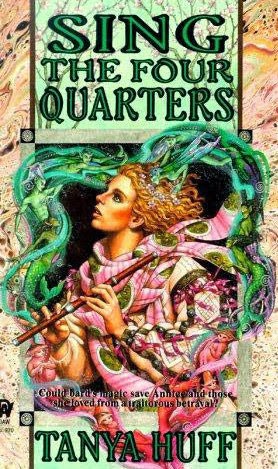
Re-Read Rollout: "Sing the Four Quarters," by Tanya Huff

Principle Cast:

Annice: A former princess, who was cast out of the royal family when she chose to become a bard. Ten years later, she's unsure of how to tell her estranged family that she's pregnant - especially since her brother the King forbade her to have kids.

Pjerin: The Duc of Ohrin - an ignored principality of King Theron's kingdom that guards a mountain pass into a hostile country. When he's accused of abetting that country and finds himself saying words that aren't his when questioned, he knows he's been set up - but by who?

Secondary Cast:

Stasya: Annice's girlfriend who worries about her health and helps Annice try and clear Pjerin's name.

Olinda: Pjerin's scheming aunt who wants him out of the way so that she can grab power for herself.

Albek: A con artist from the neighbouring hostile country who helps Olinda with her treasonous schemes.

Gerek: Pjerin's four-year-old son and heir. Olinda hopes to use him as a figurehead once Pjerin's out of the way.

King Theron: Annice's brother. Has pigheadedly refused to deal with the equally pigheaded Annice for  ten years, but now regrets the bitter gap between them.

Fantasy Convention Checklist:
  • 1 Use of Evil Magic
  • 4 Types of Elementals
  • 1 Giant Godzilla Elemental
  • 1 Magic-Boosting Fetus
  • 1 Nation of Suspicious Foreigners
  • All the LGBT People
The Word: This always happens sooner or later - not everything you loved as a kid, or a teenager, or a younger adult always holds up when you read it again. I initially read Sing the Four Quarters (and the three following novels in the quartet) in my early teens, when I was huge into my Epic Lady Fantasy phase - Robin Hobb, Kate Elliott, Melanie Rawn, Mercedes Lackey before her Magical Horse Books got stupid, Mickey Zucker Reichert whose novels were already stupid but enjoyably silly. 

Oddly enough, I'd never re-read this novel until now. The story takes place in a world where the four elements are controlled by kigh: playful, unpredictable spirits who can be managed and cajoled through music. People with the ability to sing the kigh are called bards, and they tramp up and down the country singing songs, conveying messages and fixing problems in service of the king. 

However, when 14-year-old Princess Annice joins the bards in defiance of her brother Theron's wish to marry her off to the prince of a neighbouring country, the young king strips her of all royal privileges, cuts her off from the family, and bars her (on pain of treason) from marrying or having children without his express permission. 

Ten years later, Annice comes back from her bard's Walk to discover there's a reason she's tired and throwing up all the time: she's pregnant. Moreover, before she can find a politic way to inform the brother she hasn't spoken to in a decade, the father of her baby - Pjerin, the Duc of Ohrid and handsome one night stand -  is accused of conspiring with an enemy nation and admits to treason when put to Bardic questioning. 

Annice knows there's no way she can tell the King about her pregnancy now that both her baby and her babydaddy are traitors, but she also suspects that something's not quite right about Pjerin's confession, especially since Pjerin maintains his innocence. Throwing caution to the wind, Annice rescues Pjerin from prison, and the two hie off to see if they can find out who set Pjerin up.

Let's start with the good - I didn't quite grasp this when I first read it at 13 or 14, but Sing the Four Quarters is an entirely sex-positive, feminist, LGBT-friendly fantasy novel. Annice is bisexual and in a committed relationship with her girlfriend, Stasya. Gay marriage exists - hell, gay political marriage exists (Annice's uncle turned down the offer to marry a foreign prince), women and men are found in equal numbers in almost every type of job, and premarital sex and bastardy carry little to no stigma. Best of all, none of this ever merits more than a passing mention when establishing setting - there's nothing special or remarkable or abnormal about any of it. For a novel published in 1994, that's pretty awesome.

However, despite all this positive stuff, this re-read ultimately didn't measure up to my memory of it. Yes, there are positive feminist themes and excellent LGBT representation and family issues and magic,  this novel would be practically perfect - except it isn't. Firstly - I had some serious problems with Pjerin, the male protagonist. He is an entitled ass - and I really could have gone without knowing he repeatedly banged his biological aunt.

Secondly, for a novel with such interesting themes, its story is pretty boring. Sing the Four Quarters packs a lot of content - but not all of that content is valuable to the narrative. A lot of it is redundant explanation of character motivation - Annice does something, but not before she explicitly tells us why she's doing this and why the world she lives in supports such an action, etc. The pacing is frustratingly slow-moving and dense, which works against the story itself since the latter half of the novel is really one extensive chase sequence. I finally gave up once I reached the halfway mark and skimmed my way to the end. 

However, I would hesitate to condemn this novel out of hand. It may have bored me, but it had a lot of good things going for it. If you're more into uber-detailed high fantasy, you may really enjoy this novel. However, if you're more into faster-paced, less cluttered stories, you're out of luck.
C+

Saturday, April 27, 2013

"The Lies of Locke Lamora," by Scott Lynch

The Main Cast:

Locke Lamora: An orphan with a mysterious past, he possesses a brilliant intelligence and a near-supernatural ability to cause mischief. Now the leader of the Gentlemen Bastards, he uses his skills to fleece the aristocracy of their misused wealth.

Jean Tannen: The son of wealthy merchants who perished in a fire, he was recruited into the Gentlemen Bastards for his prodigious, instinctive fighting ability. Now Locke's right-hand man, he fights for the Bastards with a pair of hand-axes known as the Wicked Sisters.

The Secondary Cast:

Calo and Galdo Sanza: Twin brothers who serve as wingmen in Locke's schemes. Recruited by Father Chains, they helped train Locke and Jean in the ways of the Bastards.

Bug: The Gentlemen Bastards' current apprentice, recruited by Locke. What he lacks in impulse control he makes up for in resourcefulness.

Father Chains: A priest of the (possibly heretical) god of thieves - and the founder of the Gentlemen Bastards. He recruits orphans with special talent to train and educate them to be the best thieves the world has ever known.

Don and Dona Salvara: An immensely rich aristocratic couple who are targeted by the Gentlemen Bastards for their con game.

Capa Barsavi: Camorr's King of Thieves. He united all of Camorr's criminals under one banner and established the Secret Peace with the city's Duke: so long as no one robs the aristocracy or the Duke's law enforcement, the Capa and his thieves are free to pilfer from the merchant and middle classes beneath the Duke's blind eye and lax hand. Of course, this means Locke and his Bastards have to be especially careful the Capa never finds out about their plots.

The Grey King: A mysterious figure with possibly magical powers who has returned to wreak vengeance upon Capa Barsavi for an unknown insult - and he's willing to use force to obtain Locke's assistance.

Fantasy Convention Checklist:

  • 1 Evil Mage
  • 1 Magical Animal Familiar
  • Several Orphans with Mysterious Pasts
  • 1 Really Awesome Cake
  • 1 Garden of Magical Blood-Drinking Glass Flowers (for reals)
  • Several Fake Moustaches
  • Several Hungry Sharks
  • 1 Duplicitous Priest

The Word: What I particularly loved about reading Lies of Locke Lamora is that it uses traditional high fantasy storytelling (which I already enjoy) to tell an unorthodox tale in a slightly skewed setting. Camorr, the city-state that Locke and his clan call home, is not based on Medieval England, but rather Venice - with its canals and its slums and its beautiful spires.

Moreover, this novel has no quests to complete or powerful magical artefacts to obtain or epic wars to fight. Instead, The Lies of Locke Lamora uses repeated flashbacks and character detail to create the story of a brilliant con.

Locke Lamora and his gang, the Gentlemen Bastards, are the best con artists Camorr has ever seen but is too embarrassed to speak of. They are so good, they repeatedly steal enormous sums from wealthy nobles despite a Secret Peace between the authorities and the Capa (king of thieves) that forbids them from robbing the aristocracy. As well, they also have to convince the Capa and their fellow gangs that they are just a humble street band that can barely steal enough to make ends meet.

At the beginning of the novel, Locke and his conspirators set out to cheat a wealthy aristocratic couple out of tens of thousands of gold crowns with an intricately-constructed lie involving foreign wars, expensive brandy, and a lucrative smuggling operation. Locke's plans are knocked awry when the Grey King, a mysterious interloper with powerful magic and designs upon the current Capa's position, decides to "recruit" Locke into his own schemes, consent-optional. Somehow, Locke has to balance his obligations to his Capa, keep the Grey King at bay, and maintain his current con without getting caught or killed.

On top of all that, Lynch braids the present drama with frequent and in-depth flashbacks into the Gentlemen Bastards' origins - how these orphaned children became, with the help of a resourceful and duplicitous priest, the cleverest, best educated, most experienced, and luckiest band of ne'er-do-wells Camorr has ever seen.

The Lies of Locke Lamora is pure pleasure from beginning to end. You want your doorstopper fantasy with amazingly detailed settings and cultures? You've got it - and all of it conveyed organically (and addictively) through the story itself instead of in infodumps. You want your fiendishly clever Oceans 11-style con artist adventures? It's all here - disguises, set-ups, fake accents, misdirection and gloriously improvised malarkey. You want your detailed, damaged characters with intricate backstories? Done - the story breaks for several interludes into the characters' pasts as they learn their trade, and each interlude always carries some relevance to the larger story so that it never feels like it's distracting from the main narrative. Witty dialogue? In spades - as long you don't mind it heavily-laced with expletives (which I don't!).

The Lies of Locke Lamora is an enormous novel, bursting at the seams with detail and dialogue and adventure. While it can take a while to work up to the actual plot line, much like how I felt about the similarly-doorstop-sized Diviners, not a single page feels wasted.
A+

Saturday, April 06, 2013

"The Killing Moon," by N.K. Jemisin

The Primary Cast:

Ehiru: Gujaareh's top Gatherer - a priest who collects people's dreams while sending them into a peaceful afterlife. He is devoted to his calling and trusts his superiors implicitly - but what if that trust is misplaced?

Nihiri: A young apprentice Gatherer who has been in love with Ehiru for most of his life. But when his master starts acting strangely and their priesthood turns against him, whose side should he take - the priesthood's, or Ehiru's?

Sunandi: An ambassador from the nation of Kisua who is investigating corruption among the highest levels of the Gujaareh nobility.

Fantasy Convention Checklist
  • 2 Morally Shady Superiors
  • 1 Ultra Complicated Magic System
  • Several Devoured Souls
  • 1 Bro-Verging-On-Actual-Ro-Mance
  • Several Rounds of Politiking
The Word: Now, I'm a fan of N.K. Jemisin. I really enjoyed the first two novels of her Hundred Thousand Kingdoms series (and appreciated how the final one ended even though it was still a hot ass mess). She has a deft hand with world building, female characters, gay characters, and Hot Immortal Sex God characters.

The Killing Moon, while not as romantic as the Kingdoms trilogy, nevertheless creates an immersive experience in an extremely original fantasy setting. The story takes place in the kingdom of Gujaareh (based on ancient Egypt): a kingdom of peace, honour, and plenty. All of its citizens are cared for, there are no conflicts or major crimes, and all but the most serious illnesses and injuries can be easily cured.

All of this is thanks to the unique magic of the priesthood of the Dreaming Goddess, Hananja, and more specifically, the sect of priests known as Gatherers. Gatherers are capable of siphoning dreams from people and converting them into magic for healing and stability - all the while shepherding their charges' souls into a blissful afterlife. While Gatherers frequently visit the elderly and the sick who willingly give their dreams to their country in return for a joyful death, they also serve as Gujaareh's judges - by eliminating criminals and those deemed corrupt.

But what if the priesthood itself becomes corrupt? Sunandi is an ambassador-cum-spy for the neighbouring kingdom of Kisua who is in Gujaareh to discreetly investigate the mysterious death of her mentor and several other contacts who all look to have died (rather unpleasantly) in their sleep. Conveniently enough, once she uncovers some pretty shady info about Gujaareh's Prince, she receives a nocturnal visit from Ehiru, one of Gujaareh's most dedicated Gatherers, as well as his devoted apprentice Nihiri.

Ehiru believes wholeheartedly in his vocation as a Gatherer and takes it extremely seriously. He doesn't understand why people fear his sect - Gathering is painless and even the corrupt are ushered into a joyful afterlife with their Goddess. However, when his intended target wakes up before he can do the deed and accuses the priesthood of being used as political assassins, Ehiru cannot brush off those accusations lightly. He decides to delay Sunandi's judgement until he gets more information - and in the process, Sunandi, Ehiru, and Nihiri all get more than they bargained for.

While I connected intellectually with this book, I had a hard time connecting emotionally with it. The world building is intense and extremely dense (particularly in the first few chapters of the book), and I found myself flipping to the Entirely Necessary Glossary at the back of the book to figure out what they were talking about.

As well, the worldbuilding, while intricate, seemed a bit uneven - some aspects of the magic, traditions and settings were extremely detailed, perhaps more than they needed to be (in the sense that these aspects weren't really relevant to the immediate storyline), while other aspects were barely touched on, leaving, if not plot holes, than some pretty cumbersome questions that were never answered.

As for the characters, while they were solid, believable, and relatively likeable, I didn't feel they were as fleshed-out as they could have been. Sunandi is described as this incredibly competent spy but she continually makes monumental errors and rash, emotional decisions. Nihiri is a bit one-note - an aggressive, reckless youth who is wildly in love with Ehiru. Ehiru is probably the best developed of the three - devout, righteous, certain in his vocation even as he grows increasingly uncertain about his superiors and their motives in directing his vocation.

All in all, while The Killing Moon was enjoyable and creative, it didn't really "click" with me as an emotional reader. If you love original fantasy elements and excellent worldbuilding, however, I would definitely recommend it.
B

Saturday, January 21, 2012

"The Broken Kingdoms," by N.K. Jemisin

The Protagonist: Oree Shoth. A blind artist with a powerful secret - she can see magic.
The Rub: Her ability to see magic - along with a secret untapped potential locked in her ability to paint - is dragged into the limelight when she rescues and harbours a mysterious man with a very dangerous past.

The Secondary Cast:

Shiny: A strange man Oree rescues from a muckbin. He glows at sunrise, and has the power to come back to life after dying - something he does with disturbing frequency. Also, the godlings in the city don't like him one bit.

Madding: Godling of Obligation, and Oree's ex-boyfriend. They share a romantic past rife with awkwardness.

Lil: Godling of Hunger - nasty, crazy, wants to eat you, but occasionally useful in dangerous situations.

Hado: The Master of Initiates for the New Lights, a dangerous heretical cult with eyes on Oree and her magical abilities, but he's hiding a secret card up his sleeve

Dateh: The leader of the New Lights - wants to use Oree's power to restore the world to the monotheistic dictatorship it used to be.

Fantasy Convention Checklist:
1 God In Disguise

1 Almost-But-Not-Quite God In Disguise

1 Thousand-Foot Drop, Mysteriously Survived

Several Resurrections

3 Accidental Disembowelments

1 Kindly Murder Attempt

1 Magic Power

1 Secret Heritage

The Word: WARNING - THIS REVIEW WILL CONTAIN MAJOR SPOILERS FOR THE PREVIOUS BOOK, THE HUNDRED THOUSAND KINGDOMS. Please do read that book, because it is awesome. But this review will be spoilery. You have been warned.
So in the first book of N.K. Jemisin's fantasy trilogy, The Hundred Thousand Kingdoms, the author established a world that was formerly ruled by three gods - Itempas (Light/Order/Stasis), Nahadoth (Darkness/Chaos/Progress) and Enefa (Twilight/Balance). However, war erupted among the three, with Itempas killing Enefa and subjecting Nahadoth and their gaggle of godly children (known as godlings) to imprisonment and slavery for two thousand years. During that time, the Arameri (Itempas' chosen people) conquered the rest of the world and enforced the monotheistic worship of Order and Light, and if they met any resistance, well, those enslaved gods and godlings made pretty good weapons of mass destruction.

The heroine of The Hundred Thousand Kingdoms, however, managed to break the gods' bondage, releasing Nahadoth and all the godlings, fracturing the Arameri's stranglehold on the world, and devising a special punishment for Itempas.

On the day that happens, in a little village in a far away country, a blind girl named Oree Shoth discovers she has the ability to see magic - but nothing else. Inspired to abandon her backwater life and search for adventure, she moves to Shadow, the unique and colourful city that built itself around the roots of the World Tree that sprang up at the end of the last book.

Ten years later, the world is a very changed place, at least in Shadow. Itempas' dominion has been broken, and an unpredictable and lively new population of godlings walk the city, gathering new followers and pilgrims. Oree now works as a street artist, selling trinkets and souvenirs to Shadow's now-thriving tourist industry. Thanks to the new proliferation of magic and magical beings, she can see certain things, and it gives her a bit of an advantage over people who think she's completely blind.

Things get complicated when she discovers a dying man in her muckbin and takes him in. He dies several times over the course of his stay, coming back to life shortly thereafter, but otherwise he's as mortal as any man. On top of that, someone has discovered how to murder godlings, and a now-free Nahadoth threatens to obliterate the entire city of Shadow and everyone in it if the killer isn't brought to justice.

At its most basic, unadorned level, The Broken Kingdoms has a similar foundation to the previous novel - the story revolves around an underestimated, whip-smart woman of colour who finds her fate bound (very much against her will and better judgement) to a god who's fallen from grace. But the similarities end there. This novel does a great job of both creating its own story and examining its own themes while building on those established before.

The previous book showed how shallow and colourless a society can be when it abandons chaos and balance and focuses solely on order and light. This is contrasted by the vibrant, yet unpredictable and violent settings shown in this novel, which also examines how religious politics can exist in a world in which the gods are multiple and very present. There were quite a few darkly funny scenes where a god in disguise is forced to listen to the nonsensical blather his followers preach to excuse their heinous behaviour.

But, at the same time, the novel also examines what separates gods from humans. Just as she did in the first novel in this series, N.K. Jemisin nails the characterization of her immortal characters, drawing on myths and folklore. They can be capricious, jealous, vengeful, delighted - yet they have a billion years of experience and layers and ambiguity that render them too complex to define by human standards. Mild Spoilers --- I particularly enjoyed the portrayal of Itempas, especially how he has to deal with the limitations of mortality and just how badly his celestial mistakes have caught up with him. Yes. This is "his" book the way Hundred Thousand was "Nahadoth's" book. Even though BOTH books are ACTUALLY about the two bad-ass women who put up with these idiots.

Simply put, The Broken Kingdoms works on all levels. It's a fantastic book on its own (and could even be read as a standalone, although the first book is too good to recommend doing that), it's an excellent follow-up to the first book, and it provides a wealth of new material and directions to go in for the third novel, Kingdom of Gods (which apparently centers around child-God Sieh, a.k.a. He Who Pulls The Cute Adorable Face While He Kicks You To Death).
A.

Monday, August 22, 2011

"A Dance with Dragons," by George R. R. Martin

I'd like to think this goes without saying, but I might as well mention it just in case - if you are a fan of the HBO series Game of Thrones, this book is FULL OF SPOILERS. Season 5 spoilers, yes, but spoilers all the same. I highly recommend you read the books anyway rather than wait five years, but still - SPOILERS! YOU'VE BEEN WARNED!

The Principal Cast:


Tyrion Lannister: Brother to a queen, uncle to a king, and The Reason You Waited Five Years For This Book, now this clever dwarf is a fugitive on the run from several crimes, a few of which he actually committed.

Daenerys Targaryen: Thanks to her gumption, her dragons, and an army of freed slaves, she captured the free city of Meereen and abolished its cruel slave trade - but how long can she hold onto it?

Arya Stark, a.k.a. "No one": Last seen being trained in the art of being a holy assassin, Ned Stark's tomboyish daughter is about to take the ultimate Final Exam.

Jon Snow: Voted Lord Commander of the Night's Watch, Jon has some difficult decisions to make - about wildlings, wights, fire gods, and what the Night's Watch's true purpose is.

Bran Stark: Fleeing into the woods with a motley band of companions, Bran's only hope is to find the source of his visions of a three-eyed crow - which might just be a wizard or magic-user powerful enough to restore the use of his legs.

The Supporting Cast:

Cersei Lannister: The evil sex-crazed murderous incestuous queen who finally gets what she deserves!

Quentyn Martell: A young Dornish prince on a secret mission to capture Daenerys' hand in marriage.

Griff: This knight, disinherited and banished from Westeros, gave up his livelihood to protect a secret heir to the throne - whose day has finally come.

Ser Barristan Selmy: An elderly knight who has sworn himself to Daenerys' service after being cast out of the Kingsguard in Westeros.

Reek: The traitor formerly known as Theon Greyjoy, this tormented pet of a masochistic lord has endured years of torture only to be released as a pawn in a dangerous game.

Fantasy Convention Checklist

3 Vicious Dragons

1 (Mostly) Friendly Giant

1 Tree-Hugging, Dying-Out Mythical Race

1 Secret Prince

1 Jousting Pig

1 Ultimate Walk of Shame

1 Marriage of Political Convenience

1 Bungled Coup

Several Deaths of Characters You Loved and Were Intensely Emotionally Invested In

The Word: I can still remember when the book right before this one in the Song of Ice and Fire series came out. I remember waiting in line at Greenwoods' books to have George R. R. Martin sign it.

Ah, the halcyon days of 2005. Yes, it's been one long-ass wait for the latest book in this densely-plotted, irresistibly dramatic fantasy series. And is it worth it?

Yes.

Mostly.

While, like the other books in this series, this novel juggles about a dozen plotlines all told, the three main ones concern the characters left out of A Feast for Crows - Tyrion Lannister, Daenerys Targaryan, and Jon Snow. People who have this read this book and are now reading this review (for whatever reason), I apologize in advance for not mentioning your particular favourite character/plotline, but there are dozens and hundreds of them and I want this review to clock in under a million words.

Anyway, Tyrion Lannister is now on the lam for the murder of his nephew, Joffrey (which wasn't his fault) and his father, Tywin (which actually was). Still reeling from his father's revelation that the love of Tyrion's life actually had loved him (and wasn't a prostitute as his father and brother Jaime had both assured him), Tyrion finds shelter with a band of rebels harbouring an enormous secret that could seriously affect the line of succession. Tyrion, now seeking vengeance against his crazed sister Queen Cersei and his lying brother Jaime, is all too willing to participate in anything that will blow over their house of royal cards. Still, as much as he wants to convince himself (and others) that he's a completely amoral, selfish Imp - there's an undercurrent of compassion, wit, and plain human decency to him that's the main reason why Tyrion is the most popular character of the series.

Meanwhile, up at the Wall that protects the Seven Kingdoms from the ravages of the north, Jon Snow has been voted Lord Commander of the Night's Watch, i.e. The Most Difficult and Unwanted Position in Existence. Much like the author himself, Jon is forced to juggle a number of demanding problems and characters while keeping everyone satisfied. His ultimate goal is to keep the Wall defended, but it's against what that is the real problem. Everyone agrees that the wights (horrifying re-animated corpses who nearly stormed the Wall in the previous books) must been driven back, but many of Jon's men disagree with Jon's decision to try and ally with the wildlings - clans of humans who live in the lawless north who also nearly stormed the Wall. On top of that, Jon has offered shelter to rebel King Stannis but must also struggle to maintain the Watch's traditional neutrality in political affairs.

Across the Narrow Sea, Daenerys has crowned herself Queen of Meereen, a bloodthirsty slave-port brought to its knees with the might of her dragons and an army of freed, adoring slaves. However, her reign is anything but stable. Her rejection of the slave trade has earned her the enmity of the neighbouring city-states, as well as violently conservative factions within her own walls. To top it all off, her dragons are becoming larger and more unstable, and when one of them is accused of hunting The Most Dangerous Game, Daenerys may well be forced to take her three most valued assets off the table.

Of these three major plotlines, Daenerys' is probably the most prominent. Her conquest of Meereen made serious waves, and several of the smaller plotlines delve into the lives of people who seek to kill, ally themselves with, or marry her (particularly this last one - no fewer than four characters seek Daenerys' hand).

But, really, there are dozens of stories, both major and minor, going on in this jam-packed novel. I recently read an article in Entertainment Weekly that compared George R. R. Martin to Tolkien, and I've never found that comparison more accurate than while I was reading this book. A Dance with Dragons' biggest weakness is its pacing - despite the book's 1000+ pages, the surplus of characters, subplots, and description means that no storyline (even the Three Major Ones) gets very much done in the larger span of things.

Like The Lord of the Rings, however, what this book lacks for in narrative momentum it makes up for in scope. A cast of thousands. A wide-spanning world, each corner of which has its own unique cultures and traditions. Three different religions (at least!). A Dance of Dragons is like the world's most glorious and colourful travel book - so even if the story isn't moving too quickly, you don't really mind because it gives you time to look around.

Yes, the pacing can be slow, but the writing is stellar, the characters are vivid, the morals are grey and blurred (just how I like 'em), the punches are un-pulled, and the scope is epic. On its own, A Dance of Dragons does shift to the bloated and unwieldy side, but as an addition to A Song of Ice and Fire it serves its purpose admirably.
A-

Wednesday, April 13, 2011

Mini-Reviews: "Something About You," "The Sharing Knife, Volume One: Beguilement" and "Bad to the Bone"

Okay, I didn't want to do this, but what with my move and my reading slump, my reviewing backlog just got too big for me to handle. It usually takes me four to five hours to write a decent review for one book, and it's even harder when I've read the book a long-ass while ago - and it's even harder when that book I read a long-ass while ago wasn't amazingly mind-blowing or ridiculously terrible to begin with. So. In order to catch up to the review of the ridiculous terrible book I did just read, I'm going to clear the slate by doing mini reviews.

Bad to the Bone, by Jeri Smith Ready.

The Chick: Ciara Griffin. Con artist, identity thief, vampire radio station manager, and part-time college student. Possibly has magic vampire-healing blood - and severe commitment issues.
The Dude: Shane McAllister. '90s Grunge Vampire (nope, not kidding). Catholic. Misses his family. Likes Nirvana.

The Problem: Ciara: "I just want to run a vampire radio station without misogynist anti-Vampire Christian cults trying to shut us down! IS THAT TOO MUCH TO ASK?"

The Word: Okay, I was going through a lot of Moving Day WTFkery while I was reading this, and, despite the author's personal insistence (when I met her at RWA 2009) that this, the second book in her Vampire DJ series, could work as a stand alone - well, it couldn't. There were a lot of references to characters and plotlines and worldbuilding from the previous book, to the point where I felt left out and grasping at straws most of the time.

The general gist is this: vampires are real, and immortal, but they don't age very well. Mentally, they stay sane and stable by remaining connected in some way to the historical era in which they were turned. This is where our heroine comes in - thanks to some shenanigans in the last book that I don't totally understand, she now manages WVMP - a radio station where all the DJs are vampires pretending to be humans pretending to be vampires, playing the music from the decades in which they were turned.

In Bad to the Bone, some fundamentalist Christian group starts hijacking the WVMP's signal whenever they use a female DJ or play songs by female artists, replacing the original broadcast with fire-and-brimstone preaching. Ciara and her friends investigate, only to discover vampire dogs, weird cults, emo college journalists, lots of angst, Daddy Issues, and other drama. Not having read the first book, I found the overarching story to be pretty hard to keep up with, nonetheless the worldbuilding was interesting enough to make me consider getting the first book out at the library. B.


The Sharing Knife, Volume One: Beguilement, by Lois McMaster Bujold

The Chick: Fawn Bluefield.
The Dude: Dag Long-Complicated-Last-Name-I-Forgot-During-The-Move-And-Am-Too-Lazy-To-Check
The Problem:
"I just want to fight evil spirits and marry this girl who's less than half my age without society getting all up in my bidniss! IS THAT TOO MUCH TO ASK???"

The Word: This was a weird book for me - I've read Bujold before (I enjoyed Paladin of Souls), and I thought I could expect a similar, interesting epic fantasy from The Sharing Knife, but what I got instead was...

...A romance with an itty bitty bit of fantasy-adventure thrown in at the beginning. I'm not kidding. Dag is a Lakewalker - a member of a nomadic race of people gifted with the ability to sense and manipulate "grounds" - a source of magic found in people and in the land. The Lakewalker's universal mission is to patrol the land and hunt down "malices," or evil spirits that devour and destroy "grounds," thereby causing the land to dry up and die.

SO YOU'D THINK THE NOVEL WOULD BE ABOUT DAG HUNTING MALICES - but you'd be wrong. While tracking a particularly nasty malice, Dag saves a pregnant runaway named Fawn from said creature, and Fawn turns around and actually kills the malice (the only malice we see in the entire book), which starts a chain of events YOU'D THINK WOULD LEAD TO ACTION AND ADVENTURE but really lead into a protracted road-trip romance between an 18-year-old girl and a 56-year-old one-armed man.

The book itself is very pleasant, with nice writing and some clever dialogue, and the romance itself is rather sweet, but there is little to no conflict - PERIOD - in this book, much less conflict of a fantasy-adventure kind. It's basically Dag and Fawn travelling together, meeting all of Dag's friends, having lots of info-dumpy conversations, and eventually meeting Fawn's family.

While not horrible, it's not very interesting either, and the marketing for this book is a little misleading. Even worse - I have the next two books in the series on my bookshelf, and I have no desire to read them. At all. C+

Something About You, by Julie James.

The Heroine: Cameron Lynde. Assistant district attorney. Does not like getting woken up by illicit, Viagra-flavoured hot politician sex. Likes possibly witnessing a murder suspect leave the scene of the crime even less.The Hero: Jack Pallas. The FBI agent newly returned from exile in Nevada who's assigned to protect the very woman who had him put in exile in the first place.
The Problem:
"I just want to be able to inadvertently witness a murder without having to have the studly FBI guy I screwed over three years ago come back to reluctantly-yet-sexily protect me! IS THAT TOO MUCH TO ASK?!"

The Word: Okay, I'm a fan of Julie James, in novel format and on Twitter, but I have to say I was less than impressed with Something About You. It was just - okay.

Cameron Lynde is, like Julie James' previous heroines, a workaholic lawyer who loves her job but is less enamoured with how little time it leaves for possible relationships. The closest thing she had was a few sparks with FBI agent Jack Pallas a couple of years ago, when he helped her prosecute a notorious crime boss. When her sleazy boss ordered her to drop the case, she was forced to break the news to Jack, who did not take it very professionally. Their professional and personal relationship imploded, Jack was exiled to Nevada, and Cameron kept working for her sleazy boss, because he was district attorney and it paid the bills, I guess.

Cut to the present - Cameron is pampering herself with a fancy night at a hotel, only to be kept awake by what she thinks is the sound of two sex fiends getting in on like bunnies who just escaped from prison for smuggling Viagra. She calls security just as she sees a tall, hooded figure leaving the hotel room - and when security arrives, they find a dead call girl. Suddenly, Cameron's a star witness, and the FBI agent assigned to protect her is none other than Jack Pallas. Awkward.

Don't let the set-up fool you, this isn't really a romantic suspense or a mystery - we're told who the killer is right away in a long and elaborate infodump. The novel mainly focuses on our two protagonists and while nothing about the development of their romance seemed particularly wrong or off-putting, none of it was exactly memorable either.
B-.

And there you have it! And now I'm off to hurry up and write that review of the terrible romance I just read.

Saturday, January 01, 2011

"Wicked: The Life and Times of the Wicked Witch of the West," by Gregory Maguire

The Heroine: Elphaba Thropp, a.k.a. "The Wicked Witch of the West." Apparently born mean and green, this neglected daughter of an aristocrat and a religious minister nevertheless seeks to understand her world and whether she can make a difference in it, despite her outcast status.
The Rub: The land of Oz has been overtaken by a despotic Wizard and his repressive government - is Elphaba doing the right thing by fighting against what she believes is evil? Or by doing so is she becoming a different kind of evil?

The Supporting Cast:

Galinda/Glinda: Elphaba's blond, popular classmate at Shiz University. Privileged, spoiled, but still pestered by a burgeoning social conscience.

Boq: Short Munchinkinlander with a crush on Glinda, who is nevertheless one of the first people to befriend Elphaba and become involved in her causes.

Nessarose: Elphaba's crippled sister, and their father's favourite. First owner of the Ruby Slippers. Possibly a religious fanatic.

Nanny: Elphaba and Nessarose's childhood nurse. Total Bad-Ass MoFo.

Fiyero: A nomadic Arjiki prince who meets Elphaba in Shiz University, and later conducts a romantic affair with her.

The Wizard: Big Ol' Bag of Dicks, politics-wise. A very bad dude.

Madame Morrible: Head of Shiz University, and a very bad dudette - and a possible recruiter for the Wizard's secret service.

The Word:
I hate books that don't make sense.

I really hate well-reviewed, "literary" books that don't make sense, because as little as I want to admit it, I sometimes do buy into the Emperor's New Clothes aspect of literary reception - where if I don't enjoy or "get" a well-received book, I tend to think it's because something is wrong with me rather than with the book itself. I'm too stupid to get the references. I'm too shallow or superficial to enjoy the theological and moral debates. I'm an ignorant philistine, etc. etc.

Well, that's how I feel about Wicked. But by now, after years of reviewing, I should know better. I should believe that with my intelligence, education, and experience, if I don't like a book, there is a reason for it. It may not be everyone's reason, but it's mine, and I'll try to explain it.

I opened this book expecting it to be a character study - a view of The Wizard of Oz from the side of the Wicked Witch of the West. However, characters factor fairly low on the novel's list of priorities - along with consistent worldbuilding and fantasy development.

But to make this fun - let's have the Wicked Drinking Game, where we take a shot every time we have a plot point that's unexplained or a newly introduced idea that goes nowhere.

In the eastern corner of Oz (Munchkinland), the wife of a minister gives birth to a green baby with sharp, sharklike teeth. How does this happen, exactly? Take a shot. However, the minister takes this as a sign from the Unnamed God that he's being punished for a lack of faith and decides to become more aggressive in his ministry, going so far as to uproot his young family and make them all missionaries.

The novel shoots ahead many years later, as a privileged, social-climbing upper-class girl named Galinda arrives at the prestigious Shiz University only to discover she'll be rooming with a strange, green girl named Elphaba. Despite her initial dislike of her prickly roommate who prefers speaking in stilted, pretentious dialogue (why? Take a shot!) Galinda and Elphaba grow closer in their studies, eventually learning that life in Oz outside the walls of the university is not as rose-tinged as their Head, Madame Morrible, would have them believe. Prejudice and bigotry run rampant, especially against Animals (note the capitalization - animals with sentience and the power of speech), and the Wizard who rules Oz apparently supports their disenfranchisement.

Despite their growing friendship, Galinda and Elphaba change when their Goat instructor, Professor Dillamond, is brutally murdered. When their attempt to bring the matter of the Professor's research of the true differences between Humans and Animals to the Wizard is disregarded, Elphaba decides to drop out of sight and join an underground resistance against the Wizard's tyranny, while Glinda, rather randomly, marries an old, rich dude (why? Take a shot!).

But that whole Animal prejudice business, is it resolved or even a major part of the plot? Take a shot! After this scene, the rest of the book really gives up on any kind of coherent plot, and mainly follows Elphaba around until the inevitable clash with Dorothy. She spends time as a terrorist, falls in love with a (married) former classmate, tries to make amends with the spurned wife of said classmate after their affair goes horribly awry, unintentionally kills two people with her thoughts (how? Take a shot!), and decides to refer to herself as a Witch despite possessing no inborn magical talent (why?? Take another freakin' shot!).

The story is built around all these random encounters, interactions that go nowhere, magical powers or objects that magically appear right when they're most needed and go away when they're not, none of which are explained. Similarly, the characters don't really act like people - their decisions and actions and reactions seem very abrupt and convenient.

Which makes the type of book I least like to read: the Idea-Driven Book. A book where the author has an Idea, one they want to explore and discuss, but instead of making a long-ass essay about it, they try to explain and display their Idea within the context of a narrative. Now, this isn't necessarily a bad thing, but in the more extreme cases of Idea-Driven Books, the strength of the Idea comes at the expense of the Characters - in Wicked's case, the characters and the magical plot devices and the worldbuilding are all ciphers meant to help explain the Idea, rather than narrative elements that are well-developed on their own.

In Wicked's case, the Idea is Morality - what it is? What affects it? How does religion affect it? How does the lack of religion affect morality? How does morality change or suffer when it has to be applied by one dominant person to a large group? And while it's certainly a worthy idea for discussion, I think the examination of morality in the characters is doomed to fail if one doesn't bother to examine or develop the characters themselves.

I sympathized with Elphaba occasionally, but more frequently I was put off by the stilted dialogue, her sudden shifts in mood or temperament, or the random and unexplained appearance of a magical object that directly influences her character development (like the flying broomstick, a truly puzzling plot device - who exactly gave it to her and why? Take a shot!).

So as it was, the book failed to grab me. It's dark, it's depressing, it's frequently nonsensical and inconsistent and pretentious. I like to read about characters that act like people, and not like puppets for rhetoric. Failing to grasp the brilliance of Wicked may make me a phillistine, but so be it.
C

Saturday, September 25, 2010

Re-Read Review and Commentary: "Ship of Destiny," by Robin Hobb

*warning: Mad Ship and Ship of Magic spoilers ahead*

The Principal Cast:

Althea Vestrit: Now on board the Paragon, sailing onward to rescue Vivacia from Kennit's clutches.

Malta Haven: Survived both an earthquake and being magically inundated with memories of a long-ago past - only to end up babysitting a spoiled king in order to ensure her own survival.

Reyn Khuprus: Having lost the woman of his dreams to an earthquake, he's now expected to kowtow to the haughty demands of a newly-hatched dragon - the same reptile he believes let Malta die.

Kennit: Thanks to his luck, his crew members aren't just convinced of his awesomeness, but now believe he has magical powers. Can he make his luck hold, or will it leave him high and dry?

Wintrow Haven: After nearly dying trying to rescue a sea serpent from captivity, he discovers and unintentionally reveals the gruesome truth about Vivacia's heritage.

The Secondary Cast:

Bolt: Vivacia's dragon half. Not a lizard you want to mess with.

Paragon: Emo ship's got a past, y'all.

Selden Haven: After a close encounter with the dragon Tintaglia, Malta's baby brother becomes an avid dragon fanboy.

Serilla: The Satrap's brutalized Companion, who hopes to use the Satrap's disappearance in order to gain power for herself in Bingtown.

Brashen Trell: Still hot. Now drug-free. Pretty good captain. Totes in love with Althea.

Magnadon Satrap Cosgo: The spoiled, pampered, and drug-addicted ruler of Jamaillia who's the unwitting lynchpin in a massive powergrab conspiracy involving three nations.

Ronica Vestrit: Refusing to flee Bingtown during the riots, she hopes to bring Bingtown together again and clear her family's name of rumours of treachery.

She Who Remembers: A serpent blessed with her race's communal memories and freed from captivity by Wintrow, she hopes to find other serpents and lead them to where they may become dragons.

Tintaglia: A newly-hatched dragon. Desperate to repopulate her race by any means necessary, even if it means dealing with emo humans.

Fantasy Convention Checklist

1 Man-Crush Taken to an Extremely Disturbing Level

Several Serpent Fights

1 Rape

1 Spoiled Brat

1 Magical Allergic Reaction

Several Signed Contracts

1 Surprisingly Fashionable Cicatrix

1 Secret Baby

2 Tasty Walruses

1 Liveship Makeover

The Word: So here we are. The end of a truly fantastic trilogy, where all the pieces finally come together. You already know this is going to be a gushing fangirl review, so a lot of this is going to be more of a commentary.

The final book, Ship of Destiny, bases a lot of its narrative on politics - international politics, sexual politics, revolutionary politics.

In the last book, Mad Ship, some Traders discovered an international plot to murder the ruling Satrap during his visit to Bingtown, in order to blame Bingtown and give its sovereign nation Jamaillia and its skeezy ally Chalced an excuse to subjugate and plunder the trading city. While the Satrap was successfully spirited away, riots, looting and destruction destroyed Bingtown and crippled its power structure.

In this novel, we learn just how depleted the Vestrit fortunes are thanks to this predicament. While Keffria and her children fled into the Rain Wilds, Ronica - the family matriarch - remained in Bingtown as her house was looted, her possessions destroyed, and her family branded as traitors responsible for the death of the Satrap. Despite losing everything of material value, Ronica is a tough old broad, who quickly determines that if Bingtown wants to gain independence from Jamaillia and defend itself against Chalcedean attack, its peoples will have to unite - and that means all of its peoples.

Here is where all the great worldbuilding from the previous two books really takes off. Everything about how Bingtown used to be was based on tradition and status - the Vestrits, the Teniras, the Trells, and others took great pride in the political importance that came with being a Trader or a member of a Trader family, as opposed to being a vulgar New Trader, an immigrant, or a slave. Ronica ruffles more than a few feathers in this novel when she starts suggesting that if Bingtown wants to reign independently, all of its citizens will require an equal voice, not just the Trader ones.

Meanwhile, Malta learns the power of diplomacy firsthand when she rescues the overindulged teenage Satrap Cosgo and his bimbo Companion Kekki from an earthquake, only for all of them to be captured by evil Chalcedeans. Despite the fact that Cosgo is an unbearably spoiled and useless girly-man, Malta soon realizes that the only way to keep him, and therefore herself, alive, is to learn and navigate the political currents surrounding his capture. By this point it's (almost) hard to remember that, only a book or two ago, Malta was just as much of a brat as Cosgo.

And while this is going on, Althea and Brashen, who refitted the unstable liveship Paragon to use him to track down the captured liveship Vivacia, prove that even an island as small as a single ship has a chain of authority and command that can't be messed with. Brashen and Althea's growing attraction comes up against the complication that Brashen is the captain, Althea is only the second mate, and Lavoy, Brashen's first mate, might not be the most trustworthy knife in the drawer.

The difficulty that comes with writing this review is the fact that this only scratches the very surface of what happens in this novel. I haven't even mentioned the dragon Tintaglia's determination to revive her race, or how the liveship Vivacia changes once she discovers she's built from a dragon's stolen memories, or the secret horrific past between Kennit and Paragon. There's so much going on in this book, all of it important. In fact, this book, more than the others, makes some pretty dark, controversial, albeit intensely thought-provoking turns in its later chapters.

I've described the first two books for you, so you should already know that this series is Made of Awesome and that you should Go To Your Nearest Library or Bookstore and Read These Books RIGHT NOW, so maybe a more detailed synopsis here isn't really necessary.

However, is this novel just as gripping as the first two? Not quite. Pacing-wise, it does start to sag a bit in the middle, but after two unflagging novels I'm not going to begrudge a few slow bits here especially when the ending is so powerful and satisfying.

No, now that I've gone over the general review, I'd like to write a bit of a commentary.

I love Robin Hobb's Farseer Trilogy and her Tawny Man Trilogy. However, while each trilogy has strong and memorable female characters, they're both kind of sausagefests, narratively and thematically speaking. There's nothing wrong with that - especially since the protagonist of both series, Fitzchivalry Farseer, is one of my Favourite Fictional Characters of all time. I'm not kidding - he's up there with Anne Shirley and Jane Eyre.

The Second Son Trilogy is also a total man-party, but I can't group it together with the others because, um ... it sucks.

But the Liveship Trader Trilogy has a strong and pervasive feminine element that differentiates it from those other trilogies. Now, there are some pretty attention-consuming male characters - like the exquisitely written antihero Kennit, instigator of a Thousand Debates on the Nature of Good and Evil, Action and Intention. But throughout its three novels, the Liveship Trader Trilogy devotes a lot of time to the exploration of women.

And such a wide spectrum of women. We have the Traditional Fantasy Hoyden (or at least, we think we do) in the character of Althea. We have the elderly matriarch in Ronica. Keffria begins the series as a meek housewife content to live beneath the thumb of her dominating husband but ends the series as someone very different. With Malta we experience the pangs of both adolescence and destiny. With Etta, we have a whore who is immeasurably transformed and improved by her love for Kennit (whether it is reciprocated or not). We have Serilla, a Companion viciously raped at the Satrap's behest whose power-struggles are rooted in fear, and who must learn to overcome it in order to discover how much power she truly has. Vivacia and Tintagla explore femininity without the burden of humanity.

I mean, now that I list them all - look at them all. Women of all ages and walks of life, all of them integral to the story, all of them sympathetic and with their own strengths and weaknesses. But it's not only the characters. The worldbuilding is steeped in the question of how women should be treated. At one point, Ronica describes how the first generation of Traders in Bingtown required full female participation in all points, political and economical - a contrast to how Traders now see sheltering their daughters and denying them a practical education as a symbol of wealth and status.

Similarly, through Althea's point of view the novel explores the tenuous status of women on ships. Without her father's protection, she has to fight for every scrap of authority and respect on almost every vessel she sails on, and she can't rely on her fists the way her male counterparts do. The notion of liveships also explores the tradition of calling ships "she" - what's it like for an almost all-male crew to work a ship that is literally female, open to flirtation and seduction? Kennit, in particular, works this angle in Mad Ship by exploiting the jealousy between his human lover, Etta, and his liveship Vivacia.

It's also not an accident that when we learn about the series' Major Bad Guys - the nation of Chalced - the most prominently demonstrated aspect of their culture is their subjugation of women. The saying in their country is, "A woman without a man is no man's woman - and every man's woman." Meaning if you don't have a strong enough husband, father, or brother - you're rapebait. Every encounter our female characters have with the Chalcedeans demonstrates their hatred and fear of women, so let's just say it's Extra-Happy-Special when the Chalcedeans get their asses hand to them (or, if Tintaglia's fighting them, melted off).

I haven't read a whole lot of epic or high fantasy (i.e. fantasy that takes place in a pseudo-historical time period) that explores women as well as this series does, so this trilogy has a really special place in my heart. It's a delight and a relief that, even though books like C.L. Wilson's "romantic" Tairen Soul series can get away with female characters who are nearly all submissive victims or easily manipulated shrews, books like Ship of Magic, Mad Ship, and Ship of Destiny are still out there, waiting to be read.
A+

Monday, August 30, 2010

Re-Read Review: "Mad Ship," by Robin Hobb

*Warning: Ship of Magic Spoilers Ahead*

The Principal Cast:

Althea Vestrit: Still determined to claim The Vivacia, her family liveship, as her own - only now she has to rescue it from pirates. Also, to her surprise, she finds herself the lynchpin of a love triangle.

Wintrow Vestrit: He gambles with fate to save his life and that of his father when he develops a shaky alliance with Captain Kennit. Develops crush on Kennit's ho, Etta.

Captain Kennit: Still recovering from failing to keep his arms and legs in the boat at all times, he's nevertheless determined to woo Vivacia to his cause - even if it means manipulating the jealousy between Vivacia and his ho-for-show Etta.

Vivacia: The sentient liveship of the Vestrit family, she's swiftly becoming a rabid Kennit fangirl.

Malta Vestrit: Slutty, selfish, manipulative, and possibly evil thirteen-year-old niece of Althea who struggles with her family's declining fortunes and her unwitting betrothal to Rain Wild Trader Reyn.

The Supporting Cast:

Brashen Trell: Former shipmate of Althea who's totally in love with her - but is he willing to clean up his act for her?

Reyn Khuprus: A mysterious member of a wealthy Rain Wild Trader family who's in love with Malta (Heaven knows why) - marrying him could set her up for life, but how much does she really know about him?

Etta: Kennit's GF, a former whore with a sharp tongue who dotes on Kennit but develops a fondness for Wintrow.

Grag Tenira: First mate and heir of the liveship Ophelia, he thinks Althea is the bee's knees and he's from a wealthy, upstanding Trader family to boot. What's not to like?

Paragon: A crazed liveship, abandoned by his Trader family, he only wants to be left alone - but he just might be the only one capable of rescuing Vivacia from pirates.

Maulkin, Sessurea, Shreever: Part of a tangle of sea serpents who are trying to discover why their kind are losing their memories, and what their ultimate destiny is supposed to be.

Fantasy Convention Checklist:

1 Pissy Charm Bracelet

Several Psychic Connections

1 Love Triangle

1 Unfortunate Knife Fight

1 Bad Dad

2 Romantically Lacklustre Rivals

1 Angry Dragon

The Word: In this sequel to Ship of Magic, to quote Martin Lawrence: "Shit just got real." At the end of the last book, thanks to Captain Kennit and a slave uprising, the sentient liveship Vivacia ended up in the hands of pirates and most of her crew was killed. However, Kennit is dying, thanks to a poisoned leg that was gnawed off by a sea serpent. In a bid to save his father's life, Wintrow offers to heal Kennit with his priest training. However, by the end of it, pirate, boy, and ship wind up enmeshed in a bond none of them expected, revealing that Kennit's and Wintrow's pasts aren't so different.

Meanwhile, back in Bingtown, Wintrow's sister Malta learns about real life the hard way. Fed up with her family's poverty and horrible old-fashionedness, she longs for when her dashing father will return, replenish the Vestrit finances, and punish her cruel mother and grandmother for not treating her like the beautiful, pampered princess she is. When the news of Vivacia's capture reaches Bingtown, the Vestrit family is devastated. The idea that Malta's father might never come back, that her family might never regain their high status and luxury, forces her to re-examine her priorities with painful results.

Althea, having returned from a successful voyage aboard the liveship Ophelia, decides to mend fences with her family when she hears the news. She still wants to claim Vivacia as her own, especially now that she finally has the proof she needs to get her back, but she realizes that a united front is the best chance the Vestrits have of getting Trader support to rescue their ship.

In the midst of all this crisis, Brashen Trell, onetime friend and lover of Althea, comes up with a possible plan. It's unorthodox, it's dangerous, and it involves the despised, maddened lifeship Paragon, but it just might work. However, if he wants to be taken seriously (particularly by Althea, for whom he still carries a ginormous flaming torch), that'll mean taking responsibility, thinking ahead, and dealing with his drug addiction.

If the last book was about how the characters learn they have a lot of growing up to do, Mad Ship is about their attempts to do so - even if not all of them have the right idea. For the first half of the book, Malta is just about intolerably evil. She is outright manipulative, hungry for attention and power, and perfectly willing to play one suitor against another if it means making her friends jealous or getting more presents.

And she's thirteen. At the start of the book, her idea of gaining respect and growing up is to act like an adult without really understanding what it means to be one. There's an hilarious and painful scene where she very overtly propositions Brashen (who's 25), who reacts with as much horror and disgust as one would expect. But once the bright bubble-dream of her father's return bursts and she realizes there's no miracle waiting in the wings to set everything to rights, Malta learns just how much her petty scheming is worth in the long run.

As for Althea, the erstwhile black sheep of the Vestrit family finally tries to fit in society and act like a proper Trader daughter, even going so far as to accept the advances of Grag Tenira, a thoughtful, kind and upstanding Trader son. A great deal of the novel deals with her struggles within a more traditional role, and her self-exploration as to why a conventional lifestyle fails to appeal to her. Her internal conflict is externalized in her relationships with Grag and Brashen. Grag is everything a woman could want in a husband - wealthy, considerate, amusing. The only problem is that Althea doesn't want Grag enough to consent to be a wife, to organize the household and raise babies while Grag gallivants at sea. Similarly, she shouldn't still be this attracted to Brashen after a single one-night stand - especially considering his tawdry past and reckless use of cindin (an addictive narcotic). However, Brashen pushes her buttons and Grag does not - so what does that say about her?

As well, Robin Hobb also reveals more about the mysterious origins of wizardwood, the silvery material zealously guarded by Rain Wild Traders who fashion it into liveships for outrageous sums. Malta's Rain Wild suitor Reyn gains firsthand knowledge of what, exactly, wizardwood is but finds few people willing to believe him. And (at least to this reader), the revelation is both startling and original.

Those of you worried about Middle-Book-Itis need not fear - it isn't so much a second book as a flawless continuation of the first. It's hard to read them both and think of them as separate books rather than one continuous narrative divided into two books, with some characters fading into the background as newer ones (like Malta and Reyn) gain precedence. As you can probably guess from my review, it's easier to separate these two books by theme than by narrative. As it is, Mad Ship is a mad-good continuation of a great series.
A+