Showing posts with label D- Reviews. Show all posts

Saturday, November 16, 2013

"Nobody's Baby But Mine," by Susan Elizabeth Phillips (HarperCollins, 1997)

The Chick: Dr. Jane Darlington. A brilliant super-genius who longs to have a baby of her own.
The Rub: In order for her baby to be "normal," she has to bang a stupid guy in order to even out her offspring's IQ - and who better than a football player? They're all dumb, right?
Dream Casting: Claire Coffee.

The Dude: Cal Bonner. A star quarterback for the Chicago Stars who's in denial over the end of his football career.
The Rub: He finds out some random lady made a baby with him without his knowledge - oh noes! Commitment!
Dream Casting: Josh Duhamel.

The Plot: I am just too damn tired. Try reading my LiveTweets about it instead!

Romance Convention Checklist:

  • 1 Commitment-Phobe Hero
  • 1 Book-Smart, Literally-Everything-Else-Dumb Heroine
  • 3 Misogynist Good Ol' Boy Friends
  • Several Boxes of Tampered Lucky Charms
  • 1 Kooky Grandma
  • 1 Secondary Romance
  • 1 Greedy, Soulless Lawyer
The Word:
It's no secret that I'm a fan of Susan Elizabeth Phillips. She's consistently entertained me with her books - and even surprised me with the depth of her characterization as well as her excellent use of drama.

However, every time I raved about one of her books, there'd be a ghostly echo on the edge of my Twitter feed - a haunted whisper, thick with regret and despair, "Wait until Nobody's Baby But Miiiiiiine!"

At first I thought, "Challenge accepted!" But in reality, I was so not ready for this jelly. This Completely-Divorced-From-Reality Jelly. Served on a Traditional Gender Roll. With a side order of Offensive Stereotypes. Drenched in a hefty serving of Crazysauce.

So really, the only way to help this bad medicine go down is a good ol' Drinking Game! Our first rule - chug whenever an offensively stale stereotype rears its ugly head.

Dr. Jane Darlington is our "heroine." She is a "brilliant" award-winning physicist who Doogie Howser'd her way to a Ph.D. We know this, because she talks about quarks. A lot - take a chug every time she mentions a quark. Thankfully, she's also a knockout - once you convince her to let her hair down and take off her glasses (drink!).

Of course, none of her accomplishments matter because she's 34 and babyless. Unfortunately, she can't go to a sperm bank, because medical and science students are the primary donors. In this detailed fantasy world that SEP has created, all male scientists are misogynist nerds with bad haircuts who wear black socks to bed (drink!).

More importantly, Jane wants a dumb baby. No, really. Her ~*terrible childhood*~ as a Super Genius scarred her so completely, she refuses to "subject" her unborn child to that type of First World White Privileged Suffering. So let's drink to her pain whenever she mentions her "terrible childhood" of being better than everyone else.

Jane thinks she needs to score some love gravy from a Forrest Gump-type that will even out her child's intelligence to a more "reasonable" level. Because that is exactly how science works. And our heroine is a "brilliant" "scientist." If I could add more quotation marks without violating the laws of grammar, I would. Instead, I'll just drink whenever the heroine gleefully imagines her child's IQ dropping a couple of points. No, really.

Cal Bonnor is our "hero," a 36-year-old quarterback for the Chicago Stars who's in denial of the impending end of his football career. He refuses to date women older than 22, because dating older women implies he's old, which means commitment (drink)! And nagging wives (drink)! And the stale laughter of a live studio audience, since Cal appears to derive his understanding of gender politics from old reruns of According to Jim.

Cal prefers younger women because they still have that "smell of newness" about them, a "dewy sparkle" - and shudders at women thirty and older because he thinks they're "already turning brown at the edges." Dude, this wouldn't happen if you just dipped them in lemon juice first! Take a drink whenever Cal expresses his desire for sparkly teenagers and his revulsion for "elderly" women over the age of twenty four. 

His birthday's coming up, and his Totally Not Offensive Football Bros decide to buy him a hooker as a birthday present. But a super-classy hooker. And they make her wear a big pink bow just to hammer home the point that she's his gift. Of course, this blatant objectification of women is completely okay because They're Dumb Football Players Who Don't Know Any Better (drink!).

Thanks to shenanigans I'm frankly too tired to explain at length, the "Classy Birthday Hooker" is really Jane in disguise, armed with a sabotaged condom. You see, after seeing one interview with Cal on the television, our "brilliant" heroine has already deduced that he must be an idiot because a) he's a football player (drink!) and b) he's Southern (drink!).

But one look at him convinces her that he's a hardened warrior, and genetically perfect for her baby. Because an "ancient, wise" female voice in her head tells her so. So drink whenever Jane refers to Cal as a warrior (or maybe just sip, she says it a LOT), and also whenever Psychic Judi Dench gives Jane romantic advice.

Despite the fact that Jane is terrible at sex, doesn't finish, and doesn't remove any of her clothes (this is the same heroine who complained about her ex wearing socks to bed, by the way), Cal is so inexplicably besotted with her that he bones her again when she comes back for seconds a month later. Both sex scenes are awkward and unpleasant - but, to be fair, incredibly fascinating. Both the hero and the heroine treat the other as a sex object. Cal initially refuses Jane and wants to "pass her along" to one of his friends, while Jane refers to Cal as a mere "device" to give her a baby. There actually is some real potential for nuance and discussion in this scenario - if only the protagonists were less punchable.

(For a less punchable version of this scenario, I recommend A Lady Awakened by Cecilia Grant.)

Long story longer, Cal finds out about the baby, throws his money around threatening to ruin Jane's career, and forces her into marriage, because doggone it if his baby won't be legitimate because he's an Old School Man with Old School Values (drink!). Of course, he plans to divorce Jane as soon as the cord is cut, but those nine months of matrimony will magically make all the difference. I can't say I understand Cal's logic in this scenario. Neither can Jane.

Of course, the gossip gets out so Cal has to pack up Jane and drive them both down to his small, southern hometown of Salvation, North Carolina, in order to evade reporters until the baby's birth and the return of football season. However, Cal gives Jane some specific instructions:
  1. She can't talk to his family or friends without his knowledge.
  2. If a scenario arises in which she's forced to meet his family or friends, she has to act as Terrible As Possible so his family won't grow attached to her.
  3. She can't leave the house or own her own car to leave said house without his consent. 
  4. If anyone asks, she's twenty-five years old - because Cal can't bear the shame of people knowing he married a woman as old as twenty-eight. People will think he's poor! (drink!)
To her credit, Jane ignores and defies most of these super-stalkery rules, and that's when we get a better picture of what Jane and Cal's romantic dynamic is supposed to be like, once they've stopped trying to be The Worst People Ever. Cal describes himself as a "yeller" - he was never truly satisfied with his dewy, sparkly, overly-moisturized college girls because he could never be his Awful Shouting Self around them without them bursting into tears. Um, okay. So Jane is his perfect match because she can put up with his Dominating Caveman Bullshit.

Maybe you could just stop being a Dominating Caveman? No? Okay then.

Once we get to Salvation, we get a host of dull, silly secondary subplots - the worst of which is a romantic one with Cal's estranged parents. His dad's flaw is that he's a privileged, emotionally abusive asshole going through a midlife crisis. His mum's flaw is … um, she's apparently unable to psychically detect that her husband's abuse comes from a place of love. Right.

Honestly, the narrative slows down and gets kind of boring around this point. There's less crazy, but there's no emotional substance to fill the void. The rest of the book is just squabbling that seems aimless and petty after the Seed-Stealing-Super-Genius plot of the first half.

Ultimately, it all comes down to the poorly-realized characters. Gonzo stories aren't a romantic deal breaker - just read some of the plots of Laura Kinsale's awesome books - but they still need grounded, realistic characters, and neither of these goons fit the bill.

Jane Darlington is a monstrously privileged character who jumps to hugely prejudiced conclusions about just about everyone. She believes Cal is a moron for a huge chunk of the book based solely on his southern accent (drink!), colloquial dialect (drink!), and his love of comic books (drink!). She is so horrified to discover Cal graduated summa cum laude that she threatens to take her child to Africa, where it's "primitive" (finish the whole damn bottle). Seriously. I guess the only way to escape the problems of White Privilege is to take the child away from white people.

And despite all this, her desperate desire to have a "normal" baby thanks to her "freakish" childhood, a desire that fuels the majority of her actions, is solved with one line in the epilogue.

Cal, meanwhile, is a cartoon. His actions and thought processes are just too exaggerated to believe or empathize with. His "old school values" that make no sense, his disgustingly hypocritical dismissal of women over twenty-five, his narrow-minded idea of what makes a man a "real man." He's built out of cliches - and not even positive ones. It's impossible to view his actions and decisions on a human spectrum because he's essentially a plot device/fantasy object. Although definitely not my fantasy.

It's interesting to compare this book to the other SEP novels I've read and loved - how could this one book hit so many wrong notes and fail to grasp realistic human behaviour on such a basic level? No idea. Even amid the awfulness, a few sparks of SEP's skillful humour slip through (like a hilarious scene where the heroine tries to sexy-dance to classical music - which winds up being "Flight of the Bumblebee"), but it's like reading a human story written by aliens who decided to watch old family sitcoms instead of doing research.

I'm far from giving SEP up completely, but this book is definitely the odd one out.
D-

Sunday, July 22, 2012

"Sins of a Wicked Duke," by Sophie Jordan

The Chick: Fallon O'Rourke. When she's fired for the umpteenth time for not giving into her employer's licentious advances, she decides to disguise herself as a man and find work as a footman.
The Rub: However, she's soon hired by the most notorious womanizer in London! Will she be able to hide her identity?
Dream Casting: Bryce Dallas Howard.


The Dude: Dominic Hale, Duke of Damon, a.k.a. "The Demon Duke." He refuses to live by society's rules, ever since he was abused as a child.
The Rub: Not living by society's rules is really boring, lonely work.
Dream Casting: Tom Cruise by way of Stacee Jaxx from Rock of Ages.

The Plot:

Dominic: Hey! Pretty girl! Let me seduce you by snogging a prostitute in front of you!

Fallon: NO! GROSS! *leaps from carriage*

Dominic: ... huh. That usually works.

Fallon: Crap! Now that I'm in drag as a footman, I have to work for this creep!

Dominic: Hey, footman! Serve me while I sleep until noon, seduce married women and laugh at their gun-toting husbands, and act like a jerk to my lovers ....

Fallon: UGH!

Dominic: ...all the while sporting this Bad-Ass Snake Tattoo on my man-boob!

Fallon:*swoons*

Dominic: Holy crap, you're a girl! Sex time!

Fallon: What? NO.

Dominic: But - I save urchins! And I'm a secret painter!

Fallon: *swoons* All is forgiven!

Dominic: And there's always my rebellious manboob tattoo!

Fallon: TAKE ME NOW!

Dominic: HOORAY!

Romance Convention Checklist
  • 1 Unfortunately Dead Parent 
  • 1 Bad Nanny
  • Several Nasty Hos
  • 1 Footman in Drag
  • 1 Significant Serpent Nipple Tattoo
  • 2 Sad Childhoods
  • 1 Horny Maid
  • 2 Cases of Questionable Consent
  • Several Doses of Misogyny
LiveTweeted: My livetweets for this novel have been Storified here.

The Word: Fallon O'Rourke, our heroine, is a scrappy Irish lass who's had and lost more jobs than she can count. Thanks to her glorious mane of red-gold-honeymustard-passionfruit-pixiewish-coloured hair, she can only hold a job so long before a randy nobleman makes a pass at her, resulting in her sexy ass being fired. During one such encounter where her employer's son fires her for kneeing him in the balls, a well-appointed carriage rolls up and a gentleman offers her a ride.

Fallon (who's just realized she's used up her last chance with her employment agency and is now homeless) accepts - only to discover she's sharing the coach with a Duke of Slut and two of his Hos. The Duke of Slut is immediately attracted to Fallon, and his idea of seduction/hospitality is to have one of his hos 'be mother' while she watches - and I'm not talking about pouring tea.

Fallon is inexplicably turned on by this grossness, but when the Duke refuses to let her out of his carriage, she retains enough common sense to leap out of it at the first opportunity. The Duke follows her and gives her his card - as it turns out, he is a duke. Dominic Hale, Duke of Damon, to be precise. He promises that he's super good at sex, and then he leaves.

While Fallon stays the night with a childhood friend, she ponders her declining options. As a woman, she knows she will always be vulnerable to sexual advances and the ensuing dismissals if she refuses - so, on impulse, she cuts off her Magical Fantastic Hair, fakes some references, and shows up at her employment agency looking for work as a footman. Unfortunately, due to Plot-Propelling Coincidence, Fallon is hired by the Duke himself.

What follows is a disturbing and entirely unromantic mistorical rife with inaccuracies, shady moralizing and misogynist victim-blaming themes.

Dominic's father had such a terrible reputation that when he died and Dominic's maternal grandfather became his guardian, Dear Ol' Granddad consigned Dominic to the care of a zealot governess who physically abused him in an attempt to repress his bad genes and stick him to the straight and narrow. Since then, Dominic has intentionally lived a life of a licentious prick to stick it to the man. He's so bad, you guys! He even got a tattoo! Take THAT, Grandpa!

However, the truth is that Dominic is a disgusting, misogynistic narcissist who pimps his Sad Childhood all over town as a moral Get-Out-Of-Jail-Free card. Because he feels so dead inside and he's got a sad past, he's free to exploit, seduce, corrupt, and ultimately abuse women as he sees fit.

He comes equipped with a few tacked-on "sympathetic tropes," but they're only tenuously connected to his character or the narrative as a whole, since their entire purpose is to make Dominic look slightly less like a Completely Terrible Human Being:
  • He occasionally rescues "urchins" and gets them decent work (these urchins are exclusively male)
  • He's protective of the female members of his staff
  • He paints.
The latter is the most hilariously out-of-touch indicator of his Secretly Sensitive Nature. You paint? That's nice, but at the risk of Godwinning, so did Hitler.

Fallon, meanwhile, has issues with blue bloods - her father was a gardener for a wealthy lord, only to take ill and die overseas on an errand for his employer. No matter that her father died of an unplanned-for illness doing what he was paid to do, Fallon believes her dad was all but bloodily trampled beneath the feet of every member of the House of Lords, and thus hates aristocrats with a Fiery Redheaded Irish Passion.

One would think this baggage, however overblown and unreasonable, would qualify Fallon for the presidency of the I Hate Dominic Hale Club. Well, you'd be wrong, and this is where the disturbing themes come into play.

The "romance" is completely and utterly unbelievable. Dominic is, at heart, a narcissist. Everything comes down to him and what he wants. His desire for Fallon (both during their first encounter and when he sees through her footman's disguise) is motivated entirely by how it makes him feel. Fallon's presence is the only thing that can pierce his numbness, so he craves it. Her feelings never factor into his equation. She makes him feel good, therefore she should be his.

One of the most heinous examples of this is the scene where Fallon, having been promoted to Dominic's valet, takes a bath in an adjoining room while believing Dominic is enjoying a prostitute. Dominic walks in on her naked and accosts her. Fallon tells Dominic to stop, but Dominic, "recognizing her desire," molests her to orgasm without her consent, and then snarls, "You're welcome!" You know, because he didn't get off. He's just selfless like that. He then proceeds to mope about how violated he feels for having been duped.

As well, he abandons his Tacked-On Sympathetic Tropes as soon as they become actually difficult, such as his reputation for protecting the females on his payroll:
She stared. Her breath rising and falling. "You said I would be safe from you."

He nodded fiercely, dragging a hand over his face. His every muscle strained to drag her back into his arms. "I did."

"You lied."

Her whispered accusation knifed through him. "I did not know I would want you so much." - p.243
Yup, he's sworn to protect his female domestics and would never exploit his power over them - unless he really really wants to. What moral fortitude.

Moreover, it's totally Fallon's fault that he really, really wants her. A lovely scene happens later when Dominic catches Fallon and another footman exchanging friendly, platonic banter. Dominic's narcissism causes him to project his violently possessive jealousy onto Fallon. He tells her, "You could be less provocative," (p.253) upgrades to "Perhaps you should rethink what you do around men ...  [you] Twist them into knots ... make them want you even when they know they should not" (p.253-54) and completes the Victim-Blaming Combo Move by shoving her against a wall.

And how does Fallon react to having him mansplain that her history of unwanted sexual advances is entirely the fault of her Nasty Womany Wiles? She kisses him. As you can probably tell, I'm not a huge fan of the heroine, either.

Ultimately, the hideous Orgasm-As-Consent and Orgasm-As-Love themes lie at the heart of the relationship in Sins of a Wicked Duke, because there's no other romantic development to be had. The couple share nothing in common and have almost no positive scenes together that aren't sex scenes.

Fallon has no reason to like Dominic - until she sees him naked and is aroused. Fallon clearly and distinctly tells Dominic to stop as he attacks her after her bath, but he makes her like it, so it's okay! Fallon, as a footman, witnesses Dominic's laziness, appalling treatment of women and disregard for the safety of his house and staff, and yet after one orgasm she is willing to convince others of his innate goodness despite witnessing no actual actions to back this up. Oh wait, I forgot - he paints. Just like Mother Teresa!

Dominic's attitude, behaviour, and actions remain unaltered by the book's end. He's simply "misunderstood." Can't you see? His precious paintings! His precious urchins! In the end, it is Fallon who has to learn to overcome her bigotry towards the One Percent and simply give in to her desires. I think I need to go take a shower.

Avoid this book like the plague.
D-

Thursday, November 05, 2009

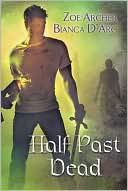
ANTHOLOGY REVIEW: "Half Past Dead," by Zoe Archer and Bianca D'Arc


Alternate Title: Twist & Shuffle

First things first, I would like to thank the authors of this piece, particularly Zoe Archer, for being kind enough to offer an ARC of their two-novella zombie romance anthology, Half Past Dead. To repay your generosity as well as the time and effort you spent writing your novellas, "The Undying Heart" (Archer) and "Simon Says" (D'Arc), I would like to, very tentatively, suggest you not read this review. It may hurt your feelings. I'm not attacking you personally, because (at least in Zoe Archer's case) you are hilarious on Twitter and you have some really original ideas. I just didn't happen to care for your stories.

Onwards and upwards, as they say:
"The Undying Heart", by Zoe Archer.
The Chick: Cassandra Fielding. Freshly initiated into the magic-protecting secret society The Blades of the Rose, she's charged with following a Bad Dude named Broadwell, who may be in possession of a powerful Source of magic.
The Rub: Whattayaknow! Her secret crush who was thought dead is also tailing the same Bad Dude! Wait - what? He still is dead?
Dream Casting: Anne Hathaway.

The Dude: Samuel "Sam" Reed. Transformed into a zombie by evil sorcerer Broadwell, he managed to break free of his control and vowed to have vengeance.
The Rub: His surprise reunion with the love of his life reheats all of his cold parts - but his mission is to break Broadwell's spell - and that means death, real death, for him.
Dream Casting: Rufus Sewell.

The Plot:

Cassandra: I'm so sneaky, trailing after this sneaky sorcerer. I'm so glad I'm not at Almack's!

Sam: BOO!

Cassandra: OMG! You're alive!

Sam: Uh...yeah, about that...

Cassandra: No worries. Let's go kill a sorcerer!

Sam: You're not scared of the fact I'm a walking corpse? That I'm cold to the touch and all broody and stewing in angst?

Cassandra: Dude, I've read Twilight. I'm all over that shit.

Evil Sorcerer: Curses! Foiled again by meddling Anachronistically Feminist heroines and Angsty Heroes! *defeated*

Sam: Oh Cassandra, I never stopped loving you. Your heart, your strength, your braaaaaaaains...

Cassandra: What was that?

Sam: Nothing.

Cassandra and Sam: *break spell*

Sam: *dies* ... *revives* OMG, I'm alive!

Cassandra: Hooray!

Sam: You still love me?

Cassandra: Yeah! Team Jacob! *flashes T-shirt*

Sam: Hooray! ... I think.

Romance Convention Checklist

1 Anachronistically Feminist Heroine

1 Hero Suffering from Overdose of Vitamin Angst

1 Evil Sorcerer

2 Secret Societies

Several ZomBoners

1 Magic Hoo-ha

1 Death By Bees

Several Undead Marines

The Word: Cassandra Fielding, the aforementioned Anachronistically Feminist Heroine, is staking out a nasty fellow by the name of Broadwell when she receives the surprise of her life - Samuel Reed, the man she believed was killed in the Crimean War beside her brother Charlie, is not only alive, but hunting the same man she is!

Eh, turns out she's only half right. Sam was killed in battle, but by his commanding officer (Broadwell), who then used evil magic to bring him back as a zombie and make him do his evil bidding. Sam is very vague about what's he's done (going only so far as to say it was Very Very Evil, No Really I'm Talking Evil Evil, So Evil I Can't Tell You Because I'll Lose Readers' Sympathy Evil), but it was enough to make him break free of his master's spell. For the last three years he's hunted Broadwell, hoping that once Broadwell's dead, Sam will become completely dead (instead of *heh heh* mostly dead) and gain some peace.

He, rather reasonably, expects Cassandra to freak the hell out upon learning he's a walking corpse. Conveniently, however, Cassandra is part of a secret society known as the Blades of the Rose, whose purpose is to protect sources of magic from being misused, particularly by yet another secret society called the Heirs of Albion, of which Broadwell is a member. She thinks that Broadwell's in possession of a powerful Source - probably the very one that gave him the power to raise zombies - and she convinces Sam to team up with her and stop him before he turns a boatload of drowned Marines into the 1858 version of Thriller.

While I applaud Zoe Archer for the originality of making the hero a zombie, she neglected the number one rule of zombie fiction: don't make your main characters less interesting or understandable than the zombies. Cassandra is Standard Issue Mary Sue - she fights for factory reform! She scoffs at Stuffy Social Strictures! She still finds Sam sexy despite the fact that he doesn't breathe, eat, sleep, or have a pulse! She's so beautiful and willow-waisted but of course totally strong and not fragile at all! Also - did I mention she's an experienced Sex Goddess who went out and lost her virginity with some random dude because it's not fair that men are allowed to sow their wild oats while women are not? In 1850s England!

In one of the cooler aspects of Zoe Archer's world-building, Sam can't stay in public long without awakening instinctual That Ain't Right feelings in the local populace, who tend to go all lynch-mob-y about that sort of thing. But not Cassandra, of course! She even righteously condemns the townsfolk for being "ignorant fools." Yes, yes, what morons they all for hating a zombie, especially when all other zombies are still being used for Evil by Broadwell. What fools. This just struck me as bad characterization, that Cassandra wasn't at all perturbed, even instinctively, by Sam, when every other human being within a 100-foot radius was, to the point where they're willing to murder him within one hour of him going out in public. I can definitely believe she'd be able to fight or suppress those feelings, but the fact she felt none at all made her a little Too Perfect. Sam's a zombie. There's a reason people are afraid of them.

As for Sam, he, too, is shiny-happy-good. He was able, through sheer Awesomeness (the novella really doesn't give any other reason), to break Broadwell's enchantment over him and gain back control over his own body. He uses this as an excuse to drown in angst about how he's a monster and worthless and he and and Perfect Good Cassandra can never have a future. As understandable as it is, it gets a mite repetitive, along with his constant declarations of how Perfect and Wonderful and Thin and Gorgeous and Loving and Spirited and Compassionate Cassandra is.

It's often a sad tendency for characters in fantasies and romance fantasies to suffer from Mary Sue Disease, because authors tend to focus on the External Tension (wizards, monsters, the end of the world, etc.) and so they keep the Internal Tension (i.e. character flaws) to a minimum. I'm looking at you, Lord of the Fading Lands! However, Zoe Archer's world-building is flat and inconsistent as well.

Yes, yes, yes, Cassandra is Feisty and Passionate and Righteous and all that crap, but she's never handled a firearm or weapon in her life and she's banned from using magic - so could someone explain to me why the Blades of the Rose thought an unarmed woman would be the perfect person to tail a dangerous sorcerer by herself? Even Sam, bless the decaying chunks of his heart, thinks that's ridiculous. Also - why would the Blades even recruit Cassandra in the first place? She mentions they heard of her campaigns for factory reform and contacted her. Yes, because handing out pamphlets and frequent public speaking have everything to do with hunting down evil wizards, right?

And I haven't even got to the zombie stuff yet! Sam mentions his heart was cut out, oh, then it's back! He hasn't had a zomboner in three years, yet once Cassandra shows up, wow! But wait - Sam establishes that zombies have no blood circulation! So, what, his zomboner's really rigour mortis or something? HOW DOES THAT WORK?

I'll tell you how - the Magic Hoo-ha. Jennifer Crusie established the romance novel concept of the Sparkly Hoo-ha, where a hero who used to go half-mast with just a sexy smile from a stranger can now only float his boat in his Soul Mate's port. Well, this is the Magic Hoo-ha - where consistency, good story-telling and established rules go out in the window. Logic has no place in the heroine's vagina! Hence, Sam gains zomboners, a higher body temperature, and restored nerve sensitivity, and all just from burying his bone in the right woman's Pleasure Cemetery!

Maybe I better cut down on the euphemisms. But seriously, the novella offers no other explanation for the blatant deviations from established zombie-ness. Zoe Archer is blazing a relatively new trail with zombie heroes. That's fine. When writing fantasy, you can make up whatever rules for zombies you like. Zombies smells like cheesecake. Zombies tap-dance in the sun. Zombies can register to vote - whatever you want. You can make up whatever rules you want SO LONG AS YOU ABIDE BY THEM. D


I'm already running a high word count, though, so let's move on to the next novella:

"Simon Says," by Bianca D'Arc
The Chick: Dr. Mariana Daniels. Years ago, she had a brief, torrid affair with a soldier in Special Forces who abandoned her without a word. Just when she thought she'd gotten over him, he shows up covered in blood at her clinic.
The Rub: Uh, ZOMBIES!
Dream Casting: Jennifer Morrison.

The Dude: Simon Blackwell. When a horde of zombies took out his team, he was bitten but, miraculously, didn't die. He's not only immune to the contagion, but now that he's got super-healing powers he can hunt zombies really well.
The Rub: Um, having super-healing is, uh, so freaky, yeah, he's such a monster, no one can ever love him, also he's a lone wolf, etc., um, ohlookZOMBIES!
Dream Casting: Michael Muhney.

The Plot:

Simon: ZOMBIES!

Zombie: *nom nom nom* Tastes like angst!

Simon: Wow! I'm alive! With my newfound superpowers, I can be ... overcome with broodiness!

Mariana: You're hurt!

Simon: That's classified.

Mariana: Are those zombies?

Simon: Let me distract you with sex!

Mariana: Do you love me or are you just going to wimp out thanks to a mild, contrived inner turmoil?

Simon: Hmm, which Kama Sutra position haven't I tried yet?

Evil Marine Zombie: Braaaaaaains!

Simon: *kills Zombie* Oh, all right, I love you.

Mariana: Hooray!

Romance Convention Checklist

1 Lone Wolf Hero

1 Soulful Healer Heroine

1 Set of Commitment Issues

Several Zombie Marines

1 Zombie Grandma

1 Brief Torrid Affair

Several Sex Positions

The Word: We start with a rather snappy prologue where Special Forces commander Simon Blackwell and the one survivor in his command run the hell away from a shitload of zombies. While Zoe Archer's zombies are based on fantasy and folklore, Bianca D'Arc's are science fictional in origin - started by a contagion a la 28 Days Later. Simon's friend gets eaten, while he's only nibbled - however, he doesn't die right away like his comrades. Instead, he lives long enough to be rescued.

Cut to, uh, sometime later and Simon is spying on his ex-girlfriend's house. For her own good, natch. He's not only survived the contagion, but emerged from the ordeal with super-healing powers, so the military's hired him to hunt the last remaining zombies in the forest near Quantico to make sure they can't spread the disease.

While he heals fast, he doesn't heal, say, Wolverine fast and when, after his super-secret-stalker mission, he's clawed up pretty good by the undead, he decides to show up at his ex-girlfriend's naval clinic. See, he's kept his super-healing powers a super secret because he doesn't want to end up a labrat, and he fears going to a bigger hospital. Yeah. That's it.

His ex-girlfriend, Mariana, must fight the resurgence of Tingly Feelings for Simon because after their brief affair (where he was the best lover EVER and ruined her for ALL other men) he left without a word. Without even a post-it. Simon, too, has Tingly Feelings for Mariana, but with his super-secret-super-healing powers he feels like a freak (I can practically hear "Undying Heart"'s Samuel Reed cackling, "That's your angst? Man up, dude!") and figures the life of an ex-Special-Forces Zombie Hunter is no place for a lady or some other such vague hogwash.

And then zombies show up. They eat a grandma. Mariana should contract herself out to the Pentagon because her soulful searching eyes are really good at weaselling out Simon's super-military-secrets. Lots of sex is had. Emotions are questioned. More zombie Marines - (zombie Marines seem to be the running theme between these two novellas, and yet, they are still not as creepy as the Marines Katiebabs and I met at RWA 2009).

I can't really describe much more about this story. I may not have liked Zoe Archer's plot or characters, but at least her writing engaged the reader. She showed us what was happening, how her characters felt, with imagery and use of the five senses. Bianca D'Arc tells, tells, TELLS us everything, and in the most overused, laziest of cliches. Simon is actually described as the "strong, silent type" with a complete lack of irony. "Undying Heart" reads like it actually took some literary skill and creativity to write - "Simon Says" reads like someone built a story out of pre-used sentences, like those magnetic poetry kits you put on the fridge. ________(heroine) ________ (verb) ______ (overused expression for worry) = (Mariana) (watched him go) (with her heart in her throat).

For example, this torrid affair Simon and Mariana had in the past? We are told what happened, in the vaguest of terms - most of which boils down to: We Had Lots of Sex, He Touched Me Like No Other Man Ever Did, Sometimes He Was Charming And Nice As He Made Me Breakfast. Simon's angst is pretty mild, but he keeps repeating it like a mantra. Even the zombies were m'eh - easily recognizable creatures based on horror movies. Claws, eaten-away faces, moaning, the misbegotten results of an experiment gone wrong, all that jazz.

While this story doesn't quite merit an F as it's not so bad it's offensive, it's relentlessly tedious. D-

General Anthology Grade: This anthology's dead on its feet - whenever it's not contrived, it's boring. Whenever it's not obviously spoonfed to the reader, it's nonsensical or inconsistent. Definitely a Big Ol' D

Sunday, October 25, 2009

"Wild Blue Under," Judi Fennell


Alternate Title: Chasing Tail

The Chick: Valerie Dumere. After years of rootless wandering, she's finally settled down to help run her dead mother's store - too bad it's about to go bankrupt. Could a mysteriously hot dude who claims she's earned an inheritance from her deadbeat dad be her salvation?
The Rub: Yeah, she's earned an inheritance - she just has to follow this hot dude to the ocean to get it. Don't mind his talking seagull sidekick. Just ignore the evil albatross trying to divebomb your car. Forget the fact your dead mom said you're allergic to the ocean.
Dream Casting: Sarah Michelle Gellar.

The Dude: Rod Tritone. As son of the High Councilman of Atlantis, he's basically Prince of the Sea, and he doesn't like the idea of having to go all the way to freakin' Kansas to retrieve a long-lost sea princess who's only half-human. With great power comes great responsibility, though, right?
The Rub: Valerie's totally got it goin' on, but Rod can't dilute his precious princely bloodline with the dirty mudblood of a hybrid.
Dream Casting: Matt Bomer.

The Plot:
Valerie: Look at this store, isn't it neat?
Wouldn't you think my story's complete?
Wouldn't you think I'm the girl - the girl who's got everything?

Rod: I've got issues and complexes aplenty.
I've got guilt trips and plot holes galore.

Valerie: You want daddy issues? I've got twenty!
But who cares, no big deal - I want moooooooore.....

Rod: *ahem, next song* An albatross is trying to kill us,
'cause humans, dey killed his wife.
He's been hired by a heinous villain,
and has been paid to end your life.

But hey if you come with me, girl,
Just ignore my talking bird,
I'll give you a big fat diamond,
And pretend this plot isn't absurd.

Valerie: This dude's CRAY-ZEE.
This dude's CRAY-ZEE.
But, god, his six-pack's,
Tasty as a Big Mac,
Take it from me!

I'm risking danger? Think I'll pass,
But hot holy DAMN look at his ASS.
Fine I'll go with you, ignore all my red flags,
But you're CRAY-ZEE.

Rod: *cough KEY CHANGE* There, you see her, checking out your sexy thighs,
Wow she's got such pretty eyes, I really want to bang her.
Though I fucked my brother's life, so I can't take a wife,
I wanna, BANG DE GIRL.

Valerie: Wow, I want him, even though he's really nuts.
I have seen a lot of butts, and by far his is the nicest.
Though my dad ran away, so all men must be that way,
I wanna BANG DE BOY.

Livingston, the Talking Seagull: SHALALALALALA, you're both dumb,
Your "issues" aren't worth chum,
Go on and BANG DE GIRL (WHOA WHOA)
SHALALALALALA this is contrived,
How are you both still alive,
Enough to BANG DE GIRL?

SHALALALALA, this book is hell,
The girl's TSTL,
Go on and BANG DE GIRL! (WHOA WHOA)
She's not smart enough to do much else,
Our hero's dumb as well.
Might as well BANG DE GIRL!

Rod and Valerie: Hooray!

Romance Convention Checklist
1 Secret Princess with Daddy Issues

1 Secret Sea Prince With Brother Issues

2 Huge-Ass Diamonds

Several Talking Birds

1 Evil Albatross

Several Interfering Deities

1 Remarkably Incompetent Villain

2 Inconveniently Dead Parents

1 Fake Allergy

1 Letter From an Inconveniently Dead Parent That Conveniently Explains Entire Backstory All At Once

The Word:
When I picked this book up at the Sourcebooks signing at RWA National, I was pretty interested. A merman romance? Intriguing! I felt some pretty heavy anticipation in regards to the worldbuilding. I haven't read very many books that have an underwater setting so I was curious as to how it could be accomplished in a romance. Also, I had a bit of an unhealthy curiosity about how merpeople actually DO IT - sparked, in part, by a hilarious spoof on Saturday Night Live where Reese Witherspoon, playing a mermaid, tries to seduce Will Ferrell while talking about laying eggs and having him fertilize them.

BACK ON TOPIC - the merman romance. Yay or nay?

NAY. SO MUCH NAY. There aren't enough perturbed horses in the world to convey just how much NAY there was to this story. The characters are contrived, the villain is breathtakingly incompetent, the threats are silly and the worldbuilding is cartoonish. And the PUNS. Horrible water-themed PUNS were everywhere.

Our merman hero is Rod Tritone, brother to Reel, the hero of Fennell's debut novel, In Over Her Head. Yes. Merman brothers named Rod and Reel. It's silly all by itself without considering the contextual implications of naming mermen after things that are supposedly dangerous to them - isn't that akin to naming human kids Gun and Knife? Anyhoo - he's a prince, or rather, the son of the High Councilman of the sea (who's named Fisher. I shit you not. Can someone tell me how that is NOT like calling a human Murderer? Or Killer? REALLY?).

Rod's been given a strange mission by the Council - it turns out Lance Dumere, one of the recently deceased Councilmen, begat an heir with a human woman, and the Council believes this hybrid girl is the key to some vaguely described prophecy and that bringing her back to her heritage could possibly save the world. The book's hazy on the exact details, but suffice it to say - Rod's got a job: find the girl, bring her back to the ocean, and dump salt water on her so she turns into a mermaid. He also has to do all of this in three days, or the tail he's sacrificing to pass for human won't grow back.

Rod flies out to Kansas, of all places, to find the woman (Valerie) who's currently running a shop that sells ocean-themed souvenirs. He informs her of her father's death and says he left her a legacy. Valerie refuses point-blank - even though she's never met her father, knowing that he abandoned them has left her very bitter and she wants nothing to do with him.

That is, until a Plot Device Accountant shows up to conveeeeeniently inform her that her deceased mother (who owned the shop) forgot to pay some taxes and the IRS is gunning for her, at which point Valerie jumps on the idea of a legacy. How ... coincidental.

By this point, Valerie and Rod have some tedious, cutesy and contrived interaction, most of which involves Valerie falling down a lot and admiring Rod's bod. Yes, Rod is apparently so attractive that Valerie just falls down at random times while looking at him. I'm not exaggerating - it's a good thing she spends most the rest of this book sitting in a car because in these first chapters she makes Bella Swan from Twilight look like a figure skater.

A monkeywrench is thrown into Rod's plans when a talking seagull superspy (I'm serious) crashes his party. This seagull, seemingly named Livingston for the sole reason of providing Rod with an "I presume?" joke, tells Rod that explosives were found in a trench he'd recently been excavating, leading the Council to think someone's out to kill Rod to mess with the line of succession. It turns out the main reason Rod was even sent on this mission was to get him out of harm's way - but all for naught. Livingston informs Rod and a freaked-out Valerie that "JR," an infamous albatross mercenary/assassin (again, not making this up), has been hired to take both Rod and Valerie out.

This starts off what turns out to be a road romance as Valerie, Rod and Livingston hop in Valerie's car and try to race to the ocean before JR - who's gained control of all the birds in the area. This leads to some painfully silly action sequences where birds drop dead fish on the car and fly around with blankets to block the windows and peregrine falcons launch other, smaller birds at the windows and somehow Valerie, Rod and Livingston scream about how OMG! Our fast-moving metal box designed to weather heavy impact is no match for dead fish and blankets and very determined small birds!

Meanwhile, uh, back in the ocean, Rod's family are kicking themselves for not actually telling Rod about the threat on his life before sending him three thousand miles inland without any backup. They also make some half-assed attempts to find out who is responsible for the threat, but it's all for show - the villain, Rod's cousin Drake, is so obviously, idiodically evil that it's practically tattooed on his forehead and the fact that his nefarious plans remain undiscovered for so long suggests bad things about the combined IQs of the Atlantean Royal Family.

But really, none of Judi Fennell's characters are much sharper than a bowling ball. Valerie is one of those people who probably has trouble chewing gum and walking at the same time. She nearly runs her car off the road more than once because she's so entranced by Rod's unbelievable sexiness that she fails to remember she's driving a vehicle at high speed to escape from murderous attackers.

Much of the novel is from her POV and 85% of her mental output is Ass! Look at that ass! And those abs! And his chest! Pectorals! Glutes! Manly Thighs! Rock hard --- shit! Birds are attacking! It's really hard to get to know her character - especially what she sees in Rod other than his physical appearance since the very sight of him sends her into Bimbo Mode. If she's like this all the time I wonder if she's capable of driving a car with an Abercrombie and Fitch catalogue in the passenger seat.

Also - she tells Rod she doesn't want to go to the ocean with him because she's deathly allergic to it. Why does she think this? Because of a poorly-remembered event in her childhood and because her mother told her so. Has she ever been tested? Does she carry any medication? Has she ever been to an allergy doctor? You can't just believe you're allergic to the entire fucking ocean (75% of the earth's surface) based on hearsay without checking it out with a doctor! She's supposed to be twenty-nine years old! When my throat starting itching when I ate bowls of mixed nuts as a teenager, I said, "Huh, guess I won't eat nuts anymore" - only for my mum to say, "Don't be a moron. Get yourself tested to make sure what you're allergic to!"

Of course, Valerie also has Daddy issues stemming from her belief that her father abandoned her. She's spent years living a vagrant lifestyle which she blames on her father - she thinks he passed on a "deadbeat" gene and that's why she's never been satisfied sticking in one place. She's determined to keep her mother's store afloat because she thinks doing otherwise is to abandon her mother's memory the same way her Dad did.

Rod, on the other hand, is one of those rigid stick-to-the-rules types thanks to one mistake he made in his past. In one of the few interesting aspects of this book, Rod actually blames himself for his brother Reel falling in love with a human (the events of In Over Her Head). Apparently, Reel had a shot at the Immortality that's bestowed on certain members of the royal family and turned it down to live as a human with with his lady love Erica. Rod, who accidentally introduced them, doesn't really consider the whole "true love" part - thinks he's condemned Reel to a shortened lifespan separated from the ocean. Yes, it's pretty selfish reasoning on Rod's part but at least it's something.

Still, despite the "issues" which are supposed to make our protagonists so darn "deep," they remain superficial and mostly inconsistent characters. When Rod jumps in the sea 3/4 of the way through the book and his tail doesn't grow back, he takes it as a sign he should flip the almighty gods the almighty bird, and run off to Kansas with Valerie - completely forgetting the whole "Valerie needs to be returned to the sea to save the world" aspect of his mission. Sure, I guess rules and regulations aren't the most important thing in the world but saving the fucking world sure is! Also, did I mention that our protagonists' deep inner turmoils are neatly and instantaneously solved within pages of each other?

As for Drake, the villain, the whole joke is that he's managed to convince everyone he's so stupid he couldn't possibly be behind any nefarious plot, when really he's quite functionally stupid enough to do all sorts of badness. He's the kind of villain who's so exaggeratedly bad he accidentally chokes minions into unconsciousness and unwittingly kills henchmen.

And that world-building I was so excited about? What world building? The world of Atlantis reads like Judi Fennell's "research" consisted of watching Disney's The Little Mermaid even more times than I have - which I suppose is an achievement in and of itself. I'm talking about a world fuelled by fish puns and cliches. Imagine an American sitcom circa 1985, only with all the human colloquialisms replaced with their aquatic equivalents. "Everyone was on fins and needlefish," "that's the fifty-thousand clam question," "Son of a Mer!" Also, the mermaids all wear coconut-shell bras tied with seaweed. Did I mention all the joyful sea creatures that just drift in an out, dropping chirpy "hello"s and wisecracks? Thank heavens they don't burst into song!

Oh, and after reading this book I think I owe Bertrice Small an apology. "Love lance" may be a silly name for penis, but at least it's a recognizable metaphor. "Love lance" has nothing on "shell-fillers" - the Mer term for breasts. Several times Rod catches himself admiring Valerie's "shell-fillers." I can only hope that shell-fillers isn't the actual term but more like the Atlantean equivalent of "sweater puppies." Seagulls, hilariously, use an existing but incorrect sexual euphemism - they admire Valerie's "hoo-has." Sorry, birdbrains, think further south. I realize breasts are kind of an oddity under the sea where mammals are few are far between but sheesh.

As for the plotting, it's haphazard at best, and downright contrived and sloppy at worst. Several plot threads are left dangling and plot holes left gaping under the laziest bullshit excuse of all, "The gods said so." Yes, Atlantis is a world still under the rule of the Greek gods of mythology, whose entire purpose is to serve as deus ex machina. The villain's plot is foiled by Zeus - why? Hell if I know! When asked this, Zeus just lifts an eyebrow and gives a cryptic riddle response which is I guess is supposed to make the reader want to get the next book (Catch of a Lifetime). When Rod first jumps in the water, his tail doesn't grow back right away - but it does once Valerie's in danger. Why? The gods refuse to say - although they assure Rod it won't happen again. It turns out Valerie's not the vague MacGuffin needed to fulfill the prophesy - so why did the gods tell the Council to tell Rod to get her in the first place? STOP QUESTIONING THE ALMIGHTY DEITIES!

When you get right down to it, the novel doesn't have a point at all. Wild Blue Under is just an awful piece of writing. The characters are inconsistent and stupid, the villain cliched, the world-building unoriginal and unfunny, the tone flips from cartoonish to dead serious without enough transition, the characters' deeply ingrained personal problems are solved too easily and neatly, and the plot remains incomplete thanks to convenient deus ex machina excuses.

I picked this book up at RWA Nationals thinking it was a fresh new tail - but what I got instead was a three-week-old stinker. If you snag yourself a copy, do yourself a favour - throw it back.
D-

Tuesday, September 22, 2009

"The Last Heiress," by Bertrice Small

Alternate Title: Inglorious (Spineless, Whiny, Badly Characterized) Bastards

The Chick: Elizabeth Meredith. As the mistress of the wealthy estate of Friarsgate, Elizabeth is independent and outspoken, but she still needs an heir if she wants her lands to prosper after she's gone.
The Rub: Of course, Elizabeth is Fiery and Spirited and Strong-Willed, so she will only tolerate a husband who obeys her every whim, won't disagree with her ideas for Friarsgate, and will let her wear pants. In the 1500s. Yeah, good luck with that, lady.
Dream Casting: Claire Danes.

The Dude: Baen McColl. The bastard son of minor Scottish gentry, Baen is sent by his Da to Elizabeth's farm to see if he can purchase some of her famous sheep. He quickly discovers that being bossed around is a real turn-on.
The Rub: Being born on the wrong side of the blanket has left him with Inferiority Issues, and all the spine of a beached jellyfish. At least he's well endowed!
Dream Casting: Gerard Butler.

The Plot:
Rosamund, Elizabeth's Mum: You need an heir!

Elizabeth: NO! I'm 22 and can do what I want! *stomps foot*

Thomas, Elizabeth's Ambiguously Gay Uncle: You need a husband!

Elizabeth: Husbands are for sissies! Love is for sissies! I am WOMAN! And I can do what I want! *tosses hair*

Baen McColl: Hey, you're pretty.

Elizabeth and Baen: *smooch*

Elizabeth: I need a maaaaaaaaaaaaaaaaan.

Thomas: Off to court with you!

After Several Very Boring and Pointless Tudor Court Chapters...

Elizabeth: Baen, let's get married!

Baen: No, I have ISSUES! And I love my Daddy too much!

Elizabeth: Why don't you just ask him if you can get married?

Baen: What? And ruin a perfectly good father-son bond with logic? ARE YOU MAD?

Elizabeth: You're a moron. Don't come back.

Elizabeth: *preggers* SHIT.

Baen: Fine, let's get married.

Elizabeth: NO. I am an angry, hormonal pregnant woman and I can do what I want! *water breaks* Fine, I forgive you.

Baen: Hooray!

Thomas: But wait, wait, wait - book's not over!

More Pointless and Self-Indulgent Tudor Court Chapters...
Anne Boleyn: *dies*

Elizabeth: Hooray! ... wait a minute.

Romance Convention Checklist:

1 Fiery, Tempestuous Female Who Can't Be Tamed

1 Bastard Hero with an Inferiority Complex

1 Set of Daddy Issues

1 Ambiguously Gay Uncle

1 Snooty Sister

Half a Book's Worth of Redundant Description

Several Uses of the Word "Love Lance," "Love Passage," and "Love Juice" To Describe the Male Sexual Organ, Female Sexual Organ, and Sexual Bodily Fluids of Both Genders, Respectively

1 Romantically Quite Good Rival (sorry, Flynn!)

Several Historical Personages (watch The Tudors, I'm not catching you up)

1 Surprise! Baby

The Word: When I told my friends and bloggers and fellow Tweeters that I was going to read a Bertrice Small novel, I got a lot of LOLs and smirks. "Can't wait to read the review," they said.

"Can't wait to read what you think of Small," they said.

Well, HA HA HA FRIENDS. Thank you SO MUCH for letting me read this. "Oh no, keep driving AnimeJune, don't worry about the CLIFF of ridiculously bad plotting and asinine characters you're heading towards."

After finally finishing The Last Heiress, I'm tempted to spread my arms and scream, Gladiator-style, "ARE YOU NOT ENTERTAINED??!"

Actually, the start of this book was rather deceptive. See, I could tell from the e-giggles of my Twitter pals that Bertrice Small didn't have the highest reputation for good writing, so I was tentative, perhaps expecting another literary clusterfuck a la Fern Michaels. But no. Bertrice Small's storytelling has many faults that I can't wait to describe at length to you, dear readers, but actual bad writing isn't one of them. I started this book expecting the worst and when the beginning was rather blandly pleasant I was put off my guard.

Sneaky, sneaky Bertrice Small.

The novel starts off harmlessly enough - Elizabeth Meredith, rambunctious Tudor-Era Feminist, is the heiress to Friarsgate, a tidy estate on the border between England and Scotland. She cares only for her sheep and her crops, and we know this because Elizabeth takes every possible opportunity to tell anyone who will listen that she cares about only for her sheep and her crops.

Her mother, Rosamund, and her Ambiguously Gay Uncle Thomas despair over Elizabeth's future - at age 22, she's already an old maid by Tudor standards and Friarsgate needs a proper heir. At last, they decide to send her on a trip to court to see if she can snag a husband.

While preparations are underway, Baen McColl, the bastard son of a Scottish noble interested in Friarsgate's famous wool, arrives at the estate to see if he can buy some of Elizabeth's sheep. While thoroughly charmed by the breathtakingly small scope of Elizabeth's hobbies, interests, and world-knowledge as well as her childish and self-absorbed personality, Baen knows he hasn't got a chance because he's an unlanded bastard.

Despite their unsuitability, Baen and Elizabeth share a few smooches before Elizabeth's packed off to court.

Okay, so by this point I've realized the characters are a tad simplistic and the writing style veers into Redundencyville, but we've only touched the tip of the iceberg. Once Elizabeth goes to court, we are treated to the most tedious, pointless, self-indulgent segment of the novel. Elizabeth knows it's unlikely she'll find a proper husband at court and that the whole endeavour's doomed to fail - well GUESS WHAT? It does!

But not before we are treated to chapter, after chapter, AFTER CHAPTER of Elizabeth's wanderings around the court that only confirm her suspicions again and again. Meanwhile, the reader is clumsily spoonfed Tudor history as Elizabeth miraculously befriends a sketchily-characterized Anne Boleyn who whines about how life is so hard (tell it to Catherine of Aragon, honey). This entire segment of the novel goes on for way too long and contributes absolutely nothing to the story. I nearly made this novel a DNF by the halfway mark - not because it was heinously bad, but because it was JUST. SO. BORING.

Elizabeth's character isn't affected in the least by her failed introduction at court, and when she returns to Friarsgate, her relationship with Baen is picked up as easily as if she'd only been gone a day. The Tudor court sequence of the novel, which takes up a disastrously large chunk of the book, reeks suspiciously of an author desperate to show off how much historical research she's done, regardless of whether it serves the story or not. I'm sorry, Bertrice Small, but Phillipa Gregory you ain't.

The novel picks up after Elizabeth returns - and by picks up, I mean becomes childish and stupid instead of boring and stupid. So yeah, it's still pretty stupid but at least stuff is going on. Elizabeth comes to the lightning-flash conclusion that Baen is the man of her dreams and decides she'll go to any lengths to get under that kilt. I kind of admire her angst-free love for Baen and her gumption, but her efforts are wasted on Baen, who rejects her advances because he is a coward and a weenie. He loves her too, but thinks he can't marry her because he owes his loyalty to his beloved father. Of course, he never actually bothers to ask his supposedly beloved father if he can marry Elizabeth because that would mean he'd actually have to grow a pair and destroy the only contrived obstacle to their relationship.

So what happens is, they make lots of hot, illicit love (described with creeeepy creepy euphemisms like "love passage," "love lance," and "love juice"), but when Elizabeth asks for a ring, Baen makes a lot of sad mopey faces and rides away. Elizabeth ends up impregnated with his Ultra-Fertile Weenie Male Seed, and even when her male relatives show up to drag Baen to the altar he's all like, "But I can't, I'm just a poor bastard, my loyalty's to my Da" (to Small's credit, Baen's dad is all "WTF. My son is a moron.").

Of course, Baen returns to Friarsgate to marry Elizabeth, who is quite determined to make his life a living hell for having the audacity to come back and help take care of her baby. Once she goes into labour and her Huge-Ass Alpha Male Spawn ends up wedged in her, uh, love passage and Baen has to help it out, Baen quickly apologizes and is just as quickly forgiven. The end? Nope.

Bertrice Small has done so much arduous historical research that she simply can't let us finish the book without making sure we know just how faithfully she watched every episode of The Tudors, so in the final chapters Elizabeth is yanked out of her HEA by a hysterical Anne Boleyn (now pregnant with Queen E) as the plot comes to yet another standstill as we are subjected to pages of pointless description of Anne's coronation that have nothing whatsoever to do with Elizabeth, Baen, or Friarsgate and everything to do with self-indulgent page-padding.

UGH. Not only was the plot a torturous slog, but the romance was paltry, to say the least. Elizabeth and Baen are very childish, simplistically drawn characters who are given exactly ONE motivation each to explain all their illogical, selfish behaviour. Elizabeth loves Friarsgate with an obsessive, all-consuming passion that blinds her to everything else. Her romance doesn't change this - one of the most unintentionally hilarious scenes in the novel is when her water breaks and her mother realizes Elizabeth has neglected to prepare any baby clothes or even bring the family cradle out of the dusty attic in the entire nine-month span of her pregnancy because she was just too darn busy with Friarsgate. Bertrice Small's overuse of speech tags only emphasizes Elizabeth's immaturity - she's always wailing, shrieking, sobbing, pouting everything she says.

Baen was just as bad, if not worse. His father is supposedly Scotland's Awesomest Dad who took in his bastard and raised him with love and kindness, so Baen refuses to do anything on his own because he fears his dad will take any independent action on his part as a sign of disloyalty. Elizabeth (quite reasonably) assumes Baen's dad must be a tyrant, but the truth is that Baen is a coward. Baen's given a relationship obstacle that could have been solved with one conversation, and it never made sense why he held out as long as he did. He never even solves his obstacle himself by growing some balls and flat-out asking his dad if he could marry Elizabeth - he has to be dragged kicking and screaming to that conclusion as Elizabeth's male relatives do the asking for him (Baen's father says yes immediately, because he really is Scotland's Awesomest Dad).

Waiting for other people to solve your problems for you doesn't make you romantic protagonist, it makes you a weenie.

Add to that the fact that Baen and Elizabeth don't spend that much time together. Well, "on page" time. The author tells us Baen spends months working for Elizabeth, but throughout the novel Elizabeth spends more pages at court or alone on her estate than she does with Baen.

On top of that, the book's length was painfully unnecessary. If I could describe Bertrice Small's writing with a single word, it would be "redundant." She writes as if for an audience of goldfish, always reminding us of perfectly obvious things and repeating backstories and descriptions, along with doing an abominable amount of telling over showing - as well as telling and showing, which is even worse. For instance, Elizabeth will have an experience at court, and in the next scene, Elizabeth will meet a secondary character and take up an entire page describing in dialogue exactly what we just read. Bertrice Small's characters also have no sense of privacy or discretion and will happily regurgitate their backstories and personal histories to anyone who will listen. Phillipa, Elizabeth's sister, has her history with Queen Catherine of Aragon repeated no fewer than three times to three different people.

Also, Bertrice Small needs to ease up on her adverbs and speech tags - maybe this is because she is from an older generation of romance writers who used more purple language (like Kathleen E. Woodiwiss *shudder*), but she re-uses the same ones again and again! The words "wickedly" and "candidly" should be removed from her vocabulary because every time she used them, I heard Inigo Montoya's voice saying, "You keep using that word. I don't think it means what you think it means."

Also - Bertrice Small, I hate to be the one to break the news to you but - boys have a penis, and girls have a vagina. "Love lance" is not an appropriate euphemism for penis. You also use the word "manroot," and I really would prefer you use "manroot" so long as "love lance" is never mentioned again. Same with "love passage" for vagina - you're not going to end up on the other side. You go in and out, that's how sex works. Also, it's called semen, not "love juice." The penis is not a fruit, the vagina is not a juicer, and that is not how you fulfill your daily vitamin C intake.

So there you have it, folks. I read a Bertrice Small novel, and it was repetitive, boring, illogical, simplistic, juvenile, self-indulgent, pointless and silly. That being said, I don't think it quite merits an F grade. Why? Because even though I disliked her novel, Small's style can be pleasant on occasion when the story isn't quite so silly (such as at the beginning) and her historical scenic descriptions do create a sense of atmosphere - unlike Fern Michaels, who can't even write about her own century accurately. And, unlike Susan Mallery, while I found the story stupid, I didn't find it hateful. Frankly, Baen and Elizabeth are both idiots, and deserve each other.

ARE YOU HAPPY NOW?
D-

Tuesday, November 04, 2008

"Gilding the Lady," by Nicole Byrd


The Chick: Clarissa Fallon. Yanked from her upper class life as a child and dropped into the servant class by a Duplicitous Solicitor, she's only recently been rescued by her brother and his wife, who believe the best way to make up for lost time is to train her to be a lady again and give her a proper social season.
The Rub: Nasty people from her unfortunate past have a tendency to show up again, and either try to murder her or frame her for murder.
Dream Casting: Atonement's Romola Garai.

The Dude: Dominic Shay, Earl of Whitby. After Dominic humiliates the cousin of one of his friends, said friend makes a bet that he can't turn the clumsy, foul-mouthed Miss Fallon into the toast of the ton.
The Rub: He's damaged from the war, and doesn't like having responsibility over people's lives.
Dream Casting: I got lazy this time around, and just thought of Hugh Jackman.

The Plot:

Clarissa: Oh, 'ow will I evah be a damn shit bloody lady with my lower-class clumsiness and bad language and socialist sympathies?

Random Buddy: Hey Dominic - can you say Extreme Makeover: Regency Edition?

Dominic: Fine, whatever. Hello Clarissa, let's see if we can make you into a lady...

Mysterious Horrid Woman From Clarissa's Past: *dies*

Bone-Headed Magistrate: A large, female criminal was murdered! Surely it must have been the wisp of a gently-bred girl with powerful social connections who done it!

Clarissa: Let's save me from the noose, first.

Storyline: *abandoned*

Gemma, Clarissa's Sister in Law: Jinkies! Let's put our heads together to solve the crime!

Gang of Gently-Bred, Sheltered Ladies: Eureka! We've solved it!

Criminals (all but one): *CAUGHT!*

Final Criminal: Nyaa! There's only one thing I can do! Blow up the witnesses!

Clarissa and Dominic: *trapped by gunpowder*

Dominic: We've only got an hour to live - let's see if there's a window, or some way to escape!

Clarissa: Actually, I was thinking we could have sex first.

Dominic: Do we have time?

Clarissa: Oh yeah.

Dominic: Then let's get it on!

Romance Convention Checklist:

1 Socially Backward Heroine

1 Disdainful Damaged (Half-)Deaf Hero Adored by the Ton

1 Evil Fake Belgian

1 Noticeable But Still Sexy Facial Scar

1 Gang of Amateur Female Sleuths

1 Mortality-Induced Bout of Lovemaking

1 False Accusation

1 Unique Social Wager

The Word: In the case of this book, I really do think you can judge it by its cover. It's pink, has a bizarre title that has little to do with the story itself (I think it's some bastardization of "Gilding the Lily"), the image looks like a woman having a seizure, and, although you can't tell from the photo, it's covered in glitter. That pretty much explains this novel - in a nutshell, it's a cutesy, cheap, incomprehensible piece of idiotic, inconsistent drivel whose plot convulses in all directions.

As the novel starts, it looks like it might at least have an interesting story, if a blunt and spoon-fed writing style and characters who are stereotypes from the outset. Apparently (I say apparently because I think most of this story is explained in more detail in Byrd's previous novel Vision in Blue) when Clarissa Fallon was a little girl, her brother was lost at sea and her mother died, and the Duplicitous Solicitor charged with her care dumped her in an orphanage so he could keep her trust fund for himself (to purchase a lifetime supply of wax for that handlebar moustache of his, I'm assuming).

Anyway, after years of abuse at the orphanage, she was sold into service and worked as a maid until her brother and his sweetheart Gemma tracked her down and returned her to the good life. Sadly, she's picked up a few bad habits from her time in service - including bad language (translation: "says 'bloody hell' a lot"), clumsiness, a lack of manners, and a "charming" tendency to drop her "h"s. Her brother and sister-in-law try to prepare her to have a proper social season, but apparently demonstrating good breeding and flawless manners isn't like riding a bike.

Enter Dominic Shay, a man adored by the Ton for ... well, apparently for being an ass. When one of his thoughtless comments humiliates the cousin of one of his friends, the friend makes a wager. Pointing to a girl running with wild abandon from her outraged governess outside their men's club, the friend bets that Dominic won't be able to transform her into the toast of the ton. Dominic accepts.

So we have this Eliza Doolittle My Fair Lady thing going on - not bad. Their meet-cute continues the interesting-if-not-exactly-genius element of the novel: Clarissa, frayed by the pressure to re-learn lady-like behaviour, trades places with her maid for a few minutes so she can engage in a normal, relaxed conversation with some neighbouring servants - and gets unmasked by Dominic, who has no idea what she's doing. Could this lead to something interesting? Sadly no.

The plot takes a complete U-turn when Mrs Craigmore - the villainous matron of the orphanage Clarissa stayed in who ended up fleeing with embezzled funds - turns up dead, strangled by a scarf Clarissa dropped on the street. The major eye-rolling doesn't start until an oblivious magistrate has Clarissa dragged into the law courts to declare her a person of interest in the crime - even though there were no witnesses, the victim was a huge-ass woman with a criminal past and Clarissa is a blond wisp of a thing, and without even taking into consideration the fact that Clarissa's a gently-bred lady with a shit-ton of powerful social connections (Countesses and Earls and Marquises, oh my!). Realistically, no magistrate in his right mind who valued his job would so bluntly accuse a woman of Clarissa's social stature on such a dearth of evidence (the only thing that ties Clarissa to the crime is her scarf and a witnessed disagreement between her and Mrs Craigmore).

But of course, NO ONE in this book considers these completely logical facts. Clarissa half-convinces herself she's headed for the gallows already, and the Pygmalion plot is promptly jettisoned for Regency Scooby-Doo as Dominic, Clarissa, and all of her muslin-clad girlfriends take out their magnifying glasses and Nancy Drew Amateur Detective kits to try and find the real murderer before the English Legal System (which has never been known to favour the white, wealthy, and upper-class before!) invariably condemns poor Clarissa to death.

This book reads like something a highschooler would write for a project on category romance - each character resembles a doll plastered with post-it notes detailing some romantic cliche or other. Clarissa's got a Traumatic Past, a Delightful Sympathy for the Lower Class, a Lower-Class accent. Dominic's got a Facial Scar, a Traumatic War Past, a Disdain for the Ton, etc. However, Nicole Byrd never actually follows through on any of these tropes or keeps them consistent with their characters. Clarissa inexplicably loses her servant accent halfway through the novel, and somehow, even though her My Fair Lady subplot was interrupted by muuuuurder, still manages to ace her coming-out ball.

Similarly, we are told Dominic has a scar and a traumatic war past, but does he have nightmares? Shades of PTSD? Does his scar affect how his face moves? How other people see him? Are other people repulsed? That answer to all these questions is no. None of these time-worn stereotypes have any bearing or relevance on these puppet-like characters or how other people react to them - which makes the novel read like Byrd felt she had to stick her characters with these stinkers or people wouldn't think she was writing a romance novel.

On top of that, her plot is obviously, egregiously contrived. The best romance plots are stories that are determined by the actions and decisions of the characters. Romances are, at heart, character-driven stories. However, in Gilding the Lady, Byrd treats her narrative like a hockey puck, an inanimate object to be smacked around by unbelievable coincidences in the direction of her choosing, rather than letting the consequences of her characters' actions move the plot forward.

The most obvious instance of this is the ending. I have no qualms about spoiling this, because it is so exhasperatingly bad that if it prevents you from reading the book, I have done you a service. Dominic and co. eventually thwart the gang of thieves who killed Mrs Craigmore, but their ringleader (who coincidentally turned out to be Clarissa's dancing-master - whoda thunk?) escapes. However, they've gathered enough evidence to clear Clarissa's name so Clarissa and her family go out to the country to have her coming-out ball.

Clarissa is promptly kidnapped by the Evil Dancing Master shortly after desert. How did the Evil Dancing Master make it out to the country unnoticed even though he's a wanted man? How come any of the real servants didn't see through his footman's disguise? Nicole Byrd doesn't bother to explain. Evil Dancing Master locks Clarissa and Dominic in a shed and piles gunpowder against the door tied to the same fuse to be used for the fireworks display in an hour's time. Of course, none of the servants will notice the fireworks fuse suddenly leads to an abandoned shed instead of to the fireworks because the servants are all idiots.

It's at this point that Clarissa says, "We only have an hour to live. Sure, we could spend that looking for a window or calling for help or ripping my ballgown into a rope - but why don't you take my virginity first?" Cue the gagtastic Oh-My-God-Magical-First-Time-Deflowering-Orgasm scene. Of course, once they're finished, then they find a window to call for help, which appears within the minute. I very nearly put the book down then (this wasn't the first time I'd had that impulse, though). For three hundred pages, Clarissa and Dominic battle sexual tension without anything more serious than some hot kisses, but it must have been around this time that Nicole Byrd got the ridiculous bullshit idea that if she didn't put in a steamy sex scene full of throbbing and heaving and mindless pleasure, that her readers might mistake her book for something else (like *gasp* regular fiction???). Once again, the actions the characters take don't seem motivated by firm and well-established characterization, but by the outlandish and absurd dangers that Nicole Byrd puts them in.

In essense, avoid Gilding the Lady at all costs. It looks and reads more like a sad parody of romance than a true example of the genre - everything from the pink glitter of the cover to the bland, blind supportiveness of the hero to Clarissa's anachronistic "hot DAMN" approval of the Earl's hot bod at the start of the novel speaks to the lowest common denominator. Girls like pink! Girls like glitter! Girls like steamy sex scenes with no narrative-build up! Girls don't care if the heroes have no consistent character traits so long as they're hot! Girls want to read about a Cinderella story but would much rather skip the boring work the heroine has to do in the middle for something more exciting - like a murder mystery! Girls like CSI, right?

Gilding the Lady is essentially the book that non-romance-novel-readers think we romance-novel fans read. Want to prove them wrong? Then leave this book the hell alone. D-.