Monday, December 30, 2013

2013: The Year in Review - the Best of the Best

Since I already told you how many books I read in 2013, now you'll want to know how many of those books kicked almighty ass - and which ones stunk to high heaven. Yesterday was all about how I did this year as a Reader. Today is all about how I did as a Reviewer. Specifically, which books blew my socks off. For my next post, I'll talk about the books that just, well, blew.

ANIMEJUNE'S TOP 11 READS OF 2013:

A Christmas Bride, by Mary Balogh, from Christmas Bride/Beau. Romance, Historical. A+
Best Redemption of a Villainess
Yup, Balogh's A Christmas Bride makes a heroine of Helena, Lady Stapleton, the slutty stepmum who scared the pants off the hero of A Precious Jewel in every way but the literal one. Her unsuccessful attempts to bone her husband's emotionally-vulnerable son left her with enough baggage for a thirteen year guilt trip. Which makes her so fascinating! Balogh doesn't sugarcoat Helena's sins, nor is Helena some simpering martyr. She's still not a very nice person - but she's definitely an interesting one, and her redemptive holiday romance is a darkly spiced treat.

To Have and To Hold, by Patricia Gaffney. Romance, Historical. A+
Best Book That Makes Me Wonder If I'm a Bad Feminist for Loving It
This novel is so good, and crammed so full of problematic elements that in normal circumstances I would despise. WTF, Gaffney? The hero rescues our abused heroine from an unfair prison sentence in order to exploit her for sex. And yet I couldn't stop reading it - and not in the "I must see how much stupider this gets" way. The author makes much of what a bad, bad boy the hero is - the better to torment him once he gets his Good Guy epiphany and realizes the woman he coerced and raped is the One for Him. 

It sounds like the plot of Whitney My Love. AND YET IT'S NOT. Thanks to a bizarre, potent alchemy of breathtakingly lyrical writing, a well-realized heroine, and an intriguingly self-aware hero, this hot mess of an idea somehow works. Really, really well.

Burn for Burn and Fire With Fire, by Siobhan Vivian and Jenny Han. A+
Best One-Two Punch of Awesome Crazysauce Girl Power
The three heroines of the first two novels in the compulsively-readable Burn for Burn trilogy are the definition of crazy-good. Sure, they might spike your drink with liquid E, or publish your Secret Emo Poetry all over school, or blow out all the lightbulbs in the gym with their latent psychic powers, but they're so sympathetic and well-realized and thought-provoking! These girls come with layers, and real problems - and so do the characters they target for vengeance. The final book, Ashes to Ashes, is due to arrive NotSoonEnough-uary 2014. 


OCD Love Story, by Corey Ann Haydu. YA, Contemporary. A+
Best Novel That Makes Me Itch Just Thinking About It
Also known as the book I'm too scared to read again. Corey Ann Haydu takes us deep into the mind of a teenager struggling with severe Obsessive Compulsive Disorder - maybe a little too deep. It's not all about saying the same catch phrase five times or washing your hands. Sometimes it's just thinking about scary things - thinking and thinking and not being able to stop until you do something - even if that something is silly and irrational. This book will make you rethink saying, "I'm a little OCD" to explain your meticulously-organized Blu-Ray shelf. 

Can't Buy Me Love, by Molly O'Keefe. Romance, Contemporary. A+
Best Use of a Supermodel Mum
There's nothing particularly special about the story - other than the fact that the hero, Luc, has an awesomely fierce French-Canadian supermodel mum. We have a pretty standard Angsty Aging Athlete hero paired with White Trash Con Artist Made Good Heroine. No, what lifts this novel above the other romances I read this year is the flawless execution, the refusal to rely on hoary and often sexist stereotypes (see: Supermodel Mum, and how she is not a frigid, superficial bitch), and utterly amazing writing. You can't buy me love, but you can buy this book, and you'll love it, so  um, I'm not that good at metaphors. Just read it.

The Lies of Locke Lamora, by Scott Lynch. High Fantasy. A+
Best Doorstopper Fantasy That Isn't About How an Oblivious Empowered Orphan Finds the Magical Thingee Of Indescribable Power before The Obvious Bad Guy Does
Nope, this doorstopper fantasy is all about a gang of brilliant con artists and what happens when their meticulously planned con goes horribly wrong - in an intricate and original fantasy setting. It's got disguises! It's got trickery! It's got murder and betrayal and swords named after ladies! It hits all my High Fantasy buttons (complicated politics, in-depth magical worldbuilding, high stakes adventure)  without rehashing old High Fantasy formula. 

Black Silk, by Judith Ivory. Romance, Historical. A+
Best Use of Illicit Hand-Drawn Pornography as a Meet-Cute
Judith Ivory wins me over yet again with this beautifully written, unconventional romance that explores the concept of perception and point of view. When our heroine's husband dies, she tracks down his former ward to uncover the provenance of the box of unsavoury art her husband bequeathed to her. The hero and heroine discover they have vastly different perceptions of the heroine's husband and his immediate family. And what do their respective perceptions say about themselves? Slow-moving and thoughtful.

Me Before You, by Jojo Moyes. Fiction, Contemporary. A+
Best Wedding-Ruining Wheelchair Slowdance Scene
The author lures you in with an extremely formulaic opening set-up - a kooky but cute screwup is inexplicably hired to care for a curmudgeonly quadriplegic who's given up on life (even though he's still handsome and rich!). And then it whacks you over the head with the Reality Club and throws you down a well of Feels. Moyes demonstrates that romantic, heartfelt stories don't have to have the rough edges sanded off. 

The Diviners, by Libba Bray. Fantasy, Historical, YA. A+
Best Excuse to Remind People about Cloche Hats and Egg Creams
This book is just the cat's pyjamas! The duck's quack! The ocelot's clocked stockings! Despite being roughly the size of a cinderblock, this historical paranormal YA novel zips along at a frantic clip thanks to its zany, slang-spouting heroine (who is capable of accessing memories from inanimate objects), an enormous cast of interesting characters with paranormal powers, and a 1920s setting so well-realized you can hear the jazz piano and smell the cigarette smoke.

Seraphina, by Rachel Hartman. Fantasy, Historical, YA. A+ 
Best Joint Review With Magic-Fantastic Reviewer Fox Meadows
You've got dragons. You've got people. You've got half-dragons who are also people, although they have to hide the half-dragon part. You've got prejudice. You've got murrrrrrder. You've got retired knights. You've got a handsome prince who's also a detective! You've got interracial politics, and music, and magical powers galore. A novel that plays into what's awesome about YA fantasy without falling prey to the awful stereotypes of YA fantasy (no instalove!). 

So there you have it - my favourite reads of 2013! Stay tuned for my next post - where I go all Judge Judy on my worst reads of 2013.

Sunday, December 29, 2013

2013: The Year in Reading


It's that time of year again. Time to clean up the torn wrapping paper and throw away the spent bookstore gift cards and take stock of what sort of a year I had as a reader, writer, and reviewer. Since so much has happened to me this year, I decided to spare your attention spans and divide them into separate blog posts. Let's start out with how I spent my year as a Reader.

As a Reader, I finished 81 books this year (counting rereads) - slightly less than 2012's record of 90 books. 

Of those 81 books:
  • 29 were YA
  • 28 were Romance
  • 12 were Fantasy (including Urban Fantasy and High Fantasy)
  • 10 were Fiction
  • 2 were Middle Grade

Of romance novels I read:
  • 20 were Historical
  • 7 were Contemporary
  • 1 was Sci-Fi and Fantasy

Of my YA novels:
  • 15 were Contemporary
  • 12 were Fantasy or Sci-Fi
  • 2 were Historical (thanks, Elizabeth Wein!)

This year really surprised me - it's the first year I read another genre more than romance - it's amazing how quickly I fell into reading YA, to the point where it outstripped my romance reading (if only by one book). I've learned from my mistakes reading romance, however, and will spend 2014 diversifying the genres I read to prevent me from burning out.

How did you spend 2013 reading?

Friday, December 27, 2013

Re-Read Rollout: "Welcome to Temptation," by Jennifer Crusie

Coming off the disappointment of rereading Sing the Four Quarters, I was overjoyed to discover that time (five years, to be exact) has not dulled my enjoyment of Welcome to Temptation, one of Jennifer Crusie's best novels and one of my favourite contemporary romances ever.

There's not much more I express in this reread review that my original review didn't, although I can reiterate the aspects of this novel that made it one of my absolute favourites.

First of all, I loved the sheer number of subplots packed into one novel. Of course, we have the wonderful romance between Sophie, the sole white sheep in a family of con artists, and Temptation's mayor Phineas T. Tucker. But we also have Sophie's changing relationship with her manipulative sister Amy, the suspicious death of Phin's wife, the murder of a blackmailing TV anchor, the filming of a movie that inexorably turns into porn, the election shenanigans between Phin and his hypocritical opponent Stephen Garvey, and various love triangles, secrets, adulteries, and secondary romances. There is a lot of stuff going on in this novel, and reading it a second time really brought home the amount of skill Jennifer Crusie must have had to organize all these narratives into something cohesive and enjoyable.

Second of all, I loved Phin. I liked Sophie, too, but Phin really is one of the most adorable romance heroes ever. He's confident, he's assertive - but he's also really mellow and laid-back, which is unusual for the heroes in the novels I read. Most of the heroes I've come across in romance lately are perpetually drowning in angst or stressed out by how controlling they are or risking an aneurysm by how hard they have to fight to keep it in their pants.

But Phin? He's mellow. When he wants something, he goes after it, but he's a charmer, not an enforcer. He solves his problems with charisma and dialogue. Really, really good dialogue. Some of the best hero-heroine banter I've ever read comes from this very book.

This is going to be a fairly short review because honestly, my opinion of this novel hasn't changed much from when I first read it five years ago. It's an astoundingly detailed and hilarious small-town romance with great staging, an enormous but well-organized cast of characters, more subplots than you can shake a stick at - and a phenomenal romance between two likeable characters. At no point was I bored, annoyed, or anything less than enjoyably entertained while reading this novel.

If you haven't read it already, do so. It's a classic.
A+

Thursday, December 26, 2013

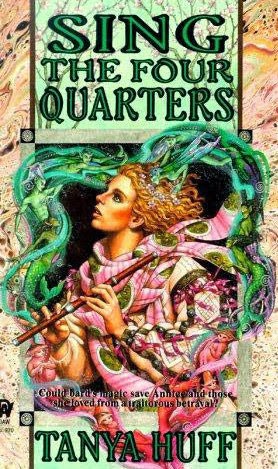
Re-Read Rollout: "Sing the Four Quarters," by Tanya Huff

Principle Cast:

Annice: A former princess, who was cast out of the royal family when she chose to become a bard. Ten years later, she's unsure of how to tell her estranged family that she's pregnant - especially since her brother the King forbade her to have kids.

Pjerin: The Duc of Ohrin - an ignored principality of King Theron's kingdom that guards a mountain pass into a hostile country. When he's accused of abetting that country and finds himself saying words that aren't his when questioned, he knows he's been set up - but by who?

Secondary Cast:

Stasya: Annice's girlfriend who worries about her health and helps Annice try and clear Pjerin's name.

Olinda: Pjerin's scheming aunt who wants him out of the way so that she can grab power for herself.

Albek: A con artist from the neighbouring hostile country who helps Olinda with her treasonous schemes.

Gerek: Pjerin's four-year-old son and heir. Olinda hopes to use him as a figurehead once Pjerin's out of the way.

King Theron: Annice's brother. Has pigheadedly refused to deal with the equally pigheaded Annice for  ten years, but now regrets the bitter gap between them.

Fantasy Convention Checklist:
  • 1 Use of Evil Magic
  • 4 Types of Elementals
  • 1 Giant Godzilla Elemental
  • 1 Magic-Boosting Fetus
  • 1 Nation of Suspicious Foreigners
  • All the LGBT People
The Word: This always happens sooner or later - not everything you loved as a kid, or a teenager, or a younger adult always holds up when you read it again. I initially read Sing the Four Quarters (and the three following novels in the quartet) in my early teens, when I was huge into my Epic Lady Fantasy phase - Robin Hobb, Kate Elliott, Melanie Rawn, Mercedes Lackey before her Magical Horse Books got stupid, Mickey Zucker Reichert whose novels were already stupid but enjoyably silly. 

Oddly enough, I'd never re-read this novel until now. The story takes place in a world where the four elements are controlled by kigh: playful, unpredictable spirits who can be managed and cajoled through music. People with the ability to sing the kigh are called bards, and they tramp up and down the country singing songs, conveying messages and fixing problems in service of the king. 

However, when 14-year-old Princess Annice joins the bards in defiance of her brother Theron's wish to marry her off to the prince of a neighbouring country, the young king strips her of all royal privileges, cuts her off from the family, and bars her (on pain of treason) from marrying or having children without his express permission. 

Ten years later, Annice comes back from her bard's Walk to discover there's a reason she's tired and throwing up all the time: she's pregnant. Moreover, before she can find a politic way to inform the brother she hasn't spoken to in a decade, the father of her baby - Pjerin, the Duc of Ohrid and handsome one night stand -  is accused of conspiring with an enemy nation and admits to treason when put to Bardic questioning. 

Annice knows there's no way she can tell the King about her pregnancy now that both her baby and her babydaddy are traitors, but she also suspects that something's not quite right about Pjerin's confession, especially since Pjerin maintains his innocence. Throwing caution to the wind, Annice rescues Pjerin from prison, and the two hie off to see if they can find out who set Pjerin up.

Let's start with the good - I didn't quite grasp this when I first read it at 13 or 14, but Sing the Four Quarters is an entirely sex-positive, feminist, LGBT-friendly fantasy novel. Annice is bisexual and in a committed relationship with her girlfriend, Stasya. Gay marriage exists - hell, gay political marriage exists (Annice's uncle turned down the offer to marry a foreign prince), women and men are found in equal numbers in almost every type of job, and premarital sex and bastardy carry little to no stigma. Best of all, none of this ever merits more than a passing mention when establishing setting - there's nothing special or remarkable or abnormal about any of it. For a novel published in 1994, that's pretty awesome.

However, despite all this positive stuff, this re-read ultimately didn't measure up to my memory of it. Yes, there are positive feminist themes and excellent LGBT representation and family issues and magic,  this novel would be practically perfect - except it isn't. Firstly - I had some serious problems with Pjerin, the male protagonist. He is an entitled ass - and I really could have gone without knowing he repeatedly banged his biological aunt.

Secondly, for a novel with such interesting themes, its story is pretty boring. Sing the Four Quarters packs a lot of content - but not all of that content is valuable to the narrative. A lot of it is redundant explanation of character motivation - Annice does something, but not before she explicitly tells us why she's doing this and why the world she lives in supports such an action, etc. The pacing is frustratingly slow-moving and dense, which works against the story itself since the latter half of the novel is really one extensive chase sequence. I finally gave up once I reached the halfway mark and skimmed my way to the end. 

However, I would hesitate to condemn this novel out of hand. It may have bored me, but it had a lot of good things going for it. If you're more into uber-detailed high fantasy, you may really enjoy this novel. However, if you're more into faster-paced, less cluttered stories, you're out of luck.
C+

Sunday, December 22, 2013

Re-Read Rollout: "Gentlemen and Players," by Joanne Harris

Principle Cast:

Roy Straightley: An aging professor of Latin who worries the new school reforms will force him into retirement before he completes his 100th term of teaching.

Snyde: A secret intruder who's invaded the hallowed halls of St. Oswald's in order to destroy the institution for its stagnant exclusivity.

Secondary Cast:

Pat Bishop: The genial, compassionate Second Head who's aces at managing students but terrible at managing scandals.

The New Head: The progressive headmaster who's more focused on the school's reputation and cost-cutting measures than the students themselves.

Colin Knight: A resentful school outcast who becomes an unwitting pawn in Snyde's plots against the school.

Marlene: The mother of a former student, she now works as St. Oswald's ultra-competent receptionist.

Mr. Keane: A new teacher to St. Oswald's, he hopes his adventures in teaching will give him plenty of material for a novel he's writing.

Ms. Dare: Another new teacher who displays a remarkable gift for dealing with students, but tries to stay out of the increasingly toxic office politics.

Leon: A student at St. Oswald's 15 years ago whom Snyde befriended while disguised as a fellow student.

The Word: 
I was a little bit afraid to reread Gentleman and Players for my annual Re-Read Rollout. When I first read this way, way back in February 2010, it utterly destroyed me - but I was so determined at the time to be a "romance-only blog" that I didn't review it.

But this book was so good. Almost too good - I was afraid to re-read it because I was worried the experience of reading it a second time wouldn't measure up to the first. That I'd suddenly notice all these flaws and mistakes and ruin my memory of that One Perfect Read.

Because Gentleman and Players was one of those Perfect Reads. I love a lot of books, but Perfect Reads are rare. The type of book I would grab if my house was on fire. The type of book that keeps me voraciously reading through my TBR in order to fine another one like it.

Gentleman and Players takes place at St. Oswald's Grammar School for Boys, a posh private school for the best and brightest of England's young male elite - provided their parents can afford six thousand pounds a year for tuition. It is a school steeped in prestige and tradition.

For Roy Straightley, a Latin professor at St. Oswald's, he could do with a little more tradition. Sixty-five years old and a term away from his Century (his 100th term teaching at St. Oswald's), he continually frustrates St. Oswald's administration by refusing to adapt to their educational reforms. He relies on ancient chalkboards, dusty black robes, and common sense when dealing with his pupils, even though he knows the more progressive Head and his cronies are losing patience with him.

However, for a mysterious figure known simply as Snyde, St. Oswald's relies far too much on tradition.  Snyde's father worked as a porter and groundskeeper for St. Oswald's - a porter whose termination was completely hushed up by the powerful administration. After spending a childhood living in St. Oswald's shadow, longing after the privileged lifestyle of its entitled students, Snyde has returned, disguised as a teacher, to destroy the corrupt and stagnant school from the inside out.

I loved Gentleman and Players because the story is all about conflict - good versus evil, progress versus tradition, hands-on educators versus detached administrators, rich versus poor, parents versus teachers, Straightley versus Snyde. There is so much detail and drama and scandal - and yet very little direct confrontation in the novel.

Rather, most of the conflict involves the points of view of Straightley and Snyde. Straightley is an Old Boy who has dedicated the greater part of his life to the school, and from him we get a highly entertaining, satirical look into the politics of private school administration and the private lives of teachers. While Straightley isn't blind to St. Oswald's imperfections, nor to the emptiness of the parts of his life that don't involve the school, he is fiercely loyal to it and its boys.

However, Straightley is mainly an observer. It is Snyde who sets most of the plot in motion - oftentimes by using St. Oswald's traditions against itself and brewing dissent amidst the envious townies, the dissatisfied parents, and the disgruntled students of St. Oswald's. Snyde exposes and exploits the hidden resentments over class differences, favouritism, money, and privilege that have been weakening the "impervious" foundations of the school for generations. At the same time, we get frequent flashbacks to the last year Snyde's father was porter, the year the teenaged Snyde decided to impersonate a student and experience the St. Oswald's experience firsthand - with disastrous results.

So did it hold up upon re-reading? Yes indeed. Perception plays a very large part in my enjoyment of Gentleman and Players - the characters' points of view and their respective blind spots thanks to their own privileges and prejudices, the way outsiders perceive St. Oswald's versus the way St. Oswald's fights to be perceived, and how a few carefully-revealed secrets can change one's perception of several major characters. Without going into too much detail, there is a delightful twist at the end of the novel that added an extra layer of enjoyment to this particular reread.

Simply put, Gentlemen and Players is a fiendishly clever, insightful, and entertaining novel about education, revenge, and privilege.
A+

Tuesday, December 17, 2013

The 100-Page Drop: "The Assassin's Curse," by Cassandra Rose Clarke

I was fairly excited to read this novel - it had a great cover, a fabulous premise, and lots of my blogger friends had read it. I figured it was the perfect thing to read on my Kobo while my mother and I vacationed at the Library Hotel in New York City (I saved my paper copy of Anne of Avonlea for take-off and landing).

Imagine my surprise when I found myself scrolling through Twitter and perusing articles on my phone in the Library Hotel's reading room rather than actually reading the book that I'd brought.

Yes, The Assassin's Curse is that boring and stupid.

So our heroine Pineapple - I'm sorry, Ananna - is the daughter of prominent pirates who is about to be married off to the son of other, equally-prominent pirates. All is well until Pineapple suddenly goes, "DO NOT WANT" and impulsively flees on a camel. Because why not?

Unfortunately, her ex-fiance's Pirate Parents are not pleased with her marriage-dodging camel shenanigans and send a Magical Assassin after her. Thankfully, the Magical Assassin (named Naji) is Terrible At His Job and almost gets bitten by a poisonous snake while attacking Pineapple. Thankfully, Pineapple is Terrible At Everything In General and kills the snake for no other reason than she's a Heroine and has to save the man trying to murder her because the plot wills it.

Unfortunately, this unleashes a curse which means Naji has to serve, protect, and remain in her vicinity at all times or else he feels excruciating pain. Which turns out to be super-convenient as Pineapple's Pirate In-Laws have sent other Magical Assassins after her, and some Evil Dudes from an Alternate Dimension are also after Naji for Reasons Unexplained. Oh, and this bitchy river witch whom Naji used to bone is also involved.

Everything's written in this dull, arbitrary style - "of course the heroine's a pirate, and of course this must happen because this is what Feisty Heroines Do" - and it doesn't help that the heroine is a moron. She cuts herself off from her entire family and way of life on a moment's whim then acts surprised that her actions have actual consequences. Flawed heroines are great and realistic and all, but I couldn't empathize with this aggressively idiotic scatterbrain for longer than 100 pages.

Her character didn't feel organic or well-realized - she came off like a checklist of Feisty Heroine Traits that had all been checked off at once. I felt the same way with Naji - he was just filling out his quota of Angsty Hero Traits (angsty scar? Check! Refusal to tell the heroine anything for her own good? Check! Bad manners? Check! Bitchy ex? Check!) The whole story seemed to run on cliches and aimed for all the major points in a Teen Fantasy Novel - oh look, here's the scene where the heroine dislikes the hero's ex and feels ugly by comparison; here's the scene where the hero refuses to tell the heroine the whole truth and this gets them both in trouble; oh look, the heroine has Super Special Magical Powers she never knew she had! ugh, again? By that point, I was tired of Ananna's quippy sarcastic narration and Naji's Brooding Scarred Angst, and had no real interest in following along with their adventures.

So I moved on to something else.

DNF

Monday, December 16, 2013

Re-Read Rollout: "Anne of Avonlea," by Lucy Maud Montgomery

The Protagonist: Anne Shirley. Now 16 years old, she teaches the children of Avonlea while looking after her guardian, Marilla.
Her Angst: Reality won't stop intervening in her attempts to have a perfectly blissful year.

Secondary Cast:

Gilbert Blythe: Anne's friend who is totes in love with her. Has decided to give up teaching to become a doctor.

Marilla: Anne's guardian - she's not as young as she used to be, but at least she's not going blind anymore.

Mr. Harrison: A cantankerous old bachelor who is mighty set in his ways.

Davey Keith: A young orphan (and budding sociopath) who is adopted by Anne and Marilla, along with his sister Dora.

Paul Irving: A new pupil in Anne's class who is sometimes ridiculed for being too sensitive and dreamy. Just you wait until puberty!

Anthony Pye: The worst. Of course.

Miss Lavendar: An eccentric old maid who has a history with Paul Irving's widowed father Stephen.

Angst Checklist:

  • Accidental Grand Theft Cow
  • Secret Wives
  • Dead Mothers
  • Dead Husbands
  • Estranged Husbands
  • Isn't it really doing the world a favour if we dropped Davey down a well?
  • Bringing Firecrackers to School
  • Pyes are the Worst at Everything

The Word: Well, it's December - time for another month of re-reads! Since I read Anne of Green Gables last year, it makes sense that I would read the sequel, Anne of Avonlea, this year as well.

Much like Gables, Anne of Avonlea doesn't really have a plot, but instead chronicles the next two years of Anne's life in a linear chain of heartwarming or comedic episodes. Most of these episodes have to do with Anne's experiences as Avonlea's newest schoolteacher, her efforts heading the Improvement Society (an attempt by Avonlea's youth to pretty up the town), and her attempts to teach and raise two very different boys - her new pupil Paul Irving (a shy dreamer) and the irrepressible orphan Davey (who might possibly be the son of Satan).

While Anne of Green Gables is a beloved classic - I've heard that the later novels are…less classic. I've read about four books into the series and have loved all of them, but I can kind of see where the complaints come from. Sure, some of the stories may seem a little idealized - and while I love Anne's melodramatic ways, it gets a little bit cloying when she discovers and interacts with two more melodramatic dreamers (Paul and the eccentric Miss Lavendar). I mean, you can't all be crazy manic snowflakes.

And yet, despite the episodic nature of the novel, Anne grows and matures. She deals with far more responsibility in this book - not only does she have to teach the children of Avonlea, but she also finds herself in charge of a pair of orphaned siblings. Her fairy fancies are consistently tempered by the reality of her setting and her increasingly-competent interactions with such a setting. While she still gets into scrapes, it's because she's creative and impulsive, not because she's stupid. My favourite chapter is the one where Anne meets her favourite author - fangirl behaviour really hasn't changed much in the last century.

Anne of Avonlea might be episodic and linear, but it's never repetitive. Montgomery understands her characters' charms but also allows them to change and develop. I still found this book endlessly enjoyable, a real comfort read during the stresses of my trip to New York City.
A

Sunday, December 15, 2013

"A Christmas Bride/Christmas Beau," by Mary Balogh (Dell, 2012)

Mary Balogh's bundled Christmas Bride/Beau is an interesting book because it clearly establishes what Mary Balogh does well - and what she doesn't.

Christmas Bride is first, and it is excellent. Our heroine, Helena, Lady Stapleton, is the slutty stepmum who flashed her ta tas at the hero of A Precious Jewel and turned him into a misogynist. Now a wealthy, vaguely-scandalous widow of 36, she is cynical, jaded - and deeply, desperately remorseful for her actions thirteen years ago.

When she meets Edgar Downes, a prosperous merchant, at a party, she is immediately and inexplicably attracted to him. Edgar, in order to fulfill a promise to his father, is looking to marry a well-bred lady by Christmas - hopefully one who's able to look past the fact that he's not a gentleman. However, he's drawn to Helena as well, and the two share an uncharacteristic but hotly passionate one-night stand. Then Helena gets preggers. Whoops.

Part of the reason I loved this novel is that it indulges one of my favourite tropes - the Witty, Troubled, Morally-Ambiguous Heroine. Helena is not a very nice person and Balogh doesn't sugarcoat her, but the majority of her bitterness is directed inward. She hates herself for what she did to a stepson who trusted her, and her self-loathing has caused her to retreat from all forms of commitment or happiness. It takes some reckless bravery on Edgar's part - combined with Edgar's endearing family and the Christmas season - to convince her to forgive herself and move on with her life.

Balogh ably balances dark and light in this novel. Helena's sarcasm and anxiety prevent the Christmas aspects of the story from becoming too cutesy or cloying - the gathering of holly and the creation of a kissing bough are adorable but Helena's observations keep the story grounded. For his part, Edgar is a very controlling hero who finds he's happier with a mature woman who can counter him than the dewy eighteen-year-old marriage prospects he was initially looking at.

Christmas Bride also has a superbly organized supporting cast of previous Heroes and Heroines who contribute to rather than clutter up the storyline. The novel even improves upon the story of Priss and Gerald from A Precious Jewel. Balogh has stumbled before when including Prequel characters (see the bloated mess of Simply Love) so this was a delightful surprise.

Christmas Bride hits all the right spots for a Christmas story - warm, loving, but spiced with angst.

Christmas Beau, on the other hand hand - oy.

The story is as follows - once upon a time, Judith and Max, Marquess of Denbigh were engaged to be married. It was an arranged match, and Judith found Max creepy, cold and heartless - so she ran off with another dude a month before the wedding. That marriage didn't turn out so well either, but now that dude's dead and Judith is preparing to celebrate her first Christmas out of mourning with her two young children, Rupert and Kate, and her self-pitying dishrag of a sister-in-law, Amy.

However, for the first time in eight years, Max has returned to London as well - with revenge in mind. During their betrothal, Max was madly in love with her, and was horrifically brokenhearted by her desertion. He now plans to inflict the same pain on her - by seducing her children.

Creeped out yet? Yes, he cozies up to her kids and tempts them with horsie rides, candy and fairs and invites them to his isolated manor house which he's filled up with Christmas trees and abandoned street urchins (for reals). And Judith - despite being royally grossed-out by his overtures - is simply forced to comply because, in this novel, any mother who doesn't utterly martyr herself for her children at every opportunity is a Horrible Person. Man up, Judith. Your kids are under six - they'll get over it.

Every character has something to hate about them. Max is an asshat of the highest order. So he was crazy in love with Judith - but not crazy enough to demonstrate or express that love in any way. According to Judith, he never even smiled during their entire courtship. But he still plans to punish Judith for not MAGICALLY cluing in to his Secret Squishy Feels.

Judith, meanwhile, is an insufferably short-sighted martyr who believes her children's immediate happiness is worth more than getting them away from a Creepy Stranger With Designs On Her. Her reasons for disliking Max during their courtship were perfectly valid, but the novel is determined to Teach Her A Lesson for not giving cold, unsmiling, silently awkward dudes the sympathy they deserve.

We also get a drippy secondary romance for Amy, the sister in law who simply can't shut up about how Unlovable and Ugly and Childless and Futureless she is, and some random dude who inexplicably finds her self-pitying whining charming.

It's strange - while Christmas Bride was all about how the heroine who has actually done something wrong should forgive herself and be happy, Christmas Beau was all about how the heroine should be stalked and mistreated until she's forced to apologize for her relatively minor sins as a teenager. No thank you.

Christmas Bride: A+. Christmas Beau: C

Thursday, December 12, 2013

"Someone Else's Love Story," by Joshilyn Jackson (William Morrow, 2013)

The Primary Cast:

Shandi Pierce: A young woman with a 3-year-old son who decides to finally find out the truth behind her son's conception.

William Ashe: A brilliant, autistic chemist who is still is mourning his lost family thanks to a car accident.

The Secondary Cast:

Natty: Shandi's genius-level son, and the love of her life, regardless of how he came into the world.

Walcott: Shandi's childhood best friend who's a little too White Knight for Shandi's liking.

Paula: William's bitchy and AWESOME attorney BFF - who does not like Shandi or the moves she's been putting on William.

Stevie: The hopeless loser who tries to rob a Circle K and winds up holding everyone hostage.

Mimmy: Shandi's protective but exasperating mother.

Bethany: Shandi's awful stepmonster.

Bridget: William's wife. Was planning to become a nun before he wooed her away with his autistic charm.

The Word: In Joshilyn Jackson's engaging and unconventional romantic story, our hero and heroine meet during a robbery at a Circle K. Shandi is a single mother who's spent the last four years repressing the fact that her beloved son Natty was conceived from rape. William is a brilliant chemist with high-functioning autism who's still struggling to recover from the loss of his wife and infant daughter a year after their car accident.

When William ends the hostage crisis by incapacitating the gunman, taking a bullet in the process, Shandi becomes convinced that their meeting is destiny. She insinuates herself into William's life by asking him to help find the man who fathered Natty (with SCIENCE! Just roll with it), all the while taking care of him, getting to know him, and showering him with good ol' southern hospitality. Unfortunately, she faces fierce opposition from William's best friend Paula, her own BFF Walcott, and William's own fixation on his lost wife.

With this novel, expectations are not your friend. Jackson builds the novel on well-written but instantly-recognizable cliches - the jealous best friend, the over-critical mother, the chirpy female protagonist who flutters about in frilly sundresses dispensing home cooked meals to the reclusive male protagonist. However, just when you think the narrative is about to turn left, it veers right. Without giving too much away, the novel is about Shandi, William, and why destiny brought them together - but not in the way you think.

I really enjoyed how the novel establishes a thematic conflict between logic and faith, elements both our protagonists consistently struggle with. For Shandi, this is internal as she relinquishes her irrational belief in Natty's immaculate conception in favour of confronting what really happened. William explores this theme as he reminisces on his marriage to a woman who almost became a nun. William, thanks to his autism, is extremely literal and finds his wife's deep religious faith difficult to reconcile. And yet, despite this, William is just as guilty as Shandi of retreating from painful truths.

Joshilyn Jackson crafts an incredibly empathetic, warm-hearted novel that satisfies on an emotional level without being overtly manipulative (except perhaps at the end). While I'll admit I wasn't entirely happy with the too-sudden swerve at the end, by that time, I'd come to love the characters too much to abandon ship. I'll be keeping this one on my shelf for a while - I suspect it will improve upon repeated readings.
A-

Saturday, November 30, 2013

"Forgive Me, Leonard Peacock," by Matthew Quick (Little, Brown; 2013)

The Protagonist: Leonard Peacock. Today is his birthday, and he plans to go out the same way he came in - with a lot of blood and screaming as he shoots the boy who abused him and then himself.
His Angst: Um, see above.

Secondary Characters:

Asher Beal: Leonard's childhood best friend who then became his abuser and tormentor. Leonard plans to cap off his birthday by blowing a hole in Asher's head.

Walt: Leonard's kindly, elderly neighbour who often likes to watch old Humphrey Bogart movies with him.

Baback: A violin prodigy whom Leonard defends from bullies in return for listening to him make beautiful music.

Lauren: An evangelical, homeschooled Christian girl whom Leonard develops a crush on.

Herr Silverman: An inspiring teacher of Holocaust Studies, whom Leonard idolizes and looks up to.

Linda Peacock: Leonard's awful, oblivious, neglectful, utterly self-absorbed and useless mother.

Angst Checklist
  • Bullying
  • Sexual Abuse
  • Terrible Parenting
  • Humphrey Bogart
  • Religion
  • Suicide
  • Homophobia
  • Depression and Mental Illness
The Word: December's a great month - full of twinkling lights and wishes and cookies and family. So what better thing to read for the Forever Young Adult Book Club than a novel about suicide?

Yaaaay….

It's Leonard Peacock's 18th birthday, and how does he plan on celebrating? By taking his P-38 pistol to school and shooting his high school abuser, Asher Beal, and then himself. First, however, he's got four presents to hand out to the four people who at least tried to make his life bearable. 

Jay Asher (the author of Thirteen Reasons Why) blurbed this book, and I can see why, as the narratives are superficially similar. Both plots follow the viewpoint of an abused, vengeful outsider explaining the reasons they've decided to end their life. Both books explore the myriad ways in which parents, friends, and educators can (and do) fail the children they're supposed to be protecting. 

However, while I couldn't quite connect with Leonard Peacock, it was nowhere near as hateful as Thirteen Reasons Why. For one thing, Leonard's pain doesn't beatify him or excuse his intentions the way Hannah's premeditated psychological torture of her "tormentors" was. 

Leonard's intentions are gruesome - but the narrative acknowledges the monster he's planning on becoming even as it examines how he got to this point from an empathetic standpoint. There's also an element of suspense that keeps one reading - each gift that Leonard gives evokes memories and flashbacks, but also serves as a countdown to Leonard's murder-suicide. Will he go through with it as planned, or will someone finally be able to talk him out of it?

Reading Leonard Peacock was similar in a lot of ways to Catcher in the Rye. The narrative, told from the outsider's point of view, keeps the rest of the world at a distance. Everyone is a poser and a phoney. Our protagonist reaches out for help but at the same time resists it, distrusting other people's intentions. Leonard has no hope for the future because he can't find a single adult in his life who demonstrates that adulthood is any less miserable than adolescence. 

There are some bright spots in the never-ending misery, but they are toned down and often bittersweet, such as the post-apocalyptic "letters from the future" that Leonard writes to himself. There are no magical happy endings or solutions.

At the same time, however, I reacted to Leonard Peacock in the same way I reacted to Catcher in the Rye. I couldn't really connect to Leonard. I empathized with his pain but at the same time felt removed from it. As a result, while the reading experience of this book was pleasant I didn't take anything away from it. It was just a story that existed. I'm also not sure the story argued its point very well, but to be fair it's a subject that is pretty murky and miserable.

In the end, Forgive Me, Leonard Peacock gets the "m'eh" reaction from me. I never really felt for Leonard the way the author probably wanted me to. Still, the novel does have some insightful and clever moments and is an interesting look at an unusual point of view.
B-

Sunday, November 24, 2013

"First Comes Love," by Christie Ridgway (Avon, 2002)

The Chick: Kitty Wilder. Tired of living in the slutty shadow of her brothel-owning ancestors, she's planning on leaving her hometown of Hot Water just as soon as she earns enough money.
The Rub: Her plans are upended when her husband - who's only just realized their marriage is legal - returns to town. And he's not happy.
Dream Casting: Kristen Bell.

The Dude: Dylan Matthews. An FBI agent who's slaved away for the last eight years trying to atone for a teenage mistake that may have cost a woman her life.
The Rub: Finding out he's married forces him to return to a town he's desperately missed - but it's too full of excruciating memories of his failure for him to stay.
Dream Casting: Brett Dalton.

The Plot: 

Kitty: Just because I play a hooker in my town's re-enactments doesn't mean I'm one in real life! Wish my town could see it!

Dylan: WHY THE HELL ARE WE MARRIED? THIS IS NOT OKAY.

Kitty: Eep! Let me distract you with my cutesy shenanigans and pratfalls and adorably perky boobs for the next fifty pages!

Dylan: Curse your adorably perky boobs! But you're going to have to answer the question some time!

Kitty: Noooooope! Time for more pratfalls!

Dylan: Seriously, though.

Kitty: Oh, it was just that I've been secretly in love with you this whole time and never slept with another person because cheating is wrong! But I forgive you for doing it!

Dylan: … I inexplicably find your delusional stalkery behaviour appealing!

Kitty: HOORAY!

Romance Convention Checklist:
  • 1 Hardened (heh) FBI Agent
  • 1 Bad Reputation
  • Several Hooker Dresses
  • 1 Defiled Minivan
  • 1 Terrrrrrrible Vagina Euphemism
  • 1 Legalized Marriage Certificate
  • 1 Small Town Murder
  • 1 Secondary Parental Romance
The Word:
In First Comes Love, Christie Ridgway creates one of the most well-realized and metaphorically clever settings I've ever come across in romance. Hot Water is a former Gold Rush town that's devoted to the past - in more ways then one. Not only does the bulk of its tourism revenue come from its historical reenactment district (called Old Town), but its social stratification is also based on your ancestors' history. 

And Kitty Wilder is sick of it. Her family is descended from Rose Wilder, the town's first ho and proprietor of The Burning Rose brothel. Since then, every woman in the Wilder family has lived under (and up to!) that reputation - including Kitty's mother, who abandoned her as a baby. Kitty is nevertheless devoted to the town and works herself to the bone to crawl out from under her family's licentious history - but, in a hilarious paradox, she does so by dressing as a madame and reenacting that history every weekend for tourists. I loved this concept.

Kitty longs for conventionality, and deeply resents how the town continues to tar her with the same harlot brush despite her nun-like existence. And now that her scandalous mother has unexpectedly returned to town, revving up the Wilder rumour mill once again, she believes the only way to escape her past is to leave Hot Water for good - once she pays off her college debt to her great-aunt Cat.

All her plans come crashing down when the last man she expected to return to town interrupts one of her tours - Dylan Matthews, her husband of eight years. Who has only just realized this fact.

Dylan Matthews is a workaholic FBI agent made famous by his numerous high-profile rescues of women and children. Son of the town judge, descendant of Hot Water's first sheriff, and destined for law school, he was Hot Water's Golden Boy until he attempted to intervene in a carjacking. While he managed to rescue the children in the car, the driver (his best friend's wife) was killed. Haunted by this failure, he left Hot Water to join the FBI and never looked back.

He is furious that Kitty's legalization of the joke marriage certificate they got as teens has forced him to return to a town whose hero-worship of him wracks him with guilt.

Unfortunately, a quickie divorce is not in the cards. Kitty, in order to pay off her college debt, forces Dylan to become Old Town's reenactment sheriff for the summer (in return for his divorce) in order to boost Old Town's sales and get her enough money to leave town guilt-free.

Yeah. Outside of the whole "secret nonconsensual marriage thing" and the "extorting a man by refusing to end said nonconsensual marriage thing," Kitty is a very empathetic character.

BUT - that "nonconsensual marriage thing" is a pretty huge flaw to swallow, and one I continually struggled with throughout the novel. Did Kitty seriously never consider how her actions might affect Dylan later on? Did she never wonder what would have happened if Dylan had wanted to marry somebody else? And the "secret reason" she did it is meant to be romantic (she was in love with him the whole time!) but in reality is just really creepy. Especially once we learn she's remained chaste this entire time because she was remaining "true to her marriage vows." Honestly, I just heard the Psycho soundtrack in my head whenever she brought it up. That's not a healthy mindset.

It's interesting to read this romance after Nobody's Baby But Mine. Both romances are about heroines who intentionally do something that monumentally affects their heroes' lives without their consent or knowledge - and both of them do it for stupid reasons. However, while I still think Kitty is bonkers, she doesn't possess that same obnoxious entitlement and privilege that Jane does. Kitty's upbringing was lonely and difficult, and she's worked so hard to be the Perfect Upstanding Citizen to people who only see her mother's actions, so her bonkers decision is - WHILE STILL NOT OKAY - easier to interpret as a misguided teenage mistake, rather than a selfish, privileged decision.

Besides, Kitty and Dylan have good chemistry and are generally good people (extortion and obsessive behaviour aside), and the setting is well-realized and ultimately positive without being a corny and idealized small town. There are some definite drawbacks to living in Hot Water and Kitty endures pretty much all of them.

I was a little squicked out by the secondary romance because it's between Dylan's father D.B. and Kitty's neglectful mother Samantha. It's just a kind of pseudo-incest scenario that bothers me. However, I really appreciated how Kitty and her mother eventually obtain an adult reconciliation but never become close. Once we got Samantha's viewpoint, I was afraid there'd be some dialogue or explanation about how Kitty "owes" Samantha forgiveness, love and understanding simply on account of their shared genes. But that's not true - Samantha dumped Kitty as a baby, and Kitty's over it, but Samantha doesn't suddenly regain her "mother" role. I liked that.

All in all, despite a bonkers premise, First Comes Love is an enjoyable (and often very funny) romance with a great setting.
B+

Monday, November 18, 2013

"Vessel," by Sarah Beth Durst (McElderry,2013)

The Protagonist: Liyana. As the vessel for her clan's goddess, she has been chosen to die so that her goddess may live in the physical realm.
Her Angst: What's a heavenly sacrifice to do when the sacrificer fails to show?

The Secondary Cast:

Korbyn: The trickster god of the Raven clan, who successfully found his vessel but must rescue his heavenly brethren so that they can find theirs.

Fennick: The vessel of the Horse clan. Proud but stubborn.

Pia: The blind vessel of the Silk clan. She has devoted her entire life to her cause and follows every holy rule to the letter.

Raan: The unwilling vessel of the Scorpion clan. Sees the abduction of her goddess as a ticket to freedom and the life she believes she deserves.

The Emperor: The ruler of the Crescent Empire. His entire land is dying, but he just might have an unconventional way of saving his country - if only those pesky desert people don't get in his way.

Angst Checklist:

  • I have to die for my goddess and my goddess didn't even bother to show up
  • Worthy sacrifices
  • I'm in love with a god and I'm also the receptacle for his girlfriend's soul. Awkward.
  • Hipster desert tattoos

The Word: Liyana, a young member of the Goat clan of desert nomads, has always known she doesn't have a future - ever since she was small, and her clan's magician discovered she was destined to be the vessel for her clan's goddess, Bayla.

Every one hundred years, the deity of each desert clan emerges from the spirit world of the Dreaming to take over the body of one of their chosen people, and work enough miracles to provide for their respective clans for the next one hundred years. While the soul of each vessel has to die in order for their god or goddess to walk about in their skin, their sacrifice ensures the continued survival of their people. The deities are required especially now that the Great Drought has rendered life in the desert even more difficult.

However, when the special day arises, Liyana dances the ritual dance - but Bayla doesn't come. Her clan, appalled at what they deem as Liyana's failure and Bayla's displeasure, abandons her in the desert to try and appease their goddess. Before Liyana succumbs to the elements, she is rescued by Korbyn - the desert god of trickery who successfully found his vessel. According to Korbyn, Bayla and four other clan gods have been kidnapped by an unknown enemy, and it is up to Korbyn and Liyana to seek out the other clans' vessels and try and rescue their deities.

I've wanted to read this book for a long time thanks to the great reviews and what sounded like an awesome premise, and on that score, the book doesn't disappoint. Vessel's world building is simple and elegant - conveying a fantastic desert culture and magical system without bogging it down with millions of different names or concepts.

The novel also focuses just as much on the human story as it does on the magical one. Liyana is an intriguing character - she's spent her whole life in perfect obedience, keeping her body pure, avoiding attachments, training her body to be the perfect instrument for her goddess. She's been raised to believe she's important, that she's responsible for the survival of her clan, but only as an object for someone else's power. Abandoned by her clan and saddled with this near-impossible quest soon teaches her how to find power in her own agency.

But at what cost? As Liyana meets up with different vessels, she discovers that not all of them welcome the fate of being honourably murdered for the good of the clan. Thanks to the Great Drought, countless lives will be lost to thirst and starvation without divine intervention. However, as one character wonders, what are the vessels really saving? Are they saving the lives of the clans - or the way of life that keeps the clans in the inhospitable desert, when instead they could move to an easier environment where magic isn't required?

The author explores the different angles of this theme - the morality of killing a few in order to save an entire people - using all the different characters and their backgrounds, from the fanatically-obedient Pia to the rebellious Raan, to the Emperor of the Crescent Empire. Interestingly, the most bland character of the bunch is Korbyn, an actual god inhabiting a human body. He never really came across as godlike to me - trickster or no. He just seemed like a particularly jovial teen with phenomenal cosmic powers. He doesn't even endure a lot of conflict or angst. Perhaps I'm comparing him too unfairly with NK Jemisin's portrayal of deities in The Hundred Thousand Kingdoms, but there was nothing about his personality or his decisions that rendered him distinct from the human characters.

While the novel has an original setting, colourful characters and engaging themes, overall the book didn't wow me as much as I thought it would. While the book does a great job setting up the difficult conflict - is there a way to protect people from the Great Drought without killing other people? - it fumbles royally when it comes to solving that conflict. Despite the lead up and the tension and some truly awesome action scenes, the book concludes with a solution the main characters already discussed and declared to be untenable. So how was stuff solved? Are we just supposed to believe in the power of love? What? Ugh, whatever.

Vessel has a lot of things going for it - an original premise, thought-provoking themes, and an awesome heroine. Just don't get too invested in the actual conflict.
B+

Saturday, November 16, 2013

"Nobody's Baby But Mine," by Susan Elizabeth Phillips (HarperCollins, 1997)

The Chick: Dr. Jane Darlington. A brilliant super-genius who longs to have a baby of her own.
The Rub: In order for her baby to be "normal," she has to bang a stupid guy in order to even out her offspring's IQ - and who better than a football player? They're all dumb, right?
Dream Casting: Claire Coffee.

The Dude: Cal Bonner. A star quarterback for the Chicago Stars who's in denial over the end of his football career.
The Rub: He finds out some random lady made a baby with him without his knowledge - oh noes! Commitment!
Dream Casting: Josh Duhamel.

The Plot: I am just too damn tired. Try reading my LiveTweets about it instead!

Romance Convention Checklist:

  • 1 Commitment-Phobe Hero
  • 1 Book-Smart, Literally-Everything-Else-Dumb Heroine
  • 3 Misogynist Good Ol' Boy Friends
  • Several Boxes of Tampered Lucky Charms
  • 1 Kooky Grandma
  • 1 Secondary Romance
  • 1 Greedy, Soulless Lawyer
The Word:
It's no secret that I'm a fan of Susan Elizabeth Phillips. She's consistently entertained me with her books - and even surprised me with the depth of her characterization as well as her excellent use of drama.

However, every time I raved about one of her books, there'd be a ghostly echo on the edge of my Twitter feed - a haunted whisper, thick with regret and despair, "Wait until Nobody's Baby But Miiiiiiine!"

At first I thought, "Challenge accepted!" But in reality, I was so not ready for this jelly. This Completely-Divorced-From-Reality Jelly. Served on a Traditional Gender Roll. With a side order of Offensive Stereotypes. Drenched in a hefty serving of Crazysauce.

So really, the only way to help this bad medicine go down is a good ol' Drinking Game! Our first rule - chug whenever an offensively stale stereotype rears its ugly head.

Dr. Jane Darlington is our "heroine." She is a "brilliant" award-winning physicist who Doogie Howser'd her way to a Ph.D. We know this, because she talks about quarks. A lot - take a chug every time she mentions a quark. Thankfully, she's also a knockout - once you convince her to let her hair down and take off her glasses (drink!).

Of course, none of her accomplishments matter because she's 34 and babyless. Unfortunately, she can't go to a sperm bank, because medical and science students are the primary donors. In this detailed fantasy world that SEP has created, all male scientists are misogynist nerds with bad haircuts who wear black socks to bed (drink!).

More importantly, Jane wants a dumb baby. No, really. Her ~*terrible childhood*~ as a Super Genius scarred her so completely, she refuses to "subject" her unborn child to that type of First World White Privileged Suffering. So let's drink to her pain whenever she mentions her "terrible childhood" of being better than everyone else.

Jane thinks she needs to score some love gravy from a Forrest Gump-type that will even out her child's intelligence to a more "reasonable" level. Because that is exactly how science works. And our heroine is a "brilliant" "scientist." If I could add more quotation marks without violating the laws of grammar, I would. Instead, I'll just drink whenever the heroine gleefully imagines her child's IQ dropping a couple of points. No, really.

Cal Bonnor is our "hero," a 36-year-old quarterback for the Chicago Stars who's in denial of the impending end of his football career. He refuses to date women older than 22, because dating older women implies he's old, which means commitment (drink)! And nagging wives (drink)! And the stale laughter of a live studio audience, since Cal appears to derive his understanding of gender politics from old reruns of According to Jim.

Cal prefers younger women because they still have that "smell of newness" about them, a "dewy sparkle" - and shudders at women thirty and older because he thinks they're "already turning brown at the edges." Dude, this wouldn't happen if you just dipped them in lemon juice first! Take a drink whenever Cal expresses his desire for sparkly teenagers and his revulsion for "elderly" women over the age of twenty four

His birthday's coming up, and his Totally Not Offensive Football Bros decide to buy him a hooker as a birthday present. But a super-classy hooker. And they make her wear a big pink bow just to hammer home the point that she's his gift. Of course, this blatant objectification of women is completely okay because They're Dumb Football Players Who Don't Know Any Better (drink!).

Thanks to shenanigans I'm frankly too tired to explain at length, the "Classy Birthday Hooker" is really Jane in disguise, armed with a sabotaged condom. You see, after seeing one interview with Cal on the television, our "brilliant" heroine has already deduced that he must be an idiot because a) he's a football player (drink!) and b) he's Southern (drink!).

But one look at him convinces her that he's a hardened warrior, and genetically perfect for her baby. Because an "ancient, wise" female voice in her head tells her so. So drink whenever Jane refers to Cal as a warrior (or maybe just sip, she says it a LOT), and also whenever Psychic Judi Dench gives Jane romantic advice.

Despite the fact that Jane is terrible at sex, doesn't finish, and doesn't remove any of her clothes (this is the same heroine who complained about her ex wearing socks to bed, by the way), Cal is so inexplicably besotted with her that he bones her again when she comes back for seconds a month later. Both sex scenes are awkward and unpleasant - but, to be fair, incredibly fascinating. Both the hero and the heroine treat the other as a sex object. Cal initially refuses Jane and wants to "pass her along" to one of his friends, while Jane refers to Cal as a mere "device" to give her a baby. There actually is some real potential for nuance and discussion in this scenario - if only the protagonists were less punchable.

(For a less punchable version of this scenario, I recommend A Lady Awakened by Cecilia Grant.)

Long story longer, Cal finds out about the baby, throws his money around threatening to ruin Jane's career, and forces her into marriage, because doggone it if his baby won't be legitimate because he's an Old School Man with Old School Values (drink!). Of course, he plans to divorce Jane as soon as the cord is cut, but those nine months of matrimony will magically make all the difference. I can't say I understand Cal's logic in this scenario. Neither can Jane.

Of course, the gossip gets out so Cal has to pack up Jane and drive them both down to his small, southern hometown of Salvation, North Carolina, in order to evade reporters until the baby's birth and the return of football season. However, Cal gives Jane some specific instructions:
  1. She can't talk to his family or friends without his knowledge.
  2. If a scenario arises in which she's forced to meet his family or friends, she has to act as Terrible As Possible so his family won't grow attached to her.
  3. She can't leave the house or own her own car to leave said house without his consent
  4. If anyone asks, she's twenty-five years old - because Cal can't bear the shame of people knowing he married a woman as old as twenty-eight. People will think he's poor! (drink!)
To her credit, Jane ignores and defies most of these super-stalkery rules, and that's when we get a better picture of what Jane and Cal's romantic dynamic is supposed to be like, once they've stopped trying to be The Worst People Ever. Cal describes himself as a "yeller" - he was never truly satisfied with his dewy, sparkly, overly-moisturized college girls because he could never be his Awful Shouting Self around them without them bursting into tears. Um, okay. So Jane is his perfect match because she can put up with his Dominating Caveman Bullshit.

Maybe you could just stop being a Dominating Caveman? No? Okay then.

Once we get to Salvation, we get a host of dull, silly secondary subplots - the worst of which is a romantic one with Cal's estranged parents. His dad's flaw is that he's a privileged, emotionally abusive asshole going through a midlife crisis. His mum's flaw is … um, she's apparently unable to psychically detect that her husband's abuse comes from a place of love. Right.

Honestly, the narrative slows down and gets kind of boring around this point. There's less crazy, but there's no emotional substance to fill the void. The rest of the book is just squabbling that seems aimless and petty after the Seed-Stealing-Super-Genius plot of the first half.

Ultimately, it all comes down to the poorly-realized characters. Gonzo stories aren't a romantic deal breaker - just read some of the plots of Laura Kinsale's awesome books - but they still need grounded, realistic characters, and neither of these goons fit the bill.

Jane Darlington is a monstrously privileged character who jumps to hugely prejudiced conclusions about just about everyone. She believes Cal is a moron for a huge chunk of the book based solely on his southern accent (drink!), colloquial dialect (drink!), and his love of comic books (drink!). She is so horrified to discover Cal graduated summa cum laude that she threatens to take her child to Africa, where it's "primitive" (finish the whole damn bottle). Seriously. I guess the only way to escape the problems of White Privilege is to take the child away from white people.

And despite all this, her desperate desire to have a "normal" baby thanks to her "freakish" childhood, a desire that fuels the majority of her actions, is solved with one line in the epilogue.

Cal, meanwhile, is a cartoon. His actions and thought processes are just too exaggerated to believe or empathize with. His "old school values" that make no sense, his disgustingly hypocritical dismissal of women over twenty-five, his narrow-minded idea of what makes a man a "real man." He's built out of cliches - and not even positive ones. It's impossible to view his actions and decisions on a human spectrum because he's essentially a plot device/fantasy object. Although definitely not my fantasy.

It's interesting to compare this book to the other SEP novels I've read and loved - how could this one book hit so many wrong notes and fail to grasp realistic human behaviour on such a basic level? No idea. Even amid the awfulness, a few sparks of SEP's skillful humour slip through (like a hilarious scene where the heroine tries to sexy-dance to classical music - which winds up being "Flight of the Bumblebee"), but it's like reading a human story written by aliens who decided to watch old family sitcoms instead of doing research.

I'm far from giving SEP up completely, but this book is definitely the odd one out.
D-

Monday, November 11, 2013

"Good Omens," by Terry Pratchett and Neil Gaiman (HarperTorch, 2006)

The Primary Cast:

Crowley: A Fallen Angel who wears dark glasses and drives a Bentley.

Aziraphale: An Angel (unfallen), who collects antique books and wears a bow tie. Friends with Crowley.

The Secondary Cast:

Anathema Device: A young witch, and descendent of a woman whose book of prophesies has accurately predicted every major event in her life.

Newt Pulsifer: An apprentice witchfinder, for no particular reason than he has nothing better to do with his life.

Adam Young: The 11-year-old Antichrist, who's more concerned with climbing trees and playing games in the hedge than de

Fantasy Convention Checklist:

  • 1 Inexplicably-Empowered Child With World-Destroying Powers
  • 1 Bigoted Witchfinder
  • 1 Rather Open-Minded Witchfinder
  • 1 Book of Entirely Accurate Prophesies
  • 4 Bad Little Kids
  • 4 Horsemen of the Apocalypse
  • 4 More (Albeit Less Effective) Horsemen of the Apocalypse
  • 1 Talkative Nun
The Word: I'm not the hugest fan of Terry Pratchett - I read one of his Rincewind books and thought the humour was just too over-the-top for my taste. Neil Gaiman has also been hit or miss for me. Loved 1602, Stardust and Coraline - disliked American Gods

So what would it be like to read a book written by both of them together? Amazingly, rather pleasant. Gaiman tones down Pratchett's goofball humour and Pratchett lightens up Gaiman's moody navel-gazing, and the result is a pleasant, often funny, if a bit overlong novel.

So the end of the world is apparently nigh - the Antichrist has just been born, which means in a few years' time the world will come to an end as the armies of Heaven and Hell duke it out for Best Afterlife Ever. However, two small, insignificant peons in these supernatural armies are not as excited for this splendid event. Aziraphale (an angel) and Crowley (a Fallen angel) have become friends during their petty squabbling over the souls of humanity, and they've rather come to like the human world. 

On top of that, thanks to the incompetent machinations of a group of Satanic nuns, the infant World-Destroyer is accidentally switched with another baby and sent home with the wrong family, where he grows up without any supernatural influence, Good or Evil. However, the Apocalypse waits for no one, and as events ratchet up towards the end of the world, Crowley and Aziraphale - with the help of some kooky characters and a book of disturbingly accurate prophesies - have to keep the world in one piece as much as possible. 

Good Omens is extremely cleverly written, with almost non-stop humour from start to finish. For the most part, the novel trots along at a nice clip as the narrative lightly tip toes along, across, and around weighty issues such as Free Will versus Fate, Good versus Evil, Human Nature, and the catchiness of Queen songs. The plot is rather slow-moving (the whole story takes about a week, all told) and is more of an excuse to cleverly skewer pop culture, religion, politics, and other subjects inappropriate for the dinner table.

That being said, the novel does begin to overstay its welcome about three quarters in. I actually found it difficult to keep track of some of the characters, since many of them (Anathema and Newt, to name a few) are almost entirely superfluous to the plot. The pacing could have been tightened in many places, and around the end a lot of the humour feels more like padding than plot. 

All in all, though, Good Omens is a quirky, funny read with a great deal of imagination and wit - even if it's a little short on story.
B

Saturday, November 02, 2013

October Round-Up!

Please excuse this brief introduction to my October round-up - I've started National Novel Writing Month! But I still took a break from typing madly away at my new novel to let you know what sorts of books I read in the last thirty-one days:

*October Winners*
To Have and To Hold, by Patricia Gaffney. Romance, Historical. A+
Pros: Gorgeous language, nuanced characters, beautiful relationship. Cons: Rape scene. Hero's an ass for the first half.

Burn for Burn, by Siobhan Vivian and Jenny Han. A+
Pros: Excellent developed heroines, great continuation of story, well-established but subtle paranormal element. Cons: Doesn't really stand on its own.

*October Dud*
This is W.A.R., by Lisa Roecker and Laura Roecker. YA, Contemporary. C
Pros: Revenge. Cons: Cliched, unlikable characters. Badly constructed plot.

*The Best of the Rest*
In This House of Brede, by Rumer Godden. Fiction, Contemporary (circa 1960). A
Pros: Diverse cast of female characters, eye-opening examination into monastic life. Cons: No real plot.

Thieftaker, by D.B. Jackson. Mystery, Fantasy, Historical. B
Pros: Interesting setting, colourful characters. Cons: Repetitive plot, so-so mystery.

Trial by Desire, by Courtney Milan. Romance, Historical. C+
Pros: Awesome heroine, interesting dramatic plot. Cons: Condescending jerkface hero.

The Postmistress, by Sarah Blake. Fiction, Historical. DNF
Pros: Historical detail, decent writing. Cons: Utterly boring and a complete lack of plot.

"How to Say Goodbye in Robot," by Natalie Standiford (Scholastic, 2010)

The Protagonist: Beatrice. Called a "robot" by her own mother because of her inability (or unwillingness) to make firm attachments, she's about to start her senior year of school in Boston.
Her Angst: Her parents are fighting, her mother keeps acting weirder and weirder - and this strange boy at school interests her more than she'd like to admit.

Secondary Characters:

Jonah: Nicknamed "Ghost Boy" by his peers for his pale appearance and solitary status, he hides a creative and kooky heart - and a dark family past.

Anne: One of the popular kids at Bea's new school who tries to befriend Bea.

Tom: A popular guy at Bea's high school who has a reputation for dating and dumping new girls.

The Night Lights: A group of (mostly elderly and weird) people who all listen and call in to a late night radio show about aliens and time travellers.

Matthew: Jonah's severely disabled brother, who is currently in a private hospital because he requires constant care.

Angst Checklist:

  • Family Secrets
  • Bullying
  • Infidelity
  • People with Disabilities
  • Time Travel
  • Radio Dee Jays
  • Depression
The Word: I picked up this book because it was the Forever Young Adult Bookclub's November pick, and I just so happen to be the co-founder of my hometown's branch of the FYA Bookclub.

Thanks to her family moving around a lot at the behest of her college-professor father, Bea has never had an easy time forming relationships - a trait that causes her emotionally-unstable mother to call her a "heartless robot." Well, all Robot Girl wants to do is get through her last year of high school without being noticed.

Until, on her first day at her new school, she meets Jonah, a pale, antisocial teen the other students call "Ghost Boy." He hasn't had a friend in ten years - not since his mother and disabled twin brother were killed in a car accident when he was eight. However, Bea discovers she has far more in common with the unusual and creative Jonah than the rest of her privileged private school peers, and against all odds, the two form a friendship.

Then Jonah makes an amazing discovery - his brother Matthew isn't dead. Instead, he's been in an institution this whole time. His father, determined that Jonah should live a "normal life" without being "burdened" by his severely disabled brother, refuses to tell Jonah where Matthew is being cared for, so Jonah and Bea have to come up with a plan to find Matthew - and maybe even rescue him.

How To Say Goodbye In Robot is a detailed study of an unusual, flawed, but ultimately positive relationship. Jonah is a very imperfect character - while creative and interesting, he can also be callous, judgemental, selfish, and extremely jealous of whomever Bea befriends other than him. Bea often finds herself questioning the definitions of their relationship - are they boyfriend/girlfriend? Not really, but calling themselves "just friends" doesn't seem enough, somehow. Either way, Bea grows to learn that she's not nearly the heartless Robot Girl she believes herself to be.

Despite these points, How to Say Goodbye didn't leave a huge impression on me. It's a very quick read, and it doesn't really delve into any theme other than "Feelings Are A Bitch" with any particular depth. The resolution to Bea's parents' drama seemed rather anticlimactic to me after all the sinister build-up, and Matthew's storyline remains a dramatic yet strangely irrelevant plot device that doesn't really contribute to any particular message or idea. Even after finishing the book, I remain at a loss as to what Matthew's storyline was supposed to contribute to the story - and since it's the central plot, that's a pretty large mark against How To Say Goodbye in Robot.

All in all, How To Say Goodbye In Robot has some cute and creative points, but is ultimately a "m'eh" book. I didn't really take anything away from this book. It wasn't an unpleasant read, but it didn't give anything back for the time I spent reading it.
C+

Thursday, October 31, 2013

"This is W.A.R.," by Lisa Roecker and Laura Roecker (SoHo Teen, 2013)

The Protagonists:

Madge: When her sister is murdered by a member of the privileged Gregory family, she decides then and there that she'll do whatever it takes to make the Gregorys pay. And she won't let anything, or anyone, stand in her way.

Rose: As the daughter of the Club's event planner, she's always been treated as a member of "the help." When the only girl who treated her decently is murdered, she volunteers to help Madge and her friends serve the Gregorys their just desserts.

Sloane: A shy girl who's had to cheat and lie to hide the fact that, well, she's dumb as a post. But she's not too dumb to help concoct a revenge plan against the Gregorys.

Lina: With neglectful parents, tattoos and an uncertain sexuality to boot, she's definitely the "troubled" member of the revenge group.

The Secondary Cast:

Willa: A kind-hearted free-spirit whose death by drowning was passed off as an accident, despite being a champion swimmer.

James Gregory: The pampered and favoured grandson of the Club patriarch, James can get away with anything. But did he really get away with murder?

Trip Gregory: James' twin brother and the family's black sheep.

The Captain: The club's lecherous, crazy-wealthy, and untouchable social king. Cross him, and you might find yourself fired, evicted, or deported!

Angst Checklist
  • Revenge
  • Privileged White Dudes
  • Teenage Sexuality
  • Accepting that You're Stupid
  • Alcoholism
  • General Insanity
  • Date Rape
The Word: At the Hawthorne Lake Country Club, money can buy you whatever you want - even a get out of jail free card. Everyone at the Club saw golden boy James Gregory get into a boat with Willa Ames-Rowan - and come back alone. It doesn't take much to put two and two together when Willa's drowned corpse is dragged out of the lake a few hours later.

But no one messes with the ultra-rich, ultra-powerful Gregory family, headed by the Captain. Witnesses are paid off or driven off and everyone is eager to forget and go back to their tennis games and martinis.

Except for four girls - Rose, Lina, Sloane and Willa's sister Madge. All four of them had a special connection to the free-spirited Willa and share a burning desire to finally give the Gregorys what they deserve: much needed revenge. They just have to come up with a plan, and figure out what really happened that night.

Perhaps my reaction to This is W.A.R. is a little unfair - after all, it's impossible for me these days to read a teen revenge story without comparing it to the sublime Burn for Burn series. But This Is W.A.R. was just a sloppy, unpleasant, and disconnected read.

Firstly, there is a thin line between a flawed character and an unlikeable character, and all four girls toe that line. The novel never digs much deeper into their issues than the average episode of Degrassi, so we don't get the nuance and humanity behind their flaws - we just get their flaws. Rose is too pathetic to take seriously, Lina is cruel (and a racist), Sloane's whole deal is that she's a rare "dumb Asian," and Madge is a borderline murderous sociopath. Oh, and every single parental figure is a colossal failure. According to this book, being rich automatically makes you a terrible person incapable of empathizing with other human beings. That's pretty much the extent of this novel's exploration of class distinction.

The plot is also unevenly structured and aimless. None of the girls' revenge plans take much brainpower, nor are they very effective. Their actions don't have realistic consequences. And the book sets up so many plot threads that it doesn't pay off - a waitress refuses a Gregory bribe, and yet nothing happens to her until she randomly becomes a villain; one of our heroines is date raped, and this event is never referred to again; the Gregory brothers have a tragic past which fuels the murderer's entire motive, and yet we never learn what that past is.

The book's theme is also confusing, if not outright hypocritical. This is WAR is all about privilege, and how easily the wealthy can get away with reprehensible behaviour. And yet, apart from Rose, our protagonists are all wealthy and privileged - and get away with some pretty reprehensible behaviour! Sure, none of them are as wealthy as the Gregorys, but their perspectives still come from within the Bubble. There's a couple of token maid characters who help out the girls, but they only get a few appearances, and apart from one brief scene of shallow introspection, none of the girls pause to reflect on how hideously rude and entitled they are to the Club staff.

In Burn for Burn, we did have one privileged character (Lillia), but her perspective was countered by the different points of view from the lower-class Kat and the socially-outcast Mary. In WAR, the novel's perspective is overwhelmingly privileged, three-fourths of it coming from angry Poor Little Rich Girls who steal their daddies' money to act outside the law. Colour me unimpressed.

There is literally nothing that This is WAR does that Burn for Burn doesn't do better. Read that book instead!
C