For my last reread pick, I went with a book from my childhood - A Little Princess, by Frances Hodgson Burnett.
While I remember enjoying it at the time, I always loved The Secret Garden more. This was for a number of reasons. First, Garden was pretty much Jane Eyre for kids and I was all over that. Think about it - the moors, the orphaned narrator, the dark angsty lord of the manor, secret damaged relatives locked away somewhere in the house. Also, Garden inspired an obscure Mandy Patinkin musical with an absolutely mesmerizing soundtrack which strengthened my devotion still more.
Finally, even as a young adult I recognized that Garden's Mary had more of a definite character arc than Princess' Sara. Mary starts her book as a pampered brat, then grows to appreciate the environment and the people around her. Sara, meanwhile, is a preternaturally kind, thoughtful, and compassionate child and, well, remains one throughout the book. At the time, I thought she was a little bit dull, even as the story itself was deliciously melodramatic and interesting.
However, reading it again as an adult gave me a little more insight. In case you're not familiar - A Little Princess is the story of Sara Crewe, a little girl adored and cosseted by her rich, silly father who sends her to school in England where she is further adored and cosseted by the headmistress, Miss Minchin. However, when her father abruptly dies after losing his fortune, Miss Minchin shows her true colours and forces the now-penniless Sara to work as a servant alongside Becky, the school's mistreated scullery maid.
If Secret Garden was Jane Eyre for kids, then Little Princess is the Book of Job. The book is not so much about how her character changes, but how her character endures in the face of hardship. Despite an extremely pampered upbringing, Sara isn't spoiled or unkind. She's always thinking of others and using her imagination to solve problems - she still does this when she's forced to live in an attic, with little to eat and under constant derision from almost everyone at the school, but it's just so much more difficult. Some of these scenes, even for me as an adult, were legitimately heartbreaking. In a lot of ways, Sara reminded me of Anne Shirley (of Green Gables) - another youngster who used her brilliant brain to escape a loveless initial upbringing.
As much as I adore narratives about flawed characters redeeming themselves, I think I've underestimated stories of Genuinely Good People who struggle to maintain that goodness despite dire obstacles.
A Little Princess also shines a pretty bright and painful light on privilege. A lot of this comes from Sara's friends Lottie and Ermengarde who attempt to maintain their friendship with Sara after her fall from grace. Most of their interactions end with Sara using her imagination and willpower to pretend her situation is better off than it is in order to make her friends feel more comfortable about her change in circumstances.
As often as I tried to remind myself that these two were upperclass children with no frame of reference for poverty, some of their interactions with Sara were excruciatingly awkward to read. In one scene, Ermengarde sighs that she wishes she was as thin as Sara - her starved orphan attic-dwelling bestie. Yeah, that's awful, but it's kind of the point - FHB points out how even the most well-meaning wealthy person can be utterly oblivious to the suffering of others.
Of course, with all that realness, there's also a fair about of delightful fantasy and melodrama - loving descriptions of expensive doll clothing, diamond mines, bad investments, intuitive Indian manservants, and mischievous monkey sidekicks. Reading it felt like eating my cake and my vegetables at the same time.
Once I finished the novel, there was really nothing else to do but watch the 1995 film adaptation, directed by Alfonso Cuaron (better known for his work on Gravity, Children of Men, and Harry Potter and the Prisoner of Azkaban).
There are a lot of things this film does right - the sumptuous visuals, the creative cinematography, and the gorgeous music, to name a few. The actress who plays Miss Minchin is flawlessly cast (Eleanor Bron), and you might recognize Sara Crewe's father as Sir Davos from Game of Thrones (Liam Cunningham).
While I was irked at them moving the setting from England to America (and from 1888 to 1914), some of the changes added interesting layers - particularly the casting of scullery maid Becky as African-American. That added an extra visual and contextual oomph to just how Becky was the lowest of the low in the school's social hierarchy.
That being said, all this goodness melts away the moment the actress playing Sara (Liesel Matthews) opens her mouth. Oy. While the visuals and the music for this movie are beyond compare, the acting and dialogue are laughably ham-handed, a stampeding bull of overacting through the exquisite china shop of FHB's original story. The underage acting in this movie is just awful.
The film's biggest deviation from the source material lies in the ending (mild spoilers). In the novel, Sara's father dies of a brain fever after learning he's been ruined. It's his guilt-ridden business partner who tracks Sara down and rescues her from drudgery to atone for fooling around with her father's money. In the movie, Sara's father is still alive - albeit mustard-gassed into amnesia. He conveniently recovers his memories in time to save her from the police (long story).
Unlike many others, I didn't take issue with this change. Both endings are equally, outrageously melodramatic - plus the film avoids the vaguely classist ending of the novel by having the Crewes adopt Becky. In the book, Becky remains a servant - albeit Sara's better paid, better fed servant. Appropriate to the politics of the time in which the novel was written, FHB always maintained a boundary between the torments of Sara (an upperclass girl forced into a servant's position) and Becky (a member of the servant class in her natural sphere who simply has the misfortune of a cruel employer).
The only real beef I have with the film (other than the acting), is the fate of the horrid Miss Minchin. The film takes an outlandishly childish and nonsensical turn with her cosmic punishment, showing us that this educated, well-connected woman of means has been reduced to a chimney sweep's assistant in a matter of a few weeks. A fate which makes absolutely no damn sense. If you really want to see Miss Minchin suffer, read the book, in which her humiliation is far more realistic, far more searingly personal, and thus much more delicious.
A+
Romance, YA, Fiction and Fantasy Novel Reviews, Nonsensical Rants, and My Own Writing Adventures
Showing posts with label reread rollout. Show all posts
Friday, January 02, 2015
Tuesday, December 23, 2014
"The Innkeeper's Song," by Peter S. Beagle
The Word: The Innkeeper's Song was one of those hidden literary gems that I picked up by chance at a remainders bookstore and immediately fell into. Written by the same dude who wrote the novel (and screenplay!) for The Last Unicorn, it was one of those transformatively good novels I was a little hesitant to read again, for fear that lightning wouldn't strike twice.
The novel centres around three strange, fascinating women who are drawn to the same inn. Lal is a storytelling warrior tracking the distress call of her former mentor, Lukassa is a drowned girl who was resurrected from the river by mysterious magic, and Nyateneri is a wanderer fleeing the murderous members of her former convent.
After arriving at the inn, the three women discover they're connected - Lal and Nyateneri were taught by the same old wizard at different points and Lukassa was revived by one of his spells. This same wizard, it turns out, is in rather dire straits and the women will have to band together and combine their unusual skills to rescue him.
The main plot (save The Wizard) is kind of weird and thin and not all that important in the grand scheme of things. It's a large, easily identifiable story that binds together the host of smaller stories that make up the bulk of the novel. Smaller stories involving the three women and their respective cultures and pasts, their ties to The Wizard, the employees of the inn (such as put-upon stableboy Rosseth), outsiders like Lukassa's fiancé and Nyateneri's shapeshifting fox companion, and their interactions with others.
The Innkeeper's Song is a surprisingly dense book, packed with lush description and tantalizing hints of various exotic worlds lying just at the margins of the main environment. Sometimes - at least during this particular reread - it felt a little too dense, but it could also have just been my frame of mind at the time that made the reading experience slower than I wanted. That part of me wanted more of a meat-and-potatoes, get-to-the-point story, instead of the pleasant, descriptive ramble The Innkeeper's Song is.
It remains a weird, subtle, meandering and unique book about three awesome magical ladies (two of whom are POCs ... one of whom is not as much of a lady as the others) and a truly bizarre/hilarious scene involving a fourway menage where not everyone remains the same gender they were when they started.
If you're looking for a diverse, original stand-alone fantasy, you can't do much better than The Innkeeper's Song.
A
The novel centres around three strange, fascinating women who are drawn to the same inn. Lal is a storytelling warrior tracking the distress call of her former mentor, Lukassa is a drowned girl who was resurrected from the river by mysterious magic, and Nyateneri is a wanderer fleeing the murderous members of her former convent.
After arriving at the inn, the three women discover they're connected - Lal and Nyateneri were taught by the same old wizard at different points and Lukassa was revived by one of his spells. This same wizard, it turns out, is in rather dire straits and the women will have to band together and combine their unusual skills to rescue him.
The main plot (save The Wizard) is kind of weird and thin and not all that important in the grand scheme of things. It's a large, easily identifiable story that binds together the host of smaller stories that make up the bulk of the novel. Smaller stories involving the three women and their respective cultures and pasts, their ties to The Wizard, the employees of the inn (such as put-upon stableboy Rosseth), outsiders like Lukassa's fiancé and Nyateneri's shapeshifting fox companion, and their interactions with others.
The Innkeeper's Song is a surprisingly dense book, packed with lush description and tantalizing hints of various exotic worlds lying just at the margins of the main environment. Sometimes - at least during this particular reread - it felt a little too dense, but it could also have just been my frame of mind at the time that made the reading experience slower than I wanted. That part of me wanted more of a meat-and-potatoes, get-to-the-point story, instead of the pleasant, descriptive ramble The Innkeeper's Song is.
It remains a weird, subtle, meandering and unique book about three awesome magical ladies (two of whom are POCs ... one of whom is not as much of a lady as the others) and a truly bizarre/hilarious scene involving a fourway menage where not everyone remains the same gender they were when they started.
If you're looking for a diverse, original stand-alone fantasy, you can't do much better than The Innkeeper's Song.
A
Monday, December 22, 2014
Reread Rollout: "The Giver" by Lois Lowry
So, for the first book on my Reread Rollout, I decided to reread that life-ruiner of required school reading: The Giver.
Kids either hate this book or love this book, but few, I suspect, ever forget reading it.
BECAUSE IT'S A LIFE RUINER.
The Giver is the great-grandma of the current dystopian YA trend. Our hero, Jonas, is a 12-year-old boy who lives in an idyllic Community where everyone has their proper place. There is no starvation, no poverty, no strife, and once a member of the Community turns twelve, their career is chosen for them based on careful study of their interests and skills. Lowry uses only a few succinct chapters to craft the idea of this "perfect" world where everyone is taken care of.
This lasts until Jonas turns twelve and is chosen to become the next Receiver of Memories, and has to watch as his perfect world is torn apart piece by piece. The Receiver's job is to remember all the messy, wonderful, unpleasant, chaotic crap the Community intentionally forgot/did away with in order to preserve order. As Jonas learns more, he eventually learns the darker ways in which the Community preserves order. Oh God, the scene with Jonas' dad and the box. THE BOX. If you've read the book, you know the scene I'm talking about.
I'm pleased to say The Giver is every bit as potent as it was when I read it as a young adult. The recent deluge of Hunger Games and The Knife of Never Letting Gos and Divergents have done nothing to dull the surprising razor-slash of revelation halfway through this book. The Giver is dark and horrifying without being explicit, and ambiguous without being unsatisfying. I ached for Jonas - ridiculously young by today's YA standards - and everything he had to suffer and learn.
And the decades have tarnished none of this novel's relevancy, either. The only thing scarier than what the founders of the Community gave up is knowing what the current members are giving up without even knowing it. It makes you think about the sacrifices we allow others to make for us in the name of safety and order.
So yeah, The Giver ruined my life again. It still packs a punch.
Don't watch the movie.
A-
Kids either hate this book or love this book, but few, I suspect, ever forget reading it.
BECAUSE IT'S A LIFE RUINER.
The Giver is the great-grandma of the current dystopian YA trend. Our hero, Jonas, is a 12-year-old boy who lives in an idyllic Community where everyone has their proper place. There is no starvation, no poverty, no strife, and once a member of the Community turns twelve, their career is chosen for them based on careful study of their interests and skills. Lowry uses only a few succinct chapters to craft the idea of this "perfect" world where everyone is taken care of.
This lasts until Jonas turns twelve and is chosen to become the next Receiver of Memories, and has to watch as his perfect world is torn apart piece by piece. The Receiver's job is to remember all the messy, wonderful, unpleasant, chaotic crap the Community intentionally forgot/did away with in order to preserve order. As Jonas learns more, he eventually learns the darker ways in which the Community preserves order. Oh God, the scene with Jonas' dad and the box. THE BOX. If you've read the book, you know the scene I'm talking about.
I'm pleased to say The Giver is every bit as potent as it was when I read it as a young adult. The recent deluge of Hunger Games and The Knife of Never Letting Gos and Divergents have done nothing to dull the surprising razor-slash of revelation halfway through this book. The Giver is dark and horrifying without being explicit, and ambiguous without being unsatisfying. I ached for Jonas - ridiculously young by today's YA standards - and everything he had to suffer and learn.
And the decades have tarnished none of this novel's relevancy, either. The only thing scarier than what the founders of the Community gave up is knowing what the current members are giving up without even knowing it. It makes you think about the sacrifices we allow others to make for us in the name of safety and order.
So yeah, The Giver ruined my life again. It still packs a punch.
Don't watch the movie.
A-
Thursday, January 02, 2014
ReRead Rollout: "Harry Potter and the Prisoner of Azkaban," by J.K. Rowling
The Protagonist: Harry Potter, recently on the run from Privet Drive after turning his uncle's cruel sister into a meat balloon.
His Angst: His parents are still dead, and now the wizard responsible for turning them over to the Dark Lord has escaped from prison!
New Characters:
Professor Lupin: The new Defence Against the Dark Arts teacher. Despite his ill health and shabby clothing, he's a talented and well-loved teacher by all except the Slytherins, who are The Worst.
Sirius Black: A supporter of Voldemort who took out thirteen people (including 12 Muggles) before he was apprehended. Also betrayed Lily and James Potter - strange, since he and James used to be BFFs in school.
Buckbeak: A proud and glorious hippogriff who finds himself at the centre of a scandal after he bites Draco Malfoy.
Professor Trelawny: Professor of Divination - she teaches wizards about predicting the future. Kind of a crackpot.
Peter Pettigrew: Another BFF of James Potter, and the one wizard who stood up to Sirius before being blown to pieces.
Angst Checklist:
His Angst: His parents are still dead, and now the wizard responsible for turning them over to the Dark Lord has escaped from prison!
New Characters:
Professor Lupin: The new Defence Against the Dark Arts teacher. Despite his ill health and shabby clothing, he's a talented and well-loved teacher by all except the Slytherins, who are The Worst.
Sirius Black: A supporter of Voldemort who took out thirteen people (including 12 Muggles) before he was apprehended. Also betrayed Lily and James Potter - strange, since he and James used to be BFFs in school.
Buckbeak: A proud and glorious hippogriff who finds himself at the centre of a scandal after he bites Draco Malfoy.
Professor Trelawny: Professor of Divination - she teaches wizards about predicting the future. Kind of a crackpot.
Peter Pettigrew: Another BFF of James Potter, and the one wizard who stood up to Sirius before being blown to pieces.
Angst Checklist:
- Prejudice
- Wizard Prison Reform
- Let's have the Most Evil Creatures in the World Guard the Most Evil Wizards in the World, What Could Possibly Go Wrong With That?
- Getting Caught in the Middle of a Fight Between Friends
- The Proper Care and Feeding Of Your Fugitive Murderer
- Time-Travel Paradoxes
- Vengeance
- Overcoming Phobias
The Word: Harry Potter starts his third year at Hogwarts while the wizarding world is in a panic - Sirius Black, an infamous Voldemort supporter who reportedly murdered thirteen people before he was brought to justice, has escaped from the magical prison of Azkaban. Even worse, many believe Sirius escaped in order to track down and kill Harry for incapacitating his dark master. As a result, the Minister of Magic has hired loathsome, happiness-sucking Dementors to beef up Hogwarts security, and their presence provokes intense fear in Harry.
Harry Potter and the Prisoner of Azkaban is considered by many Harry Potter fans, including myself, as a transitional point in the series. The first two books had delicious moments of terror and darkness, but they were definitely aimed at younger readers and their stakes were relatively small. Survive the trials of junior high school, oh and also don't get killed. While Azkaban sticks with this pattern for the most part (Harry worries over his exams, his Quidditch skills, getting caught in the middle of Ron and Hermione's arguments), it also starts to wedge open the Hogwarts door and widen the story's scope beyond the walls of one magical boarding school. We now have wizard prisons and wizard politics, not to mention double-crosses, grudges and plots that have been in motion since before Harry was even born.
As well, Azkaban introduces the idea that authority figures (other than Snape, obvs) aren't always altruistic or effective, and thus disobeying them is sometimes necessary. None of the Ministry's efforts to protect Harry from Sirius Black succeed, and many of them are actually worse than ineffective - the Dementors not only induce blackouts and anxiety in Harry, but spread panic throughout the rest of the school. As well, both Professor Lupin and Hagrid's hippogriff Buckbeak are ultimately betrayed and cast aside by close-minded wizards in power.
Yes, kids, sometimes life isn't fair. It's a pretty tough message, but one I think the novel handles wonderfully. While Azkaban isn't nearly as dark as later books become, it does an excellent job of setting the stage for these larger and darker stories.
But how does Prisonor of Azkaban do on its own? Excellently. Azkaban mixes in the darker themes without sacrificing the recognizable early tone of the series. It's also well-plotted and, like the previous two books, ends with a fantastic twist that'll have you reading it again to catch all the clues and details. It mixes in a lot of delightful magical nonsense but still infuses it with human drama - Harry's angst over his parents, reckless adventurer Ron clashing with goody two-shoes Hermione, Harry learning to overcome his fear of the Dementors - which has always been, in my opinion, the number-one draw of the Harry Potter series.
A+
Harry Potter and the Prisoner of Azkaban is considered by many Harry Potter fans, including myself, as a transitional point in the series. The first two books had delicious moments of terror and darkness, but they were definitely aimed at younger readers and their stakes were relatively small. Survive the trials of junior high school, oh and also don't get killed. While Azkaban sticks with this pattern for the most part (Harry worries over his exams, his Quidditch skills, getting caught in the middle of Ron and Hermione's arguments), it also starts to wedge open the Hogwarts door and widen the story's scope beyond the walls of one magical boarding school. We now have wizard prisons and wizard politics, not to mention double-crosses, grudges and plots that have been in motion since before Harry was even born.
As well, Azkaban introduces the idea that authority figures (other than Snape, obvs) aren't always altruistic or effective, and thus disobeying them is sometimes necessary. None of the Ministry's efforts to protect Harry from Sirius Black succeed, and many of them are actually worse than ineffective - the Dementors not only induce blackouts and anxiety in Harry, but spread panic throughout the rest of the school. As well, both Professor Lupin and Hagrid's hippogriff Buckbeak are ultimately betrayed and cast aside by close-minded wizards in power.
Yes, kids, sometimes life isn't fair. It's a pretty tough message, but one I think the novel handles wonderfully. While Azkaban isn't nearly as dark as later books become, it does an excellent job of setting the stage for these larger and darker stories.
But how does Prisonor of Azkaban do on its own? Excellently. Azkaban mixes in the darker themes without sacrificing the recognizable early tone of the series. It's also well-plotted and, like the previous two books, ends with a fantastic twist that'll have you reading it again to catch all the clues and details. It mixes in a lot of delightful magical nonsense but still infuses it with human drama - Harry's angst over his parents, reckless adventurer Ron clashing with goody two-shoes Hermione, Harry learning to overcome his fear of the Dementors - which has always been, in my opinion, the number-one draw of the Harry Potter series.
A+
Labels:
A Plus Reviews,
Fantasy,
harry potter,
reread rollout,
YA
Friday, December 27, 2013
Re-Read Rollout: "Welcome to Temptation," by Jennifer Crusie
Coming off the disappointment of rereading Sing the Four Quarters, I was overjoyed to discover that time (five years, to be exact) has not dulled my enjoyment of Welcome to Temptation, one of Jennifer Crusie's best novels and one of my favourite contemporary romances ever.
There's not much more I express in this reread review that my original review didn't, although I can reiterate the aspects of this novel that made it one of my absolute favourites.
First of all, I loved the sheer number of subplots packed into one novel. Of course, we have the wonderful romance between Sophie, the sole white sheep in a family of con artists, and Temptation's mayor Phineas T. Tucker. But we also have Sophie's changing relationship with her manipulative sister Amy, the suspicious death of Phin's wife, the murder of a blackmailing TV anchor, the filming of a movie that inexorably turns into porn, the election shenanigans between Phin and his hypocritical opponent Stephen Garvey, and various love triangles, secrets, adulteries, and secondary romances. There is a lot of stuff going on in this novel, and reading it a second time really brought home the amount of skill Jennifer Crusie must have had to organize all these narratives into something cohesive and enjoyable.
Second of all, I loved Phin. I liked Sophie, too, but Phin really is one of the most adorable romance heroes ever. He's confident, he's assertive - but he's also really mellow and laid-back, which is unusual for the heroes in the novels I read. Most of the heroes I've come across in romance lately are perpetually drowning in angst or stressed out by how controlling they are or risking an aneurysm by how hard they have to fight to keep it in their pants.
But Phin? He's mellow. When he wants something, he goes after it, but he's a charmer, not an enforcer. He solves his problems with charisma and dialogue. Really, really good dialogue. Some of the best hero-heroine banter I've ever read comes from this very book.
This is going to be a fairly short review because honestly, my opinion of this novel hasn't changed much from when I first read it five years ago. It's an astoundingly detailed and hilarious small-town romance with great staging, an enormous but well-organized cast of characters, more subplots than you can shake a stick at - and a phenomenal romance between two likeable characters. At no point was I bored, annoyed, or anything less than enjoyably entertained while reading this novel.
If you haven't read it already, do so. It's a classic.
A+
There's not much more I express in this reread review that my original review didn't, although I can reiterate the aspects of this novel that made it one of my absolute favourites.
First of all, I loved the sheer number of subplots packed into one novel. Of course, we have the wonderful romance between Sophie, the sole white sheep in a family of con artists, and Temptation's mayor Phineas T. Tucker. But we also have Sophie's changing relationship with her manipulative sister Amy, the suspicious death of Phin's wife, the murder of a blackmailing TV anchor, the filming of a movie that inexorably turns into porn, the election shenanigans between Phin and his hypocritical opponent Stephen Garvey, and various love triangles, secrets, adulteries, and secondary romances. There is a lot of stuff going on in this novel, and reading it a second time really brought home the amount of skill Jennifer Crusie must have had to organize all these narratives into something cohesive and enjoyable.
Second of all, I loved Phin. I liked Sophie, too, but Phin really is one of the most adorable romance heroes ever. He's confident, he's assertive - but he's also really mellow and laid-back, which is unusual for the heroes in the novels I read. Most of the heroes I've come across in romance lately are perpetually drowning in angst or stressed out by how controlling they are or risking an aneurysm by how hard they have to fight to keep it in their pants.
But Phin? He's mellow. When he wants something, he goes after it, but he's a charmer, not an enforcer. He solves his problems with charisma and dialogue. Really, really good dialogue. Some of the best hero-heroine banter I've ever read comes from this very book.
This is going to be a fairly short review because honestly, my opinion of this novel hasn't changed much from when I first read it five years ago. It's an astoundingly detailed and hilarious small-town romance with great staging, an enormous but well-organized cast of characters, more subplots than you can shake a stick at - and a phenomenal romance between two likeable characters. At no point was I bored, annoyed, or anything less than enjoyably entertained while reading this novel.
If you haven't read it already, do so. It's a classic.
A+
Labels:
A Plus Reviews,
contemporary,
reread rollout,
Romance
Thursday, December 26, 2013
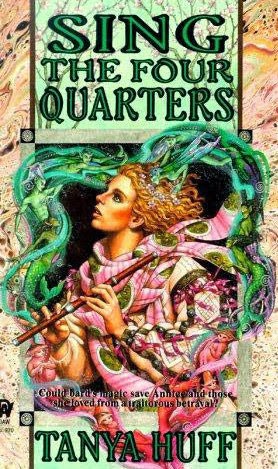
Re-Read Rollout: "Sing the Four Quarters," by Tanya Huff
Principle Cast:
Annice: A former princess, who was cast out of the royal family when she chose to become a bard. Ten years later, she's unsure of how to tell her estranged family that she's pregnant - especially since her brother the King forbade her to have kids.
Pjerin: The Duc of Ohrin - an ignored principality of King Theron's kingdom that guards a mountain pass into a hostile country. When he's accused of abetting that country and finds himself saying words that aren't his when questioned, he knows he's been set up - but by who?
Secondary Cast:
Stasya: Annice's girlfriend who worries about her health and helps Annice try and clear Pjerin's name.
Olinda: Pjerin's scheming aunt who wants him out of the way so that she can grab power for herself.
Albek: A con artist from the neighbouring hostile country who helps Olinda with her treasonous schemes.
Gerek: Pjerin's four-year-old son and heir. Olinda hopes to use him as a figurehead once Pjerin's out of the way.
King Theron: Annice's brother. Has pigheadedly refused to deal with the equally pigheaded Annice for ten years, but now regrets the bitter gap between them.
Fantasy Convention Checklist:
However, I would hesitate to condemn this novel out of hand. It may have bored me, but it had a lot of good things going for it. If you're more into uber-detailed high fantasy, you may really enjoy this novel. However, if you're more into faster-paced, less cluttered stories, you're out of luck.
C+
Annice: A former princess, who was cast out of the royal family when she chose to become a bard. Ten years later, she's unsure of how to tell her estranged family that she's pregnant - especially since her brother the King forbade her to have kids.
Pjerin: The Duc of Ohrin - an ignored principality of King Theron's kingdom that guards a mountain pass into a hostile country. When he's accused of abetting that country and finds himself saying words that aren't his when questioned, he knows he's been set up - but by who?
Secondary Cast:
Stasya: Annice's girlfriend who worries about her health and helps Annice try and clear Pjerin's name.
Olinda: Pjerin's scheming aunt who wants him out of the way so that she can grab power for herself.
Albek: A con artist from the neighbouring hostile country who helps Olinda with her treasonous schemes.
Gerek: Pjerin's four-year-old son and heir. Olinda hopes to use him as a figurehead once Pjerin's out of the way.
King Theron: Annice's brother. Has pigheadedly refused to deal with the equally pigheaded Annice for ten years, but now regrets the bitter gap between them.
Fantasy Convention Checklist:
- 1 Use of Evil Magic
- 4 Types of Elementals
- 1 Giant Godzilla Elemental
- 1 Magic-Boosting Fetus
- 1 Nation of Suspicious Foreigners
- All the LGBT People
The Word: This always happens sooner or later - not everything you loved as a kid, or a teenager, or a younger adult always holds up when you read it again. I initially read Sing the Four Quarters (and the three following novels in the quartet) in my early teens, when I was huge into my Epic Lady Fantasy phase - Robin Hobb, Kate Elliott, Melanie Rawn, Mercedes Lackey before her Magical Horse Books got stupid, Mickey Zucker Reichert whose novels were already stupid but enjoyably silly.
Oddly enough, I'd never re-read this novel until now. The story takes place in a world where the four elements are controlled by kigh: playful, unpredictable spirits who can be managed and cajoled through music. People with the ability to sing the kigh are called bards, and they tramp up and down the country singing songs, conveying messages and fixing problems in service of the king.
However, when 14-year-old Princess Annice joins the bards in defiance of her brother Theron's wish to marry her off to the prince of a neighbouring country, the young king strips her of all royal privileges, cuts her off from the family, and bars her (on pain of treason) from marrying or having children without his express permission.
Ten years later, Annice comes back from her bard's Walk to discover there's a reason she's tired and throwing up all the time: she's pregnant. Moreover, before she can find a politic way to inform the brother she hasn't spoken to in a decade, the father of her baby - Pjerin, the Duc of Ohrid and handsome one night stand - is accused of conspiring with an enemy nation and admits to treason when put to Bardic questioning.
Annice knows there's no way she can tell the King about her pregnancy now that both her baby and her babydaddy are traitors, but she also suspects that something's not quite right about Pjerin's confession, especially since Pjerin maintains his innocence. Throwing caution to the wind, Annice rescues Pjerin from prison, and the two hie off to see if they can find out who set Pjerin up.
Let's start with the good - I didn't quite grasp this when I first read it at 13 or 14, but Sing the Four Quarters is an entirely sex-positive, feminist, LGBT-friendly fantasy novel. Annice is bisexual and in a committed relationship with her girlfriend, Stasya. Gay marriage exists - hell, gay political marriage exists (Annice's uncle turned down the offer to marry a foreign prince), women and men are found in equal numbers in almost every type of job, and premarital sex and bastardy carry little to no stigma. Best of all, none of this ever merits more than a passing mention when establishing setting - there's nothing special or remarkable or abnormal about any of it. For a novel published in 1994, that's pretty awesome.
However, despite all this positive stuff, this re-read ultimately didn't measure up to my memory of it. Yes, there are positive feminist themes and excellent LGBT representation and family issues and magic, this novel would be practically perfect - except it isn't. Firstly - I had some serious problems with Pjerin, the male protagonist. He is an entitled ass - and I really could have gone without knowing he repeatedly banged his biological aunt.
Secondly, for a novel with such interesting themes, its story is pretty boring. Sing the Four Quarters packs a lot of content - but not all of that content is valuable to the narrative. A lot of it is redundant explanation of character motivation - Annice does something, but not before she explicitly tells us why she's doing this and why the world she lives in supports such an action, etc. The pacing is frustratingly slow-moving and dense, which works against the story itself since the latter half of the novel is really one extensive chase sequence. I finally gave up once I reached the halfway mark and skimmed my way to the end.
However, despite all this positive stuff, this re-read ultimately didn't measure up to my memory of it. Yes, there are positive feminist themes and excellent LGBT representation and family issues and magic, this novel would be practically perfect - except it isn't. Firstly - I had some serious problems with Pjerin, the male protagonist. He is an entitled ass - and I really could have gone without knowing he repeatedly banged his biological aunt.
Secondly, for a novel with such interesting themes, its story is pretty boring. Sing the Four Quarters packs a lot of content - but not all of that content is valuable to the narrative. A lot of it is redundant explanation of character motivation - Annice does something, but not before she explicitly tells us why she's doing this and why the world she lives in supports such an action, etc. The pacing is frustratingly slow-moving and dense, which works against the story itself since the latter half of the novel is really one extensive chase sequence. I finally gave up once I reached the halfway mark and skimmed my way to the end.
However, I would hesitate to condemn this novel out of hand. It may have bored me, but it had a lot of good things going for it. If you're more into uber-detailed high fantasy, you may really enjoy this novel. However, if you're more into faster-paced, less cluttered stories, you're out of luck.
C+
Labels:
C Plus Reviews,
high fantasy,
reread rollout
Sunday, December 22, 2013
Re-Read Rollout: "Gentlemen and Players," by Joanne Harris
Principle Cast:
Roy Straightley: An aging professor of Latin who worries the new school reforms will force him into retirement before he completes his 100th term of teaching.
Snyde: A secret intruder who's invaded the hallowed halls of St. Oswald's in order to destroy the institution for its stagnant exclusivity.
Secondary Cast:
Pat Bishop: The genial, compassionate Second Head who's aces at managing students but terrible at managing scandals.
The New Head: The progressive headmaster who's more focused on the school's reputation and cost-cutting measures than the students themselves.
Colin Knight: A resentful school outcast who becomes an unwitting pawn in Snyde's plots against the school.
Marlene: The mother of a former student, she now works as St. Oswald's ultra-competent receptionist.
Mr. Keane: A new teacher to St. Oswald's, he hopes his adventures in teaching will give him plenty of material for a novel he's writing.
Ms. Dare: Another new teacher who displays a remarkable gift for dealing with students, but tries to stay out of the increasingly toxic office politics.
Leon: A student at St. Oswald's 15 years ago whom Snyde befriended while disguised as a fellow student.
The Word:
I was a little bit afraid to reread Gentleman and Players for my annual Re-Read Rollout. When I first read this way, way back in February 2010, it utterly destroyed me - but I was so determined at the time to be a "romance-only blog" that I didn't review it.
But this book was so good. Almost too good - I was afraid to re-read it because I was worried the experience of reading it a second time wouldn't measure up to the first. That I'd suddenly notice all these flaws and mistakes and ruin my memory of that One Perfect Read.
Because Gentleman and Players was one of those Perfect Reads. I love a lot of books, but Perfect Reads are rare. The type of book I would grab if my house was on fire. The type of book that keeps me voraciously reading through my TBR in order to fine another one like it.
Gentleman and Players takes place at St. Oswald's Grammar School for Boys, a posh private school for the best and brightest of England's young male elite - provided their parents can afford six thousand pounds a year for tuition. It is a school steeped in prestige and tradition.
For Roy Straightley, a Latin professor at St. Oswald's, he could do with a little more tradition. Sixty-five years old and a term away from his Century (his 100th term teaching at St. Oswald's), he continually frustrates St. Oswald's administration by refusing to adapt to their educational reforms. He relies on ancient chalkboards, dusty black robes, and common sense when dealing with his pupils, even though he knows the more progressive Head and his cronies are losing patience with him.
However, for a mysterious figure known simply as Snyde, St. Oswald's relies far too much on tradition. Snyde's father worked as a porter and groundskeeper for St. Oswald's - a porter whose termination was completely hushed up by the powerful administration. After spending a childhood living in St. Oswald's shadow, longing after the privileged lifestyle of its entitled students, Snyde has returned, disguised as a teacher, to destroy the corrupt and stagnant school from the inside out.
I loved Gentleman and Players because the story is all about conflict - good versus evil, progress versus tradition, hands-on educators versus detached administrators, rich versus poor, parents versus teachers, Straightley versus Snyde. There is so much detail and drama and scandal - and yet very little direct confrontation in the novel.
Rather, most of the conflict involves the points of view of Straightley and Snyde. Straightley is an Old Boy who has dedicated the greater part of his life to the school, and from him we get a highly entertaining, satirical look into the politics of private school administration and the private lives of teachers. While Straightley isn't blind to St. Oswald's imperfections, nor to the emptiness of the parts of his life that don't involve the school, he is fiercely loyal to it and its boys.
However, Straightley is mainly an observer. It is Snyde who sets most of the plot in motion - oftentimes by using St. Oswald's traditions against itself and brewing dissent amidst the envious townies, the dissatisfied parents, and the disgruntled students of St. Oswald's. Snyde exposes and exploits the hidden resentments over class differences, favouritism, money, and privilege that have been weakening the "impervious" foundations of the school for generations. At the same time, we get frequent flashbacks to the last year Snyde's father was porter, the year the teenaged Snyde decided to impersonate a student and experience the St. Oswald's experience firsthand - with disastrous results.
So did it hold up upon re-reading? Yes indeed. Perception plays a very large part in my enjoyment of Gentleman and Players - the characters' points of view and their respective blind spots thanks to their own privileges and prejudices, the way outsiders perceive St. Oswald's versus the way St. Oswald's fights to be perceived, and how a few carefully-revealed secrets can change one's perception of several major characters. Without going into too much detail, there is a delightful twist at the end of the novel that added an extra layer of enjoyment to this particular reread.
Simply put, Gentlemen and Players is a fiendishly clever, insightful, and entertaining novel about education, revenge, and privilege.
A+
Roy Straightley: An aging professor of Latin who worries the new school reforms will force him into retirement before he completes his 100th term of teaching.
Snyde: A secret intruder who's invaded the hallowed halls of St. Oswald's in order to destroy the institution for its stagnant exclusivity.
Secondary Cast:
Pat Bishop: The genial, compassionate Second Head who's aces at managing students but terrible at managing scandals.
The New Head: The progressive headmaster who's more focused on the school's reputation and cost-cutting measures than the students themselves.
Colin Knight: A resentful school outcast who becomes an unwitting pawn in Snyde's plots against the school.
Marlene: The mother of a former student, she now works as St. Oswald's ultra-competent receptionist.
Mr. Keane: A new teacher to St. Oswald's, he hopes his adventures in teaching will give him plenty of material for a novel he's writing.
Ms. Dare: Another new teacher who displays a remarkable gift for dealing with students, but tries to stay out of the increasingly toxic office politics.
Leon: A student at St. Oswald's 15 years ago whom Snyde befriended while disguised as a fellow student.
The Word:
I was a little bit afraid to reread Gentleman and Players for my annual Re-Read Rollout. When I first read this way, way back in February 2010, it utterly destroyed me - but I was so determined at the time to be a "romance-only blog" that I didn't review it.
But this book was so good. Almost too good - I was afraid to re-read it because I was worried the experience of reading it a second time wouldn't measure up to the first. That I'd suddenly notice all these flaws and mistakes and ruin my memory of that One Perfect Read.
Because Gentleman and Players was one of those Perfect Reads. I love a lot of books, but Perfect Reads are rare. The type of book I would grab if my house was on fire. The type of book that keeps me voraciously reading through my TBR in order to fine another one like it.
Gentleman and Players takes place at St. Oswald's Grammar School for Boys, a posh private school for the best and brightest of England's young male elite - provided their parents can afford six thousand pounds a year for tuition. It is a school steeped in prestige and tradition.
For Roy Straightley, a Latin professor at St. Oswald's, he could do with a little more tradition. Sixty-five years old and a term away from his Century (his 100th term teaching at St. Oswald's), he continually frustrates St. Oswald's administration by refusing to adapt to their educational reforms. He relies on ancient chalkboards, dusty black robes, and common sense when dealing with his pupils, even though he knows the more progressive Head and his cronies are losing patience with him.
However, for a mysterious figure known simply as Snyde, St. Oswald's relies far too much on tradition. Snyde's father worked as a porter and groundskeeper for St. Oswald's - a porter whose termination was completely hushed up by the powerful administration. After spending a childhood living in St. Oswald's shadow, longing after the privileged lifestyle of its entitled students, Snyde has returned, disguised as a teacher, to destroy the corrupt and stagnant school from the inside out.
I loved Gentleman and Players because the story is all about conflict - good versus evil, progress versus tradition, hands-on educators versus detached administrators, rich versus poor, parents versus teachers, Straightley versus Snyde. There is so much detail and drama and scandal - and yet very little direct confrontation in the novel.
Rather, most of the conflict involves the points of view of Straightley and Snyde. Straightley is an Old Boy who has dedicated the greater part of his life to the school, and from him we get a highly entertaining, satirical look into the politics of private school administration and the private lives of teachers. While Straightley isn't blind to St. Oswald's imperfections, nor to the emptiness of the parts of his life that don't involve the school, he is fiercely loyal to it and its boys.
However, Straightley is mainly an observer. It is Snyde who sets most of the plot in motion - oftentimes by using St. Oswald's traditions against itself and brewing dissent amidst the envious townies, the dissatisfied parents, and the disgruntled students of St. Oswald's. Snyde exposes and exploits the hidden resentments over class differences, favouritism, money, and privilege that have been weakening the "impervious" foundations of the school for generations. At the same time, we get frequent flashbacks to the last year Snyde's father was porter, the year the teenaged Snyde decided to impersonate a student and experience the St. Oswald's experience firsthand - with disastrous results.
So did it hold up upon re-reading? Yes indeed. Perception plays a very large part in my enjoyment of Gentleman and Players - the characters' points of view and their respective blind spots thanks to their own privileges and prejudices, the way outsiders perceive St. Oswald's versus the way St. Oswald's fights to be perceived, and how a few carefully-revealed secrets can change one's perception of several major characters. Without going into too much detail, there is a delightful twist at the end of the novel that added an extra layer of enjoyment to this particular reread.
Simply put, Gentlemen and Players is a fiendishly clever, insightful, and entertaining novel about education, revenge, and privilege.
A+
Labels:
A Plus Reviews,
contemporary,
fiction,
reread rollout
Monday, December 16, 2013
Re-Read Rollout: "Anne of Avonlea," by Lucy Maud Montgomery
The Protagonist: Anne Shirley. Now 16 years old, she teaches the children of Avonlea while looking after her guardian, Marilla.
Her Angst: Reality won't stop intervening in her attempts to have a perfectly blissful year.
Secondary Cast:
Gilbert Blythe: Anne's friend who is totes in love with her. Has decided to give up teaching to become a doctor.
Marilla: Anne's guardian - she's not as young as she used to be, but at least she's not going blind anymore.
Mr. Harrison: A cantankerous old bachelor who is mighty set in his ways.
Davey Keith: A young orphan (and budding sociopath) who is adopted by Anne and Marilla, along with his sister Dora.
Paul Irving: A new pupil in Anne's class who is sometimes ridiculed for being too sensitive and dreamy. Just you wait until puberty!
Anthony Pye: The worst. Of course.
Miss Lavendar: An eccentric old maid who has a history with Paul Irving's widowed father Stephen.
Angst Checklist:
The Word: Well, it's December - time for another month of re-reads! Since I read Anne of Green Gables last year, it makes sense that I would read the sequel, Anne of Avonlea, this year as well.
Much like Gables, Anne of Avonlea doesn't really have a plot, but instead chronicles the next two years of Anne's life in a linear chain of heartwarming or comedic episodes. Most of these episodes have to do with Anne's experiences as Avonlea's newest schoolteacher, her efforts heading the Improvement Society (an attempt by Avonlea's youth to pretty up the town), and her attempts to teach and raise two very different boys - her new pupil Paul Irving (a shy dreamer) and the irrepressible orphan Davey (who might possibly be the son of Satan).
While Anne of Green Gables is a beloved classic - I've heard that the later novels are…less classic. I've read about four books into the series and have loved all of them, but I can kind of see where the complaints come from. Sure, some of the stories may seem a little idealized - and while I love Anne's melodramatic ways, it gets a little bit cloying when she discovers and interacts with two more melodramatic dreamers (Paul and the eccentric Miss Lavendar). I mean, you can't all be crazy manic snowflakes.
And yet, despite the episodic nature of the novel, Anne grows and matures. She deals with far more responsibility in this book - not only does she have to teach the children of Avonlea, but she also finds herself in charge of a pair of orphaned siblings. Her fairy fancies are consistently tempered by the reality of her setting and her increasingly-competent interactions with such a setting. While she still gets into scrapes, it's because she's creative and impulsive, not because she's stupid. My favourite chapter is the one where Anne meets her favourite author - fangirl behaviour really hasn't changed much in the last century.
Anne of Avonlea might be episodic and linear, but it's never repetitive. Montgomery understands her characters' charms but also allows them to change and develop. I still found this book endlessly enjoyable, a real comfort read during the stresses of my trip to New York City.
A
Her Angst: Reality won't stop intervening in her attempts to have a perfectly blissful year.
Secondary Cast:
Gilbert Blythe: Anne's friend who is totes in love with her. Has decided to give up teaching to become a doctor.
Marilla: Anne's guardian - she's not as young as she used to be, but at least she's not going blind anymore.
Mr. Harrison: A cantankerous old bachelor who is mighty set in his ways.
Davey Keith: A young orphan (and budding sociopath) who is adopted by Anne and Marilla, along with his sister Dora.
Paul Irving: A new pupil in Anne's class who is sometimes ridiculed for being too sensitive and dreamy. Just you wait until puberty!
Anthony Pye: The worst. Of course.
Miss Lavendar: An eccentric old maid who has a history with Paul Irving's widowed father Stephen.
Angst Checklist:
- Accidental Grand Theft Cow
- Secret Wives
- Dead Mothers
- Dead Husbands
- Estranged Husbands
- Isn't it really doing the world a favour if we dropped Davey down a well?
- Bringing Firecrackers to School
- Pyes are the Worst at Everything
The Word: Well, it's December - time for another month of re-reads! Since I read Anne of Green Gables last year, it makes sense that I would read the sequel, Anne of Avonlea, this year as well.
Much like Gables, Anne of Avonlea doesn't really have a plot, but instead chronicles the next two years of Anne's life in a linear chain of heartwarming or comedic episodes. Most of these episodes have to do with Anne's experiences as Avonlea's newest schoolteacher, her efforts heading the Improvement Society (an attempt by Avonlea's youth to pretty up the town), and her attempts to teach and raise two very different boys - her new pupil Paul Irving (a shy dreamer) and the irrepressible orphan Davey (who might possibly be the son of Satan).
While Anne of Green Gables is a beloved classic - I've heard that the later novels are…less classic. I've read about four books into the series and have loved all of them, but I can kind of see where the complaints come from. Sure, some of the stories may seem a little idealized - and while I love Anne's melodramatic ways, it gets a little bit cloying when she discovers and interacts with two more melodramatic dreamers (Paul and the eccentric Miss Lavendar). I mean, you can't all be crazy manic snowflakes.
And yet, despite the episodic nature of the novel, Anne grows and matures. She deals with far more responsibility in this book - not only does she have to teach the children of Avonlea, but she also finds herself in charge of a pair of orphaned siblings. Her fairy fancies are consistently tempered by the reality of her setting and her increasingly-competent interactions with such a setting. While she still gets into scrapes, it's because she's creative and impulsive, not because she's stupid. My favourite chapter is the one where Anne meets her favourite author - fangirl behaviour really hasn't changed much in the last century.
Anne of Avonlea might be episodic and linear, but it's never repetitive. Montgomery understands her characters' charms but also allows them to change and develop. I still found this book endlessly enjoyable, a real comfort read during the stresses of my trip to New York City.
A
Labels:
A Reviews,
classic,
reread rollout
Sunday, January 06, 2013
My ReRead Rollout - The Results!
Okay, sorry this post is a little slow, but my Year End post took longer than expected, and I've been working longer hours at my Paying Day Job.
So during the month of December I decided to reread some of my favourite novels (or novels I perceived to be my favourite), and the results were thus:
Anne of Green Gables, by Lucy Maud Montgomery.
Did It Hold Up? Yes. Yes it most definitely did! Anne is still awesome, Diana Berry is still a bosom friend, Matthew still makes me cry, and Josie Pye is still a bitch! It really amazed me how many layers this book has, how many more different things I noticed about this book reading it as an adult. I may now have to read the other books in the series again!
The Secret Pearl, by Mary Balogh.
Did It Hold Up? Yes. This time around (since I'd already written a review), I focused on what I felt to be the most powerful aspect of this book: the villains. Well-developed, creepy, tragic, they were so memorable and contributed so well to the romanticism and drama of the novel, I figured they deserved their own examination.
Fitzpatrick's War, by Theodore Judson.
Did It Hold Up? No. Not really. I think the reason I enjoyed exploring the novel the first time was thanks to the unique formatting of the story as well as the detailed world building. However, rereading the novel when I already knew the plot allowed me to notice how incredibly slow and overdetailed the story was - how much more time was wasted on minutiae than the plot, which was far more simple than I'd remembered. Still, if you love detailed, original settings and military stories, you might still enjoy it.
Beauty, by Robin McKinley.
Did It Hold Up? No. I reread this one with a little impatience - probably because I already know how the fairy tale goes so I found the lead-up (which explains Beauty's family and backstory) to be a little top-heavy, while the part that matches actual fairy tale was disappointingly bare of the elaboration or character development (especially on the Beast's part) that I was hoping for. However, McKinley apparently plumbed the Beauty and the Beast well another time for Rose's Daughter, so I might try reading that, someday.
The Birth House, by Ami McKay
Did It Hold Up? Yes! I still enjoyed this novel just as much as I did back in University. Interesting themes, great characters, fabulous historical details, strong feminist undertone, and a gorgeous writing style. Even though her second book wasn't nearly as good, I'll be keeping this novel on my Keeper Shelf for a long time to come.
Harry Potter and the Philosopher's Stone, by J.K. Rowling
Did It Hold Up? Yes indeedy - enough to make me want to re-read the whole series!
Private Arrangements, by Sherry Thomas.
Did It Hold Up? Better! I really enjoyed the novel the second time around, and I tried to figure out why I loved it now when I was only ambivalent towards it before. The only explanation I can really come up with beyond My Tastes Have Matured is that Sherry Thomas' style was so different (read: better) than a lot of what I was reading at the time that I didn't connect to it the same way. Now that I'm used to (read: adore) her style, I was able to truly enjoy coming back to her debut novel. What can I say? I'm a hopeless fangirl.
I must admit, I might have to do this again next year. There's just something so relaxing about reading a book that you've already enjoyed. So, dear readers, have you taken to rereading any of your favourite classics lately? If so, which ones?
So during the month of December I decided to reread some of my favourite novels (or novels I perceived to be my favourite), and the results were thus:
Anne of Green Gables, by Lucy Maud Montgomery.
Did It Hold Up? Yes. Yes it most definitely did! Anne is still awesome, Diana Berry is still a bosom friend, Matthew still makes me cry, and Josie Pye is still a bitch! It really amazed me how many layers this book has, how many more different things I noticed about this book reading it as an adult. I may now have to read the other books in the series again!
The Secret Pearl, by Mary Balogh.
Did It Hold Up? Yes. This time around (since I'd already written a review), I focused on what I felt to be the most powerful aspect of this book: the villains. Well-developed, creepy, tragic, they were so memorable and contributed so well to the romanticism and drama of the novel, I figured they deserved their own examination.
Fitzpatrick's War, by Theodore Judson.
Did It Hold Up? No. Not really. I think the reason I enjoyed exploring the novel the first time was thanks to the unique formatting of the story as well as the detailed world building. However, rereading the novel when I already knew the plot allowed me to notice how incredibly slow and overdetailed the story was - how much more time was wasted on minutiae than the plot, which was far more simple than I'd remembered. Still, if you love detailed, original settings and military stories, you might still enjoy it.
Beauty, by Robin McKinley.
Did It Hold Up? No. I reread this one with a little impatience - probably because I already know how the fairy tale goes so I found the lead-up (which explains Beauty's family and backstory) to be a little top-heavy, while the part that matches actual fairy tale was disappointingly bare of the elaboration or character development (especially on the Beast's part) that I was hoping for. However, McKinley apparently plumbed the Beauty and the Beast well another time for Rose's Daughter, so I might try reading that, someday.
The Birth House, by Ami McKay
Did It Hold Up? Yes! I still enjoyed this novel just as much as I did back in University. Interesting themes, great characters, fabulous historical details, strong feminist undertone, and a gorgeous writing style. Even though her second book wasn't nearly as good, I'll be keeping this novel on my Keeper Shelf for a long time to come.
Harry Potter and the Philosopher's Stone, by J.K. Rowling
Did It Hold Up? Yes indeedy - enough to make me want to re-read the whole series!
Private Arrangements, by Sherry Thomas.
Did It Hold Up? Better! I really enjoyed the novel the second time around, and I tried to figure out why I loved it now when I was only ambivalent towards it before. The only explanation I can really come up with beyond My Tastes Have Matured is that Sherry Thomas' style was so different (read: better) than a lot of what I was reading at the time that I didn't connect to it the same way. Now that I'm used to (read: adore) her style, I was able to truly enjoy coming back to her debut novel. What can I say? I'm a hopeless fangirl.
I must admit, I might have to do this again next year. There's just something so relaxing about reading a book that you've already enjoyed. So, dear readers, have you taken to rereading any of your favourite classics lately? If so, which ones?
Labels:
monthly round up,
reread rollout
Tuesday, January 01, 2013
Re-Review: "Private Arrangements," by Sherry Thomas
For the last post of my ReRead Rollout, I chose a very special book.
I am a huge Sherry Thomas fangirl. She is one of my absolute favourite writers, regardless of genre. She just has such a grasp of language and historical detail that lend her environments and characters a depth that most other historical writers just can't match.
But I just "didn't get" her debut novel. Everyone absolutely raved about this book when it came out - for its unconventional use of flashbacks, for its original characters, for its gorgeous language.
On my first read of this novel, I appreciated the skill that went into it, but I just couldn't emotionally connect with it. I didn't get it. I didn't dislike it, I just didn't love it.
One of my favourite personal anecdotes from my first RWA Conference was when I ran into Sherry Thomas at the Smart Bitches' Blogger Party, and exclaimed, "Oh I liked Private Arrangements!" because it was the first novel of hers that came to mind and the only novel of hers at that point that I'd read. To my mortification, she responded, "Really? Because your review said you didn't like it very much."
But a lot's changed since then. Not Quite a Husband, His At Night, Delicious and Beguiling the Beauty later, I'm totally hooked. So what better time to revisit her first book to see if my opinion's changed than during my ReRead Rollout?
I'm quite happy to say that it has. I think maybe the first time I read it, I was put off by the amount of detail, the delicious complexity she injected into her stories - a complexity that a lot of romances lack, to be honest. Perhaps because it was such a different tone from the vast majority of historicals. I was used to historicals with simplistic settings that went for the gut-punch of drama with Secret Mistresses and Tarnished Pasts and whatnot. Sherry Thomas, instead, includes the setting and the historical period and makes it all relevant to the story, rather than as a pretty backdrop.
Also, none of her protagonists are Angsty Islands whose only friends are Equally Angsty and often Sequel-Baiting chums - all of them have family members, friends, acquaintances, histories and complex connections to the outside world. I love that about her writing.
For this second read, I found I could dive into the complex marital tangle between Gigi and Camden more easily, now that I was used to (and highly addicted to) Sherry Thomas' writing style. I enjoyed so much more and remembered more about the characters this time around - how reluctant Gigi was to give up on her attachment to Freddie, because she'd come to fear the passion that made her abandon her morals as well as her good sense. How deep Camden was in denial, to the point where it took him nearly the entire book to realize he'd subconsciously started this whole mess (by demanding an heir) in order to win Gigi back from the start.
I adored how Sherry Thomas convincingly depicts both protagonists at two different stages of their lives - their heady passions and rages at 19 and 21, and their restrained but no less powerful feelings at 29 and 31. Although the flashback periods of the novel are clearly marked, the subtle differences in the characters' maturity levels also indicates which period of time the novel takes place in.
True, Not Quite a Husband remains my personal favourite of Thomas' novels, but now I can definitely agree that Private Arrangements deserves a place on my Keeper Shelf.
A
I am a huge Sherry Thomas fangirl. She is one of my absolute favourite writers, regardless of genre. She just has such a grasp of language and historical detail that lend her environments and characters a depth that most other historical writers just can't match.
But I just "didn't get" her debut novel. Everyone absolutely raved about this book when it came out - for its unconventional use of flashbacks, for its original characters, for its gorgeous language.
On my first read of this novel, I appreciated the skill that went into it, but I just couldn't emotionally connect with it. I didn't get it. I didn't dislike it, I just didn't love it.
One of my favourite personal anecdotes from my first RWA Conference was when I ran into Sherry Thomas at the Smart Bitches' Blogger Party, and exclaimed, "Oh I liked Private Arrangements!" because it was the first novel of hers that came to mind and the only novel of hers at that point that I'd read. To my mortification, she responded, "Really? Because your review said you didn't like it very much."
But a lot's changed since then. Not Quite a Husband, His At Night, Delicious and Beguiling the Beauty later, I'm totally hooked. So what better time to revisit her first book to see if my opinion's changed than during my ReRead Rollout?
I'm quite happy to say that it has. I think maybe the first time I read it, I was put off by the amount of detail, the delicious complexity she injected into her stories - a complexity that a lot of romances lack, to be honest. Perhaps because it was such a different tone from the vast majority of historicals. I was used to historicals with simplistic settings that went for the gut-punch of drama with Secret Mistresses and Tarnished Pasts and whatnot. Sherry Thomas, instead, includes the setting and the historical period and makes it all relevant to the story, rather than as a pretty backdrop.
Also, none of her protagonists are Angsty Islands whose only friends are Equally Angsty and often Sequel-Baiting chums - all of them have family members, friends, acquaintances, histories and complex connections to the outside world. I love that about her writing.
For this second read, I found I could dive into the complex marital tangle between Gigi and Camden more easily, now that I was used to (and highly addicted to) Sherry Thomas' writing style. I enjoyed so much more and remembered more about the characters this time around - how reluctant Gigi was to give up on her attachment to Freddie, because she'd come to fear the passion that made her abandon her morals as well as her good sense. How deep Camden was in denial, to the point where it took him nearly the entire book to realize he'd subconsciously started this whole mess (by demanding an heir) in order to win Gigi back from the start.
I adored how Sherry Thomas convincingly depicts both protagonists at two different stages of their lives - their heady passions and rages at 19 and 21, and their restrained but no less powerful feelings at 29 and 31. Although the flashback periods of the novel are clearly marked, the subtle differences in the characters' maturity levels also indicates which period of time the novel takes place in.
True, Not Quite a Husband remains my personal favourite of Thomas' novels, but now I can definitely agree that Private Arrangements deserves a place on my Keeper Shelf.
A
Labels:
A Reviews,
historical,
reread rollout,
Romance,
sherry thomas
Sunday, December 30, 2012
"Harry Potter and the Philosopher's Stone," by J.K. Rowling
The Protagonist: Harry Potter. The mistreated nephew of Mr. and Mrs. Dursley, he sleeps in a cupboard under the stairs and wears nothing but cast-offs from his spoiled cousin Dudley, until he gets a mysterious letter in the mail inviting him to the magical school of Hogwarts.
His Angst: "Harry, yer a wizard." Also, everyone wants to kill him.
The Secondary Cast:
Ron Weasley: Harry's loyal, comical BFF. From a large, impoverished, but loving family.
Hermione Granger: A persnickety, bookish, type-A personality student who quickly befriends Ron and Harry.
Dumbledore: The benevolent but mysterious headmaster of Hogwarts.
Snape: The Potions professor who holds a (possibly deadly?) grudge against Harry Potter.
Voldemort: Evil Wizard Extraordinaire. Hates Harry and goodness in general.
Angst Checklist:
The Word: I hadn't originally put this on the list for my ReRead rollout, but due to some carelessness on my part, when I went off to stay with my parents for the Christmas holidays, I packed only one book (the one I was currently reading - Ami McKay's The Birth House).
I normally never pack only one book, because I am absolutely paranoid about running out of books to read, regardless of where I am at the time. I was a little self-conscious about how much I was already packing because I was staying with my parents for more than a week and I anticipated bringing quite a bit of additional stuff back home with me (which I will be, thanks Mum and Dad!).
So I only packed one book, which I finished about two days in. What to do, what to do? I then realized the bookshelf in my old bedroom still had the entire series of Harry Potter books on it, so what better book to add to my Rollout?
The story is already pretty well-known thanks to the series' phenomenal success - boy meets evil wizard, boy defeats evil wizard with baby love powers, boy repeatedly defeats evil wizard with increasingly higher stakes and losses.
But does it hold up when one goes back to it? Well, once you've read the entire series, it's impossible to truly go back to the first book and repeat the experience of reading it for the very first time, before you knew why Sirius Black was so important or why Snape persisted in saving Harry's bacon despite obviously wanting to bang his mum.
However, as a first book, Harry Potter and the Philosopher's Stone (which is its real title, none of this dumbed-down Sorcerer's Stone bull crap), does such an excellent job of conveying a fully-realized, yet whimsically absurd world. Despite its brief length (at least compared to the gargantuan later books), Philosopher's Stone conveyed an environment, an atmosphere, a community of wizards and witches that instantly hooked me. While the story was certainly interesting, ultimately it was the worldbuilding that entertained me the most about this first book and kept me coming back for more.
The worldbuilding of Harry Potter succeeds because it's a perfect combination of fantasy and familiarity. It takes the whimsical aspects of wizardry and magical objects and mythical creatures and conveys it all through the familiar framework of a year at an English boarding school with houses, dorms, prefects and professorial politics. Rowling also imbues the story with an emotional honesty that transcends the fantasy setting. Harry falls into the world of wizardry not because of an innate curiosity for magic but because it is a world into which he is welcomed, for the first time in his life.
In this first book, he is still a little unsure of his place in this world, as indicated by his experience with the Mirror of Erised. In the mirror he sees himself surrounded by his biological family, and becomes obsessed with this impossible idea of what could have been. It takes Dumbledore to pull him free of the mirror's enchantment and show him the importance of friendships and bonds in the here and now. I've always seen this as a message to the book's readers as well. Harry's past and that of his parents and their allies is a horrific tragedy, and it's easy to wonder what kind of life Harry might have had if none of this had happened, but the point of the story is that there is no going back, there is only forward.
And forward it shall be. Having read the first book, I don't think I can just walk away without reading the entire series over again. Not all at once, mind - I'll still read other books on my TBR, but I'll alternate with more of Harry Potter's adventures.
Unsurprisingly, Harry Potter and the Philosopher's Stone merits an
A
His Angst: "Harry, yer a wizard." Also, everyone wants to kill him.
The Secondary Cast:
Ron Weasley: Harry's loyal, comical BFF. From a large, impoverished, but loving family.
Hermione Granger: A persnickety, bookish, type-A personality student who quickly befriends Ron and Harry.
Dumbledore: The benevolent but mysterious headmaster of Hogwarts.
Snape: The Potions professor who holds a (possibly deadly?) grudge against Harry Potter.
Voldemort: Evil Wizard Extraordinaire. Hates Harry and goodness in general.
Angst Checklist:
- The cupboard I sleep in is full of spiders
- The magical school dorm I sleep in is full of ghosts
- The Most Evil Person In Existence keeps trying to kill me
- My parents are dead and I'm not even Batman
- Passing Potions is a bitch
- Overcoming fears
- Moving on from tragedy
The Word: I hadn't originally put this on the list for my ReRead rollout, but due to some carelessness on my part, when I went off to stay with my parents for the Christmas holidays, I packed only one book (the one I was currently reading - Ami McKay's The Birth House).
I normally never pack only one book, because I am absolutely paranoid about running out of books to read, regardless of where I am at the time. I was a little self-conscious about how much I was already packing because I was staying with my parents for more than a week and I anticipated bringing quite a bit of additional stuff back home with me (which I will be, thanks Mum and Dad!).
So I only packed one book, which I finished about two days in. What to do, what to do? I then realized the bookshelf in my old bedroom still had the entire series of Harry Potter books on it, so what better book to add to my Rollout?
The story is already pretty well-known thanks to the series' phenomenal success - boy meets evil wizard, boy defeats evil wizard with baby love powers, boy repeatedly defeats evil wizard with increasingly higher stakes and losses.
But does it hold up when one goes back to it? Well, once you've read the entire series, it's impossible to truly go back to the first book and repeat the experience of reading it for the very first time, before you knew why Sirius Black was so important or why Snape persisted in saving Harry's bacon despite obviously wanting to bang his mum.
However, as a first book, Harry Potter and the Philosopher's Stone (which is its real title, none of this dumbed-down Sorcerer's Stone bull crap), does such an excellent job of conveying a fully-realized, yet whimsically absurd world. Despite its brief length (at least compared to the gargantuan later books), Philosopher's Stone conveyed an environment, an atmosphere, a community of wizards and witches that instantly hooked me. While the story was certainly interesting, ultimately it was the worldbuilding that entertained me the most about this first book and kept me coming back for more.
The worldbuilding of Harry Potter succeeds because it's a perfect combination of fantasy and familiarity. It takes the whimsical aspects of wizardry and magical objects and mythical creatures and conveys it all through the familiar framework of a year at an English boarding school with houses, dorms, prefects and professorial politics. Rowling also imbues the story with an emotional honesty that transcends the fantasy setting. Harry falls into the world of wizardry not because of an innate curiosity for magic but because it is a world into which he is welcomed, for the first time in his life.
In this first book, he is still a little unsure of his place in this world, as indicated by his experience with the Mirror of Erised. In the mirror he sees himself surrounded by his biological family, and becomes obsessed with this impossible idea of what could have been. It takes Dumbledore to pull him free of the mirror's enchantment and show him the importance of friendships and bonds in the here and now. I've always seen this as a message to the book's readers as well. Harry's past and that of his parents and their allies is a horrific tragedy, and it's easy to wonder what kind of life Harry might have had if none of this had happened, but the point of the story is that there is no going back, there is only forward.
And forward it shall be. Having read the first book, I don't think I can just walk away without reading the entire series over again. Not all at once, mind - I'll still read other books on my TBR, but I'll alternate with more of Harry Potter's adventures.
Unsurprisingly, Harry Potter and the Philosopher's Stone merits an
A
Labels:
A Reviews,
Fantasy,
reread rollout,
YA
Saturday, December 29, 2012
"The Birth House," by Ami McKay
The Protagonist: Dora Rare. When local midwife Miss B asks Dora to help her with her practice, Dora is hesitant to render herself even more of an outcast in her tiny, conservative Nova Scotia town.
Her Angst: Both Miss B's livelihood and the health of the women in Scots Bay are threatened by the arrival of a high-handed, condescending obstetrician who wants to rid the town of midwives for good.
The Secondary Cast:
Marie Babineau, a.k.a. "Miss B.": The elderly local midwife. Despite the fact that she's personally caught most of the babies in town for decades, many of the residents superstitiously avoid her - when they don't currently require her services.
Aunt Fran: Dora's wealthy and narrow-minded aunt - however, Dora learns firsthand that overly righteous Fran doesn't always practice what she preaches.
Dr. Thomas Gilbert: A condescending, malicious, and misogynist doctor on a mission to mansplain the process of childbirth to everyone he possibly can. Most definitely not related to Anne Shirley's Dr. Gilbert.
Bertine, Sadie, Mabel, and Ginny: The four town women who befriend Dora and support her as she takes over Miss B's practice.
Archer Bigelow: Dora's crush and eventual husband. Not a Good Man.
Hart Bigelow: Archer's older brother - shyer and more reserved, he continues to look out for Dora even after she marries Archer.
The Word: I had to read this novel way, way back in university for a Comparative Literature - Women's Studies course, and I enjoyed the novel so much that I held on to it. I always planned to read it again, in a setting where I didn't have a deadline, but I never got around to it - that is, until I read Ami McKay's second book, The Virgin Cure, and was less than thrilled with it.
So, for my ReRead Rollout, I decided to go back and try McKay's debut novel that I'd loved so well to see if it held up as well outside of the classroom. Thankfully, it did!
The Birth House takes place in the early years of the twentieth century, in the tiny little Nova Scotia town of Scots Bay. Our teenaged protagonist, Dora Rare, gets roped into helping the town's midwife, Miss B, who starts teaching her the ways of herb usage and folk medicine as they help the town's expectant mothers. The two are threatened by the arrival of Dr. Thomas Gilbert, a fancy, high-handed obstetrician who opens an expensive maternity home in the area.
Dr. Gilbert is a pretty nasty character who looks down on Miss B's "quackery" and promotes the superiority of male-dominated medicine for childbirth. He markets his services like a product, one that's all the better for being "official" and expensive, and pretty soon many of the oblivious husbands in the area begin to insist their wives have their babies at the maternity home instead of coming to Miss B and Dora for help. Dr. Gilbert's arrival sets off a furious, quiet war between the women and men of Scots Bay.
Part of the reason I enjoyed this novel so much is that it offers powerful, thought-provoking themes along with well-realized characters and human drama. Too many "lit fic" novels let their message take over the story, transforming the characters into passionless ciphers who behave in ways that support the message rather than in recognizable human ways. Here, I felt for all the characters at the same time I was entertained by the novel's central theme.
Dr. Gilbert is very obviously depicted as the novel's villain, and his maternity home is a cold, clinical, impersonal place where babies are "extracted," still wheezing from the chloroform administered to their mothers. This is contrasted sharply with the communal, comforting nature of the homebirths Miss B performs.
Ami McKay takes a risk with this depiction since, in this day and age, hospital births are fairly common. However, she wisely focuses the novel on the gendered aspect of the contrast. It's not so much that obstetricians are worse than midwives - rather, it's about how Dr. Gilbert presumes to enforce how women have children when he clearly has no respect for women, and how that symbolizes the oblivious male attempt to control an event that is innately feminine. Dr. Gilbert repeatedly endangers his patients by mistaking their legitimate fears and concerns for "hysteria" - if he cannot find a scientific explanation on hand for it, then clearly the female is being silly and male science must save the day.
This bleeds over into the general theme of women's reproductive rights as Dora treats a wide spectrum of women - from exhausted women whose husbands want another baby to survivors of repeated sexual abuse. This message is conveyed all the more potently thanks to the vivid characterization and gorgeous writing style told from Dora's point of view as she comes to learn more about the women of Scots Bay.
I enjoyed this novel fully as much as I did the first time. Stellar characterization, excellent historical detail, and pertinent themes wrapped in a rich, evocative writing style. If you're a fan of historical fiction that still maintains a contemporary relevance, look no further than The Birth House.
A
You can purchase The Birth House here.
Her Angst: Both Miss B's livelihood and the health of the women in Scots Bay are threatened by the arrival of a high-handed, condescending obstetrician who wants to rid the town of midwives for good.
The Secondary Cast:
Marie Babineau, a.k.a. "Miss B.": The elderly local midwife. Despite the fact that she's personally caught most of the babies in town for decades, many of the residents superstitiously avoid her - when they don't currently require her services.
Aunt Fran: Dora's wealthy and narrow-minded aunt - however, Dora learns firsthand that overly righteous Fran doesn't always practice what she preaches.
Dr. Thomas Gilbert: A condescending, malicious, and misogynist doctor on a mission to mansplain the process of childbirth to everyone he possibly can. Most definitely not related to Anne Shirley's Dr. Gilbert.
Bertine, Sadie, Mabel, and Ginny: The four town women who befriend Dora and support her as she takes over Miss B's practice.
Archer Bigelow: Dora's crush and eventual husband. Not a Good Man.
Hart Bigelow: Archer's older brother - shyer and more reserved, he continues to look out for Dora even after she marries Archer.
The Word: I had to read this novel way, way back in university for a Comparative Literature - Women's Studies course, and I enjoyed the novel so much that I held on to it. I always planned to read it again, in a setting where I didn't have a deadline, but I never got around to it - that is, until I read Ami McKay's second book, The Virgin Cure, and was less than thrilled with it.
So, for my ReRead Rollout, I decided to go back and try McKay's debut novel that I'd loved so well to see if it held up as well outside of the classroom. Thankfully, it did!
The Birth House takes place in the early years of the twentieth century, in the tiny little Nova Scotia town of Scots Bay. Our teenaged protagonist, Dora Rare, gets roped into helping the town's midwife, Miss B, who starts teaching her the ways of herb usage and folk medicine as they help the town's expectant mothers. The two are threatened by the arrival of Dr. Thomas Gilbert, a fancy, high-handed obstetrician who opens an expensive maternity home in the area.
Dr. Gilbert is a pretty nasty character who looks down on Miss B's "quackery" and promotes the superiority of male-dominated medicine for childbirth. He markets his services like a product, one that's all the better for being "official" and expensive, and pretty soon many of the oblivious husbands in the area begin to insist their wives have their babies at the maternity home instead of coming to Miss B and Dora for help. Dr. Gilbert's arrival sets off a furious, quiet war between the women and men of Scots Bay.
Part of the reason I enjoyed this novel so much is that it offers powerful, thought-provoking themes along with well-realized characters and human drama. Too many "lit fic" novels let their message take over the story, transforming the characters into passionless ciphers who behave in ways that support the message rather than in recognizable human ways. Here, I felt for all the characters at the same time I was entertained by the novel's central theme.
Dr. Gilbert is very obviously depicted as the novel's villain, and his maternity home is a cold, clinical, impersonal place where babies are "extracted," still wheezing from the chloroform administered to their mothers. This is contrasted sharply with the communal, comforting nature of the homebirths Miss B performs.
Ami McKay takes a risk with this depiction since, in this day and age, hospital births are fairly common. However, she wisely focuses the novel on the gendered aspect of the contrast. It's not so much that obstetricians are worse than midwives - rather, it's about how Dr. Gilbert presumes to enforce how women have children when he clearly has no respect for women, and how that symbolizes the oblivious male attempt to control an event that is innately feminine. Dr. Gilbert repeatedly endangers his patients by mistaking their legitimate fears and concerns for "hysteria" - if he cannot find a scientific explanation on hand for it, then clearly the female is being silly and male science must save the day.
This bleeds over into the general theme of women's reproductive rights as Dora treats a wide spectrum of women - from exhausted women whose husbands want another baby to survivors of repeated sexual abuse. This message is conveyed all the more potently thanks to the vivid characterization and gorgeous writing style told from Dora's point of view as she comes to learn more about the women of Scots Bay.
I enjoyed this novel fully as much as I did the first time. Stellar characterization, excellent historical detail, and pertinent themes wrapped in a rich, evocative writing style. If you're a fan of historical fiction that still maintains a contemporary relevance, look no further than The Birth House.
A
You can purchase The Birth House here.
Labels:
A Reviews,
fiction,
historical,
reread rollout
Sunday, December 23, 2012
"Beauty," by Robin McKinley
The Protagonist: Honour, a.k.a. "Beauty." The daughter of a wealthy merchant, she struggles with being brainier, less proper, and less beautiful than her two older sisters.
Her Angst: When the family fortunes suddenly wane, and her father runs afoul of an angry Beast in an enchanted castle, Beauty has to sacrifice her freedom in return for her father's life.
Secondary Characters:
Grace: Beauty's older sister. Gorgeous but depressed after losing the love of her life in a shipwreck.
Hope: Beauty's second oldest sister. Also gorgeous. Married to Gervais, a blacksmith.
Gervais: A blacksmith and originally one of Beauty's father's employees. Marries Hope and proved to be of invaluable assistance when their fortunes waned.
Beast: A mysterious, furry figure who lives in an enchanted castle. Supposedly a love interest.
Lydia and Bessie: Two invisible servants who help tend to Beauty during her stay. The longer she stays at the castle, the easier it gets to hear and understand them.
Angst Checklist:
- Living in reduced circumstances
- Being uglier than one's sisters
- Family responsibility
- Forceful Invisible Servants Who Keep Trying To Make Me Wear Slutty Clothes
- Reading books that don't exist yet.
The Word: I remember when I first read this book as a young teen, I thought it was a good story, but it ripped off the 1991 Disney film Beauty and the Beast far too much. Smart-alecky enchanted servants? Beast giving Beauty a library? Sure. Right.
At least, that's what I thought until I picked up this novel again for my ReRead Rollout and realized that it was originally published in 1978.
Whoops.
Ah well. For some reason (probably because Beauty and the Beast is one of my favourite fairy tales), I held onto this volume. In the interim, I've read dozens of reviews praising McKinley's books, but I never got around to buying or reading anything else of hers (except for Deerskin, which remains on my TBR, as yet unread). So I decided to reread this YA novel again and see if I could understand what all the fuss was about.
Beauty is a good book, but in the end, I may end up damning it with faint praise.
The novel starts by diving into Beauty's life and history. A solid third of the book goes by before we see a glimpse of an enchanted castle or illegally-obtained rose. Beauty (whose childhood rejection of her given name "Honour" left her with her current annoying nickname) lives with her widowed merchant father and her two beautiful sisters, Grace and Hope. Formerly wealthy, the family loses their standing in a matter of weeks when their father's fleet is devastated by storms, pirates, and other misfortunes. Forced to auction their mansion and their more expensive belongings, the family packs up and departs inland, to a small town where Hope's new husband, Gervais, has secured employment as a blacksmith. It's a decent place to live, provided one stays out of the enchanted forest nearby.
After the family spends some time adapting to their reduced circumstances, their father gets word that some of his ships miraculously returned to port, and he decides to return to the city to sell them and settle some of his affairs. Before he leaves, he asks his daughters if they'd like him to bring anything back from the city. Beauty's two sisters jokingly ask for pearls and jewels, but Beauty asks for rose seeds instead, so that she may plant them around their cottage and spruce the place up a bit.
However, their father returns burdened with impossibly wealthy gifts and an impossibly terrible choice to make. As it turns out, on his way home, he got lost in a storm and took shelter in a mysterious castle. On his way out, he thought nothing of plucking a single rose bud from the castle's miraculous garden to bring back to Beauty. However, the moment he removed it, he was confronted by a terrifying, howling Beast who demanded his death in return for the desecration of his garden and hospitality. When their father begged for his life, the Beast relented - saying he would let the man go free if his daughter Beauty came to the castle in his place, and of her own free will.
Their father has a month to decide - in one month, if Beauty does not go to the castle in the enchanted forest, the Beast will come for him instead. Beauty, against her family's wishes, stubbornly insists on meeting the Beast's challenge. When she arrives, however, she finds neither the castle, nor its Beastly inhabitant, are as frightening as they seem.
First, let's list the things I liked about the story. Robin McKinley has a lovely writing style, and I quite liked the main character of Beauty. While everything post-rose-theft follows the fairytale pretty closely, the development of Beauty and her family members are where most of McKinley's revision occurs. Beauty is not actually beautiful (at least in her own eyes), but bookish and awkward. Her two older sisters are not vain, spoiled, or frivolous and Beauty's father does not willingly offer his daughter in his own place. As Beauty deals with being under the Beast's curse, she learns to understand herself as an independent being, rather than as a sister or a daughter.
That being said, while I appreciated how McKinley took the time to develop Beauty as a character and explored the dynamics of her family and upbringing, the narrative strength and detail of the novel's first third did not carry over into the rest of the novel - i.e. the Beast part of the novel. The Beast's character is disappointingly underdeveloped - in fact, he's barely outlined at all. We never even learn his name, who he was as a person, his personality, beyond a tossed-off explanation at the very end. He's an object, a plot point, and that annoyed me and weakened the novel. How are we to understand why Beauty falls in love with him if we don't even know who he is? So he makes sad eyes at her and lets her read in his library. Okay. So what? He's also keeping her a virtual prisoner. We're going to need more than sad eyes and the occasional line uttered with heart-rending anguish to understand him as a character and how he relates to Beauty.
As well, the magic in the book isn't very well explained either. It's vague and undefined until a hasty last-minute explanation - much like the Beast. The last half of the book seemed, well, unnecessary. It follows the original fairy tale so closely (and with about as little embellishment). We already know this part of the story - why not develop it the way Beauty's history was developed? Why not explain it from the Beast's POV? Why is he dying? Why does he suddenly heal? How has he overcome his curse to remain inwardly human?
The whole point of rewriting a fairy tale is to explore it from a new angle, or to build something fresh upon the foundations of an older story to impart a new idea or message, and I feel the novel sort of gave up on this halfway through. It's not that this novel wasn't entertaining, or even that it was poorly-written. It just could have been more. It was a novel that started out strong but ultimately left me dissatisfied.
B-
Labels:
B- Reviews,
Fantasy,
reread rollout,
YA
Sunday, December 16, 2012
"Fitzpatrick's War," by Theodore Judson
The Protagonist: Sir Robert Mayfair Bruce. A talented young engineer with a knighthood for bravery is delighted to find himself noticed by the powerful and influential Fitzpatrick in his quest for glory.
His Angst: Robert finds his loyalty tested as Fitzpatrick's quest for glory promises to wreak untold devastation on the surrounding nations.
The Secondary Cast:
Isaac Prophet Fitzpatrick: A charismatic, brilliant, driven individual who seeks to unite the world under one banner and culture. However, one cannot make a World Domination Omelette without breaking a few tens of millions of eggs.
Charlotte Raft: A possible agent of the mysterious Timermen who falls in love with Robert and decides to be his wife. His beliefs factor very little into her decisions.
Sir Jeremiah Truth Hood: The leader of Fitzpatrick's armies. An upright and religious man, like Robert he also comes to regret his actions committed at his commander's behest.
Pularski, a.k.a. "Buck": Fitzpatrick's hulking bodyguard, who hides a deeply moral soul as well as a talented green thumb. He much prefers tilling beautiful gardens and growing flowers to carrying out Fitzpatrick's murderous orders.
Dr. Murray: A member of the mysterious Timermen society, the only people on the planet who still possess electrical power and outerspace travel. Because of this, they unofficially rule the planet and can easily manipulate any power player to their whims - including Fitzpatrick.
Zimmerman: A nefarious member of Fitzpatrick's secret police force with no capacity for human empathy whatsoever.
Science Fiction Convention Checklist:
The reason I enjoyed it is still present (in the novel's unconventional formatting), but this time around the cleverness of the narrative framework can no longer disguise how tedious, boring, and repetitive much of the novel is.
The story is a little complicated to describe, but I'll try: Fitzpatrick's War is framed as the personal memoirs of Sir Robert Mayfair Bruce, a soldier in North America circa 2490 A.D., in a nation that has been reduced to a warmongering, steam-powered, Neo-Victorian society in the wake of a global disaster in the 21st century that stripped the world of all electrical power. America, Canada, Australia, Great Britain, and a number of other nations have all united into a mega-nation known as the Yukon Confederacy.
But the story's gimmick is also the fact that this is a "special anniversary edition" of Sir Robert's memoirs that have been edited and annotated by an obsequeious little university professor exactly 100 years later. Sir Robert's memoirs have, since their publication, been deemed a slanderous text, and thus the novel is full of "helpful" (and hilarious) footnotes that explain, elaborate on, and "correct" Robert's treasonous and deceitful allegations.
The reason Robert's writings have been discredited is because he alleges that the legendary national hero Fitzpatrick (of whom Robert was a companion) was not the glorious, noble figure that Official History paints him as, but rather a megalomaniacal tyrant whose actions were manipulated by an insidious secret society.
Still there? Okay - so most of the story involves how Robert, a talented commoner, comes to be included in the inner circle of Isaac Prophet Fitzpatrick, a privileged boy expected to inherit the title of Consul of the Yukon Confederacy. Robert is initially dazzled by Fitzpatrick's attentions and the privileges and promotions this association wins him, but slowly comes to realize that loyalty to Fitzpatrick comes at an ever-higher moral cost.
This is all good stuff, and the personal politics of Fitzpatrick's War are a treat to read (especially when compared to the point of view of the memoir's future editor), but the novel doesn't really have enough of this.
In many ways, Fitzpatrick's War reminded me a lot of Solaris, by Stanislaw Lem. Both authors pay such meticulous attention to their settings, imbuing them with endless detail. The world Judson creates is so complete and detailed - the societies, the geography, the history, the politics, the weapons, the military ideology, and their steam-powered technology.
However, like Solaris, all this detail cuts into the time used to tell the actual story. Despite the unusual and creative setting, the plot of the novel (how one man is completely and utterly corrupted by power) is hardly new and would have suited a much shorter story. In many parts of the novel (most especially during the Yukon Confederacy's assault on the Chinese), the inundation of detail is simply too much. I really didn't need to know exactly how many platoons there were, the descriptions of the different weaponry they carried, and which members carried which guns. In many places Fitzpatrick's War felt like reading a history textbook - lots of detail and information but no narrative. I found myself skimming many passages.
Again, the parts of the novel that involved around actual human interactions and politics were, for the most part, interesting. All the characters had interesting roles to play - however, the one woman in the story (Robert's wife Charlotte) is such an Insufferably Smug Morally Superior Manic Pixie Dream Wife that I just couldn't stand her. It's not that I don't understand her character, and how she was supposed to shock Robert out of his staid ways and get him to embrace open-mindedness, but she could have been dialled down way more, at least if the author wanted us to interpret her as a realistic character rather than a moral-spewing cartoon.
Is this novel terrible? Hardly. It's still well-written with a splendid eye for detail. It's also very interesting to have a novel with two points of view - Robert's and the "Official Historical Account" of the future that aptly demonstrates how official history is written by winners. If you're a fan of military sci-fi, steampunkish settings, and alternate histories, you might very well enjoy Fitzpatrick's War. If you are more a fan of politics and human characters, you should probably look elsewhere.
B
His Angst: Robert finds his loyalty tested as Fitzpatrick's quest for glory promises to wreak untold devastation on the surrounding nations.
The Secondary Cast:
Isaac Prophet Fitzpatrick: A charismatic, brilliant, driven individual who seeks to unite the world under one banner and culture. However, one cannot make a World Domination Omelette without breaking a few tens of millions of eggs.
Charlotte Raft: A possible agent of the mysterious Timermen who falls in love with Robert and decides to be his wife. His beliefs factor very little into her decisions.
Sir Jeremiah Truth Hood: The leader of Fitzpatrick's armies. An upright and religious man, like Robert he also comes to regret his actions committed at his commander's behest.
Pularski, a.k.a. "Buck": Fitzpatrick's hulking bodyguard, who hides a deeply moral soul as well as a talented green thumb. He much prefers tilling beautiful gardens and growing flowers to carrying out Fitzpatrick's murderous orders.
Dr. Murray: A member of the mysterious Timermen society, the only people on the planet who still possess electrical power and outerspace travel. Because of this, they unofficially rule the planet and can easily manipulate any power player to their whims - including Fitzpatrick.
Zimmerman: A nefarious member of Fitzpatrick's secret police force with no capacity for human empathy whatsoever.
Science Fiction Convention Checklist:
- Countless Zeppelins
- 1 Bioengineered Race of Locusts
- 2 Secret Police Forces
- Several Flocks of Biological-Warfare-Mosquitos
- A network of Evil Big Brother Satellites
- 1 Secret Evil Racist Society
The Word: With my ReRead Rollout, it was bound to happen sooner or later - but Fitzpatrick's War, a novel I read and enjoyed some time ago, did not quite live up to my first experience reading it.
The reason I enjoyed it is still present (in the novel's unconventional formatting), but this time around the cleverness of the narrative framework can no longer disguise how tedious, boring, and repetitive much of the novel is.
The story is a little complicated to describe, but I'll try: Fitzpatrick's War is framed as the personal memoirs of Sir Robert Mayfair Bruce, a soldier in North America circa 2490 A.D., in a nation that has been reduced to a warmongering, steam-powered, Neo-Victorian society in the wake of a global disaster in the 21st century that stripped the world of all electrical power. America, Canada, Australia, Great Britain, and a number of other nations have all united into a mega-nation known as the Yukon Confederacy.
But the story's gimmick is also the fact that this is a "special anniversary edition" of Sir Robert's memoirs that have been edited and annotated by an obsequeious little university professor exactly 100 years later. Sir Robert's memoirs have, since their publication, been deemed a slanderous text, and thus the novel is full of "helpful" (and hilarious) footnotes that explain, elaborate on, and "correct" Robert's treasonous and deceitful allegations.
The reason Robert's writings have been discredited is because he alleges that the legendary national hero Fitzpatrick (of whom Robert was a companion) was not the glorious, noble figure that Official History paints him as, but rather a megalomaniacal tyrant whose actions were manipulated by an insidious secret society.
Still there? Okay - so most of the story involves how Robert, a talented commoner, comes to be included in the inner circle of Isaac Prophet Fitzpatrick, a privileged boy expected to inherit the title of Consul of the Yukon Confederacy. Robert is initially dazzled by Fitzpatrick's attentions and the privileges and promotions this association wins him, but slowly comes to realize that loyalty to Fitzpatrick comes at an ever-higher moral cost.
This is all good stuff, and the personal politics of Fitzpatrick's War are a treat to read (especially when compared to the point of view of the memoir's future editor), but the novel doesn't really have enough of this.
In many ways, Fitzpatrick's War reminded me a lot of Solaris, by Stanislaw Lem. Both authors pay such meticulous attention to their settings, imbuing them with endless detail. The world Judson creates is so complete and detailed - the societies, the geography, the history, the politics, the weapons, the military ideology, and their steam-powered technology.
However, like Solaris, all this detail cuts into the time used to tell the actual story. Despite the unusual and creative setting, the plot of the novel (how one man is completely and utterly corrupted by power) is hardly new and would have suited a much shorter story. In many parts of the novel (most especially during the Yukon Confederacy's assault on the Chinese), the inundation of detail is simply too much. I really didn't need to know exactly how many platoons there were, the descriptions of the different weaponry they carried, and which members carried which guns. In many places Fitzpatrick's War felt like reading a history textbook - lots of detail and information but no narrative. I found myself skimming many passages.
Again, the parts of the novel that involved around actual human interactions and politics were, for the most part, interesting. All the characters had interesting roles to play - however, the one woman in the story (Robert's wife Charlotte) is such an Insufferably Smug Morally Superior Manic Pixie Dream Wife that I just couldn't stand her. It's not that I don't understand her character, and how she was supposed to shock Robert out of his staid ways and get him to embrace open-mindedness, but she could have been dialled down way more, at least if the author wanted us to interpret her as a realistic character rather than a moral-spewing cartoon.
Is this novel terrible? Hardly. It's still well-written with a splendid eye for detail. It's also very interesting to have a novel with two points of view - Robert's and the "Official Historical Account" of the future that aptly demonstrates how official history is written by winners. If you're a fan of military sci-fi, steampunkish settings, and alternate histories, you might very well enjoy Fitzpatrick's War. If you are more a fan of politics and human characters, you should probably look elsewhere.
B
Labels:
B Reviews,
reread rollout,
science fiction
Sunday, December 09, 2012
Re-Read Rollout: The Villains of "The Secret Pearl"
For the second book in my Re-Read Rollout, I chose The Secret Pearl, by Mary Balogh. This was my first novel by her and it immediately cemented me into a serious fan of her work. Not all of her books have been great, and none have managed to impress me as much as this one, but they've all been consistently good. I can always expect thoughtful themes, interesting characters and great atmosphere in her books.
Since I already reviewed this novel, I decided that, for this ReRead, I would focus on a particular aspect of this novel that really grabbed me.
In The Secret Pearl's case, it would have to be the villains. In a genre where villains tend to be as big, loud, and flaming as the protagonists' passions, the antagonists in this novel are so incredibly subtle, fascinating, and even sympathetic.
There are three main antagonists to the hero and heroine's happiness in this novel: Adam's half-brother Lord Thomas Kent, Fleur's cousin Matthew, and finally, Adam's wife, Sybil.
Lord Thomas Kent is perhaps the least developed of the three - an asshole just for the purpose of being an asshole. When the hero, Adam, went off to fight in Waterloo, he was grievously injured and thought dead for the better part of a year. During that time, Lord Thomas inherited the dukedom - as well as the attentions of Sybil, Adam's intended.
All was well until Adam returned, miraculously alive, rendering Thomas a mere "Lord" again. Although Thomas and Sybil were betrothed by that point, Thomas no longer saw any reason to honour his agreement with Sybil and split for the continent, leaving her pregnant with his child.
In many ways, Thomas isn't really an antagonist. He doesn't really oppose Adam or Fleur in any of their endeavours - the only reason he really returns to the estate is to twist the knife in Adam's back and wrap Sybil around his little finger once again just to see if he can. He's more of a catalyst - his presence heightens emotions in Adam and Sybil and allows Matthew a way into Adam's houseparty.
He also serves as a warped mirror to enhance Adam's heroic nature by comparison. While Thomas and Adam shared a happy childhood together, Adam grew to accept his responsibilities while Thomas continually shirked them. The Thomas-Sybil-Adam triangle brilliantly displays this - while Thomas enjoyed all the pleasures of an affair with Sybil, Adam shouldered all the consequences - namely, a heartbroken, embittered wife and his brother's illegitimate child.
Matthew is next - in many ways, he's a standard villain: a wealthy man with considerable power and influence who is unnaturally obsessed with the one woman who refuses his attentions, to the point of framing her for murder and theft to force her into marrying him. Matthew is an interesting character because he's so calculating, controlled, and devious that the menace in his interactions with Fleur is entirely verbal. He's a nonviolent villain - aside from one forced kiss, his reputation and his power are enough to keep Fleur compliant.
The tension between him and Fleur is even more potent because he never does act on it - the suspense and Fleur's terror of him all derive from the potential of what he can do. Fleur never hits him, physically resists his advances, or runs from him - in her mind, there is no point in doing so. As a justice of the peace, he can chain her in fetters and drag her home whenever he pleases. Therefore, it's a delicious agony to watch their many outwardly civilized and polite dialogues regarding whether she will consent to be his wife or bare her neck for the noose.
However, Sybil's characterization leaves both Matthew and Thomas in the dust. Honestly, she's one of my favourite romance villainesses ever and a highlight of the novel. You hate her at the same time you pity her. She's a victim as much as she is an aggressor - probably even more so. She truly and passionately fell in love with Thomas while Adam was MIA, oblivious to the fact that Thomas saw her merely as an attractive accessory to the dukedom he'd unexpectedly inherited. When he found out she was pregnant, he abandoned her - leaving her forced to marry Adam or face ruin.
Their marriage subsequently curdled into bitter acrimony - in part because Sybil chose to believe Adam purposefully sent Thomas away to keep her for himself, and in part because Adam (in a mistaken attempt to spare Sybil's feelings) decided not to correct that assumption.
Unlike Matthew or Thomas, who are more stereotypically evil, Sybil's antagonism is depicted as the result of moral weakness rather than a conscious choice. As Adam reflects near the end of the book, if Sybil's life had been pleasant or happy, she might have remained a sweet-natured person for all of her life.
Much like Thomas is seen as an evil comparison for Adam, Sybil is a dark reflection of Fleur. Both Fleur and Sybil were dealt monumentally crappy hands by fate. However, while Fleur fought to rise above the tragedy of her circumstances and attain peace of mind regardless of the cost, Sybil chose to wallow in her misery, becoming indolent, selfish, and embittered, carrying on mindless affairs while refusing to let Adam touch her.
Yes, Sybil is a terrible person, but it's hard not to pity her when the foundation of her character lies on such desperate unhappiness. Because of this, she's interesting and memorable. She's a fully-fledged character rather than a mere obstacle, and her conflicts with Adam and Fleur add layers of complexity to an already detailed storyline.
If you are a fan of complex, angsty historical romances or would like to try one of Mary Balogh's novels, I implore you to try The Secret Pearl. You won't regret it.
Since I already reviewed this novel, I decided that, for this ReRead, I would focus on a particular aspect of this novel that really grabbed me.
In The Secret Pearl's case, it would have to be the villains. In a genre where villains tend to be as big, loud, and flaming as the protagonists' passions, the antagonists in this novel are so incredibly subtle, fascinating, and even sympathetic.
There are three main antagonists to the hero and heroine's happiness in this novel: Adam's half-brother Lord Thomas Kent, Fleur's cousin Matthew, and finally, Adam's wife, Sybil.
Lord Thomas Kent is perhaps the least developed of the three - an asshole just for the purpose of being an asshole. When the hero, Adam, went off to fight in Waterloo, he was grievously injured and thought dead for the better part of a year. During that time, Lord Thomas inherited the dukedom - as well as the attentions of Sybil, Adam's intended.
All was well until Adam returned, miraculously alive, rendering Thomas a mere "Lord" again. Although Thomas and Sybil were betrothed by that point, Thomas no longer saw any reason to honour his agreement with Sybil and split for the continent, leaving her pregnant with his child.
In many ways, Thomas isn't really an antagonist. He doesn't really oppose Adam or Fleur in any of their endeavours - the only reason he really returns to the estate is to twist the knife in Adam's back and wrap Sybil around his little finger once again just to see if he can. He's more of a catalyst - his presence heightens emotions in Adam and Sybil and allows Matthew a way into Adam's houseparty.
He also serves as a warped mirror to enhance Adam's heroic nature by comparison. While Thomas and Adam shared a happy childhood together, Adam grew to accept his responsibilities while Thomas continually shirked them. The Thomas-Sybil-Adam triangle brilliantly displays this - while Thomas enjoyed all the pleasures of an affair with Sybil, Adam shouldered all the consequences - namely, a heartbroken, embittered wife and his brother's illegitimate child.
Matthew is next - in many ways, he's a standard villain: a wealthy man with considerable power and influence who is unnaturally obsessed with the one woman who refuses his attentions, to the point of framing her for murder and theft to force her into marrying him. Matthew is an interesting character because he's so calculating, controlled, and devious that the menace in his interactions with Fleur is entirely verbal. He's a nonviolent villain - aside from one forced kiss, his reputation and his power are enough to keep Fleur compliant.
The tension between him and Fleur is even more potent because he never does act on it - the suspense and Fleur's terror of him all derive from the potential of what he can do. Fleur never hits him, physically resists his advances, or runs from him - in her mind, there is no point in doing so. As a justice of the peace, he can chain her in fetters and drag her home whenever he pleases. Therefore, it's a delicious agony to watch their many outwardly civilized and polite dialogues regarding whether she will consent to be his wife or bare her neck for the noose.
However, Sybil's characterization leaves both Matthew and Thomas in the dust. Honestly, she's one of my favourite romance villainesses ever and a highlight of the novel. You hate her at the same time you pity her. She's a victim as much as she is an aggressor - probably even more so. She truly and passionately fell in love with Thomas while Adam was MIA, oblivious to the fact that Thomas saw her merely as an attractive accessory to the dukedom he'd unexpectedly inherited. When he found out she was pregnant, he abandoned her - leaving her forced to marry Adam or face ruin.
Their marriage subsequently curdled into bitter acrimony - in part because Sybil chose to believe Adam purposefully sent Thomas away to keep her for himself, and in part because Adam (in a mistaken attempt to spare Sybil's feelings) decided not to correct that assumption.
Unlike Matthew or Thomas, who are more stereotypically evil, Sybil's antagonism is depicted as the result of moral weakness rather than a conscious choice. As Adam reflects near the end of the book, if Sybil's life had been pleasant or happy, she might have remained a sweet-natured person for all of her life.
Much like Thomas is seen as an evil comparison for Adam, Sybil is a dark reflection of Fleur. Both Fleur and Sybil were dealt monumentally crappy hands by fate. However, while Fleur fought to rise above the tragedy of her circumstances and attain peace of mind regardless of the cost, Sybil chose to wallow in her misery, becoming indolent, selfish, and embittered, carrying on mindless affairs while refusing to let Adam touch her.
Yes, Sybil is a terrible person, but it's hard not to pity her when the foundation of her character lies on such desperate unhappiness. Because of this, she's interesting and memorable. She's a fully-fledged character rather than a mere obstacle, and her conflicts with Adam and Fleur add layers of complexity to an already detailed storyline.
If you are a fan of complex, angsty historical romances or would like to try one of Mary Balogh's novels, I implore you to try The Secret Pearl. You won't regret it.
Labels:
mary balogh,
reread rollout,
Romance
Wednesday, December 05, 2012
"Anne of Green Gables," by Lucy Maud Montgomery
The Protagonist: Anne Shirley. An unloved orphan girl who is finally adopted by a pair of elderly siblings to help on their farm - until she finds out they'd meant to adopt a boy instead.
Her Angst: While they decide to keep her anyways, can Anne overcome her incorrigible upbringing (and equally incorrigible red hair) to make them proud of her?
The Secondary Cast:
Matthew Cuthbert: An incredibly shy, tongue-tied farmer who is terrified of social interaction, especially with women and girls. Anne, of course, is the miraculous exception.
Marilla Cuthbert: Matthew's unmarried sister. Initially appalled at receiving a girl instead of the boy they'd asked for, she intends to raise Anne up the proper way - although her idea of what's proper changes drastically the more she learns about Anne.
Diana Barry: Anne's bosom friend and kindred spirit. Nice gal, but she can't hold her booze.
Gilbert Blythe: A popular boy from Avonlea who earns Anne's undying spite and unwilling fascination when he mocks her hair.
Josie Pye: A bitch.
Angst Checklist:
Her Angst: While they decide to keep her anyways, can Anne overcome her incorrigible upbringing (and equally incorrigible red hair) to make them proud of her?
The Secondary Cast:
Matthew Cuthbert: An incredibly shy, tongue-tied farmer who is terrified of social interaction, especially with women and girls. Anne, of course, is the miraculous exception.
Marilla Cuthbert: Matthew's unmarried sister. Initially appalled at receiving a girl instead of the boy they'd asked for, she intends to raise Anne up the proper way - although her idea of what's proper changes drastically the more she learns about Anne.
Diana Barry: Anne's bosom friend and kindred spirit. Nice gal, but she can't hold her booze.
Gilbert Blythe: A popular boy from Avonlea who earns Anne's undying spite and unwilling fascination when he mocks her hair.
Josie Pye: A bitch.
Angst Checklist:
- Red Hair
- Being an orphan
- Perpetually being teased about having red hair and being an orphan
- Exacting vengeance upon those who make fun of one's red hair and orphaned status
- Learning to use one's imagination without accidentally poisoning people
- Learning to use one's imagination without accidentally drowning oneself
- Getting crunk on currant wine
- Living without puffed sleeves
- Adapting to life when one's future doesn't go as planned
LiveTweeted it! Here on Storify.
The Word: Really, for the first book of my Re-Read Rollout, what other book could I have honestly chosen?
Anne of Green Gables is the story of my life. Not only in the sense that I have always felt Anne to be a kindred spirit (in imagination, intelligence, and the inability to shut up), but in the sense that it is the book that's influenced so much about my outlook on life, literature, and my personal vocation of writing. I honestly cannot remember the first time I read this book (I still have the MacMillan Little Classics edition I was given as a child, along with Heidi - a book which prompted me to try and toast cheese in the microwave), but I don't think there will ever be a time when I do not think about it.
As it is, Anne of Green Gables is a book that holds up just as well to adult reading as it does to childhood reading.
Our story begins when two elderly siblings - rigid old maid Marilla and her reclusive brother Matthew - decide to adopt an orphan boy to help out on their farm, Green Gables. However, when Matthew drives to the train station, he discovers the orphanage sent them a little girl by mistake: a scrawny, red-headed chatterbox named Anne who survived the first eleven years of her life using her wits, her overactive imagination, and precious little else.
In the time it takes to drive back to Green Gables, Matthew (an intensely shy and passive man) is so enchanted by Anne's zeal, enthusiasm and delight that he insists on keeping Anne despite Marilla's consternation. However, even Marilla is not immune to Anne's nattering charm, resulting in five years of episodic, yet wholly entertaining adventures.
I love this book. I love pretty much everything about it. Anne is constantly observing and sharing her observations, and while she helps to create a detailed picture of the community of Avonlea that embraces her, her interpretations of these observations paint a fascinating interior portrait of herself for the benefit of the reader.
Anne is such a perfect character because Lucy Maud Montgomery allowed her to be imperfect. While kind-hearted, intelligent, creative, and honest to the point of oversharing, Anne has significant flaws as well - she's vain, lazy, hot-tempered, self-absorbed, careless, and envious. Anne is developed - her actions are supported by well-established motivations and result in significant consequences that change her as a character. For instance, she's not the smartest girl in school because she's a Mary Sue who has to be because she's the main character. She's the smartest girl in school because she studies her ass off in order to beat out the boy who humiliated her in class. To me, that's way more satisfying than if she'd just been naturally awesome.
One thing I realized on this particular re-read is that the book is about Marilla almost as much as it is about Anne. Every time Marilla reacts to Anne's equally-frequent triumphs and scrapes, we learn more about her character. Anne speaks aloud the things Marilla has always secretly thought, and Anne's scrapes force Marilla to remember her own childhood foibles and romantic entanglements. As a result, Marilla embarks on her own emotional journey as she overcomes her terror of attachment and learns to acknowledge, accept, and finally articulate her love for Anne.
And of course, there is Matthew - the shy, sweet, and secretly brave old man who falls for Anne within the first ten minutes of meeting her. Despite his deep discomfort with confrontation, social interaction, and attention, he manages to intercede on Anne's behalf in his own quiet, stubborn way.
Anne of Green Gables engages both the brain and the heart, which is why it continues to entertain me as an adult reader in a way that, say, Little Women can't. Yes, the deeply sentimental scenes and vignettes are still as powerful as ever, but one can also enjoy Montgomery's wry, witty writing style, excellent sense of setting and pace, and her sly social subtext regarding the role of women in society.
Anne of Green Gables is my true Desert Island book.
A+
Labels:
A Plus Reviews,
classic,
reread rollout,
YA
Subscribe to:
Posts (Atom)