The Protagonist: Emily Starr. A precocious aspiring writer who has to go and live with her mother's family, whom she's never met, after her journalist father dies.
Her Angst: Her new family is very concerned with preserving the "Murray pride" - even if it looks likes Emily cannot possibly live up to the family name.
Secondary Cast:
Aunt Elizabeth: Emily's hard and loveless aunt who insists on running New Moon Farm according to the traditions of a hundred years ago - including candles instead of lamps. Marilla Cuthbert, she ain't.
Ilse: Emily's wild and tempestuous BFF known for her sudden rages and impressive vocabulary.
Teddy: An impoverished neighbour who lives alone with his (quite possibly insane) single mother. Wants to go to college to study art. Also wants to marry Emily.
Perry: The Murrays' impulsive but brilliant hired boy - who aspires to be premier one day. Also nurses a hardcore crush on Emily.
The Word: I've been a huge Anne of Green Gables fangirl since the first time I read it as a child. While I've been working my way through the Anne sequels, I never actually read anything else of Montgomery's. Shame on me, right? So when the Forever Young Adult book club made Emily of New Moon its pick for June, I leapt at the opportunity.
The novel starts with young Emily Starr living in blissful, oblivious poverty with her dying father. When he finally kicks the bucket, Emily learns she is to live with her mother's family - the Murrays of New Moon, the wealthy and prideful clan who disowned Emily's mother when she eloped with an impoverished journalist. The "Murray pride" prevents them from dumping Emily off at an orphanage, but they have to draw names out of a hat to decide who has to keep her. Ouch.
Emily winds up living at New Moon farm with Aunt Elizabeth (a stone hearted tyrant), Aunt Laura (kind but utterly ineffectual) and Cousin Jimmy (a gentle, artistic soul who's been mentally handicapped since he fell down a well as a child - after Elizabeth pushed him!). Despite Aunt Elizabeth's rigid rules, Emily thrives in this new environment and learns to develop her burgeoning writing talent.
In a lot of ways, Emily of New Moon is quite a bit darker and sadder than Anne of Green Gables.
Almost all the adults in this novel are kind of terrible. Emily's Aunt Elizabeth is a selfish, joyless stick with Daddy Issues. Ilse, Emily's BFF who is both a tomboy (gasp!) and an atheist (DOUBLE GASP!) has been utterly neglected by her misogynist father ever since her mother's scandalous disappearance when she was a baby.
Meanwhile, Emily's friend Teddy is afraid to own pets because his psychotic single mother will poison them if she suspects he loves them more than her. All I have to say about poor Teddy and his deranged mother is - watch out if she decides to run a motel.
Emily of New Moon has much more melodrama than Anne (scandalous dead wives, love triangles, elopements!), but a far less cohesive storyline. Neither novel has a plot, per se, and instead both follow their respective heroines from episodic adventure to episodic adventure, developing the characters as they do so. Emily felt less focused, her episodes trivial and often tedious - especially her interminable letters to her dead father. But this could also be because I didn't find Emily nearly as interesting as Anne.
I thought I would like Emily because, as previous reviewers have pointed out, she's more explicitly an artist and a writer than Anne Shirley. She's always imagining and experiencing "flashes" of inspiration, and takes comfort in secretly writing down her angst and frustration with her emotionally barren guardians.
But, well, she's also a huge Mary Sue. Anne Shirley is an imaginative oddball surrounded by (relatively) normal people whose perspectives are changed by interacting with her. Emily, conversely, is a blandly angelic artist surrounded by angsty, damaged, and far more interesting secondary characters. She's not really affected by her environment (remaining obliviously well-adjusted despite a loveless upbringing) and she doesn't affect it in turn (Aunt Elizabeth remains as high-handed as ever, despite years of Emily's puppy-dog eyes).
I had little patience for Emily's extremely mild acts of rebellion. I would much rather have read a story from Ilse's perspective - or Teddy's. Or Perry's! I loved Anne because it was just as much about Anne's flaws (her temper, her vanity, her self-absorption) as her strengths. Emily's little ticks really can't compare to Ilse's rages, or Teddy's mama drama, or even Aunt Elizabeth's repressed paternal memories.
I'll always love Anne of Green Gables, but I found Emily of New Moon utterly forgettable. She was just too precious, with none of Anne's spice or defiance. While the novel wasn't unpleasant, I couldn't really connect with Emily or invest in her storyline, and thus it wound up being a bit of a slog ending with a measles-induced psychic vision that solves a decades-long mystery. For reals!
C+
Romance, YA, Fiction and Fantasy Novel Reviews, Nonsensical Rants, and My Own Writing Adventures
Showing posts with label C Plus Reviews. Show all posts
Sunday, June 15, 2014
Thursday, December 26, 2013
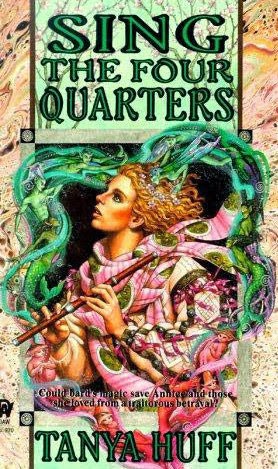
Re-Read Rollout: "Sing the Four Quarters," by Tanya Huff
Principle Cast:
Annice: A former princess, who was cast out of the royal family when she chose to become a bard. Ten years later, she's unsure of how to tell her estranged family that she's pregnant - especially since her brother the King forbade her to have kids.
Pjerin: The Duc of Ohrin - an ignored principality of King Theron's kingdom that guards a mountain pass into a hostile country. When he's accused of abetting that country and finds himself saying words that aren't his when questioned, he knows he's been set up - but by who?
Secondary Cast:
Stasya: Annice's girlfriend who worries about her health and helps Annice try and clear Pjerin's name.
Olinda: Pjerin's scheming aunt who wants him out of the way so that she can grab power for herself.
Albek: A con artist from the neighbouring hostile country who helps Olinda with her treasonous schemes.
Gerek: Pjerin's four-year-old son and heir. Olinda hopes to use him as a figurehead once Pjerin's out of the way.
King Theron: Annice's brother. Has pigheadedly refused to deal with the equally pigheaded Annice for ten years, but now regrets the bitter gap between them.
Fantasy Convention Checklist:
However, I would hesitate to condemn this novel out of hand. It may have bored me, but it had a lot of good things going for it. If you're more into uber-detailed high fantasy, you may really enjoy this novel. However, if you're more into faster-paced, less cluttered stories, you're out of luck.
C+
Annice: A former princess, who was cast out of the royal family when she chose to become a bard. Ten years later, she's unsure of how to tell her estranged family that she's pregnant - especially since her brother the King forbade her to have kids.
Pjerin: The Duc of Ohrin - an ignored principality of King Theron's kingdom that guards a mountain pass into a hostile country. When he's accused of abetting that country and finds himself saying words that aren't his when questioned, he knows he's been set up - but by who?
Secondary Cast:
Stasya: Annice's girlfriend who worries about her health and helps Annice try and clear Pjerin's name.
Olinda: Pjerin's scheming aunt who wants him out of the way so that she can grab power for herself.
Albek: A con artist from the neighbouring hostile country who helps Olinda with her treasonous schemes.
Gerek: Pjerin's four-year-old son and heir. Olinda hopes to use him as a figurehead once Pjerin's out of the way.
King Theron: Annice's brother. Has pigheadedly refused to deal with the equally pigheaded Annice for ten years, but now regrets the bitter gap between them.
Fantasy Convention Checklist:
- 1 Use of Evil Magic
- 4 Types of Elementals
- 1 Giant Godzilla Elemental
- 1 Magic-Boosting Fetus
- 1 Nation of Suspicious Foreigners
- All the LGBT People
The Word: This always happens sooner or later - not everything you loved as a kid, or a teenager, or a younger adult always holds up when you read it again. I initially read Sing the Four Quarters (and the three following novels in the quartet) in my early teens, when I was huge into my Epic Lady Fantasy phase - Robin Hobb, Kate Elliott, Melanie Rawn, Mercedes Lackey before her Magical Horse Books got stupid, Mickey Zucker Reichert whose novels were already stupid but enjoyably silly.
Oddly enough, I'd never re-read this novel until now. The story takes place in a world where the four elements are controlled by kigh: playful, unpredictable spirits who can be managed and cajoled through music. People with the ability to sing the kigh are called bards, and they tramp up and down the country singing songs, conveying messages and fixing problems in service of the king.
However, when 14-year-old Princess Annice joins the bards in defiance of her brother Theron's wish to marry her off to the prince of a neighbouring country, the young king strips her of all royal privileges, cuts her off from the family, and bars her (on pain of treason) from marrying or having children without his express permission.
Ten years later, Annice comes back from her bard's Walk to discover there's a reason she's tired and throwing up all the time: she's pregnant. Moreover, before she can find a politic way to inform the brother she hasn't spoken to in a decade, the father of her baby - Pjerin, the Duc of Ohrid and handsome one night stand - is accused of conspiring with an enemy nation and admits to treason when put to Bardic questioning.
Annice knows there's no way she can tell the King about her pregnancy now that both her baby and her babydaddy are traitors, but she also suspects that something's not quite right about Pjerin's confession, especially since Pjerin maintains his innocence. Throwing caution to the wind, Annice rescues Pjerin from prison, and the two hie off to see if they can find out who set Pjerin up.
Let's start with the good - I didn't quite grasp this when I first read it at 13 or 14, but Sing the Four Quarters is an entirely sex-positive, feminist, LGBT-friendly fantasy novel. Annice is bisexual and in a committed relationship with her girlfriend, Stasya. Gay marriage exists - hell, gay political marriage exists (Annice's uncle turned down the offer to marry a foreign prince), women and men are found in equal numbers in almost every type of job, and premarital sex and bastardy carry little to no stigma. Best of all, none of this ever merits more than a passing mention when establishing setting - there's nothing special or remarkable or abnormal about any of it. For a novel published in 1994, that's pretty awesome.
However, despite all this positive stuff, this re-read ultimately didn't measure up to my memory of it. Yes, there are positive feminist themes and excellent LGBT representation and family issues and magic, this novel would be practically perfect - except it isn't. Firstly - I had some serious problems with Pjerin, the male protagonist. He is an entitled ass - and I really could have gone without knowing he repeatedly banged his biological aunt.
Secondly, for a novel with such interesting themes, its story is pretty boring. Sing the Four Quarters packs a lot of content - but not all of that content is valuable to the narrative. A lot of it is redundant explanation of character motivation - Annice does something, but not before she explicitly tells us why she's doing this and why the world she lives in supports such an action, etc. The pacing is frustratingly slow-moving and dense, which works against the story itself since the latter half of the novel is really one extensive chase sequence. I finally gave up once I reached the halfway mark and skimmed my way to the end.
However, despite all this positive stuff, this re-read ultimately didn't measure up to my memory of it. Yes, there are positive feminist themes and excellent LGBT representation and family issues and magic, this novel would be practically perfect - except it isn't. Firstly - I had some serious problems with Pjerin, the male protagonist. He is an entitled ass - and I really could have gone without knowing he repeatedly banged his biological aunt.
Secondly, for a novel with such interesting themes, its story is pretty boring. Sing the Four Quarters packs a lot of content - but not all of that content is valuable to the narrative. A lot of it is redundant explanation of character motivation - Annice does something, but not before she explicitly tells us why she's doing this and why the world she lives in supports such an action, etc. The pacing is frustratingly slow-moving and dense, which works against the story itself since the latter half of the novel is really one extensive chase sequence. I finally gave up once I reached the halfway mark and skimmed my way to the end.
However, I would hesitate to condemn this novel out of hand. It may have bored me, but it had a lot of good things going for it. If you're more into uber-detailed high fantasy, you may really enjoy this novel. However, if you're more into faster-paced, less cluttered stories, you're out of luck.
C+
Labels:
C Plus Reviews,
high fantasy,
reread rollout
Saturday, November 02, 2013
"How to Say Goodbye in Robot," by Natalie Standiford (Scholastic, 2010)
The Protagonist: Beatrice. Called a "robot" by her own mother because of her inability (or unwillingness) to make firm attachments, she's about to start her senior year of school in Boston.
Her Angst: Her parents are fighting, her mother keeps acting weirder and weirder - and this strange boy at school interests her more than she'd like to admit.
Secondary Characters:
Jonah: Nicknamed "Ghost Boy" by his peers for his pale appearance and solitary status, he hides a creative and kooky heart - and a dark family past.
Anne: One of the popular kids at Bea's new school who tries to befriend Bea.
Tom: A popular guy at Bea's high school who has a reputation for dating and dumping new girls.
The Night Lights: A group of (mostly elderly and weird) people who all listen and call in to a late night radio show about aliens and time travellers.
Matthew: Jonah's severely disabled brother, who is currently in a private hospital because he requires constant care.
Angst Checklist:
Her Angst: Her parents are fighting, her mother keeps acting weirder and weirder - and this strange boy at school interests her more than she'd like to admit.
Secondary Characters:
Jonah: Nicknamed "Ghost Boy" by his peers for his pale appearance and solitary status, he hides a creative and kooky heart - and a dark family past.
Anne: One of the popular kids at Bea's new school who tries to befriend Bea.
Tom: A popular guy at Bea's high school who has a reputation for dating and dumping new girls.
The Night Lights: A group of (mostly elderly and weird) people who all listen and call in to a late night radio show about aliens and time travellers.
Matthew: Jonah's severely disabled brother, who is currently in a private hospital because he requires constant care.
Angst Checklist:
- Family Secrets
- Bullying
- Infidelity
- People with Disabilities
- Time Travel
- Radio Dee Jays
- Depression
The Word: I picked up this book because it was the Forever Young Adult Bookclub's November pick, and I just so happen to be the co-founder of my hometown's branch of the FYA Bookclub.
Thanks to her family moving around a lot at the behest of her college-professor father, Bea has never had an easy time forming relationships - a trait that causes her emotionally-unstable mother to call her a "heartless robot." Well, all Robot Girl wants to do is get through her last year of high school without being noticed.
Until, on her first day at her new school, she meets Jonah, a pale, antisocial teen the other students call "Ghost Boy." He hasn't had a friend in ten years - not since his mother and disabled twin brother were killed in a car accident when he was eight. However, Bea discovers she has far more in common with the unusual and creative Jonah than the rest of her privileged private school peers, and against all odds, the two form a friendship.
Then Jonah makes an amazing discovery - his brother Matthew isn't dead. Instead, he's been in an institution this whole time. His father, determined that Jonah should live a "normal life" without being "burdened" by his severely disabled brother, refuses to tell Jonah where Matthew is being cared for, so Jonah and Bea have to come up with a plan to find Matthew - and maybe even rescue him.
How To Say Goodbye In Robot is a detailed study of an unusual, flawed, but ultimately positive relationship. Jonah is a very imperfect character - while creative and interesting, he can also be callous, judgemental, selfish, and extremely jealous of whomever Bea befriends other than him. Bea often finds herself questioning the definitions of their relationship - are they boyfriend/girlfriend? Not really, but calling themselves "just friends" doesn't seem enough, somehow. Either way, Bea grows to learn that she's not nearly the heartless Robot Girl she believes herself to be.
Despite these points, How to Say Goodbye didn't leave a huge impression on me. It's a very quick read, and it doesn't really delve into any theme other than "Feelings Are A Bitch" with any particular depth. The resolution to Bea's parents' drama seemed rather anticlimactic to me after all the sinister build-up, and Matthew's storyline remains a dramatic yet strangely irrelevant plot device that doesn't really contribute to any particular message or idea. Even after finishing the book, I remain at a loss as to what Matthew's storyline was supposed to contribute to the story - and since it's the central plot, that's a pretty large mark against How To Say Goodbye in Robot.
All in all, How To Say Goodbye In Robot has some cute and creative points, but is ultimately a "m'eh" book. I didn't really take anything away from this book. It wasn't an unpleasant read, but it didn't give anything back for the time I spent reading it.
C+
Labels:
C Plus Reviews,
contemporary,
YA
Monday, October 21, 2013
"Trial By Desire," by Courtney Milan (Harlequin, 2010)
The Chick: Lady Kathleen Carhart. While hiding beneath the guise of a flaky society lady, she secretly saves women from their abusive husbands.
The Rub: Her estranged husband unexpectedly returns - right when she's hiding the battered wife of one of his bros.
Dream Casting: Rose McIver.
The Dude: Lord Ned Carhart. A young aristocrat who went to India to atone for his feckless youth and gain control over his depressive moods.
The Rub: He's back in town, but his wife threatens his tightly-held control over his emotions.
Dream Casting: Tom Mison.
The Plot:
Kate: Now that we're married, can we have sexytimes now?
Ned: NOPE SORRY, MY MANFEELINGS TELL ME I HAVE TO GO TO INDIA KTHXBAI.
Three Years Later
Ned: Sup. I'm back. What's with the cold shoulder? I abandoned you for three years, refuse to have sex with you or touch you, and ignore everything you actually say because I'm only thinking of your comfort.
Kate: You're a moron. *hies off to save ladies*
Ned: Wow! You save ladies for a living! Clearly I've come in at just the right time to do everything for you and save everyone because I'm a dude!
Kate: I am inexplicably unoffended by this. Proceed!
Day: *is saved*
Ned: Oh bee tee dubs, I have depression but I've decided to trust you now because I feel like it.
Kate: Awesome! Happy ending time!
Ned: HOORAY!
Romance Convention Checklist
The Rub: Her estranged husband unexpectedly returns - right when she's hiding the battered wife of one of his bros.
Dream Casting: Rose McIver.
The Dude: Lord Ned Carhart. A young aristocrat who went to India to atone for his feckless youth and gain control over his depressive moods.
The Rub: He's back in town, but his wife threatens his tightly-held control over his emotions.
Dream Casting: Tom Mison.
The Plot:
Kate: Now that we're married, can we have sexytimes now?
Ned: NOPE SORRY, MY MANFEELINGS TELL ME I HAVE TO GO TO INDIA KTHXBAI.
Three Years Later
Ned: Sup. I'm back. What's with the cold shoulder? I abandoned you for three years, refuse to have sex with you or touch you, and ignore everything you actually say because I'm only thinking of your comfort.
Kate: You're a moron. *hies off to save ladies*
Ned: Wow! You save ladies for a living! Clearly I've come in at just the right time to do everything for you and save everyone because I'm a dude!
Kate: I am inexplicably unoffended by this. Proceed!
Day: *is saved*
Ned: Oh bee tee dubs, I have depression but I've decided to trust you now because I feel like it.
Kate: Awesome! Happy ending time!
Ned: HOORAY!
Romance Convention Checklist
- 1 Estranged Married Couple
- 1 Super-Capable Heroine
- 1 Hiding-His-Damage Hero
- 1 Mental Illness
- 1 Malfunctioning Pistol
- 1 Abusive Misogynist Villain
- 1 Twitchy Cart Horse
The Word: This was an interesting novel to read because there was an enormous gap between how much I loved the heroine - and how incredibly annoyed I was with the hero.
The novel opens with our hero, Ned (who we previously met in Milan's debut novel Proof by Seduction) abandoning his wife of three months to battle his personal demons in India.
His abandonment devastates his new bride, Kate, and leaves her with a whole host of trust issues and a burning desire to prove to herself that she's more than just a wife to be laid aside like an accessory. So ... she becomes a Battered Woman Saver, secretly using her wealth and status to spirit away abused wives and give them new lives and identities in America.
For reals. Her newest case is her friend, Louisa, Countess of Harcroft. Her husband, the Earl of Harcroft, is a vicious abuser who has already started threatening their infant son, Jeremy. Louisa's husband's high rank and her baby being his heir make this Kate's toughest case yet, and she can't afford to make a mistake.
So, of course, this is when Ned decides to make his glorious return - three years after deserting his wife to fart around in India. And did I mention he and Harcroft used to be bros? Kate (who is hiding Louisa and her baby on her property) obviously can't afford to trust Ned with her secret.
I was consistently infuriated by Ned in this novel. We're clearly meant to empathize with him more than Kate because, as we soon learn, he suffers from bouts of terrifying clinical depression. Which sucks because, well, it's the 19th century and people hadn't even identified it as an illness yet, much less developed treatment for it.
I tried to empathize with Ned, really I did. I understood his dedication to physical activity and why he was constantly challenging himself and creating intentionally uncomfortable environments in order to keep himself mentally alert. I also understand that depression is something that only the sufferer can really deal with. Unfortunately, the bulk of his condition more or less translates into the common hero angst of, "I can't be near the heroine because she makes me feel the powerful Man Feels that are too manly for her delicate female sensibilities!"
His own capacity for empathy is breathtakingly shallow. He shows up after three years and spends much of the first half of the novel befuddled at Kate's anger with his past absence and present refusal to do the nasty. Can't she tell that he's only protecting her from his Big Bad Man Feelings? Can't she tell, magically, that he's doing all of this for her own good?
I understand that the running emotional subplot of this novel is Ned's realization that Kate is her own awesome heroine, doesn't need rescuing from him and that he doesn't have to be Big Strong Hero Ned around her, but he never really loses that condescending vibe - especially with his patronizing attempts to emotionally manipulate her into trusting him.
Kate, on the other hand, is pretty freakin' awesome. She's a gallivanting Lady Batman who saves abused women while hiding her true identity beneath the veneer of an airhead debutante. Of course, the downside of that veneer is that even the people close to her believe she's too delicate and flighty to participate in intellectual discussions, and her loneliness is starting to consume her. I loved her character and her conflict and also her refusal to put up with Ned's ridiculous angst.
All in all, Trial By Desire is kind of a middling novel - it's got a good set-up with a strong heroine, but a condescending and oblivious hero coupled with inconsistent pacing and a strangely anticlimactic ending.
C+
I tried to empathize with Ned, really I did. I understood his dedication to physical activity and why he was constantly challenging himself and creating intentionally uncomfortable environments in order to keep himself mentally alert. I also understand that depression is something that only the sufferer can really deal with. Unfortunately, the bulk of his condition more or less translates into the common hero angst of, "I can't be near the heroine because she makes me feel the powerful Man Feels that are too manly for her delicate female sensibilities!"
His own capacity for empathy is breathtakingly shallow. He shows up after three years and spends much of the first half of the novel befuddled at Kate's anger with his past absence and present refusal to do the nasty. Can't she tell that he's only protecting her from his Big Bad Man Feelings? Can't she tell, magically, that he's doing all of this for her own good?
I understand that the running emotional subplot of this novel is Ned's realization that Kate is her own awesome heroine, doesn't need rescuing from him and that he doesn't have to be Big Strong Hero Ned around her, but he never really loses that condescending vibe - especially with his patronizing attempts to emotionally manipulate her into trusting him.
Kate, on the other hand, is pretty freakin' awesome. She's a gallivanting Lady Batman who saves abused women while hiding her true identity beneath the veneer of an airhead debutante. Of course, the downside of that veneer is that even the people close to her believe she's too delicate and flighty to participate in intellectual discussions, and her loneliness is starting to consume her. I loved her character and her conflict and also her refusal to put up with Ned's ridiculous angst.
All in all, Trial By Desire is kind of a middling novel - it's got a good set-up with a strong heroine, but a condescending and oblivious hero coupled with inconsistent pacing and a strangely anticlimactic ending.
C+
Labels:
C Plus Reviews,
historical,
Romance
Tuesday, August 06, 2013
"The Infinite Moment of Us," by Lauren Myracle (Amulet 2013)
The Chick: Wren Gray. An overachieving high school graduate who's excited to attend Emory college, and later, medical school.
The Rub: But is this really her, or the person her parents want her to be? And what will they say when they discover she wants to defer her acceptance to Emory?
The Dude: Charlie Parker. A solitary foster kid who's still trying to acclimate to his loving foster family. He's loved Wren from afar, though.
The Rub: Can someone as perfect as Wren ever love someone as damaged as him?
The Plot:
Wren: I'm tired of this gilded cage of Parental Expectations! I WANT TO BE FREEEE!
Charlie: I'm tired of being the Foster Kid with no future! WREN, I LOVE YOU!
Wren: No way I totally love you too! This is awesome!
Charlie: Cool.
Disapproving Parents: *are disapproving*
Wren: OMG, Charlie loves his family more than me! Not fair!
Charlie: OMG, what'll I do if Wren moves to Guatemala without me?
Evil Slutty Ex: Who's up for some refreshing External Conflict?
Wren and Charlie: We are!
Evil Slutty Ex: Sweet! I'mma ramble on, super-villain-style, about how Charlie and I are so alike, and then I'll try to kill myself. How's that?
Charlie: Cool.
Wren: Psych! I've decided not to go Guatemala! I can be a carefree, independent girl right here in Atlanta!
Charlie: ...could you, maybe, have thought to tell me that BEFORE my super-poor parents bought me a non-refundable plane ticket to Guatemala?
Wren: ...
Charlie: And also HOORAY!
Romance Convention Checklist:
The Word: You might have noticed that I've set this novel up with my romance review format, rather than my YA novel format.
Well, it was with a little surprise that I realized Lauren Myracle's newest novel is, essentially, a romance. Just with younger protagonists. Well, a younger hero - historical romances get away with 17- and 18-year-old heroines all the time. But it's all there - the meet-cute, the longing sighs, the Evil Slutty Ex (sigh), the black moment, and rampant sex scenes that won't turn a regular romance reader's head but will likely land YA author Myracle back on the Most-Banned-Author list again.
That wouldn't have bothered me, except for the fact that, as a romance, Infinite Moment is a fairly conventional one. The too-perfect girl from the stifling privileged family. The lonesome outcast boy from the wrong side of the tracks. Been there. Done that.
Wren is on the cusp of graduating - with excellent grades, a spotless record, and an acceptance letter to Emory, the college where her mother works. It's a pretty good life - except it's not Wren's. It's her overprotective, controlling parents' life, to the point where Wren has no idea where her parents' choices end and her choices begin. So, unbeknownst to her family, she's rejected Emory and has signed up for Project Unity, a junior Peace Corps program that will have her teaching English in Guatemala. She's excited, but also terrified at the prospect of disappointing her parents.
Charlie spent years in the foster care system after his mother abandoned him in a garage during a heat wave. He's finally landed in a loving home (including a rambunctious little brother named Dev), and he's determined not to screw it up. However much he's tried to convince himself that love doesn't exist - he knows he's in love with Wren. But does he have the courage to admit it?
It's weird to read this book from the perspective of someone who's read extensively in romance before coming to YA, because I get the sense that this is all supposed to be new ground for YA readers. And I tried to appreciate it from that perspective, but I don't think I fully succeeded. It's odd - the individual parts of this story are good, but the sum of those parts fell short of the mark.
For instance, I loved the characters. I loved the excruciatingly real depiction of Wren's parents - they're not abusive or overtly cruel, but it's easy to see how their well-meant manipulations and behaviours have half-convinced Wren that their love is conditional upon their approval. Wren, herself, is an interesting character - especially as she struggles to identify which beliefs and desires are her own, and which ones have been ingrained by her parents. Her dialogue is fraught with apologies for stepping beyond the margins and thus, further away from her family.
And I appreciated where Myracle was going with Infinite Moment's sex scenes, which are frank and graphic from a YA perspective, while fairly run-of-the-mill from a romance perspective. Having teens explore their sexuality while talking to each other about it honestly was refreshing. However, while I'm more tolerant of Stupid Sex Decisions in romance (home of Secret Babies, Runaway Dukes, and Hoydens in Pants), I am less tolerant of it in a "realistic" YA so when Wren gives the whole "I'm on the pill, no condom required" schtick I nearly pulled a facial muscle with all my eye-rolling.
That being said, the sum of the story itself wasn't much. Just a pair of teenagers in love. While I liked the characterization and some of the supporting characters (with the Enormous Exception of the poorly-drawn Evil Slutty Ex, a selection straight out of Cliched Romance Central Casting), I found I couldn't get behind the story as much. Because, like, they're teens. I felt uncomfortable with how they were already thinking of changing their entire futures and college plans just to be with each other - especially since, as well-developed teen characters, they have Well-Developed Teen Feelings and make Well-Developed Really Stupid Teen Decisions.
I kept waiting around for a more substantial story, and there really wasn't one. It sort of meanders along, with lots of hugs and kisses and Perfect Understanding Until Conflict Is Required for the Plot, with the Big Question (will Wren leave for Guatemala without Charlie?) looming above them until it's abruptly resolved thanks to the Power of Love. I'm honestly not sure how I would have reacted to this story without my years of romance experience, so feel free to take my review with a grain of salt, but The Infinite Moment of Us has a lot of nice little moments, but falls short of being eternally awesome.
...and if you will permit me two more paragraphs, I'm just going to rant on the fact that the author chose to have an Obviously Unstable Evil Slut Ex as the contrived villain of this piece. Starrla and Charlie had an extremely unhealthy sexual relationship in the past - which I get. It happens. Teens can grow and develop and move on from such things. Except for the fact that Charlie walks away from that relationship smelling like a rose while Starrla is blamed for the whole thing because She's Broken and Damaged. Yeah, don't bother developing her character - just heavily imply she's a Rape Victim as a blanket explanation for all the Stupid Shit She Does. Um, it takes two people to have sex. How come Starrla's sexual choices are constantly compared to Wren's over and over and found wanting while Charlie's sexual choices are never freakin' mentioned?
The only reason she didn't ruin the entire novel is because, well, Starrla isn't really in the novel all that much. She's just there to be this Big Slutty White Trash Boogeyman who'll randomly toss her ratty mane of cheap extensions and provide Cheap Emotional Conflict whenever the protagonists are getting too cuddly.
C+
The Rub: But is this really her, or the person her parents want her to be? And what will they say when they discover she wants to defer her acceptance to Emory?
The Dude: Charlie Parker. A solitary foster kid who's still trying to acclimate to his loving foster family. He's loved Wren from afar, though.
The Rub: Can someone as perfect as Wren ever love someone as damaged as him?
The Plot:
Wren: I'm tired of this gilded cage of Parental Expectations! I WANT TO BE FREEEE!
Charlie: I'm tired of being the Foster Kid with no future! WREN, I LOVE YOU!
Wren: No way I totally love you too! This is awesome!
Charlie: Cool.
Disapproving Parents: *are disapproving*
Wren: OMG, Charlie loves his family more than me! Not fair!
Charlie: OMG, what'll I do if Wren moves to Guatemala without me?
Evil Slutty Ex: Who's up for some refreshing External Conflict?
Wren and Charlie: We are!
Evil Slutty Ex: Sweet! I'mma ramble on, super-villain-style, about how Charlie and I are so alike, and then I'll try to kill myself. How's that?
Charlie: Cool.
Wren: Psych! I've decided not to go Guatemala! I can be a carefree, independent girl right here in Atlanta!
Charlie: ...could you, maybe, have thought to tell me that BEFORE my super-poor parents bought me a non-refundable plane ticket to Guatemala?
Wren: ...
Charlie: And also HOORAY!
Romance Convention Checklist:
- 1 Good Girl
- 1 Bad Boy from the Wrong Side of the Tracks
- 2 Loving Foster Parents
- 1 Adorable Disabled Sibling
- 2 Disapproving Biological Parents
- 1 Evil Slutty Ex
- 1 Gift of the Magi Ending
The Word: You might have noticed that I've set this novel up with my romance review format, rather than my YA novel format.
Well, it was with a little surprise that I realized Lauren Myracle's newest novel is, essentially, a romance. Just with younger protagonists. Well, a younger hero - historical romances get away with 17- and 18-year-old heroines all the time. But it's all there - the meet-cute, the longing sighs, the Evil Slutty Ex (sigh), the black moment, and rampant sex scenes that won't turn a regular romance reader's head but will likely land YA author Myracle back on the Most-Banned-Author list again.
That wouldn't have bothered me, except for the fact that, as a romance, Infinite Moment is a fairly conventional one. The too-perfect girl from the stifling privileged family. The lonesome outcast boy from the wrong side of the tracks. Been there. Done that.
Wren is on the cusp of graduating - with excellent grades, a spotless record, and an acceptance letter to Emory, the college where her mother works. It's a pretty good life - except it's not Wren's. It's her overprotective, controlling parents' life, to the point where Wren has no idea where her parents' choices end and her choices begin. So, unbeknownst to her family, she's rejected Emory and has signed up for Project Unity, a junior Peace Corps program that will have her teaching English in Guatemala. She's excited, but also terrified at the prospect of disappointing her parents.
Charlie spent years in the foster care system after his mother abandoned him in a garage during a heat wave. He's finally landed in a loving home (including a rambunctious little brother named Dev), and he's determined not to screw it up. However much he's tried to convince himself that love doesn't exist - he knows he's in love with Wren. But does he have the courage to admit it?
It's weird to read this book from the perspective of someone who's read extensively in romance before coming to YA, because I get the sense that this is all supposed to be new ground for YA readers. And I tried to appreciate it from that perspective, but I don't think I fully succeeded. It's odd - the individual parts of this story are good, but the sum of those parts fell short of the mark.
For instance, I loved the characters. I loved the excruciatingly real depiction of Wren's parents - they're not abusive or overtly cruel, but it's easy to see how their well-meant manipulations and behaviours have half-convinced Wren that their love is conditional upon their approval. Wren, herself, is an interesting character - especially as she struggles to identify which beliefs and desires are her own, and which ones have been ingrained by her parents. Her dialogue is fraught with apologies for stepping beyond the margins and thus, further away from her family.
And I appreciated where Myracle was going with Infinite Moment's sex scenes, which are frank and graphic from a YA perspective, while fairly run-of-the-mill from a romance perspective. Having teens explore their sexuality while talking to each other about it honestly was refreshing. However, while I'm more tolerant of Stupid Sex Decisions in romance (home of Secret Babies, Runaway Dukes, and Hoydens in Pants), I am less tolerant of it in a "realistic" YA so when Wren gives the whole "I'm on the pill, no condom required" schtick I nearly pulled a facial muscle with all my eye-rolling.
That being said, the sum of the story itself wasn't much. Just a pair of teenagers in love. While I liked the characterization and some of the supporting characters (with the Enormous Exception of the poorly-drawn Evil Slutty Ex, a selection straight out of Cliched Romance Central Casting), I found I couldn't get behind the story as much. Because, like, they're teens. I felt uncomfortable with how they were already thinking of changing their entire futures and college plans just to be with each other - especially since, as well-developed teen characters, they have Well-Developed Teen Feelings and make Well-Developed Really Stupid Teen Decisions.
I kept waiting around for a more substantial story, and there really wasn't one. It sort of meanders along, with lots of hugs and kisses and Perfect Understanding Until Conflict Is Required for the Plot, with the Big Question (will Wren leave for Guatemala without Charlie?) looming above them until it's abruptly resolved thanks to the Power of Love. I'm honestly not sure how I would have reacted to this story without my years of romance experience, so feel free to take my review with a grain of salt, but The Infinite Moment of Us has a lot of nice little moments, but falls short of being eternally awesome.
...and if you will permit me two more paragraphs, I'm just going to rant on the fact that the author chose to have an Obviously Unstable Evil Slut Ex as the contrived villain of this piece. Starrla and Charlie had an extremely unhealthy sexual relationship in the past - which I get. It happens. Teens can grow and develop and move on from such things. Except for the fact that Charlie walks away from that relationship smelling like a rose while Starrla is blamed for the whole thing because She's Broken and Damaged. Yeah, don't bother developing her character - just heavily imply she's a Rape Victim as a blanket explanation for all the Stupid Shit She Does. Um, it takes two people to have sex. How come Starrla's sexual choices are constantly compared to Wren's over and over and found wanting while Charlie's sexual choices are never freakin' mentioned?
The only reason she didn't ruin the entire novel is because, well, Starrla isn't really in the novel all that much. She's just there to be this Big Slutty White Trash Boogeyman who'll randomly toss her ratty mane of cheap extensions and provide Cheap Emotional Conflict whenever the protagonists are getting too cuddly.
C+
Labels:
C Plus Reviews,
contemporary,
Romance,
YA
Thursday, June 20, 2013
"Dragon Keeper," by Robin Hobb (Eos, 2010)
The Primary Cast:
Thymara: An inhabitant of the Rain Wilds born with clawed hands and feet, she's an outcast in a society that traditionally abandons deformed children. She's hungry for the chance to prove she's worthy of life and love.
Alise: An absent-minded scholar of dragons and Elderlings who is shackled to a cruel and selfish husband. Her one dream is to be able to study dragons for real, but how far is she willing to go to realize it?
The Secondary Cast:
Greft: A member of the dragon keepers who isn't above using manipulation and mind games to establish dominance.
Tats: A young freed slave who joins the dragon keepers and used to have a serious crush on Thymara.
Sedric: Alise's BFF and, unbeknownst to her, her husband's gay lover. Fastidious, well-dressed and snobby, he wars between his loyalty to Alise and his love for Alise's husband.
Captain Leftrin: The owner of a liveship barge who is hired to accompany the dragons and their keepers. Starts to develop feelings for Alise.
Fantasy Convention Checklist:
The Word: Well, it appears this review will be yet another stop on the Favourite Authors Who Disappoint Me Tour. I'm a huge Robin Hobb fan, and I particularly enjoyed her Liveship Traders Trilogy, so when I heard she was going back to the world of Bingtown and the Rain Wilds for another trilogy, I was psyched.
Unfortunately, Dragon Keeper suffers a lot from repetitiveness, an overabundance of exposition, slack pacing, and annoying characters.
The Liveship Trader Trilogy ended with Tintaglia - the last living dragon - rescuing the surviving sea serpents and helping them prepare for their own transformations into dragons with the help of the Rain Wilds and Bingtown Traders, who provided assistance in return for Tintaglia's promise to protect Bingtown's shores against invaders.
Like big, scaly butterflies, dragons start out as sea serpents and then enter cocoons of mud and shared memories - emerging as dragons the next year. Thanks to an ancient earthquake, the dragons died out, the sea serpents were left adrift, and the remaining cocoons were buried, destroyed, or harvested by ignorant Traders to create liveships.
Was that so hard to explain? No? The author takes every available opportunity to repeat this piece of worldbuilding, over and over again, with different characters and threads of dialogue, until I just about threw this book down in disgust. We get it. It's doubly frustrating for me because I read the previous trilogy, and know this information already, but even to acclimate new readers, the repetition is excessive.
Anyway, this trilogy opens when the triumphant hatching of the new generation of dragons goes horribly awry. The surviving serpents were too old and starved by the time they were rescued to build proper cocoons, and the resulting dragons are either stunted, malformed, sickly, dim-witted, or a pitiable combination of all four. Dragons being an unsentimental species, Tintaglia swiftly abandoned them to pursue other options, leaving the Traders at a loss as to how to care for these expensive, useless, and increasingly aggressive creatures.
Eventually, the Traders decide to move the dragons to a new location - the ancient Elderling city of Kelsingra. But first, they'll need to hire people to tend and feed the dragons - hopefully people with no real social ties or futures.
Enter sixteen-year-old Thymara. As a Rain Wilder born with claws and scales, she should have been abandoned at infancy, but her father saved her at the last minute. While her father loves her, she is still an outcast and forbidden to marry or have children. To her, this job might be her only chance at adventure, wealth, and independence - but she discovers the deformed dragons might be smarter than the authorities let on.
Our other main character is the naive, cutesy and supremely annoying Alise. A bookish, self-taught scholar of dragon and Elderling lore, she married a handsome, wealthy, and Very Obviously Gay Husband to have the money and security to pursue her studies, but - surprise! Her Very Obviously Gay Husband is a ginormous jerk who constantly belittles her and her inability to get an heir off of his very reluctant hetero attempts. Nevertheless, she finally bullies him into letting her travel to the Rain Wilds to research the new dragons - with her Very Obviously Gay Husband's Very Obviously Gay Lover/Secretary Sedric in tow.
While the story seems interesting enough, the novel takes a tediously long time getting to it. The first seventy percent of the novel is spent on fanservice (several characters from the previous trilogy have unnecessary cameos) and set-up - long scenes of Alise's dissolving marriage and Thymara's angst at being an outcast, along with several scenes of concerned parties haggling over what to do with the dragons while repeating the central concept of serpents -- cocoons -- dragons -- liveships over and over and over again. The novel could have easily started when the story did, with the characters' backgrounds fleshed out with flashbacks.
The novel still retains hints of Hobb's mastery of fantasy - original settings, solid worldbuilding, a variety of female characters, moral ambiguity. This is especially true for the latter part of the novel, as the deformed yet still arrogant dragons adapt to the presence of the humans they depend on while humans bicker over what should be done with them.
While this novel was ultimately a disappointment, I'll still hold on to read future books. After all, now that the set-up is over, the second book can be all about story, and Lord knows Robin Hobb has redeemed heinously annoying characters before (I'm looking at you, Malta). If you're a fan of Robin Hobb, I recommend sticking it out. If you're not a fan, it would be better to read The Liveship Trilogy first.
C+
Thymara: An inhabitant of the Rain Wilds born with clawed hands and feet, she's an outcast in a society that traditionally abandons deformed children. She's hungry for the chance to prove she's worthy of life and love.
Alise: An absent-minded scholar of dragons and Elderlings who is shackled to a cruel and selfish husband. Her one dream is to be able to study dragons for real, but how far is she willing to go to realize it?
The Secondary Cast:
Greft: A member of the dragon keepers who isn't above using manipulation and mind games to establish dominance.
Tats: A young freed slave who joins the dragon keepers and used to have a serious crush on Thymara.
Sedric: Alise's BFF and, unbeknownst to her, her husband's gay lover. Fastidious, well-dressed and snobby, he wars between his loyalty to Alise and his love for Alise's husband.
Captain Leftrin: The owner of a liveship barge who is hired to accompany the dragons and their keepers. Starts to develop feelings for Alise.
Fantasy Convention Checklist:
- Several Half-Baked Dragons
- 1 Outcast Protagonist
- Countless Prequel Character Cameos
- 1 Enormous Bounty
- 1 Possibly Mythical City
- 1 Evil Gay Husband
- 1 Self-Absorbed, Somewhat Stereotypical, But Not Completely Evil Gay BFF
- 1 Foreign Invader
The Word: Well, it appears this review will be yet another stop on the Favourite Authors Who Disappoint Me Tour. I'm a huge Robin Hobb fan, and I particularly enjoyed her Liveship Traders Trilogy, so when I heard she was going back to the world of Bingtown and the Rain Wilds for another trilogy, I was psyched.
Unfortunately, Dragon Keeper suffers a lot from repetitiveness, an overabundance of exposition, slack pacing, and annoying characters.
The Liveship Trader Trilogy ended with Tintaglia - the last living dragon - rescuing the surviving sea serpents and helping them prepare for their own transformations into dragons with the help of the Rain Wilds and Bingtown Traders, who provided assistance in return for Tintaglia's promise to protect Bingtown's shores against invaders.
Like big, scaly butterflies, dragons start out as sea serpents and then enter cocoons of mud and shared memories - emerging as dragons the next year. Thanks to an ancient earthquake, the dragons died out, the sea serpents were left adrift, and the remaining cocoons were buried, destroyed, or harvested by ignorant Traders to create liveships.
Was that so hard to explain? No? The author takes every available opportunity to repeat this piece of worldbuilding, over and over again, with different characters and threads of dialogue, until I just about threw this book down in disgust. We get it. It's doubly frustrating for me because I read the previous trilogy, and know this information already, but even to acclimate new readers, the repetition is excessive.
Anyway, this trilogy opens when the triumphant hatching of the new generation of dragons goes horribly awry. The surviving serpents were too old and starved by the time they were rescued to build proper cocoons, and the resulting dragons are either stunted, malformed, sickly, dim-witted, or a pitiable combination of all four. Dragons being an unsentimental species, Tintaglia swiftly abandoned them to pursue other options, leaving the Traders at a loss as to how to care for these expensive, useless, and increasingly aggressive creatures.
Eventually, the Traders decide to move the dragons to a new location - the ancient Elderling city of Kelsingra. But first, they'll need to hire people to tend and feed the dragons - hopefully people with no real social ties or futures.
Enter sixteen-year-old Thymara. As a Rain Wilder born with claws and scales, she should have been abandoned at infancy, but her father saved her at the last minute. While her father loves her, she is still an outcast and forbidden to marry or have children. To her, this job might be her only chance at adventure, wealth, and independence - but she discovers the deformed dragons might be smarter than the authorities let on.
Our other main character is the naive, cutesy and supremely annoying Alise. A bookish, self-taught scholar of dragon and Elderling lore, she married a handsome, wealthy, and Very Obviously Gay Husband to have the money and security to pursue her studies, but - surprise! Her Very Obviously Gay Husband is a ginormous jerk who constantly belittles her and her inability to get an heir off of his very reluctant hetero attempts. Nevertheless, she finally bullies him into letting her travel to the Rain Wilds to research the new dragons - with her Very Obviously Gay Husband's Very Obviously Gay Lover/Secretary Sedric in tow.
While the story seems interesting enough, the novel takes a tediously long time getting to it. The first seventy percent of the novel is spent on fanservice (several characters from the previous trilogy have unnecessary cameos) and set-up - long scenes of Alise's dissolving marriage and Thymara's angst at being an outcast, along with several scenes of concerned parties haggling over what to do with the dragons while repeating the central concept of serpents -- cocoons -- dragons -- liveships over and over and over again. The novel could have easily started when the story did, with the characters' backgrounds fleshed out with flashbacks.
The novel still retains hints of Hobb's mastery of fantasy - original settings, solid worldbuilding, a variety of female characters, moral ambiguity. This is especially true for the latter part of the novel, as the deformed yet still arrogant dragons adapt to the presence of the humans they depend on while humans bicker over what should be done with them.
While this novel was ultimately a disappointment, I'll still hold on to read future books. After all, now that the set-up is over, the second book can be all about story, and Lord knows Robin Hobb has redeemed heinously annoying characters before (I'm looking at you, Malta). If you're a fan of Robin Hobb, I recommend sticking it out. If you're not a fan, it would be better to read The Liveship Trilogy first.
C+
Labels:
C Plus Reviews,
Fantasy,
Robin Hobb
Thursday, May 02, 2013
"Simply Love," by Mary Balogh
Published by Bantam Dell.
The Chick: Anne Jewell. A teacher at Miss Martin's School for Girls and mother of a young son, she enjoys her independence, even if she is a bit lonely.
The Rub: She bore a child out of a wedlock after her employer raped her, so she knows that not only will most of society reject her, but she's also terrified of intimacy.
Dream Casting: Georgia King.
The Dude: Sydnam Butler. The capable and dedicated steward of the Duke of Bewcastle's estate in Wales, and also a childhood friend of the Bedwyn family.
The Rub: Was horribly tortured and maimed in the war, and believes he's too ugly (inside and out) for any sort of romantic love.
Dream Casting: Rob James-Collier with an eye-patch.
The Plot:
Joshua Moore from Slightly Scandalous: Come to my house party!
Anne's Son, David: Whee!
Anne: Um, okay, I guess. So long as I'm treated like a servant because of my Dirty, Dirty Unwed Mother status. Oh hey, look, a cliff upon which I can Angst!
Sydnam: Hey! This is my Angst-Cliff!
Anne: HOLY SHIT YOUR FACE! *flees*
Later, at Dinner
Joshua Moore: Hey guys, let me introduce my Super Awesome and Dear Friend Sydnam Whose Face Will Only Bother You If You're a Terrible, Terrible Person.
Sydnam: ...'s'up.
Anne: Awkward. Sorry about the face comment.
Sydnam: 'S'cool. Wanna hang out?
Anne: Sure.
Sydnam: If only I wasn't horribly scarred and ugly!
Anne: If only I wasn't a Dirty Unwed Mother who's scared of sex!
Sex: *is had*
Syndam: Well that's at least one problem solved...
Anne: I'm pregnant.
Sydnam: Guess we better get married and solve all our internal problems before the book's over! Hey, look, I can paint just as awesomely with my left hand! Who knew?
Anne's Family: And even though we still kind of blame you for getting raped because it's the 19th century, we're sorry for dumping you and want you back!
Anne: And I like sex now!
Sydnam: HOORAY!
Romance Convention Checklist:
The Chick: Anne Jewell. A teacher at Miss Martin's School for Girls and mother of a young son, she enjoys her independence, even if she is a bit lonely.
The Rub: She bore a child out of a wedlock after her employer raped her, so she knows that not only will most of society reject her, but she's also terrified of intimacy.
Dream Casting: Georgia King.
The Dude: Sydnam Butler. The capable and dedicated steward of the Duke of Bewcastle's estate in Wales, and also a childhood friend of the Bedwyn family.
The Rub: Was horribly tortured and maimed in the war, and believes he's too ugly (inside and out) for any sort of romantic love.
Dream Casting: Rob James-Collier with an eye-patch.
The Plot:
Joshua Moore from Slightly Scandalous: Come to my house party!
Anne's Son, David: Whee!
Anne: Um, okay, I guess. So long as I'm treated like a servant because of my Dirty, Dirty Unwed Mother status. Oh hey, look, a cliff upon which I can Angst!
Sydnam: Hey! This is my Angst-Cliff!
Anne: HOLY SHIT YOUR FACE! *flees*
Later, at Dinner
Joshua Moore: Hey guys, let me introduce my Super Awesome and Dear Friend Sydnam Whose Face Will Only Bother You If You're a Terrible, Terrible Person.
Sydnam: ...'s'up.
Anne: Awkward. Sorry about the face comment.
Sydnam: 'S'cool. Wanna hang out?
Anne: Sure.
Sydnam: If only I wasn't horribly scarred and ugly!
Anne: If only I wasn't a Dirty Unwed Mother who's scared of sex!
Sex: *is had*
Syndam: Well that's at least one problem solved...
Anne: I'm pregnant.
Sydnam: Guess we better get married and solve all our internal problems before the book's over! Hey, look, I can paint just as awesomely with my left hand! Who knew?
Anne's Family: And even though we still kind of blame you for getting raped because it's the 19th century, we're sorry for dumping you and want you back!
Anne: And I like sex now!
Sydnam: HOORAY!
Romance Convention Checklist:
- 1 Scarred War Hero
- 1 Soiled Dove Heroine
- 1 Illegitimate Plot Moppet
- 1 Missing Eye
- Far Too Many Bedwyn Matchmakers
- 1 Shotgun Wedding
- 2 Sets of Concerned Parents
- 2 Counts of Sequel Baiting
- 1 Regained Artistic Talent
The Word: I enjoy romance because I love reading about people who, after pages of struggle and toil, finally obtain their Happily Ever After.
However, once the HEA is over and done with, I'd just as soon watch the hero and heroine piss off.
Nothing annoys me more than a romance novel in which prequel couples continue to hang around like unwanted houseguests, drinking all the good beer and farting on the couch when I'd much rather be reading about the actual couple at the centre of the novel.
It's particularly egregious in Simply Love.
Every. Single. Bedwyn. from Mary Balogh's previous six-book series shows up in this novel with their blissfully satiated spouse and several sticky small children in tow to spout lame jokes, act like meddling matchmakers, and achieve no narrative purpose whatsoever.
But this isn't actually the Bedwyn Reunion Novel - no, this story ostensibly revolves around Anne Jewell (a secondary character from Slightly Scandalous) and Sydnam Butler (the younger brother of the hero from A Summer to Remember). Both Anne and Sydnam experienced terrible traumas as young adults that seemingly destroyed their bright futures.
As a young governess, Anne was raped by the son of her employer, and was subsequently fired when she discovered she was pregnant. Thanks to the protagonists of Slightly Scandalous, she and her son David were saved from destitution and she eventually obtained employment with Miss Martin's School for Girls.
The hero of Scandalous (Joshua Moore) continues to correspond with Anne and dote on David, partly because, as the cousin of Anne's rapist, he feels responsible for David and considers him family. Anne accepts Joshua's friendship, but his familial overtures make her extremely uncomfortable - she does not want to dwell on her rape or accept any sort of connection from it. However, when Joshua invites David and Anne to a house party held by the Duke of Bewcastle, Anne cannot refuse a chance for David to socialize with other boys his own age, even though she cringes at the thought of inflicting her Poor Unworthy Tainted Self upon the rarified Bedwyn company.
We met Sydnam back in A Summer to Remember - once a promising painter, he joined the war effort to prove himself to his two older brothers. When he was caught by the French during a covert operation, he endured weeks of hellish torture rather than reveal British secrets, and lost his right eye, his right arm, and a vast swath of skin on his right side as a result. He now works as a steward on one of the Duke of Bewcastle's estates in Wales and has adapted to his disabilities as well as his gruesome appearance.
He and Anne meet by chance when Anne sneaks out of the house in order to avoid having to dine with the All-Important Bedwyns (Anne is incredibly martyrish at the beginning of the novel - despite being personally invited, she'd prefer to be treated as a servant). Anne takes one look Sydnam's marred face and flees. Horribly ashamed of herself, she approaches him later at a dinner to make amends and the two wind up connecting over their shared loneliness.
And it's a nice enough story, and one I was particularly looking forward to since I knew both characters from previous Balogh novels. However, this time around - I was bored. Extremely bored. I know that Balogh favours thoughtful internal conflict over overdramatic external conflict - but her best novels still include a bit of both. I didn't feel there was enough of the latter in this story, at least in the first half. The first half is basically both characters a) moping about how their love is impossible and b) agreeing with each other about how nice the landscape is while c) all the Bedwyns giggle behind their hands, show off their innumerable children, and meddle in their affairs.
The second half picks up a little - after a disappointing one-night stand, Anne winds up pregnant and the two have to marry. Yes, the "I Forced Him/Her Into Marriage" angst is annoying, but we finally get some confrontation and drama as Anne deals with her fear of intimacy, Sydnam learns to enjoy painting again, and both of them confront their families (including the one that had turned its collective back on Anne) with their rather unorthodox marriage.
Among the things I enjoyed about this novel was Anne's relationship with her son David - despite her martyrish tendencies in welcoming company, she is fiercely protective of her son, to the point where she rejects Sydnam's and Joshua's well-intentioned offers to adopt him. David is her son and has her last name - she had to raise him all by herself and she refuses to let some dude take all the credit.
That being said, I felt there really was not enough basic story material for an entire novel here. There was just such an awful amount of filler - there are too many landscape scenes to count, and every previous Balogh protagonist who shows up just has to recount the entire back cover blurb of their own novel, and Anne and Sydnam dither around with lot of woo-woo conversations about the mystical sacred beauty of Welsh nature. And those Very Real Problems the protagonists have? They're solved remarkably quickly. Maybe there would have been more time to develop them if the Bedwyns had all decided to go to Disneyland instead.
Simply Love might have worked as a novella, but as a novel, it felt bloated and watered-down.
C+
As a young governess, Anne was raped by the son of her employer, and was subsequently fired when she discovered she was pregnant. Thanks to the protagonists of Slightly Scandalous, she and her son David were saved from destitution and she eventually obtained employment with Miss Martin's School for Girls.
The hero of Scandalous (Joshua Moore) continues to correspond with Anne and dote on David, partly because, as the cousin of Anne's rapist, he feels responsible for David and considers him family. Anne accepts Joshua's friendship, but his familial overtures make her extremely uncomfortable - she does not want to dwell on her rape or accept any sort of connection from it. However, when Joshua invites David and Anne to a house party held by the Duke of Bewcastle, Anne cannot refuse a chance for David to socialize with other boys his own age, even though she cringes at the thought of inflicting her Poor Unworthy Tainted Self upon the rarified Bedwyn company.
We met Sydnam back in A Summer to Remember - once a promising painter, he joined the war effort to prove himself to his two older brothers. When he was caught by the French during a covert operation, he endured weeks of hellish torture rather than reveal British secrets, and lost his right eye, his right arm, and a vast swath of skin on his right side as a result. He now works as a steward on one of the Duke of Bewcastle's estates in Wales and has adapted to his disabilities as well as his gruesome appearance.
He and Anne meet by chance when Anne sneaks out of the house in order to avoid having to dine with the All-Important Bedwyns (Anne is incredibly martyrish at the beginning of the novel - despite being personally invited, she'd prefer to be treated as a servant). Anne takes one look Sydnam's marred face and flees. Horribly ashamed of herself, she approaches him later at a dinner to make amends and the two wind up connecting over their shared loneliness.
And it's a nice enough story, and one I was particularly looking forward to since I knew both characters from previous Balogh novels. However, this time around - I was bored. Extremely bored. I know that Balogh favours thoughtful internal conflict over overdramatic external conflict - but her best novels still include a bit of both. I didn't feel there was enough of the latter in this story, at least in the first half. The first half is basically both characters a) moping about how their love is impossible and b) agreeing with each other about how nice the landscape is while c) all the Bedwyns giggle behind their hands, show off their innumerable children, and meddle in their affairs.
The second half picks up a little - after a disappointing one-night stand, Anne winds up pregnant and the two have to marry. Yes, the "I Forced Him/Her Into Marriage" angst is annoying, but we finally get some confrontation and drama as Anne deals with her fear of intimacy, Sydnam learns to enjoy painting again, and both of them confront their families (including the one that had turned its collective back on Anne) with their rather unorthodox marriage.
Among the things I enjoyed about this novel was Anne's relationship with her son David - despite her martyrish tendencies in welcoming company, she is fiercely protective of her son, to the point where she rejects Sydnam's and Joshua's well-intentioned offers to adopt him. David is her son and has her last name - she had to raise him all by herself and she refuses to let some dude take all the credit.
That being said, I felt there really was not enough basic story material for an entire novel here. There was just such an awful amount of filler - there are too many landscape scenes to count, and every previous Balogh protagonist who shows up just has to recount the entire back cover blurb of their own novel, and Anne and Sydnam dither around with lot of woo-woo conversations about the mystical sacred beauty of Welsh nature. And those Very Real Problems the protagonists have? They're solved remarkably quickly. Maybe there would have been more time to develop them if the Bedwyns had all decided to go to Disneyland instead.
Simply Love might have worked as a novella, but as a novel, it felt bloated and watered-down.
C+
Labels:
C Plus Reviews,
historical,
Romance
Sunday, April 28, 2013
"The Mockingbirds," by Daisy Whitney
The Protagonist: Alex Patrick. When she wakes up in a stranger's dorm with no memory of what happened, she realizes she was too drunk to give consent.
Her Angst: Her school, Themis Academy, is infamous for being more focused on how their students appear decent than actually ensuring that they are, so who can she turn to for justice?
Secondary Characters:
T.S.: Alex's best friend and roommate. Is Awesome. Stands up for Alex and insists she seek justice for what happened to her.
Casey: Alex's older sister, now in college. Also Awesome. She founded the Mockingbirds back when she was at Themis to help students that the faculty ignored.
Maia: Alex's other friend, and a fierce debater. Serves as Alex's student advocate in her Mockingbird trial against her attacker.
Amy: The current leader of the Mockingbirds.
Martin: A member of the Mockingbirds, and a friend of Alex's. Although he wants to be something more, it's against the rules for a member of the Mockingbirds to get involved with someone whose case is ongoing.
Angst Checklist:
Her Angst: Her school, Themis Academy, is infamous for being more focused on how their students appear decent than actually ensuring that they are, so who can she turn to for justice?
Secondary Characters:
T.S.: Alex's best friend and roommate. Is Awesome. Stands up for Alex and insists she seek justice for what happened to her.
Casey: Alex's older sister, now in college. Also Awesome. She founded the Mockingbirds back when she was at Themis to help students that the faculty ignored.
Maia: Alex's other friend, and a fierce debater. Serves as Alex's student advocate in her Mockingbird trial against her attacker.
Amy: The current leader of the Mockingbirds.
Martin: A member of the Mockingbirds, and a friend of Alex's. Although he wants to be something more, it's against the rules for a member of the Mockingbirds to get involved with someone whose case is ongoing.
Angst Checklist:
- Date Rape
- Vigilante Justice
- Victim Blaming
- Ineffective School Discipline
- Homophobia
- Conflicts of Interest
- Awesome Girl Friends
The Word: I was clued into this book while reading a post over at Stacked about YA novels about rape and sexual assault. The premise of the Mockingbirds drew me - a girl who is date-raped at an elite prep school seeks restitution with the help of a Secret Society of Student Justice. It made me think of The Disreputable History of Frankie Landau-Banks. It made me think of Veronica Mars. Plus, with the Steubenville scandal still over our heads it seemed like a pretty relevant story.
However, it wound up being a bit of a let down.
Piano prodigy and high school sophomore Alex Patrick wakes up with a killer hangover in the dorm of a boy she doesn't know with no memory of what happened and two condom wrappers in the garbage bin. Sick and ashamed of herself for apparently acting like such a slut, she can barely bring herself to divulge the details to her best friend T.S. and her older sister Casey. Thankfully, T.S. and Casey are Smart Awesome Ladies who realize that Alex likely didn't consent to her impromptu deflowering - and Alex's slowly returning memories confirm this.
But what can she do? Discipline at her elite boarding school, Themis Academy, is a joke - no one's willing to jeopardize the school's reputation by even acknowledging that its students are capable of wrongdoing, and Alex refuses to go to the police or tell her parents. That's when Casey suggests that Alex go to the Mockingbirds.
Themis Academy's open secret, the Mockingbirds are the school's undercover law enforcers who punish the crimes that the faculty pretends don't happen. Unfortunately, what sounded like a bad-ass secret society of vengeful smart-alecks on paper is more boring in execution - the Mockingbirds are more like Law And Order: Teen Court. They serve papers. They determine court hearings. They have three separate but equal branches.
And you'll figure it all out as you read it, because all the Mockingbirds take an incredibly long time laying out their entire organization in meticulously dull detail. I realize vigilante justice isn't a healthy or admirable thing in the real world - but the Mockingbirds go to such extreme and unsolicited lengths to show Alex and the reader that they have checks and balances and regulations that all the excitement about the story quickly shrivels up and dies. The Mockingbirds spend more time explaining what they do than actually doing things.
And even with the Mockingbirds' excruciatingly detailed system, they harbour a lot of skewed perspectives on justice. For example, before she joined, one of the Mockingbirds was held down while a girl tried to carve the word "Queer" onto her back with a knife. She went to the Mockingbirds, who gave her attacker a trial that didn't actually result in anything since her attacker graduated days later. When asked why she didn't go to the cops, she said the trial had already made her point.
Except now a psychotic homophobic bigot with an Exacto knife went off to college consequence-free to harass and attack more people because her victim would rather "make a point" with a silly school-trial. Um, nice job?
And when it all comes down to it, the Mockingbirds really aren't that relevant to the story. The actual story is how Alex recovers from her rape and learns to enjoy music and boys again, and the Mockingbirds themselves have little to do with that. Their only real contributions to the story are a channel through which Alex can "press charges" against her rapist without her parents finding out, and some mild romantic conflict as one of the Mockingbirds, a science geek named Martin, develops feelings for Alex but technically isn't allowed to put the moves on her while her case is ongoing.
The novel shines when it focuses on Alex's trauma and recovery. Some people think of date-rape as "diet rape" or "not rape-rape," but Alex suffers immensely from her assault - she rearranges her whole schedule to avoid her rapist at school, and loses weight because she can't even sit in the same cafeteria with him. Her fears come to a head in a chillingly effective scene when she's forced to re-enact a rape scene from a play in class, a scene that also demonstrates the school's oblivious inability to discipline its students.
Ultimately, though, The Mockingbirds was a bit of a drag. Over-justified, over-explained, the Mockingbirds are little more than a distracting and tedious gimmick intruding on a genuine story of recovering from assault.
C+
Labels:
C Plus Reviews,
contemporary,
little brown,
YA
Sunday, September 23, 2012
"What's Left of Me," by Kat Zhang
The Protagonist: Eva. In a world where people are born with two souls, she is the "recessive soul" who was supposed to fade away and leave her sister Addie, the "dominant soul," to live her life as a normal human being. She didn't, and she and Addie have been pretending to be only one person.
Her Angst: No one can know she exists, or else both she and Addie will be shipped off to parts unknown by their tyrannical government.
The Secondary Cast:
Addie: Eva's soul sistah and the one who can control their body. She'd rather fly under the radar and live a normal, unnoticed existence.
Hally/Lissa: Schoolmates of Addie/Eva who hide the fact that they're a hybrid - even though they long to find more people like themselves.
Devon/Ryan: Hally/Lissa's brothers - Devon is silent and introspective, Ryan is open, shy and friendly.
Kitty/Nina: Addie/Eva's roommates at the cruel psychiatric facility they're shipped to when their condition becomes public.
Dr. Lyanne: A doctor at the psychiatric clinic who sincerely believes she can help hybrids reintegrate into society.
Mr. Conivent: A nasty employee of the government who helps round up hybrid children and deliver them to the psychiatric clinic for testing and treatment.
Angst Checklist:
That being said, I felt What's Left of Me was an example of a brilliant idea with faulty execution.
In an alternate universe, all human beings are born with two souls within their bodies. These two-souled beings were known as hybrids. However, the history our protagonists have been taught is that the nations ruled and populated by hybrids eventually descended into chaos and insanity, and only the Americas managed to free themselves from destruction during the American Revolution by eradicating hybrids from society and closing their borders.
In the Americas, everyone is still born with two souls, but usually by the time a child reaches the age of ten, one soul grows more dominant and the other one harmlessly and peacefully fades away, in a process called "settling." Those who do not settle by this age are taken in hand by the government and sent to shady psychiatric institutions where, more often than not, they are never seen again.
15-year-old Eva hides a secret - she is not supposed to exist. The "recessive soul" to her sister Addie (the "dominant soul"), she was supposed to fade away, and Addie/Eva's refusal to settle by the usual age ostracized and nearly bankrupted their family as they spent years in and out of hospitals trying to "cure" their affliction. For the good of their family (especially their declining brother Lyle who suffers from kidney disease), Addie and Eva have pretended to have settled for three years.
After three years of inactivity, Eva has lost all control over their shared body and is little more than a paralyzed ghost haunting Addie's mind, but she tells herself that it's better than not existing at all. That is, until they're approached by the new girl at school, Hally, who reveals she's secretly a hybrid (her sister soul is named Lissa) and that she can help them hide in plain sight and teach Eva how to move again.
Addie's afraid of jeopardizing their tenuously safe existence, but Eva is so hungry and desperate for the power to move, to live again that she insists. Addie finally consents and they spend more and more time with Hally/Lissa as well as their older hybrid brothers, Devon/Ryan. However, when disaster strikes and their condition is exposed, Addie and Eva are forced to learn the hard way just how "benevolent" their country's anti-hybrid society really is.
Let's start with the good, because there are a lot of interesting facets to this story. First of all, I loved the relationship between Addie and Eva, the push-and-pull, the power dynamic. As someone with sisters, I would seriously go batshit insane if I had to share a skull with one of them and never have any privacy ever, but the two-souls concept allowed for a fascinatingly new examination of sisterly relationships.
I loved how loving and fractured their relationship was - especially with the guilt Addie harbours over being the "dominant" soul who's capable of moving their body and being recognized in society and having a life while no one even acknowledges that her sister exists (not even their parents). I loved how Addie didn't have to set the plot going by visiting Hally/Lissa at their house. She controls their body, she could have ignored Eva's pleas and lived her life in peace and safety, but she didn't. That sacrifice adds so many layers and facets to their relationship. At the same time, I understood their frustration when they disagreed over how to act or move.
That being said, the rest of the novel is really frustrating - partly because some aspects of this novel are so good.
In regards to the central concept, the questions kept building up as I read the novel: what's supposed to be good about being a hybrid? What are the advantages? What can they do that one-souled people can't? Because even by the end of the novel it still sounded like having two souls is a major inconvenience compared to having only one. How do the two souls have lives? How do they choose postsecondary education if one wants to go into Arts and the other into Science? What happens when one soul falls in love with a man and the other soul falls in love with another man? And what about their partners' extra souls?!
And the worldbuilding for this type of society was just as frustratingly vague and nonsensical. For instance, why do parents even bother giving both souls names if they expect only one soul to make it? How do they even identify both souls in a newborn? Do they care when the recessive soul disappears? Do they mourn? Is there a social event, some sort of funeral for this sort of thing? If they don't care, why? How do they accept that one of their children will always be doomed to a premature death?
Again - these questions spring from the fact that Kat Zhang is working with a very original and fascinating story concept. There are so many directions to write about and explore with a concept like this, and I think that's where my dissatisfaction with this novel comes from. The novel has a brilliant idea - and it's put to use as mere window dressing to a standard dystopian adventure about a self-righteous teenager fighting The Evil Authority. Yup, the authority is just plain evil because it believes in the black-and-white "Hybridity is Bad" mindset - even though the story never gives a satisfactory explanation of how hybridity is good.
As for the novel's other features, the writing styles demonstrates some effort at writing lyrical prose, and while I sincerely appreciate that since I loooove lyrical writing styles, in some cases this results in cumbersome or confusing passages. For instance, there's a scene where Eva describes having a rubber stopper slammed into her windpipe - and for a few moments I kept reading to figure out who had attacked her like that, until I realized it was a poorly-integrated metaphor for her sudden silence.
That being said, What's Left of Me was still a quick read - part of that might have been my quest for answers, of which there were very, very few. I suspect many of the answers are being saved up for future books, a theory I deeply resent. I understand the need to save suspense and mystery for future novels, but a first book should still resolve and answer certain obstacles and problems, and I dislike first novels that explain nothing and leave open-ended conclusions in order to manipulate people into buying the next books.
Ultimately, though, my main beef with What's Left of Me is that it could been so much more, but it isn't.
C+
Disagree? You can purchase What's Left Of Me: A Hybrid Novel, here.
Her Angst: No one can know she exists, or else both she and Addie will be shipped off to parts unknown by their tyrannical government.
The Secondary Cast:
Addie: Eva's soul sistah and the one who can control their body. She'd rather fly under the radar and live a normal, unnoticed existence.
Hally/Lissa: Schoolmates of Addie/Eva who hide the fact that they're a hybrid - even though they long to find more people like themselves.
Devon/Ryan: Hally/Lissa's brothers - Devon is silent and introspective, Ryan is open, shy and friendly.
Kitty/Nina: Addie/Eva's roommates at the cruel psychiatric facility they're shipped to when their condition becomes public.
Dr. Lyanne: A doctor at the psychiatric clinic who sincerely believes she can help hybrids reintegrate into society.
Mr. Conivent: A nasty employee of the government who helps round up hybrid children and deliver them to the psychiatric clinic for testing and treatment.
Angst Checklist:
- Personal Identity
- Sisterhood
- Sharing
- Institutionalized Racism
- Medical Ethics
- Sticking It To The Man
That being said, I felt What's Left of Me was an example of a brilliant idea with faulty execution.
In an alternate universe, all human beings are born with two souls within their bodies. These two-souled beings were known as hybrids. However, the history our protagonists have been taught is that the nations ruled and populated by hybrids eventually descended into chaos and insanity, and only the Americas managed to free themselves from destruction during the American Revolution by eradicating hybrids from society and closing their borders.
In the Americas, everyone is still born with two souls, but usually by the time a child reaches the age of ten, one soul grows more dominant and the other one harmlessly and peacefully fades away, in a process called "settling." Those who do not settle by this age are taken in hand by the government and sent to shady psychiatric institutions where, more often than not, they are never seen again.
15-year-old Eva hides a secret - she is not supposed to exist. The "recessive soul" to her sister Addie (the "dominant soul"), she was supposed to fade away, and Addie/Eva's refusal to settle by the usual age ostracized and nearly bankrupted their family as they spent years in and out of hospitals trying to "cure" their affliction. For the good of their family (especially their declining brother Lyle who suffers from kidney disease), Addie and Eva have pretended to have settled for three years.
After three years of inactivity, Eva has lost all control over their shared body and is little more than a paralyzed ghost haunting Addie's mind, but she tells herself that it's better than not existing at all. That is, until they're approached by the new girl at school, Hally, who reveals she's secretly a hybrid (her sister soul is named Lissa) and that she can help them hide in plain sight and teach Eva how to move again.
Addie's afraid of jeopardizing their tenuously safe existence, but Eva is so hungry and desperate for the power to move, to live again that she insists. Addie finally consents and they spend more and more time with Hally/Lissa as well as their older hybrid brothers, Devon/Ryan. However, when disaster strikes and their condition is exposed, Addie and Eva are forced to learn the hard way just how "benevolent" their country's anti-hybrid society really is.
Let's start with the good, because there are a lot of interesting facets to this story. First of all, I loved the relationship between Addie and Eva, the push-and-pull, the power dynamic. As someone with sisters, I would seriously go batshit insane if I had to share a skull with one of them and never have any privacy ever, but the two-souls concept allowed for a fascinatingly new examination of sisterly relationships.
I loved how loving and fractured their relationship was - especially with the guilt Addie harbours over being the "dominant" soul who's capable of moving their body and being recognized in society and having a life while no one even acknowledges that her sister exists (not even their parents). I loved how Addie didn't have to set the plot going by visiting Hally/Lissa at their house. She controls their body, she could have ignored Eva's pleas and lived her life in peace and safety, but she didn't. That sacrifice adds so many layers and facets to their relationship. At the same time, I understood their frustration when they disagreed over how to act or move.
That being said, the rest of the novel is really frustrating - partly because some aspects of this novel are so good.
In regards to the central concept, the questions kept building up as I read the novel: what's supposed to be good about being a hybrid? What are the advantages? What can they do that one-souled people can't? Because even by the end of the novel it still sounded like having two souls is a major inconvenience compared to having only one. How do the two souls have lives? How do they choose postsecondary education if one wants to go into Arts and the other into Science? What happens when one soul falls in love with a man and the other soul falls in love with another man? And what about their partners' extra souls?!
And the worldbuilding for this type of society was just as frustratingly vague and nonsensical. For instance, why do parents even bother giving both souls names if they expect only one soul to make it? How do they even identify both souls in a newborn? Do they care when the recessive soul disappears? Do they mourn? Is there a social event, some sort of funeral for this sort of thing? If they don't care, why? How do they accept that one of their children will always be doomed to a premature death?
Again - these questions spring from the fact that Kat Zhang is working with a very original and fascinating story concept. There are so many directions to write about and explore with a concept like this, and I think that's where my dissatisfaction with this novel comes from. The novel has a brilliant idea - and it's put to use as mere window dressing to a standard dystopian adventure about a self-righteous teenager fighting The Evil Authority. Yup, the authority is just plain evil because it believes in the black-and-white "Hybridity is Bad" mindset - even though the story never gives a satisfactory explanation of how hybridity is good.
As for the novel's other features, the writing styles demonstrates some effort at writing lyrical prose, and while I sincerely appreciate that since I loooove lyrical writing styles, in some cases this results in cumbersome or confusing passages. For instance, there's a scene where Eva describes having a rubber stopper slammed into her windpipe - and for a few moments I kept reading to figure out who had attacked her like that, until I realized it was a poorly-integrated metaphor for her sudden silence.
That being said, What's Left of Me was still a quick read - part of that might have been my quest for answers, of which there were very, very few. I suspect many of the answers are being saved up for future books, a theory I deeply resent. I understand the need to save suspense and mystery for future novels, but a first book should still resolve and answer certain obstacles and problems, and I dislike first novels that explain nothing and leave open-ended conclusions in order to manipulate people into buying the next books.
Ultimately, though, my main beef with What's Left of Me is that it could been so much more, but it isn't.
C+
Disagree? You can purchase What's Left Of Me: A Hybrid Novel, here.
Labels:
C Plus Reviews,
science fiction,
YA
Monday, September 03, 2012
"Origin," by Jessica Khoury
The Protagonist: Pia. Born in the hidden scientific community of the Little Cambridge Research Facility after five generations of breeding and experimentation, she is the new face of the human race: invincible, immortal, and perfect.
Her Angst: Trouble is, she doesn't feel perfect - she feels stifled and lonely. And what are her creators - her scientist "aunts" and "uncles" - hiding from her about her origins?
The Secondary Cast:
Uncle Paolo: The head scientist of Little Cam. Responsible for Pia's upbringing and education, he trains Pia to believe that she is the next necessary step for the human race, a next step that needs to be preserved, maintained and controlled - at any cost.
Uncle Antonio: Pia's favourite Uncle, he loves and supports her, even as he expresses a mysterious unease with the direction her training is going in.
Eio: A boy from the Ai'oa tribe of South American natives who live near Little Cam, who befriends Pia. He shares her sense of not-belonging - after all, he's only half Ai'oa. His father, whom he refuses to name, is also a scientist in Little Cam.
Ami: Eio's younger foster sister. Mischievous plot moppet and conflict-bait.
Angst Checklist:
The only person who tells her differently is her Uncle Antonio who tells her that "perfect is as perfect does" (thank you, Rainforrest Gump), all the while significantly wincing and grimacing to indicate he Knows More Than He Lets On.
The first few chapters of this novel are genuinely intriguing, particularly the descriptions of life in Little Cam and the Amazon rainforest setting. Everyone on the staff, from the head scientists to the laundress, is referred to as "Aunt" or "Uncle" by Pia. Each scientist has their own lab and specialty, and Pia learns from all of them and assists in their experiments. However, Pia is only permitted to study scientific and mathematical subjects (literature and history are forbidden), there are no world maps on the site and no one is permitted to mention city names or geographical locations. Pia's never been allowed outside Little Cam and has no idea where Little Cam is.
For all of her seventeen years, Pia has been studying to become a scientist in her own right and join the Immortis team in order to help engineer more immortals like herself. Even though she's still a teenager, she's terrified of the inevitability of outliving everyone she knows and being left alone, and believes helping to create a perfect, undying human race is the only way to avoid this.
Of course, all that changes when a storm-toppled tree leaves a hole in the electric fence around Little Cam. Pia's curiosity gets the better of her, and not five minutes after crawling into the outside world, she runs into a devastatingly hot native boy with washboard abs and sky-blue eyes.
Naturally, Pia's infrequent adventures outside of Little Cam with the Hot Boy (named Eio) and his fictional Ai'oa tribe clue her in to the fact that Creepy Unexplained Things are Afoot at Little Cam and that her scientist Aunts and Uncles may be paying a higher price for Pia's immortality and special abilities than she initially believed.
My first problem? The Instalove. Gross. Nothing says True Love like a hormonal, isolated teenager falling for literally the first boy with abs she's ever seen! The fact that their adventures occur over the span of a week, ending with undying, eternal love makes so much character sense. Right.
Secondly, don't even get me started on the theme of the Special White Girl being "chosen" to save a tribe full of brown people.
Thirdly, the characters - Pia and Eio. Pia did have some depth - I appreciated how alone she felt in Little Cam, how scared she was of the idea of being alone while everyone grows old around her. I liked how goal-oriented she was and how determined she was to keep learning in order to achieve that goal. That being said, her world-weariness at being immortal seemed contrived and unrealistic, considering she's still the youngest person in Little Cam, has never encountered death, and hasn't outlived anyone yet. I also got annoyed really quickly with her goopy InstaFeelings for Eio and her constant waffling. Once she falls for Eio she seems to lose all her drive and her self-confidence in her own intelligence.
And I had far less understanding for Eio. I thought he was an emotionally manipulative prick who is constantly objectified by the narrative - he's apparently allergic to wearing shirts and his exoticism is always overplayed. He's frequently referred to as "the wild jungle boy," who lives as one with the trees and the monkeys with his uninhibited shirtlessness.
I might have tolerated the Instalove a little more if it wasn't constantly used as an excuse for both characters to act like complete fucking morons. Pia makes dozens of flat-out ridiculously stupid decisions because of Eio, and Eio has an unintentionally hilarious scene where he nearly kills himself trying to climb an electric fence to get to Pia, repeatedly shocking himself over and over because he just loves Pia too much - or at least too much to stop, use the brains God gave a butternut squash, and formulate a plan that actually works.
As to the novel's themes, while I appreciated the exploration of morality and ethical responsibility with regards to scientific experimentation and research, I thought the battle between Cold Hard Emotionless Science and Loving Homegrown Spiritualism was way too obvious and black and white. The storytelling itself is also exaggerated, ham-handed and almost cartoonish in places - I'm sorry, but the minute an absentminded scientist "accidentally" creates ants that "thirst for human flesh" but keeps them alive FOR SCIENCE! - the story loses all realistic credibility with me.
Everything was just a little too exaggerated for me with Origin - the Instalove, the Instantly Evil!Scientists, the purely good and spiritual natives, the man-eating ants (for reals). There are some good ideas here and some excellent scenic description, but not enough realistic characterization or emotional depth to hold my interest.
C+
Disagree? You can purchase Origin here.
Her Angst: Trouble is, she doesn't feel perfect - she feels stifled and lonely. And what are her creators - her scientist "aunts" and "uncles" - hiding from her about her origins?
The Secondary Cast:
Uncle Paolo: The head scientist of Little Cam. Responsible for Pia's upbringing and education, he trains Pia to believe that she is the next necessary step for the human race, a next step that needs to be preserved, maintained and controlled - at any cost.
Uncle Antonio: Pia's favourite Uncle, he loves and supports her, even as he expresses a mysterious unease with the direction her training is going in.
Eio: A boy from the Ai'oa tribe of South American natives who live near Little Cam, who befriends Pia. He shares her sense of not-belonging - after all, he's only half Ai'oa. His father, whom he refuses to name, is also a scientist in Little Cam.
Ami: Eio's younger foster sister. Mischievous plot moppet and conflict-bait.
Angst Checklist:
- Finding a Place to Belong
- Discovering Your Parents Aren't Perfect
- Discovering Your Parents Are Not Only Not Perfect, But Evil Scientists
- Morality within Immortality
- Science vs. Religion
- Science vs. Morality
- Science vs. Outright Evil Science
- Kittens!
- Killing Kittens! For Science!
- Insta-Love
The only person who tells her differently is her Uncle Antonio who tells her that "perfect is as perfect does" (thank you, Rainforrest Gump), all the while significantly wincing and grimacing to indicate he Knows More Than He Lets On.
The first few chapters of this novel are genuinely intriguing, particularly the descriptions of life in Little Cam and the Amazon rainforest setting. Everyone on the staff, from the head scientists to the laundress, is referred to as "Aunt" or "Uncle" by Pia. Each scientist has their own lab and specialty, and Pia learns from all of them and assists in their experiments. However, Pia is only permitted to study scientific and mathematical subjects (literature and history are forbidden), there are no world maps on the site and no one is permitted to mention city names or geographical locations. Pia's never been allowed outside Little Cam and has no idea where Little Cam is.
For all of her seventeen years, Pia has been studying to become a scientist in her own right and join the Immortis team in order to help engineer more immortals like herself. Even though she's still a teenager, she's terrified of the inevitability of outliving everyone she knows and being left alone, and believes helping to create a perfect, undying human race is the only way to avoid this.
Of course, all that changes when a storm-toppled tree leaves a hole in the electric fence around Little Cam. Pia's curiosity gets the better of her, and not five minutes after crawling into the outside world, she runs into a devastatingly hot native boy with washboard abs and sky-blue eyes.
Naturally, Pia's infrequent adventures outside of Little Cam with the Hot Boy (named Eio) and his fictional Ai'oa tribe clue her in to the fact that Creepy Unexplained Things are Afoot at Little Cam and that her scientist Aunts and Uncles may be paying a higher price for Pia's immortality and special abilities than she initially believed.
My first problem? The Instalove. Gross. Nothing says True Love like a hormonal, isolated teenager falling for literally the first boy with abs she's ever seen! The fact that their adventures occur over the span of a week, ending with undying, eternal love makes so much character sense. Right.
Secondly, don't even get me started on the theme of the Special White Girl being "chosen" to save a tribe full of brown people.
Thirdly, the characters - Pia and Eio. Pia did have some depth - I appreciated how alone she felt in Little Cam, how scared she was of the idea of being alone while everyone grows old around her. I liked how goal-oriented she was and how determined she was to keep learning in order to achieve that goal. That being said, her world-weariness at being immortal seemed contrived and unrealistic, considering she's still the youngest person in Little Cam, has never encountered death, and hasn't outlived anyone yet. I also got annoyed really quickly with her goopy InstaFeelings for Eio and her constant waffling. Once she falls for Eio she seems to lose all her drive and her self-confidence in her own intelligence.
And I had far less understanding for Eio. I thought he was an emotionally manipulative prick who is constantly objectified by the narrative - he's apparently allergic to wearing shirts and his exoticism is always overplayed. He's frequently referred to as "the wild jungle boy," who lives as one with the trees and the monkeys with his uninhibited shirtlessness.
I might have tolerated the Instalove a little more if it wasn't constantly used as an excuse for both characters to act like complete fucking morons. Pia makes dozens of flat-out ridiculously stupid decisions because of Eio, and Eio has an unintentionally hilarious scene where he nearly kills himself trying to climb an electric fence to get to Pia, repeatedly shocking himself over and over because he just loves Pia too much - or at least too much to stop, use the brains God gave a butternut squash, and formulate a plan that actually works.
As to the novel's themes, while I appreciated the exploration of morality and ethical responsibility with regards to scientific experimentation and research, I thought the battle between Cold Hard Emotionless Science and Loving Homegrown Spiritualism was way too obvious and black and white. The storytelling itself is also exaggerated, ham-handed and almost cartoonish in places - I'm sorry, but the minute an absentminded scientist "accidentally" creates ants that "thirst for human flesh" but keeps them alive FOR SCIENCE! - the story loses all realistic credibility with me.
Everything was just a little too exaggerated for me with Origin - the Instalove, the Instantly Evil!Scientists, the purely good and spiritual natives, the man-eating ants (for reals). There are some good ideas here and some excellent scenic description, but not enough realistic characterization or emotional depth to hold my interest.
C+
Disagree? You can purchase Origin here.
Labels:
C Plus Reviews,
science fiction,
YA
Thursday, May 10, 2012
"Never Love a Lawman," by Jo Goodman
The Chick: Rachel Bailey. A seamstress living in Reidsville, Colorado, who's perfectly content to hide from her past and live an unconnected, private existence.
The Rub: Her quiet existence screeches to a halt when she learns a recently deceased man from her past has bequeathed the town's livelihood to her - but only if she marries the Sheriff.
Dream Casting: Maggie Gyllenhaal.
The Dude: Sheriff Wyatt Cooper. The quiet and exceedingly observant bachelor lawman of Reidsville, who was hired by Clinton Maddox to protect Reidsville's newest inhabitant, Rachel Bailey.
The Rub: When that protection calls for marriage, Wyatt's all in - but can he convince Rachel his reasons for marrying her are more than mere duty?
Dream Casting: Timothy Olyphant.
The Plot:
Rachel: OMG why is everyone in this town just so helpful and considerate? How's a girl supposed to hold on to her Dark Angsty Secrets?
Wyatt: Did somebody say secretssssss?
Rachel: I did not. And now I will engage you in a 3-page conversation in which I reveal nothing about my secret pain - except with my eyes. *angsty eyes*
Wyatt: I will have a similar conversation with you in which I secretly learn everything about you because I have super-smart detective eyes. *detective eyes* BTW, your old sugar daddy says you have to marry me or the town will die out.
Rachel: Wait, what?
Wyatt: Only he's not your sugar daddy! He's your dad's friend and you're on the run from his slimy grandson who had inappropriate designs on you!
Rachel: WTF?!
Wyatt: You think I wouldn't notice? You were throwing me those purdy on-the-run-from-slimy-grandson-and-his-inappropriate-designs-eyes at me all damn day!
Rachel: CURSES!
Wyatt: Watch me brilliantly solve a bank robbery because I'm a genius!
Bank Robbers: Watch me shoot you because you're an idiot!
Wyatt: *shot* Crap.
Rachel: Guess I'll nurse you back to health.
Random Townies: By the way, the Creepy Grandson found out you were here and is on his way!
Wyatt: Sweetie, I got this.
Rachel: No, I got this.
Random Psychotic Accountant: No, I GOT THIS. *kills Evil Grandson*
Wyatt and Rachel: HOORAY!
Romance Convention Checklist
1 Heroine on the Run
Several Batches of Biscuits
1 Sexy Deputy
1 Unpleasant Stalker
1 Very Specific Will
1 73-Mile-Long Railroad Spur
2 Bank Robbers
1 Dose of Opium
2 Cattle Rustlers
1 Sassy Ho
1 Nice But Incredibly Vulnerable Ho
1 Crazy Repressed Accountant
The Word: Yup, another skimmer. I did make it all the way to the end of this book out of respect for Jo Goodman (whose books I love), but by page 290 I decided to focus on dialogue and not much else.
I'm beginning to think that TBR Impatience is behind the sudden ease with which I can do away with books that don't hold my interest tightly enough - I just have so many other books to read that there's simply no time to waste on books that aren't interesting.
And, sorry to say, but Never Love a Lawman didn't measure up. Don't get me wrong, this novel had a lot of good parts, but all in all, they never really added up to good enough.
Rachel Bailey has been working as a seamstress in the small Colorado mining town of Reidsville for about fifteen months after Very Bad Things forced her to leave her hometown of Sacramento, California. She's intensely private and defensive, and thus unsurprisingly has few real friends, although half the men in town are mad for her, including but not limited to the town's Sheriff of Many Talents, Wyatt Cooper.
Our Sheriff of Many Talents approaches Rachel to let her know that her Mysterious Wealthy Benefactor, railroad baron Clinton Maddox, has died. He then reveals that Maddox hired him to protect Rachel from More Very Bad Things, and now that he's dead, his last testament will do it for him. Clinton Maddox bequeathed to Rachel half of all the shares in the town's mine and the "Spur" (a 73-mile-long stretch of railroad that connects Denver to Reidsville) - if she marries Wyatt Cooper, Sheriff of Many Talents, One of Which is Protecting Ladies. If she doesn't say "I do," all that swag goes to Maddox's dastardly grandson Foster, the same man who forced Rachel to flee Sacramento.
Foster Maddox is a Villain with a capital V, and Rachel knows he'd be too busy Stalking and Harassing Innocent Ladies to keep the Spur open - and if the Spur goes, so will the town's connection to the outside commercial world of Denver, turning Reidsville into a ghost town. Very reluctantly, she agrees to marry Wyatt, but it will be a legal marriage only and must be kept secret.
And we all know how well that works in romance novels.
The main reason I didn't engage with this story as much as other Goodman novels is that for whatever reason, I couldn't get invested in the struggles of Lawman's wordy-yet-opaque protagonists, Wyatt and Rachel. Jo Goodman's romances are traditionally very slow-paced, with lots of dialogue and normally, these elements make her novels slow, sumptuous treats. When her characters are unrealistic or unapproachable, Goodman's book becomes a slog.
Such is the case here. We have two intensely private characters who guard their secrets like pirate treasure - including from the reader. Rachel does it because she's on the run (although, for a Jo Goodman heroine, her backstory is surprisingly light), and Wyatt keeps all his cards close to the vest because it allows him to better observe people. The thing is, they spend so much time hiding and obscuring who they are and exchanging endlessly evasive banter that doesn't reveal anything about themselves, that I never really felt like I was getting to know them. Even their trademark Goodman dialogue (oh WOW so much dialogue) seemed coy and gimmicky - these are definitely people who prefer to talk around, rather than about, their problems. Because of that, I felt distant from them and from their romance.
There are some good points. Jo Goodman has a deft hand with the well-developed settings - in this case, perhaps too developed. Did I need to learn that much about gold mining and railroad politics? I did not. The scenes where Wyatt solves crimes and performs his duties as sheriff are electric (including the best scene in the novel, were Wyatt unwittingly walks into a crime in progress and discreetly backs out and arranges for backup and firepower before the criminals realize they've been made).
As it is, that's all lovely frosting on a cake that's nothing special. Never Love a Lawman has a great setting, some good action scenes, and lots of dialogue, but without extraordinary characters to empathize with, what's the point?
C+
The Rub: Her quiet existence screeches to a halt when she learns a recently deceased man from her past has bequeathed the town's livelihood to her - but only if she marries the Sheriff.
Dream Casting: Maggie Gyllenhaal.
The Dude: Sheriff Wyatt Cooper. The quiet and exceedingly observant bachelor lawman of Reidsville, who was hired by Clinton Maddox to protect Reidsville's newest inhabitant, Rachel Bailey.
The Rub: When that protection calls for marriage, Wyatt's all in - but can he convince Rachel his reasons for marrying her are more than mere duty?
Dream Casting: Timothy Olyphant.
The Plot:
Rachel: OMG why is everyone in this town just so helpful and considerate? How's a girl supposed to hold on to her Dark Angsty Secrets?
Wyatt: Did somebody say secretssssss?
Rachel: I did not. And now I will engage you in a 3-page conversation in which I reveal nothing about my secret pain - except with my eyes. *angsty eyes*
Wyatt: I will have a similar conversation with you in which I secretly learn everything about you because I have super-smart detective eyes. *detective eyes* BTW, your old sugar daddy says you have to marry me or the town will die out.
Rachel: Wait, what?
Wyatt: Only he's not your sugar daddy! He's your dad's friend and you're on the run from his slimy grandson who had inappropriate designs on you!
Rachel: WTF?!
Wyatt: You think I wouldn't notice? You were throwing me those purdy on-the-run-from-slimy-grandson-and-his-inappropriate-designs-eyes at me all damn day!
Rachel: CURSES!
Wyatt: Watch me brilliantly solve a bank robbery because I'm a genius!
Bank Robbers: Watch me shoot you because you're an idiot!
Wyatt: *shot* Crap.
Rachel: Guess I'll nurse you back to health.
Random Townies: By the way, the Creepy Grandson found out you were here and is on his way!
Wyatt: Sweetie, I got this.
Rachel: No, I got this.
Random Psychotic Accountant: No, I GOT THIS. *kills Evil Grandson*
Wyatt and Rachel: HOORAY!
Romance Convention Checklist
1 Heroine on the Run
Several Batches of Biscuits
1 Sexy Deputy
1 Unpleasant Stalker
1 Very Specific Will
1 73-Mile-Long Railroad Spur
2 Bank Robbers
1 Dose of Opium
2 Cattle Rustlers
1 Sassy Ho
1 Nice But Incredibly Vulnerable Ho
1 Crazy Repressed Accountant
The Word: Yup, another skimmer. I did make it all the way to the end of this book out of respect for Jo Goodman (whose books I love), but by page 290 I decided to focus on dialogue and not much else.
I'm beginning to think that TBR Impatience is behind the sudden ease with which I can do away with books that don't hold my interest tightly enough - I just have so many other books to read that there's simply no time to waste on books that aren't interesting.
And, sorry to say, but Never Love a Lawman didn't measure up. Don't get me wrong, this novel had a lot of good parts, but all in all, they never really added up to good enough.
Rachel Bailey has been working as a seamstress in the small Colorado mining town of Reidsville for about fifteen months after Very Bad Things forced her to leave her hometown of Sacramento, California. She's intensely private and defensive, and thus unsurprisingly has few real friends, although half the men in town are mad for her, including but not limited to the town's Sheriff of Many Talents, Wyatt Cooper.
Our Sheriff of Many Talents approaches Rachel to let her know that her Mysterious Wealthy Benefactor, railroad baron Clinton Maddox, has died. He then reveals that Maddox hired him to protect Rachel from More Very Bad Things, and now that he's dead, his last testament will do it for him. Clinton Maddox bequeathed to Rachel half of all the shares in the town's mine and the "Spur" (a 73-mile-long stretch of railroad that connects Denver to Reidsville) - if she marries Wyatt Cooper, Sheriff of Many Talents, One of Which is Protecting Ladies. If she doesn't say "I do," all that swag goes to Maddox's dastardly grandson Foster, the same man who forced Rachel to flee Sacramento.
Foster Maddox is a Villain with a capital V, and Rachel knows he'd be too busy Stalking and Harassing Innocent Ladies to keep the Spur open - and if the Spur goes, so will the town's connection to the outside commercial world of Denver, turning Reidsville into a ghost town. Very reluctantly, she agrees to marry Wyatt, but it will be a legal marriage only and must be kept secret.
And we all know how well that works in romance novels.
The main reason I didn't engage with this story as much as other Goodman novels is that for whatever reason, I couldn't get invested in the struggles of Lawman's wordy-yet-opaque protagonists, Wyatt and Rachel. Jo Goodman's romances are traditionally very slow-paced, with lots of dialogue and normally, these elements make her novels slow, sumptuous treats. When her characters are unrealistic or unapproachable, Goodman's book becomes a slog.
Such is the case here. We have two intensely private characters who guard their secrets like pirate treasure - including from the reader. Rachel does it because she's on the run (although, for a Jo Goodman heroine, her backstory is surprisingly light), and Wyatt keeps all his cards close to the vest because it allows him to better observe people. The thing is, they spend so much time hiding and obscuring who they are and exchanging endlessly evasive banter that doesn't reveal anything about themselves, that I never really felt like I was getting to know them. Even their trademark Goodman dialogue (oh WOW so much dialogue) seemed coy and gimmicky - these are definitely people who prefer to talk around, rather than about, their problems. Because of that, I felt distant from them and from their romance.
There are some good points. Jo Goodman has a deft hand with the well-developed settings - in this case, perhaps too developed. Did I need to learn that much about gold mining and railroad politics? I did not. The scenes where Wyatt solves crimes and performs his duties as sheriff are electric (including the best scene in the novel, were Wyatt unwittingly walks into a crime in progress and discreetly backs out and arranges for backup and firepower before the criminals realize they've been made).
As it is, that's all lovely frosting on a cake that's nothing special. Never Love a Lawman has a great setting, some good action scenes, and lots of dialogue, but without extraordinary characters to empathize with, what's the point?
C+
Labels:
C Plus Reviews,
historical,
Romance
Wednesday, March 07, 2012
"Mockingjay," by Suzanne Collins
The Heroine: Katniss Everdeen, the Girl on Fire - a.k.a. "The Mockingjay." Due to her actions in both of her Hunger Games, she is now the face of a revolution that could finally topple the tyranny of the Capitol.Her Angst: Her face, unfortunately, is more important than her actual actions - her handlers are more concerned with keeping her in the limelight than actually having her fight or help.
The Secondary Cast:
Gale: Katniss' right-hand man and a highly-ranked soldier in District 13's war with the Capitol.
Peeta: Currently in Capitol custody, probably under torture, thanks to the rebels' failure to rescue him from the Quarter Quell.
President Alma Coin: The leader of District 13, she's willing to use Katniss as the figurehead of the rebellion, but she's got a personal agenda of her own when it comes to the war and the future of Panem.
Prim: Katniss' sister - now training as a medic to help the rebel cause.
Finnick: One of the former victors of the Hunger Games to survive the Quarter Quell with Katniss. While definitely an ally, he's still recuperating mentally and physically from his ordeal.
Johanna: Another former victor. Mayor of Bald Crazy-Through-Torture Town.
The Word: I didn't like this book.
No, I didn't like this book - and the strong start of The Hunger Games is partly to blame. The first novel created a heroine of such strength and determination, that it made her lack of agency in this book that much harder to swallow. I was less tolerant of the flaws of this book because I knew how good it could be, and was frustrated when it wasn't.
District 12 is in ruins after being firebombed by the Capital, and Katniss is now living in District 13, the "secret" district that rebuilt itself underground after being nuked by the Capital years ago. The people of this district, however, are ready to come out of hiding and end the rule of President Snow once and for all - and they want Katniss to be the Mockingjay, the face of the revolution that everyone in the world instantly recognizes.
And I have no problem with that. The actual worldbuilding in The Hunger Games trilogy is pretty shaky - its strong point has always been how it explores the social aspect of government-sanctioned violence. In Mockingjay, Katniss' image is just as important as it was in the first book, as footage of her fighting Capital troops can stir up the people when released to the media at the correct moment. It also means, however, that Katniss' handlers are eager to put her in the spotlight but loathe to send into her into actual danger.
This would be fine if this was just the introduction of the novel, but the first, oh, 70% of Mockingjay is a) Katniss being moved to a strategic point and acting like a good obedient puppet (albeit one with angsty thoughts), b) something going drastically wrong, ending with a minor character dying in a ridiculously over-the-top way, or c) Katniss doing something stupid and winding up in the hospital for pages and pages after, and the cycle restarts anew.
The remaining 30%, of course, is a wildly inventive, fast-pasted, gratuitously violent and heartbreaking climax that, if you've carried any emotional investment at all for any of the characters, will tear you inside out. If only the lead up to it was less sluggish and boring. And if only Katniss had more control over it. Much like Catching Fire, Katniss is removed from the majority of the major action in the novel. Until the last third of the novel, it still felt like the real story was happening off-screen and we just had to experience it third-hand from Katniss' handlers.
And through it all, Katniss is just trying to keep the pieces together. In the case of Mockingjay, I think the realism Collins tried to impart onto her narrative actually hindered how I enjoyed the book. Katniss deals with repeated traumas in a very understandable and realistic way - she is put through the physical and emotional and psychological wringer. She is butchered and burned and cut up and abandoned and frequently suicidal and witness to countless atrocities.
But the constant pressure lends her character a note of tedium. I wondered who she really was when she wasn't busy reacting to something awful. The one time she is asked to make a significant choice about Panem's future (near the end, with her vote being the deciding one), she goes with a choice that made me instantly lose all respect for her. I wondered, Is this the person she really is? and realized I still wasn't completely sure.
BUT WHAT DOES THIS BOOK DO RIGHT? Well, for starters - the love triangle. I have very shifty, Twilight-fail-created feelings about love triangles. Too often, they involve either a) a girl, the Perfect Guy, and the Obvious Asshole or b) a girl, the Perfect Guy, and A Nice, Decent, Well-Adjusted Guy Who's Just Not Bad/Vampirey Enough.
But Gale and Peeta are two of the best-developed love interests I have come across in fiction. Neither of them is the obviously wrong or obviously right choice. They both come from different worlds and upbringings and contribute their own unique takes to the world. Gale is the revolutionary. Peeta is the diplomat. Honestly, Gale has the balls to force a change in the horrid status quo, but Peeta has the smarts and social far-sightedness to make that change stick. Gale is the lifelong friend. Peeta is the obstacle turned ally.
And finally, they both love and (more importantly!) respect Katniss. There's refreshingly little dick-waving or "YOU HAVE TO CHOOSE" moments. I really enjoyed that. Neither of them tried to force the issue or guilt Katniss. And I have to say, while I agreed with Katniss' ultimate choice, I really, genuinely liked both boys as independent characters, not just as love interests.
Okay, so I didn't really like the experience of reading Mockingjay. It was tedious and frustrating for the most part, and the ending, while cathartic, seemed a little rushed and random. However, as the final entry in the series, it's a fascinating endpoint. The trilogy as a whole is a creative and engaging examination of cultural morality, social media, organized violent sports, and how good intentions in the wrong hands can lead to bad ends.
Mockingjay by itself: C+
The Hunger Games Trilogy: B+
Labels:
B Plus Reviews,
C Plus Reviews,
hunger games,
science fiction,
YA
Thursday, February 09, 2012
Blink and You'll Miss It Review: "Catching Fire," by Suzanne Collins
Okay, so this is going to be a bit of a change-up - not a regular thing, unforch, but the fact of the matter is:I read this book and totally forgot to review it.
It got lost in the shuffle.
I clicked on my YA tag and saw that there was no review for Catching Fire, even though I did read it.
And that's when I realized I'd forgotten. Eeep. I'd also already given the book back (it was borrowed). I also read it a month ago or more.
So I'm doing without my usual rigamarole because this is all from memory. I'm probably going to forget or misspell character names, that sort of thing, but my impressions of this novel are still strong.
My main impression? I felt cheated. *Spoilers for Both Books Ahead*
Let me explain. Catching Fire takes off after Hunger Games ended, with Katniss and Peeta returning triumphantly to their home district after Katniss' quick thinking saved them both from certain death. There's never been two winners in the Hunger Games before - the yearly tradition where each district sends two teenage "tributes" to a central arena where they all fight to the death.
Unfortunately, thanks to her little stunt, Katniss is under intense scrutiny from the Evil Powers that Be, who worry her defiance of the Games will spark a revolution they will have to mercilessly crush. Their Evil Leader, President Snow, makes it very clear to Katniss that she will have to toe the line as she makes her winner's progress through the districts - or else her family will suffer the consequences.
As in the last novel, "toeing the line" involves faking a romantic relationship with Peeta, which would paint her unorthodox moves in the Games as the actions of a lovestruck teenager rather than a rebel stickin' it to the man. Peeta is a nice enough guy, but Katniss also has feelings for Gale, a loyal childhood friend, and the idea of having even her romantic life controlled by the Capital (possibly for the rest of her life) is abhorrent.
The first half of the novel is quite strong. As Katniss and Peeta make their winners' progress through the districts, they witness that it's not only their hometown of District 12 that's dissatisfied with the Capital's tyranny. People everywhere feel the unfair weight of Capital control and the Capital's recent implementation of harsher punishments and regulations is taking its toll. Katniss has to war with some pretty hefty arguments - should she think of her family first and keep quiet, or should she look at the big picture and help turn that spark of defiance into a conflagration that could make things better for everyone? Or would that only end in more death and destruction?
The novel was well on its way to becoming something awesome when President Snow announces the rules for the Quarter Quell - the special Hunger Games that happen every 25 years (how convenient). Because it's the 75th anniversary of the Hunger Games, the Capital can choose just about any kind of rules it wants, and this time around, it decides that tributes will only be picked from the surviving Hunger Game winners. Which means that Peeta and Katniss have to compete in the Hunger Games again.
And then the novel's all downhill from there. It's not particularly badly-written (and the design of the particular Games is clever), but it's just. More. Of. The. SAME. Cinna gives Katniss a flamboyantly awesome entrance. Katniss meets more contestants and has to wonder if she'll have to kill them or be killed. Weird, poorly-developed sci-fi dangers are confronted and defeated. Katniss has to pretend she loves Peeta (more than she's already starting to) - only this time she's faking a pregnancy too! It's all well and good but I liked it better WHEN I READ ALL OF THIS THE FIRST TIME, IN THE HUNGER GAMES.
And I have to admit, this is a review where I will HAVE to spoil the ending, because it's integral to how I viewed this novel and why it left me so disappointed and angry. SPOILERS: At the end of the new Hunger Games, Katniss is rescued by her mentor Haymitch and is told that he and a bunch of conspirators have engineered the revolution, which is already in progress.
Yes. THIS is the part of the novel that angered me the most - ALL of the super-important stuff to the story happened TO OTHER PEOPLE, OFF-SCREEN. I, as the reader, missed it, because I was too busy slogging through what was essentially a retread of the first book. I'm sorry, but NO. I'm the fucking reader. I should have been allowed to read how the revolution was started. I should have gotten to read about the spies and the sabotage AS IT HAPPENED, not SECONDHAND at the very end of the novel. After getting to the end, I felt as if the author had put me at the kiddie table while the adults had their own conversation without me.
I've never had to worry about sequels in book form because usually, they don't end up in the same pitfalls as, say, movie sequels. Movies, because they are usually self-contained narratives, don't require a sequel - so when sequels are made in order to capitalize off the success of the first one, they often fall prey to the Same But Different trope - where they essentially tell the same story as the first movie, just with a different villain/setting, etc. Look at Home Alone 2 as an example - exact same plot, just in a New York hotel.
But with books? Where they are often written with a series in mind (as The Hunger Games clearly was), I expected Catching Fire to tell a different story. It started to, but halfway through, we get another Hunger Games, and somehow this is so much more essential to the reader than the actual revolution. And honestly, it didn't leave as big an impression on me as the first novel.
Here's hoping that Mockingjay will set things right.
C+
Labels:
C Plus Reviews,
science fiction,
YA
Subscribe to:
Posts (Atom)