Showing posts with label The Bedwyns. Show all posts

Tuesday, July 20, 2010

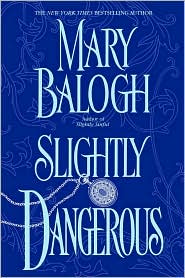
"Slightly Dangerous," by Mary Balogh

The Chick: Christine Derricks. Despite being an impoverished widow who's estranged from her bitter in-laws, she insists on looking on the brighter side of life.
The Rub: However, only a few interactions with the haughty Duke of Bedwyn convince her he's all cloud and no silver lining - so why is she so attracted to him?
Dream Casting: Kate Winslet.

The Dude: Wulfric Bedwyn, Duke of Bewcastle. Despite being rigid, proper, and supremely logical in all things, Wulfric's life hasn't been quite the same since all his siblings married and moved on with their lives.
The Rub: Surely his life could never be so empty that he'd need Mrs. Christine Derricks to fill the void - she's so uncouth and improper and unsuitable!
Dream Casting: Patrick Dempsey.

The Plot:

Christine: What a nice party.

Wulfric: What a dull affair.

Christine: What an arrogant prick!

Wulfric: What a vulgar young woman!

Christine: I don't like you.

Wulfric: I find myself in complete agreement. Sex?

Christine: Sure, why not?

Wulfric and Christine: *SexyTimes*

Wulfric and Christine: Goodbye and good riddance!

Wulfric and Christine: *invited to same wedding* DAMMIT!

Wulfric: Well, I suppose, if you were amenable, we could be married.

Christine: Oh hell no.

Wulfric: .... *sniffle*

Christine: Emotions! Oh, alright, I'll marry you!

Wulfric: Quite. *In private* HOORAY!

Romance Convention Checklist

1 Haughty Aristocrat

1 Wary Widow

2 Nasty In-Laws

5 Smug Married Couples

1 Snake in the Grass Villain

1 Stolen Quizzing Glass

7 Spare Quizzing Glasses

1 Torn Dress

1 Barren Baby Epilogue

The Word: If I want to be completely honest, I didn't start reading this book with the highest of expectations. You see, Slightly Dangerous is not only a novel, but the final novel in the lengthy series concerning the Bedwyns. The final novels in romantic series with recurring characters tend to be more significant because in more cases than not, these are the novels reserved for the "most interesting" characters, that one rake who's just that much more brooding and troubled than the rest, that one female assassin whose past is just that much more mysterious, or that one couple whose vitriolic enmity is so very obviously hiding a secret attraction. Think of Villiers in Eloisa James' Desperate Duchesses series. Or Jesse (Sweet Trouble) in Susan Mallery's Bakery Sisters Trilogy.

Again, while the previous novels in the series revolve around their main characters, they also serve to hype up the mystery/angst/hate-love aspect of those special recurring characters, and these final novels in the series end up coming under especial scrutiny because of that build-up. However, truth be told, once the mystery is gone these characters rarely live up to the hype. Secret shames turn out to be run-of-the-mill Big Misunderstandings. Villainous rakes are neutered into vulnerable fluffy ducklings in disguise.

Frankly, I was expecting Slightly Dangerous to be more of the same. Wulfric Bedwyn, fondly dubbed "The Duke of Asshat" by yours truly, turns up in every Slightly book to make cold, asshat-y comments about propriety and respectability before inevitably surrendering to the romantic whims of the protagonists, with an occasional softened gaze or private crying jag to indicate he does have a heart underneath that formidably controlled exterior. How could the last book possibly do his character justice with any sort of narrative consistency?

To my delight, with Slightly Dangerous Mary Balogh manages to create a moving and realistic romance concerning Wulfric without retroactively rewriting his character into a secret cuddler.

At the beginning of the novel, Wulfric is feeling somewhat out of sorts, but he refuses to examine his feelings deeply enough to identify his problem for what it is: loneliness. His siblings have all absconded into their respective HEAs, his mistress of ten years has died, and his ginormous estate is empty. Thanks to this, he makes a rare impulsive decision to accept a friend's invitation to a houseparty. However, when he arrives, he is appalled to discover that instead of a gathering of intellectuals, it's a betrothal party for a very young couple whose equally young friends are eager to cause mischief.

However, he's not the only accidental outsider. Christine Derricks, a penniless widow, is browbeaten by her friend Lady Renable into attending the same house party as well, even though the two hostile siblings of her late husband will be there, too. She quickly achieves the dubious distinction of making two equally awful first impressions on Wulfric: the first when she accidentally drips searing lemonade into his eye (and he mistakes her for a servant), and the second when she meets him eye-to-eye in the drawing room and openly calls him on his asstastic attitude.

She succeeds both in discombobulating Wulfric and eliminating the rest of her social nervousness and she proceeds to have a lovely time. Her natural charm bubbles to the fore and she's soon the life of the party, even though her clumsiness and unladylike antics earn her the ire of Wulfric and her spiteful in-laws. Wulfric thinks Christine is a human trainwreck, but he can't look away, and his inability to curb his interest unsettles him deeply.

However, Mary Balogh knows just how to pace this romance. Wulfric and Christine don't tumble headfirst into love or even understanding during the two weeks of that houseparty. Wulfric is a thinker, a rationalizer, and the rules of the aristocracy are embedded in his very bones. He knows that Christine is completely unsuitable to be a duchess - she's vulgar, she's clumsy, she's low born, she's barren. He knows this from the outset. He can't stop watching her or feeling attracted to her, but by Nora he'll fight it as long as he can with every rationalization he can find.

However, as he and Christine keep running into each other despite their attempts to avoid each other, Wulfric eventually succumbs to the realization that he cares about her. However - he keeps rationalizing, only this time, in the opposite direction. When he finally does buckle down and decide to pursue Christine into marrying him, he goes at it with the same coolly strategic, logical, and rational determination he applies to everything else. He doesn't suddenly break into song or burst into tears or say the magically "right" thing. By wooing Christine as Wulfric, he doesn't transform into a completely different loving character - instead Mary Balogh shows us that aspect of his character's been a part of him all along.

And Christine's no slouch of a character, herself. While there's definitely a Pride & Prejudice vibe going on here, Mary Balogh deftly demonstrates how she's Wulfric's perfect match. Just as the Duke of Bewcastle is notorious for lowering the temperature of every room he enters with his chilling hauteur and intensely private nature, Christine can't help but bring light and happiness to everyone around her with her ability to laugh at herself as well as others. However, Christine's social ease in society and around other men turned into a double-edged sword when her husband's jealousy and insecurity eventually soured their marriage. She's conflicted - while at ease with herself, she does suffer moments of hyper-consciousness of how tawdry she looks in comparison to the perfection of the ton.

Thanks again the great characterization, the opposites-attract element of the romance also poses one of its most difficult obstacles. Christine has trouble reconciling her attraction to Wulfric with her perception of him as being cold and emotionless, and has trouble grasping how two people so different could make each other happy in the long run, especially considering her first marriage to a man who was also her vast superior in rank.

Even while reading this story, I had trouble with my emotional grade and my objective grade. Emotionally, I'd rate this book a B+, because I liked and appreciated it but didn't love it. Objectively, however, there's too much that's good about this book to let it lower the novel's grade. Objectively, I adored the characterization - not only of the protagonists, but also of the villain, a character who turned out to be a real surprise and one of the most subtle and insidious baddies I've ever read, which was pretty refreshing for a genre where the villains are usually telegraphed from the very beginning. As well, I liked how the other Bedwyns were included into the story without being intrusive.

Finally, I also took into account how Slightly Dangerous fits as a final chapter in the Bedwyn saga, and how it remain absolutely consistent with the character of Wulfric while also managing to be wholly and realistically romantic. I think in this case, it works beautifully as a final chapter - while his siblings do have parts in the story, they serve more as reminders of how each of their stories have helped shape and prepare Wulfric for his own. The way he stood up for Eve in Slightly Married, how he came to Judith's defense in Slightly Wicked, how his interference set the stage for Freya's romance in Slightly Scandalous, learning the truth behind his botched first engagement from Gervase in Slightly Tempted, to enduring the heartbreak of Alleyne's "death" and miraculous return in Slightly Sinful. They've all paved the way for him to finally realize that some things cannot be ruled or controlled - like love.
A

Tuesday, January 26, 2010

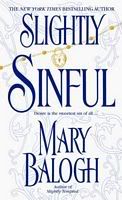
"Slightly Sinful," by Mary Balogh


The Chick: Rachel York. After a swindler makes off with her friends' life savings thanks to her naivete, she'll do anything to pay them back - even trick a distant relative into handing over her inheritance early. She just needs a man to pretend to be her husband.
The Rub: Amnesiac "Jonathan Smith" fits the bill, plus he owes her his life - but their enforced intimacy may have deeper consequences than she realized.
Dream Casting: Romola Garai.

The Dude: Alleyne Bedwyn, a.k.a. "Sir Jonathan Smith." After taking a fall from his horse, he wakes up in a brothel with no memory of who he is - but at least he's surrounded by pretty ladies, not least of whom is the lovely Rachel York.
The Rub: He rather enjoys playing the part of her loving husband - but he still has no memory of who he is, including whether or not he's already married.
Dream Casting: James McAvoy.

The Plot:
Alleyne: War sucks! *falls off horse, bonks head*

Rachel's Friends: *swindled* Poverty sucks!

Rachel: Guilt sucks! *rescues Alleyne*

Alleyne: Amnesia sucks!

Rachel: Virginity sucks.

Alleyne and Rachel: *SexyTimes*

Alleyne: You're right, virginity sucks. *glowers*

Rachel: Hmph. Wanna fake a marriage to get my inheritance?

Alleyne: What about your relative?

Rachel: Oh, don't worry, negligent uncles suck!

Uncle Richard: Being all alone and never getting to see my niece sucks.

Rachel: Utterly wrong first impressions suck. *tear*

Alleyne: Not being able to marry you sucks.

Rachel: Really? 'Cause I checked and you're single.

Alleyne: HOORAY!

Wulfric, Duke of Asshat: What about me?

Mary Balogh: Not until the next book!

Wulfric: Damn, that sucks.

Romance Convention Checklist

1 Amnesiac Hero

1 Guilt-Trippin' Heroine

1 Bad Childhood

1 Forgotten Childhood

1 Kindly Uncle

1 Traumatic Head Injury

1 Inconvenient Inheritance

4 Happy Hookers

2 Drunken Servants

2 Evil Con Artists

1 Unpleasant Deflowering

The Word:
In this penultimate volume of the Bedwyn series, we're dropped into Alleyne's story. During Slightly Tempted (Morgan's book), he went MIA during the Battle of Waterloo while delivering a letter from the Duke of Wellington and was believed to be dead. The Bedwyns held a memorial service, Morgan got some war-angst, and Wulfric, Duke of Asshat had a nice little scene where he cries his Asshat-y eyes out in the privacy of his study.

Of course, since the Bedwyn series is penned by Mary Balogh and not, say, Carolyn Jewel, Alleyne's status as a Hot Brother hands him a Get Out of Death Free Card. While galloping towards Brussels, he's shot in the thigh, knocked off his horse, bonked by a tree root, and stripped naked by war scavengers instead.

Meanwhile, in a brothel in Brussels, our heroine Rachel York tries to apologize to four whores (Geraldina, Flossie, Phyllis and Bridget - who was Rachel's childhood nurse) who have been swindled out of their retirement fund by a con artist Rachel unwittingly introduced them to. Rachel admired the Reverend Nigel Crawley for his supposed goodness, decency and tolerance and agreed to be his betrothed - and now she blames herself for her friends' misfortune.

While the kindhearted birds of paradise consider Rachel as much a victim of Crawley's deception as they are, Rachel still feels responsible and so she, Flossie and Geraldina form a half-baked plan to see what valuables can be found on the battlefield outside the city, in the hopes they'll at least make enough cash to hunt down Crawley for the rest. However, it takes about two minutes for them to realize they haven't the stones to rob the dead, but in the process Rachel discovers an unconscious Alleyne and brings him back to the brothel to recuperate.

What follows is an admittedly trite setup, in which Alleyne wakes up and panics over not remembering anything, the four painted ladies made an exhausting number of thinly-veiled references to how much they want to bang him three ways from Sunday, and Rachel intentionally allows Alleyne to infer she's a whore for some ridiculously martyrish reason. She also jumps into bed with him after knowing him for all of two weeks, then gets all huffy when Alleyne, discovering she's a virgin mid-thrust, is understandably too appalled to perform to her satisfaction.

Okay, so the set-up is tiresome, but it doesn't last for too long and it pays off in spades later. Rachel finally figures out a way to pay back her prostitute pals: while her gambling-addict father left her with nothing when he died, she still has a sizable inheritance of her mother's jewelery held in trust for her by an estranged uncle, to be doled out when she turns twenty-five (three years from now) or when she marries someone her uncle approves of.

Rachel figures if she and Alleyne can convince her uncle they're a happily married couple, he'll have no reason not to hand over her bling, which will restore the hookers' nest egg while leaving a hefty chunk for herself. Despite her tendency to guilt-trip, Rachel feels no qualms about deceiving an uncle who participated very little in her life after disowning her mother for her elopement.

Alleyne agrees to help in her scheme, partly because he owes her big time for saving his buck-naked ass, but partly due to his own cowardice. While in theory he wants to discover who he is and if he has any family, he's also terrified at the thought that his memories might never return. He'd much rather procrastinate for a while to see if his memory returns on its own and posing as Rachel's husband gives him an excellent excuse.

However, things are not so cut-and-dry: Alleyne (now called "Jonathan Smith"), Rachel, and the ladybirds head off to the cold-hearted uncle's impressive estate for a few days only to discover - a) the uncle isn't as cold-hearted as he seems, b) the estate's no longer so impressive thanks to its owner's debilitating illness, and c) the frail Uncle Richard declares that "Jonathan" and Rachel must stay with him for a month before he'll consider relinquishing her jewels.

And here is where the novel goes from pleasant to good, and from good to very, very good. Mary Balogh plays on some familiar themes - mainly, a deep and abiding love for the countryside and intense and understandable personal drama. Alleyne, much like his older brother Aidan from Slightly Married and the Marquess of Hallmere from Slightly Scandalous, discovers an affinity for Rachel's uncle's estate and how it's managed and run. In fact, all the Slightly books so far have taken place at lovingly-described country estates, with plenty of scenes where the characters grow to admire and appreciate the proximity to nature and its beauty (which, in itself, was a popular cultural theme during the Regency). Freed from social constraints and personal limitations that a knowledge of his specific identity might have placed on him, Alleyne pursues what naturally calls to him and uncovers the true essence of his identity.

As for Rachel, well, she's a very flawed character - and I mean flawed in the human way, and not in the badly-characterized way. While I didn't always like her or agree with her, thanks to Balogh's writing I almost always understood her. In many ways, she tries to feel the way she "ought" to feel, repressing her true emotions, and this is poignantly demonstrated in her relationship with her Uncle Richard. She wants to hate him and think the worst of him for not taking part in her life but she responds to the situation of his illness and his generous treatment of his guests nonetheless, and then she ends up resenting her feelings of sympathy as weakness.

Rachel is a woman who is very bound up in the past - she cannot forget her lonely and poverty-stricken childhood spent with a father who threw every penny away at the gaming tables, or her belief that Uncle Richard could have helped if he'd only forgiven her parents for their elopement. She can't overcome her memories of being alone in the world enough to stop taking responsibility for everything and misinterpreting what other people say to her (Alleyne in particular) as slights against her. Seen in this light, it makes perfect sense that it takes a man without memories and without a past to help awaken Rachel to the joys of the present and the possibilities of the future. Some people joke about how cliched the amnesia plotline is (especially in romance), but I'm always willing to suspend my disbelief in an overfamiliar or unrealistic plot device if it expresses an insightful theme or literary idea, and at the risk of repeating myself, Mary Balogh is a champion at this.

The secondary cast, primarily comprised of the four whores, are meant to be lively and humorous but their banter quickly becomes tiresome - however, even they start to grow and develop in pleasant (if predictable) ways. They seem surprisingly healthy and cheerful and well-adjusted for 19th-century prostitutes, which made me a little curious about their pasts and backstories, but otherwise they were harmless.

All in all, another thoroughly enjoyable Mary Balogh novel. You'll have to blame the predictability of my Balogh reviews on the fact that she is one of the most consistent novelists I've ever read - she's not always heart-stoppingly fabulous, but she is always good, and I have never not enjoyed reading her novels.
A-

Friday, August 28, 2009

"Slightly Tempted," by Mary Balogh

Alternate Title: All's Fair in Love and War

The Chick: Lady Morgan Bedwyn. The youngest of the Bedwyns, barely out of the schoolroom, she won't have anyone call her "naive" or "innocent." When her brother Alleyne's declared MIA at the Battle of Waterloo, she turns to a surprising source for comfort - the rakish Earl of Rosthorn.
The Rub: Her trust is shattered when she discovers the Earl of Rosthorn holds a bitter grudge against her brother Wulfric, and that his introduction to her had been motivated by vengeance. Does this mean their every tender moment since then was a lie?
Dream Casting: Michelle Trachtenberg.

The Dude: Gervase Ashford, Earl of Rosthorn. He spent nine years in exile for a crime he didn't commit, thanks in part to the Duke of Bewcastle's refusal to believe his side of the story. While in Brussels, when he spots Lady Morgan Bedwyn in a ballroom - he discovers a way to get revenge.
The Rub: Only trouble is, he doesn't spend that much time in her company before he falls head over heels. Will she still love him when the truth of their initial meeting comes out?
Dream Casting: Elliot Cowan.

The Plot:

In Brussels...
Gervase: I don't believe we've met. *in head* REVENGE! MUAHAHAHAHAHA!

Morgan: Whatevs. *in head* Loser.

Battle of Waterloo: *WAR! DEATH! INJURY!*

Alleyne, Morgan's Brother: *vanishes*

Gervase: I'm so sorry, let me help you. *in head* Muaha...ha ha...who am I kidding? She's amazing.

Morgan: You're such a dear, dear friend! *in head* A dear, dear, HAWT friend...

Morgan and Gervase: *sexx0r*

In England...

Wulfric: Sis, Gervase is only trying to get at me through you.

Morgan: Bro, you're hot, but not that hot - besides, don't you have a sequel coming up...

Wulfric: I mean Gervase is a rapist and a thief and I kicked his ass.

Morgan: GERVASE YOU SHITHEAD WE ARE DONE! AND BY DONE I MEAN BETROTHED.

Gervase: ...?

Morgan: YOU ARE GOING TO SHOWER ME WITH PRESENTS AND ATTENTION, AND THEN I'M GOING TO LEAVE AND HUMILIATE YOU, AND I'M TELLING YOU EVERYTHING I'M GOING TO DO BEFOREHAND, NOT SO THAT YOU CAN STOP ME WITH TENDER, PASSIONATE ROMANTIC GESTURES - BUT BECAUSE IT MAKES ME LOOK MORE BADASS.

Gervase: *tender, passionate romantic gestures*

Morgan: For the love of--FINE, I'll marry you for reals.

Gervase: Hooray!

Romance Convention Checklist

1 Wrongfully-Accused Man

9 Years of Exile

1 Inconvenient War

1 Inconveniently Dead Brother (or IS he?)

1 Age Gap (18-30, baby)

1 "Just Friends" Agreement Doomed to Failure

1 Lacklustre Romantic Rival

2 Surprise Lesbians

1 Fake Rape

1 Bitter Feud

The Word: I love Mary Balogh. Love love love. By the end of her books, I always feel completely swept away into the worlds she creates and the characters she's written. Mary Balogh: Warm Fuzzies Guaranteed.

That being said, of all the Balogh novels, Slightly Tempted had a pretty rocky start, with a heroine I found kind of annoying. However, by the end of the novel Balogh once again convinced me of the Warm Fuzzies - and at the same time of the consistency and depth (however annoying) of her female protagonist.

But I digress - the plot: Lady Morgan Bedwyn is partying hardy in Brussels. She's already bored with the Season even though she's been "out" for all of five minutes, but the excitement of being on the Continent at the same time Napoleon escapes from Elba gives her a measure of excitement. She wants to be a part of history, and engage in scintillating political dialogue, even as the atmosphere of impending doom and violence threatens to rain on her parade.

While she's dancing with a hot soldier, she's spotted by Gervase Ashford, Earl of Rosthorn. He's been partying hardy on the Continent for the last nine years, ever since his dad kicked him out of England for a crime he didn't commit. Wulfric, Duke of Asshat, whom Gervase had once called friend, eased him across the Channel with a firm boot to the ass, and Gervase has felt a consuming rage for the man ever since. Gervase sees Wulfric's fresh-faced 18-year-old sister and sees a way to exact revenge.

He succeeds in starting a public flirtation with her, hoping the gossips fleeing Brussels will carry the story back to Duke Asshat that his virginal lamb of a sister is hooking up with the Big Bad Wolf. However, the saucy Morgan holds her own against his insinuating charms, and his plans go further awry when French troops start marching on Brussels. While all this promises to lead up to some delightful drama, I found the writing in this first section of the book to do a lot of telling instead of showing - as I result, I was pretty bored for the first 60 pages. Could it be (gasp!) I might not like a Mary Balogh novel?

Morgan, thanks to a budding martyr complex and a rather contrived Burninating Righteousness for wounded soldiers, forces her fleeing chaperons to abandon her when she decides to stay in the city to tend the wounded and wait for her brother, Alleyne (a diplomat and messenger) to return from the front. This part of the book was initially hard to swallow - Morgan puts herself in danger, worries her family, and thinks very badly of her chaperons (who have wounded relatives of their own to get to safety), all the while shining with saintly courage and stamping her foot at Those Horrid Social Conventions. In hindsight, however, this passage really underlines just how young Morgan really is - she is full of saintly ideals and black-and-white righteousness at the start, and only through the rest of the book does she mature.

However, her stamping attracts Gervase's admiration, proving to him that she's not simply the Duke of Asshat's empty-headed social belle sister, but a woman in her own right. He stands by her side and offers comfort throughout this trying time, and when Alleyne is declared Missing in Action, he escorts the traumatized and grieving Morgan back to England.

However - the conflict takes a darker and much more delicious turn once Morgan and Gervase return to the motherland. Unfortunately for Gervase, his stalwort defence of Morgan in Brussels has unwittingly turned the harmless gossip surrounding them into full-blown scandal. While at one time Gervase might have delighted in bringing shame to the Bedwyn name, now that he's fallen in love with Morgan it becomes an impediment. Especially once Wulfric reveals to Morgan the nature of Gervase's bitter grudge against him.

While Morgan annoyed me at the start, both with her immaturity and the age gap between her and Gervase (she's 18, he's 30), her naivete and youth serve to buttress the novel's main theme: that of forgiveness, revenge, and trust. Revenge and forgiveness are obviously themes for Gervase's character: after spending nine years separated from his home and family, his schemes for the Bedwyns eventually prove an obstacle to obtaining a happy ending. Once he returns to England to resume his duties as Earl, he also has to confront the people who initially betrayed him - people who aren't dastardly moustache-twirling villains, but rather weak and cowardly people who made a foolish decision.

However, trust and forgiveness enter into Morgan's development, too. Morgan is the youngest Bedwyn, the baby, but she always craved to be taken seriously. I'm smart and capable and powerful! Age ain't nothing but a number! Why can't anyone else see that? Once she learns about Gervase and Wulfric's feud, her self-assuredness crumbles, and she has to confront the weaknesses of her youth and inexperience. For the rest of the novel, she has to learn to trust herself as well as Gervase again. Her attempts towards maturity redeem her character and develop the romance, so that by the end of it, the twelve-year age gap between Gervase and Morgan isn't so squicky as it seemed before.

Mary Balogh has a great talent for taking stock romance plots and character types and crafting them into something unique. Slightly Married had a Marriage of Convenience that actually made sense, Slightly Wicked had the Gorgeous Character Who Thinks She's Ugly who had realistic motivations other than Plot Contrivance for her distorted self-image, Slightly Scandalous had the Fake Betrothal Plotline that brought two great characters together, and now Slightly Tempted comes in with the Naive, Spunky Adolescent Heroine and actually makes her grow up! Better yet - we apparently get an Amnesia Plotline with the next book (Slightly Sinful). Can't wait to see what Balogh does with that one.

Forgive me for doubting your brilliance, Mary Balogh. I must seem horribly predictable, but Slightly Tempted is yet another lovely addition to the Slightly series, despite its slow start - with superb gradual character development, weighty themes, a heady sense of Regency atmosphere I could drown in, and most important of all: plenty of the Warm Fuzzies. That being said, after struggling over whether to give this book an A- or a B+, I settled on the latter: even though the book ended very satisfactorily, the first pages were a slog.
B+

Thursday, June 04, 2009

"Slightly Scandalous," by Mary Balogh

Alternate Title: A Very Long Engagement

The Chick:
Lady Freyja Bedwyn. The only man she ever loved broke her heart by marrying another. Now that their first child is about to arrive, Freyja flees to Bath to escape having to participate in the unbearably cheerful celebrations. Now she's bored out of her mind. When irrepressible scoundrel Joshua Moore asks her to fake a betrothal, she sees an excellent opportunity to take her mind off her troubles.
The Rub: She intends for it to be a brief, amusing affair - after all, Josh is fun, but far too infuriating and presumptuous. However, unforeseen events pop up all over the place that necessitate prolonging the charade, and Freyja fears she can't keep her heart guarded forever...
Dream Casting: Scarlett Johansson.

The Dude: Joshua Moore, Marquess of Hallmere. Formerly a poor relation in the house of Hallmere, he was treated cruelly by his vicious aunt and weak uncle until he was unexpectedly elevated to the title of Marquess. Now his aunt is determined to retain power by marrying him off to her daughter Constance. To evade her manipulations, he concocts a sham betrothal with the hot-headed Freyja Bedwyn.
The Rub: His aunt, used to having her own way, refuses to be driven off. If he won't give her daughter a title, she will use any means, fair or foul, to see him stripped of his own - even if it means dredging up old suspicions about the mysterious death of her son.
Dream Casting: Twilight's Cam Gigandet.

The Plot:

Freyja: Oh, Bath is going to be so boring.

Joshua: *runs into Freyja's room at the inn* HIDE ME!

Freyja: *punches Joshua in the face* Go to Hell!

Later, in Bath:

Joshua: Did you miss me, sweetheart?

Freyja: Go to HELL. The SEQUEL.

Joshua: Wanna fake a betrothal?

Freyja: Hell, why not? I'm bored.

Joshua: It'll just be a few days....

Joshua's Grandmother: Let's throw a party!

Joshua: I mean, a week...

Freyja's Duke Brother: We're making this official.

Joshua: Maybe several weeks....

Joshua's Evil Aunt: Hee hee hee, I'm going to secretly accuse you of murder!

Freyja: Oh Hell.

Joshua: Why don't we just get married for real?

Freyja: What the hell? Sure!

Joshua: Hooray!

Romance Convention Checklist

1 Former Poor Relation

1 Evil Aunt

1 Double-Evil Crazy Perverse Incestuous Rapist Pedophile Cousin (deceased, thank GOD)

Several Uses of the Hero as Human Punching Bag

1 False Accusation of Sexual Assault

2 True Accusations of Sexual Assault

1 Mysterious Death

2 Happenin' Betrothal Parties

1 Mentally Challenged but Definitely Not Evil Cousin

The Word: More than anything, reading this entry in Mary Balogh's consistently enjoyable Slightly series makes me want to read A Summer to Remember, a stand-alone book that apparently featured the Bedwyns before their own series came to be. Why? Because this book makes a lot of references to the events of that novel (although in a very well-written, unconfusing way that can still be easily understood even if you haven't read Summer), and they seem to have had an incredible effect on our protagonist, Freyja Bedwyn.

From what I can gather, Freyja was once in love with Kit (the hero of Summer), and kinda lost her shit when he ended up marrying Lauren (the heroine of Summer). At the beginning of Slightly Scandalous it is very clear that she still hasn't gotten over being spurned and has nothing but nasty backhanded things to say about Lauren, but is nonetheless still embarrassed at her own loss of control.

However, Kit and Lauren seem to have gotten along just fine, as Lauren is soon to give birth to their first child. As Kit and the Bedwyns are long-time neighbours, Freyja knows if she sticks around until the baby's born she'll be roped into the celebrations and she's absolutely certain she'll lose her shit all over again if she has to smile and simper and pretend to be ecstatic over Kit's boring-as-hell bride and her brand-new crying poop factory.

So she accepts a distant friend's invitation and hightails it over to Bath. While she's staying in an inn on the way to the spa town, a strange man bursts into her room and hides in her wardrobe to escape from a con artist who's attempted to trick him into marriage with his granddaughter. Freyja is a duke's daughter, she will have none of this, and when the stranger tries to charm and seduce her into complying she introduces his face to her fist and screams like a banshee until he jumps out the window.

She encounters him again in Bath, is somewhat less than pleased, but after a few misunderstandings and making a very public ass of herself, she admits that the stranger, Joshua Moore, Marquess of Hallmere, is a worthy opponent. She finds his manner infuriating and despises that he refuses to be bested (and frequently gets the best of her), but at least he's entertaining, which is more than she can say for the rest of Bath.

Joshua, however, is only in Bath to briefly visit his grandmother before he returns to his rogueish travels. While he is now the Marquess of Hallmere, as a child he was the abused orphan nephew of the previous Marquess, and has no desire to return to the ancestral estate or take up the reins beyond hiring a competent steward and answering a few letters. However, his past catches up with him when his aunt arrives in Bath with her eldest daughter in tow. Used to ruling her domain with an iron fist, the Marchionesse is determined to maintain her power by marrying Joshua to her daughter Constance. While Joshua is fond of Constance, he refuses his aunt point-blank.

His aunt is not one to be cowed, however, and he knows she'll just find some other way to enforce the desired marriage. Impulsively, he asks Freyja to join him in a sham betrothal. Freyja believes such a lark is just the thing to pluck her out of her doldrums, and accepts. They both take great delight in thwarting the manipulative, evil Marchionesse, but plan to break the betrothal as soon as the Marchionesse skips town.

Fate, however, has other plans - particularly when Joshua's grandmother and Freyja's brother Wulfric (the Duke of Asshat) find out about their betrothal and start making official plans, plans that require Joshua and Freyja to maintain the sham for just a little bit longer, a few days, a few weeks, in order to spare people's feelings and Freyja's reputation. And the longer they stay together, the harder it is for them to remember why their arrangement has to be temporary in the first place.

Now, while I enjoyed this romance as I inevitably end up enjoying all of Mary Balogh's novels, this one developed far more slowly than most and the first half of the novel was rather frustrating - the protagonists continue to bicker and banter but never really encounter or fight with any romantic feelings. While it's normal for many romance protagonists to refrain from admitting their feelings until later in the book, I'm used to protagonists at least experiencing some of the warm and fuzzies (even if they don't identify them as such) before the halfway mark. For a large chunk of the novel, Joshua and Freyja's relationship remained very shallow and flippant. While they eventually do thaw (and in very satisfying ways), this happens fairly late in the plot (as compared to other romance novels).

However, I never found this book boring or wholly unentertaining, and I attribute the bulk of this to Freyja. Her first scene with Joshua at the inn quickly bumped her up to the top of my list of favourite romance heroines - Joshua uses a mixture of seductive charm and rational thought to try and convince Freyja to keep quiet, but Freyja is the sister of a Duke! She doesn't have to be rational! And instead of simply fuming in silence like a lesser romance heroine, she shrieks like a demon and punches him in the face.

Now, on the occasions when I've compared my reviews of Mary Balogh's books with hilarious reviewer Mrs Giggles, I've often found her to lump most of Balogh's heroines into the Dreadful Martyr category. I don't think she would have any cause to label Freyja as a martyr in any way, shape, or form.

Why? Because Freyja is that rarest of romance heroines - she is a self-acknowledged, mostly unrepentant bitch. She is a blue-blooded aristocrat who expects the best of everything, and will fucking cut you if you ever insinuate she deserves less. Yes, she lost Kit to Lauren in A Summer To Remember, but she still believes (at least at the beginning of the novel), that Lauren is a prissy, dull-as-dirt and wholly uninteresting china doll who snuck under her defences and won Kit because she got lucky. When we do get to meet Lauren, she's all warmth and smiles and teddy bears but Freyja? So not falling for that sappy good-girl act. Take a long walk off a short pier, and take your perfectly-perfect womb-parasite with you, bitch!

Mostly, my adoration of Freyja comes from the fact that she's open and honest about what she feels, she doesn't cut herself down to size, and (with a few exceptions) she prefers to handle her problems by head-butting them straight on. She's not a doormat who feels sad about the bad things that happen to her because sad things will inevitably happen to her - she's a self-confident, remarkably self-aware woman who believes (rightly, for the most part), that's she awesome, and so she gets angry when sad things happen to her because awesome people deserve better, dammit! Damn right, I'm envious of Lauren's happy marriage, because I deserve a happy marriage! Damn right, I'm pissed Josh's aunt makes fun of my ugliness, because I deserve to be treated with respect! Damn right, I'm going to punch Josh in the face if he dares to pity me, because I don't deserve to be pitied! Seriously, I'm the daughter of a fucking duke, what part of that do you have trouble understanding???!!!

Joshua was a little harder to relate to. He (refreshingly) avoids the alpha-male route in dealing with the headstrong Freyja, and instead he reacts by making jokes, being flippant, and reacting to nearly everything with amusement and good humour. While there definitely is a darker, sadder aspect underneath his rakish grins, his instinctive oh-how-droll reactions to events occasionally become repetitive.

However, he is an excellent opponent for Freyja. While Freyja is open and forceful, Joshua's an artful dodger, a master of deflection and avoidance. Not just verbally. His wanderings and travels and reluctance to settle down are simply his ways of coping with his own problems and failures. He fiddles around with the idea of returning to Penhallow (the Hallmere ancestral seat) and taking up his full duties as Marquess because he's not ready to face the memories of the ill-treatment he endured, the obligations he shouldered, and the relatives he failed while he lived there. Freyja believes a problem punched hard enough in the nose will eventually go away - Joshua thinks dancing around a obstacle long enough will make it disappear.

I enjoyed watching these two slowly take lessons from each other, both of them benefiting from the process. And, yes, while I thought their relationship was slow to start, once it did really start it set a good pace. Freyja is such an extreme, headstrong, kneejerk character, but Balogh's masterful writing manages to make Freyja's acceptance of love a capitulation of sorts, without being a total surrender of her character.

As in the previous books, many of the Bedwyns show up again, and while they spent a little too much time explaining the married ones' backstories, their presence wasn't a total intrusion (like they were at the end of Slightly Wicked). There were a few pernickity things that bothered me - mainly Joshua's mentally-disabled cousin Prudence. While she demonstrates the mental capacity and attitude of a child, by the end of the novel she enters into a romantic relationship with a young man who is mentally an adult, and I wasn't sure what to feel about that. However, the secret about her past was subtly done - I truly didn't see it coming but reading back, the hints were all there.

All in all, though, I can't help but sigh over yet another lovely Mary Balogh novel. While they're not all equal (The Secret Pearl and "Spellbound" remains my favourites), I have yet to encounter a novel of hers that I didn't enjoy. She just creates such a vivid and wonderful Regency atmosphere, and characters you can believe in. With Slightly Married and Slightly Wicked we got nice-girl heroines, but in Scandalous we actually get to see into the mind of a less-than-nice girl, only to discover she's still an awesome person overall. And one as deserving of a happy ending.
B+

Tuesday, March 03, 2009

"Slightly Wicked," by Mary Balogh

Alternative Title: Ralf Fought the Law and ... Miss Law Won

The Chick:
Judith Law. En route to her aunt's house to begin her position as an Underappreciated Poor Relation, a handsome anonymous stranger offers her a ride (in more than one sense of the word) after her stagecoach overturns, and she accepts (in more than one sense of the word), thinking she'll never see him again.
The Rub: Surprise! He's courting her spoiled cousin!
Dream Casting: Bryce Dallas Howard.

The Dude: Lord Rannulf "Ralf" Bedwyn. His dying grandmother (who's leaving her entire fortune to him), wants to see him married more than anything, and even has a choice picked out. Not willing to shop for "World's Worst Grandson" coffee mugs just yet, he vows to give the girl a try.
The Rub: While he wants to fulfill his grandmother's wishes, he can't help but feel an attraction for the girl's mistreated cousin - the alluring "actress" whose virginity he unintentionally took.
Dream Casting: Seth Rogen. Yes, I am serious!

The Plot:

Ralf: Hey, little lady, need a lift?

Judith: Sure, I'm *FAKE NAME*

Ralf: Cool, I'm *FAKE NAME* Wanna have sex?

Judith: What's sex?

Ralf: Wow! Her pretend virginity kick is SO HAWT!

Judith: *flees*

Ralf: Getting dumped by Regency Post-It Note. Less hawt.

Innkeeper: *whisper whisper*

Ralf: Damn, her virginity-pretending-to-pretend-virginity thing is so exactly the opposite of hawt. Oh, hi Granny!

Grandmother: *guilt trip*Hi favouritest grandson! *guilt trip* Getting married soon? *guilt trip*

Ralf: Uh, sure. Hi prospective bride.

Prospective Bride's Cousin, Judith: Egads!

Ralf: Holy Unlikely and Yet Strangely Convenient Coincidence, Batman! Wanna get married?

Judith: My family's too poor and we're too different.

Ralf: How about if I pay your brother's debts?

Judith: Okay!

Ralf: Hooray!

Romance Convention Checklist:

1 Overlooked Poor Relation with Body Issues

1 Unwitting Deflowering

1 Dying Grandmother

1 (Perfectly Healthy) Grandmother with a Scandalous Past

1 Guilt-Trip Courtship

1 Irresponsible Sibling

1 Creepy (step-)Cousin

1 Attempted Rape

1 Attempted Compromisation

1 Dastardly Jewel Theft

The Word: Hello, I'm Animejune. And I'm a Balogh-aholic. Every time I pick up one of her novels (or short stories, as in the case of It Happened One Night), I fall in headfirst. She is the reason I love romance historicals - her characters respect historical conventions and take pleasure in period amusements but still manage to be relatable. I truly feel like I'm living in Regency England in her books, and she creates such a wonderful sense of atmosphere, especially with rural settings. This is actually my third Balogh novel, after The Secret Pearl and Slightly Married, and it doesn't disappoint.

Judith Law can't imagine how life could get any worse. Her brother's reckless spending has beggared the family finances. As a result, her wealthy aunt's offer to take in one of the Law children as a companion to her mother was impossible to refuse - even though the position is basically that of a poor relation, an unpaid servant, a Cinderella position empty of pleasure or prospects. Judith knows her future is a bleak one, and, given the nature of her brother's habits, realizes it's unlikely she'll ever return home. And on top of all that, her stagecoach overturns in the middle of nowhere.

So when an attractive stranger passes by on his horse and offers her a ride to the nearest town, she accepts. When asked her name, she sees one last chance for a small adventure before being condemned to dreary servitude and introduces herself as Claire Campbell, famous actress. Unbeknownst to her, the attractive stranger is Rannulf Bedwyn, a regular Regency gent who, in a realistic leap in reasoning for his period, sees "hot chick" and hears "actress" and thinks "good for a lay or two."

He never forces her or aggressively seduces her, but is companionable and charming, and eventually they fall into bed together. Thanks to Mary Balogh's fantastic characterisation, this never comes off as cheap or altogether implausible (a la Second Sight). After all, Judith thinks, who's going to know she's a fallen woman? And how likely is it she'll ever be married with no fortune or connections? When her certain future is as a shadow in a wealthier house, Judith sees a chance to grasp a dream for herself, if only for a couple of days. Their love scenes are not only sexy, but subtly funny - mainly because Ralf assumes "Claire Campbell" is sexually experienced and marvels at how skilled she is at pushing all of his buttons with her unaffected, innocent "act."

However, when he offers to accompany her to "York" where she's "accepting a new role," Judith realizes her plan's backfired and flees, leaving an apologetic note. Angered at being dumped, Ralf's mood is further darkened when the nosy innkeeper unwittingly reveals that "Claire Campbell," experienced Sex Goddess, was actually a virgin.

Ralf continues on to his destination, his grandmother's estate, where he quickly ascertains that his doting grandmother is dying. Long ago, she decided to leave her estate and fortune to him alone (even though he has two older brothers), and has always tried to hook Ralf up with different girls of good breeding and taste. While he's always wriggled out of her matchmaking attempts, now that he realizes his grandmother doesn't have long, he promises to give her current choice a shot.

He's quickly introduced to his prospective bride's family, who are a shallow, snobby bunch with the exception of a flamboyant grandmother and a dowdy poor relation. Imagine his surprise when the woman hidden beneath shapeless dresses and oversized caps is none other than "Claire Campbell"! He's understandably outraged, at himself as much as at her, especially now that he realizes he deflowered the innocent daughter of a gentleman, and he privately offers for her hand.

Judith refuses. Within the context of two nights of enjoyable pleasure, she was able to see Rannulf as a romantic figure. In the harsh light of reality, however, he comes off as a pig: the kind of man who thinks nothing of tumbling total strangers in roadside inns right before courting a proper lady. Those two days Judith was hoping to cherish as tender memories in her heart now feel tawdry and cheap.

Both vow never to bother the other again, but fate, as it often does in Balogh novels, has other plans. As angry as they are with each other, and as much as they'd both love to go stomping off in opposite directions, their unique and well-developed personalities won't allow that. Which means good reading for you and me, naturally!

Mary Balogh has a delightful tendency to introduce characters that appear to be flimsy cliches or familiar archtypes at the beginning, only to pull away their layers piece by piece to show the profound and realistic motivations behind their character traits. In this case, both Rannulf and Judith appear to be familiar characters: Rannulf is in typical younger-son-identity-crisis-mode (see: An Offer From a Gentleman, Romancing Mr Bridgerton, The Heir and the Spare, etc. etc.), and Judith appears to be one of those eye-roll-inducing heroines with great tits and fantastic hair who thinks she's hideously ugly because she has freckles or some crap.

In this case, Ralf always felt like he disappointed his father by not entering the clergy (the tradition among third sons of the peerage), and feels like an irresponsible shirker when compared to his brother Aidan (the hero of Slightly Married who dutifully entered his second-born self into the military). However, he doesn't let his perceived flaws turn him into a whining mope (*cough*Colin Bridgerton*cough*). He takes action, and I enjoyed how he always fought against his feelings of uselessness without wallowing in them. In fact, his strength is the main reason behind his presence in the story - while he realises pretty early on that Julianne (Judith's cousin) is a bitchface, he refuses to casually slough off responsibility once again and is determined to do right by his grandmother (awww....), even if it means giving Julianne way more consideration than she deserves. Of course, this also allows him to remain close to Judith.

Judith, once you get over the grating scene where she hopes Ralf won't be repulsed by her grotesquely large, supple breasts, also has a reason for her ugly duckling beliefs that really surprised me. It wasn't a matter of being simply oblivious or insanely naive, but more a result of how people who were supposed to care about her saw her obvious beauty as a threat and spent her life telling her it was wrong. Her father, a puritanical preacher, enforced modest clothing and caps to cover her red hair ("the devil's own colour" according to him - maybe he read The Runaway Duke?), blaming her for other men's leers.

Her aunt reacts much the same way, albeit for a different reason - she has her maid alter all of Judith's dresses to be as shapeless as possible and also insists Judith cover her hair, so that she won't take attention away from Julianne. And of course, by the novel's end, Balogh reveals yet another reason for her father and her aunt's hostility towards her looks (something to do with their mother's scandalous past), that further explains why they insisted on hiding her beauty - because they saw it as a way to crush a spirit they feared might bring shame and ridicule to their family. So, naturally, Judith has some very distorted ideas about her own image, but aside from that she's a whip-smart, responsible woman with realistic expectations.

Really, the only thing that kept this from being an A was a last-minute revenge plot at the end that succeeded in bringing other Bedwyns into the story (including Wulfric, who remains an Asshole with a capital Ass) and some suspense and misunderstandings but it felt a bit contrived and needless in a story that had done just find up until that point with dialogue, character development, maturity, and sexual tension.

That being said, Slightly Wicked was a thoroughly enjoyable read, with a well-formed theme about responsibility. Rannulf and Judith are perfectly matched - Ralf is a man who fears he's spent too much time running from life and responsibility, while Judith takes her duties and obligations to her family so seriously that she often neglects her own life and needs. Mary Balogh brings together two fully-developed characters through unlikely circumstance, and keeps them together through delightful interaction, characterization, and romance.A-.

Monday, December 01, 2008

"Slightly Married," by Mary Balogh


Alternate Title: Strange Bed(wyn) Fellows

The Chick:
Eve Morris. Thanks to her brother's untimely death in battle, she stands to lose her childhood home to a loathsome cousin. The only way to keep the estate and secure the futures of her numerous outcast dependents is to marry before the anniversary of her father's death - but the only man available is the very one who brought her the tragic news of her brother's passing.
The Rub: She'll marry Colonel Lord Aidan Bedwyn if it means her adopted orphans and her loyal servants will be safe, but she still wonders what happened to the lover she secretly waited for - and wonders if Aidan has one of his own.
Dream Casting: Keira Knightley.

The Dude: Colonel Lord Aidan Bedwyn. When he encounters a dying Percy Morris on the battlefield, he promises to protect the man's sister, "no matter what." But when it becomes apparent she's going to lose her home - does "no matter what" mean marriage?
The Rub: He's the younger brother of the Duke of Bewcastle, who might not approve of his little brother marrying the daughter of a Welsh coal miner.
Dream Casting: Stephen Moyer.

The Plot:

Percy: Protect my sister! *dies*

Aidan: Um, okay. Sorry, your brother's dead.

Eve: ....

Aidan: Anything, er, I can do? Cold beverage, perhaps?

Evil Cousin: Hello there, Lord Aidan! If you like this estate now, you should see it once I've cleared all the orphans and fallen women and handicapped dogs out of it! It'll be spectacular ... provided Eve doesn't miraculously marry someone within the next five days.

Aidan and Eve: *married by special license!*

Evil Cousin: SHIT.

Eve: Thanks, Aidan, you've been a real pal, saving my home and all. Now, if we'll just be on our merry way...

Bewcastle, Aidan's Ass of a Brother: I think NOT! You must be introduced to society! You have responsibilities! You have duties!

Eve: Okay, I'll come to London and have a season, but only to honourably repay Aidan's kindness. Yeah, honour, not love at all.

Aidan: And I'll be your protector, and make sweet, sweet love to you, and defend you against my asshole of a brother - but all in the name of honour, not love, no, not at all. Love is for chumps. And the Welsh.

Eve: Shit, now I love him, but he's only in it for the honour.

Aidan: Actually ... I'm in it for the love, too. I guess I'm a chump.

Eve: Really?! That works out perfectly, because I'm Welsh!

Aidan: Hooray!

Romance Convention Checklist:
1 Interclass Romance

1 Emotionally Repressed Hero

1 Coal Miner's Daughter With a Heart of Gold

1 Evil Cousin

1 Inconvenient Will

1 Marriage of Convenience

2 Precocious Orphans

1 Relationship-Aiding Pet

3 Snooty Siblings

1 Secondary Romance (the governess and the vicar)

1 Lacklustre Romantic Rival

The Plot:
When I read the first novel in Julia Quinn's Bridgerton series, and then the second, I couldn't help but compare them and their similar plot structures (see more in my review of The Viscount Who Loved Me), even though they turned out to be different stories in the end. Now that I am reading my second Mary Balogh novel, the first in her Bedwyn series, Slightly Married, I do find myself making some plot comparisons to The Secret Pearl.

In both books, a woman facing a future of destitution at the hands of a creepy cousin makes a terrible sacrifice with a rigidly honourable man, and ends up finding love anyway. In this case, though, while young Eve Morris finds herself in dire straits, at least she doesn't have to resort to prostitution like Fleur did in The Secret Pearl.

Aidan Bedwyn, fighting in the Napoleonic Wars, comes across one of his dying captains, Percy Morris. This same man saved Aidan's life on a previous occasion, so Aidan vows to follow Percy's dying wish: to personally carry the news of the captain's death to his sister, Eve Morris, and protect her - "No matter what!" (the doomed Percy places an especial emphasis on this) When he arrives at Eve's estate, Ringwood manor, and imparts the tragic news, the woman takes it hard, and while she expresses her sincerest gratitude for coming all this way, she insists she has no need of protection.

Aidan, relieved, takes his leave of her. However, the vehemence with which Percy demanded his sister's protection leaves Aidan uneasy at how uncomplicated their encounter was. Listening to some of the town gossips, he discovers the truth: Eve is on the very brink of losing her home.

Her father, angry at his son and daughter for thwarting his wishes (Percy in joining the army, Eve in rejecting his offered suitors), wrote in his will that Eve would own the property for only one year after his death - and then it would pass to Percy. If she decided to be a good little girl and marry just like daddy wanted within the year, Ringwood manor was hers to keep. However, if she didn't, it would go to Percy. Eve, being on loving terms with her brother, didn't see the problem - if Percy inherited, he would just give it to her, anyway. However, the will also said that if Eve didn't marry in time and Percy died before inheriting, the estate would be handed over to their bootlicking, social climbing cousin. With Percy six feet under French soil, and Daddy Dearest's Death Anniversary only days away, Eve stands to lose everything.

Aidan, bound by a rigid code of honour, sees no other way to fulfill Percy's wish than by offering Eve a marriage of convenience - if they marry in London by special license, Eve could keep her home. Eve, for reasons of her own, has no choice but to accept. It's not only her livelihood on the line - along with adopting an abused dog and a pair of neglected orphans, she's populated her staff with loyal, but ruined servants no one else would think of hiring (a governess with an illegitimate child, a housekeeper with a criminal record, a cook who once worked in a brothel, etc.). If she lost her house, she might be able to stay with distant friends, but her dependents would have nowhere to go.

Both agree to the marriage of convenience, and both agree never to see each other again after the vows are read. They are simply too different, they reason. Eve is soft-hearted to a fault, the daughter of a grubby coal miner lucky enough to marry into money. Aidan is cold, supposedly unfeeling, and his blood's so blue it's practically indigo.

However, they encounter a hitch in their plans when their secret marriage accidentally becomes public knowledge. Aidan's brother, the Duke of Bewcastle, insists that Eve return to London, learn to be a lady, and attend the requisite balls and parties and social events taking place in celebration of Napoleon's surrender. Heedless of Eve's feelings or Aidan's protests, Bewcastle doesn't want to risk the estimable Bedwyn family reputation by leaving Eve in the country as if they're ashamed of her. No one is more surprised than Aidan when Eve acquieses - as a way of repaying Aidan's sacrifice. She would only have to play the part for a month or two, she reasons, and then life could go back to the way it was. Life doesn't turn out to be that simple, however.

Aidan and Eve are the typical opposites-attract couple. Emotional vs. practical. Fire and ice. Elizabeth and Darcy. The majority of their conflict arises from the fact that they are essentially strangers when they marry, so their attempts at romance are hesistant, halting, and often painfully awkward as each discovers and adapts to the other's sharp corners. Misconceptions and misunderstandings abound within the first few days of their courtship, but these are the natural misunderstandings of people unaccustomed to the other's methods of communication or background.

Aidan's family certainly does not help matters, at least at first. Holy cow - I don't know if Julia Quinn and Mary Balogh ever considered writing together, but if the Bedwyns and the Bridgertons met at a social event, they'd start a blood feud of epic proportions. When Aidan's siblings eventually learn of his marriage, Eve isn't immediately welcomed with charming smiles and giggles. Oh no. While the Bedwyns share certain things in common with the Bridgertons (a happy childhood with loving parents, an affection for each other, the older brother who gained the title too soon thanks to their father's death), they are not the easy-going liberal aristocrats adored by Lady Whistledown.

They are conservative and they are snobs. There really isn't any other way to put it, and I enjoyed it as a happy change. They are generally a good family who share a good relationship with each other, but they sniff condescendingly when referring to "the vulgar masses," make several nasty comments about the Welsh, and make all sorts of indelicate assumptions about Eve's character. So they're basically realistic aristocrats raised with an understandably high opinion of their status that's consistent with the times. While Aidan's brother Alleyne and sister Frejya eventually warm to Eve's open-hearted refusal to be cowed, Bewcastle remains almost villain-like in his arrogant asshat-ery. Eve is not immediately welcomed into their ranks, but rather, she sneaks in through the back door. She accepts their advice on deportment, manners, and social customs, but retains her own mind when it comes to how she chooses to socialize and deport herself.

Ultimately, though, as Aidan and Eve secretly start to have feelings for the other, their main obstacle is guilt. Each gradually becomes aware of just what the other had to give up for the marriage of convenience, and as a result, the protagonists guiltily suppress their growing affection, fearful that the other is only going through the motions for the sake of honour and would resent the imposition of real emotions into their businesslike arrangement. Aidan learns that Eve never married during the year after her father's death because she was waiting for a lover who arrived too late. Eve, similarly, discovers Aidan had his eye on a General's daughter accustomed to army life.

This conflict is mostly why this review gets a B+ while The Secret Pearl got an A. While I found the conflict believable and understandable at first, I felt it was spread too thinly over the novel's length. In The Secret Pearl, the main obstacle between Fleur and Adam is pretty concrete (because it's, er, Adam's wife), but with Slightly Married, I felt two hundred pages of "I can't love him/her, because s/he's already planning on leaving forever, so there's no point in telling him/her" to be too much. They're already married, and for the last hundred or so pages Aidan and Eve were really only one pointed conversation away from an HEA, with only pride and an increasingly misplaced sense of honour keeping them apart.

That being said, this was still a very enjoyable read. Mary Balogh has a wonderful way of conveying atmosphere, particularly with rural settings like Ringwood. After closing the book, I was left with a powerful physical sense of the area - from the flower-scented dell filled with summer sunshine, to the river and the fish, to the comfortable old trees and the halls filled with comfortable friends and family.

The characters were all spectacularly drawn. On paper, Eve sounds like a complete Mary Sue - she's so perfect! She adopts orphans! She takes in the poor! She keeps a three-legged, one-eyed dog! However, I never got the impression she was Little Miss Perfect because Mary Balogh showed both sides of that characteristic: how it was its own virtue and flaw. Eve's soft-heartedness makes her a loving person and an excellent companion for the emotionally-restrained Aidan - however, her overheated emotions and sensitivity can land her in hot water and lend her a tendency to panic in tense situations. Similarly, Aidan seems like the typical Alpha Male at first (especially since most of his early dialogue with Eve is spoken in decisive sentences that start with "We will do this and this, and then you will do this and this," expecting obedience the first time), but a lot of his emotional reticence stems from a concern for other people and an unwillingness to burden or manipulate them with his emotions.

This is the reason I enjoyed The Secret Pearl and still really loved this book - Balogh takes even the most familiar of tropes and manages to put a little bit of a new spin to them that forces me to re-examine the tropes and why they exist in the first place. Despite the conflict that thins towards unbelievability near the end, this is still going on my Keeper shelf, and I look forward to reading the other books in her Slightly series. B+.