Showing posts with label mary balogh. Show all posts

Thursday, January 24, 2013

"A Matter of Class," by Mary Balogh

The Chick: Lady Annabelle Ashton. When her parents tried to wed her to a wealthy, but ugly marquis, she ran off with a coachman.
The Rub: Unfortunately, she didn't get far, and now she's ruined and her family is bankrupt. The only one willing to marry her now is her lower-class neighbour Reginald Mason.
Dream Casting: Romola Garai.

The Dude: Reginald Mason. When his extravagant ways play on his father's last nerve, he's ordered to marry an Earl's ruined daughter or be cut off from his inheritance.
The Rub: His family's merchant class - and his fiancee's family's as blue blooded as they come. Getting his future father-in-law's approval seems just about impossible.
Dream Casting: Charlie Cox.

The Plot:

Annabelle: Oh crap, my elopement plot failed.

Reginald: Darn, I spent too much money so now I have to get married.

Their Parents: WE ARE INCREDIBLY DISAPPOINTED WITH BOTH OF YOU ... we just don't feel like expressing that in an interesting way. Let's just all be nice to each other for the next hundred or so pages.

Annabelle and Reginald: Cool. Let's have an adorably bland flashback.

Adorably Bland Flashback:

Baby Annabelle and Reginald: Hey. We have opposite genitalia and our parents hate each other. Let's have sex in a field!

Just as Bland Present:

Annabelle and Reginald: *married*

Annabelle and Reginald: Cool, we totally lied to everyone and faked having personalities so that we could trick people into letting us get married! Surprise! WE HAVE NO PERSONALITIES! HOORAY!

Romance Convention Checklist:
  • 1 Interclass Romance
  • 2 Unhappy Pairs of Parents
  • 1 Inordinately Handsome Coachman

The Word: **spoiler warning - there is a "twist" at the end of the novel, and I plan to spoil the hell out of it because it is stupid. You have been warned.**
I knew it had to come eventually. Every author is going to have at least one dud book. Heck, even Laura Kinsale had Seize the Fire.

And while Mary Balogh has had more "Good" than "Great" books with me, her books have always been so consistently Good With a Capital G that I've always loved reading her. I knew I could trust her to bring an excellent story and some nice drama to the table with whichever book she presented me.

Except for this one.

A Matter of Class angered me for several reasons - 1) while I appreciate the narrative risk Balogh took, the twist at the end is ridiculous as hell and ultimately compromises the entire book, 2) I bought this book in hardcover. HARDCOVER. FOR A NOVELLA. I expect quality when I buy hardcovers!

Of course, at the beginning, everything looks interesting. Our hero, Reginald, is a Feckless Spendthrift who fills his closet with expensive boots at the same time he empties his father's metaphorical closet of Paternal Patience.

Meanwhile, our heroine, Annabelle, is an Impulsive Eloper who dashed off with her handsome coachman to escape an arranged marriage to an Ugly Bald Marquis, but was caught at an inn when her servant-class beau jumped out a window. She has since destroyed all chances of marrying any marquises, bald or not, and her Earl father's estate is swimming in debt.

On top of all that, Annabelle's and Reginald's fathers are neighbours who have shared a massive, bubbling cauldron of Hate-orade for each other for years due to Annabelle's father being a Haughty Aristo and Reginald's father being an Upstart Coal Merchant.

However, when Reginald's father hears about Annabelle's plight, a lightbulb goes off in his head - or else the coal-powered Regency equivalent of a lightbulb. With Annabelle ruined and the estate bankrupted, the Earl can't exactly be choosy with regards to her suitors, so Reginald finds himself ordered by his father to propose to and marry Annabelle - or else be cut off without a penny.

Annabelle's father, the Earl, is appalled at the notion of giving his daughter to a commoner to pay for his mistakes, but he doesn't exactly have many options besides putting a bell around Annabelle's neck to keep her from traipsing off with the first handsome wage slave she encounters.

So, despite nearly everyone Secretly Hating the Idea, Reginald and Annabelle find themselves engaged to be married.

Now, all of this sounds interesting doesn't it? It certainly seems as if there are endless opportunities for drama, misery, misunderstandings, acrimony, prejudice, and humour, doesn't it?

Oh, but how Mary Balogh loves fooling with people's expectations!

This novella was as dull as ditchwater, except for when it was Stupidly Ridiculous Beyond All Reason.

First of all, there's no real conflict. Reginald's father is so happy at the prospect of gaining a family connection to the aristocracy that he promptly turns in his Antagonist Card, while Annabelle's father spends his time whining and sitting alone in a corner. Meanwhile, the novel wastes unnecessarily large amounts of words insisting that the protagonists' parents Are Really Good People At Heart despite that one time they tried forcing their kids into marriage to serve their own ambitions. Oh, yeah, and the twenty years they spent actively hating each other.

Second of all, our protagonists, despite their gaudy Eloper and Spendthrift costumes, are bland and colourless underneath. They spend most of their time together exchanging a few weak barbs with the predictability and false liveliness of two cuckoo clocks fighting to announce the hour first. The novel tells us at the start just how Feckless and Impulsive they are - but none of this is shown in their actions or behaviour. Nothing is explored about their impulses, passions, and motivations - you know, who they are as actual people.

Thirdly, instead of actually developing the protagonists, we get treacly, intrusive and utterly useless flashbacks to the extremely infrequent times they met as children and teenagers. You know, to show us how empty and predictable and cliched they were then, too.

By the eighty-percent mark of this novella, nothing was making sense. The protagonists' families 20-year feud ended five minutes after tea. Our Spendthrift wasn't thinking about spending and our Eloper wasn't thinking about Eloping. Our flashbacks showed that, despite their extremely infrequent meetings, our protagonists fell in Sweet Savage Love with each other at the age of twelve and fifteen. So what happened?

And that's when we get "The Twist" that turns this story from boring to flat-out nonsensical.

After a hundred supremely boring pages, our hero and heroine get married - and then reveal (tee-hee!) that they miraculously engineered this whole situation in order to overcome their class differences and their parents' disapproval to get married.

Yes, our hero pretended to be a Feckless Spendthrift to intentionally provoke his father and our heroine pretended to Impulsively Elope with her coachman (who was really an actor accomplice) to intentionally ruin herself.

Because just running off to Gretna Green is apparently TOO DIFFICULT FOR THESE PEOPLE.

I don't even know where to start with how monumentally dumb this "twist" was. First of all - it's a complete character cop-out. Neither of our protagonists are developed at all beyond their initial markers of That Chick who Eloped and That Dude Who Really Likes Designer Boots. Take away those basic characteristics, and who the hell are these people? I have no idea. There is nothing definite or memorable about either of them.

Well, no, that's not true - we do learn something about their characters. We learn they're the kind of people who are willing to defraud, publicly humiliate, emotionally manipulate, and exploit the financial hardships of their own parents for personal gain. Annabelle permanently ruins herself in the eyes of society and makes her father a public laughingstock to be with Reggie.

Because, somehow, carefully choreographing a fake elopement with an actor is easier than performing a real elopement with the person you actually want to marry. 

Yeah, didn't make sense to me, either.
D


You can purchase A Matter of Class here, but don't say I didn't warn you.

Sunday, December 09, 2012

Re-Read Rollout: The Villains of "The Secret Pearl"

For the second book in my Re-Read Rollout, I chose The Secret Pearl, by Mary Balogh. This was my first novel by her and it immediately cemented me into a serious fan of her work. Not all of her books have been great, and none have managed to impress me as much as this one, but they've all been consistently good. I can always expect thoughtful themes, interesting characters and great atmosphere in her books.

Since I already reviewed this novel, I decided that, for this ReRead, I would focus on a particular aspect of this novel that really grabbed me.

In The Secret Pearl's case, it would have to be the villains. In a genre where villains tend to be as big, loud, and flaming as the protagonists' passions, the antagonists in this novel are so incredibly subtle, fascinating, and even sympathetic.

There are three main antagonists to the hero and heroine's happiness in this novel: Adam's half-brother Lord Thomas Kent, Fleur's cousin Matthew, and finally, Adam's wife, Sybil.

Lord Thomas Kent is perhaps the least developed of the three - an asshole just for the purpose of being an asshole. When the hero, Adam, went off to fight in Waterloo, he was grievously injured and thought dead for the better part of a year. During that time, Lord Thomas inherited the dukedom - as well as the attentions of Sybil, Adam's intended.

All was well until Adam returned, miraculously alive, rendering Thomas a mere "Lord" again. Although Thomas and Sybil were betrothed by that point, Thomas no longer saw any reason to honour his agreement with Sybil and split for the continent, leaving her pregnant with his child.

In many ways, Thomas isn't really an antagonist. He doesn't really oppose Adam or Fleur in any of their endeavours - the only reason he really returns to the estate is to twist the knife in Adam's back and wrap Sybil around his little finger once again just to see if he can. He's more of a catalyst - his presence heightens emotions in Adam and Sybil and allows Matthew a way into Adam's houseparty.

He also serves as a warped mirror to enhance Adam's heroic nature by comparison. While Thomas and Adam shared a happy childhood together, Adam grew to accept his responsibilities while Thomas continually shirked them. The Thomas-Sybil-Adam triangle brilliantly displays this - while Thomas enjoyed all the pleasures of an affair with Sybil, Adam shouldered all the consequences - namely, a heartbroken, embittered wife and his brother's illegitimate child.

Matthew is next - in many ways, he's a standard villain: a wealthy man with considerable power and influence who is unnaturally obsessed with the one woman who refuses his attentions, to the point of framing her for murder and theft to force her into marrying him. Matthew is an interesting character because he's so calculating, controlled, and devious that the menace in his interactions with Fleur is entirely verbal. He's a nonviolent villain - aside from one forced kiss, his reputation and his power are enough to keep Fleur compliant.

The tension between him and Fleur is even more potent because he never does act on it - the suspense and Fleur's terror of him all derive from the potential of what he can do. Fleur never hits him, physically resists his advances, or runs from him - in her mind, there is no point in doing so. As a justice of the peace, he can chain her in fetters and drag her home whenever he pleases. Therefore, it's a delicious agony to watch their many outwardly civilized and polite dialogues regarding whether she will consent to be his wife or bare her neck for the noose.

However, Sybil's characterization leaves both Matthew and Thomas in the dust. Honestly, she's one of my favourite romance villainesses ever and a highlight of the novel. You hate her at the same time you pity her. She's a victim as much as she is an aggressor - probably even more so. She truly and passionately fell in love with Thomas while Adam was MIA, oblivious to the fact that Thomas saw her merely as an attractive accessory to the dukedom he'd unexpectedly inherited. When he found out she was pregnant, he abandoned her - leaving her forced to marry Adam or face ruin.

Their marriage subsequently curdled into bitter acrimony - in part because Sybil chose to believe Adam purposefully sent Thomas away to keep her for himself, and in part because Adam (in a mistaken attempt to spare Sybil's feelings) decided not to correct that assumption.

Unlike Matthew or Thomas, who are more stereotypically evil, Sybil's antagonism is depicted as the result of moral weakness rather than a conscious choice. As Adam reflects near the end of the book, if Sybil's life had been pleasant or happy, she might have remained a sweet-natured person for all of her life.

Much like Thomas is seen as an evil comparison for Adam, Sybil is a dark reflection of Fleur. Both Fleur and Sybil were dealt monumentally crappy hands by fate. However, while Fleur fought to rise above the tragedy of her circumstances and attain peace of mind regardless of the cost, Sybil chose to wallow in her misery, becoming indolent, selfish, and embittered, carrying on mindless affairs while refusing to let Adam touch her.

Yes, Sybil is a terrible person, but it's hard not to pity her when the foundation of her character lies on such desperate unhappiness. Because of this, she's interesting and memorable. She's a fully-fledged character rather than a mere obstacle, and her conflicts with Adam and Fleur add layers of complexity to an already detailed storyline.

If you are a fan of complex, angsty historical romances or would like to try one of Mary Balogh's novels, I implore you to try The Secret Pearl. You won't regret it.

Tuesday, August 14, 2012

"A Precious Jewel," by Mary Balogh

The Chick: Priscilla "Priss" Wentworth. When the deaths of her father and brother left her destitute, she fled to her old governess' finishing school only to discover it was a brothel. Nevertheless, she made do.
The Rub: When she's hired as the mistress to Sir Gerald, she runs the risk of breaking the number one rule of prostitutes: falling in love.
Dream Casting: Ginnifer Goodwin.


The Dude: Sir Gerald Stapleton. Multiple betrayals in his youth convinced him that entanglements with women can only end in tragedy. Nevertheless, when his favourite prostitute is abused by another client, he feels compelled to make her his mistress
The Rub: The longer he stays with her, the less he can do without her - but what if she rejects him like all the others have?
Dream Casting: Tom Hiddleston.


The Plot:

Gerald: Hey, Whorekeep, I'll have the usual!

Whorekeep: The Usual's out sick. Try Priss!

Gerald: I like Priss, but she's slightly bruised. Let's make her my mistress!

Priss: SURE!

Gerald: Tend my needs! Do as I say! No backtalk!

Priss: Would you like some hot towels with that?

Gerald: WOULD I! I mean, no! NO! Commitments! Ew! Gross! Unclean!

Priss: So no hot towels?

Gerald: ... maybe one. But I'll enjoy it contemptuously!

Priss: Whatever you think is best!

Gerald: OMG STOP MAKING ME LOVE YOU!

Priss: Oh crap, I'm pregnant! I must leave after spinning an unlikely tale!

Gerald: But who'll take care of me when I have a cold? Who'll rub my tummy when I have gas? *gasp!* I must be in love! Marry me!

Priss: HOORAY!

Romance Convention Checklist:
  • 1 Prostitute Heroine
  • 1 set of Mommy Issues
  • 1 set of StepMommy Issues
  • 1 Very Bad Dad (Deceased)
  • 2 Inconveniently Dead Parents
  • Several Misunderstandings
  • 1 Nice Set of Jewels
  • 1 Awesome and Sensible BFF
The Word: I love Mary Balogh, she's one of my favourite authors and her books have always been consistently entertaining. Because of that, I'm willing to cut her a lot of slack when she uses tropes that would normally get my hackles up.

Hence, my interesting reaction to A Precious Jewel. Sir Gerald Stapleton, the novel's hero, is an open misogynist. Thanks to two (!) mother figures who Did Him Wrong, he's firmly convinced that love is beyond the emotional capability of women (and, to be fair, most men). He has scrupulously avoided commitments and entanglements, knowing they will inevitably end with the woman's betrayal. He refuses to even keep a mistress, preferring to frequent Miss Blythe's Finishing School, an exceedingly genteel and discriminating brothel.

If this were any other author, I'd already be side-eying this novel and checking for the perfect angle at which to throw it at my wall. However, this is Mary Balogh, so I figure she's got a few more tricks up her sleeve.

When he goes to his favourite brothel and discovers his Usual is out sick, he accepts a substitute - a genial, pliant, and cheerfully obedient whore named Priss. Pleased with her ability to submit to his particular tastes, he chooses her for all of his next appointments. After two months, he arrives to find a shaken Priss sporting a nasty bruise on her jaw - an ugly souvenir left by a previous client. On impulse, he buys out her contract and offers her a position as his mistress, and this is where things go awry.

Although Miss Blythe runs a pretty tight ship, Priscilla is delighted at the prospect of becoming Sir Gerald's mistress. She harbours no illusions about the respectability of the position, but she knows Gerald to be young, handsome, courteous, and gentle, and she genuinely likes his company.

Both of the protagonists in this book are pretty unconventional as far as historical romances go, although I felt this unconventionality worked both for and against my enjoyment of the novel. Gerald is an interesting character - but a difficult one to like, at first. He's autocratic, selfish, and oblivious for much of the novel. Priss is also a completely passive heroine. She is just so completely selfless and giving, even on the numerous occasions when Gerald's commitmentphobia causes him to act like a complete turd. I wound up feeling incredibly frustrated with both of them.

However, they are both so interesting and well developed, and their romance works in such a subtle and clever way. In a departure from the vast majority of six-packed genius heroes who abound in historical romances, Gerald is of average looks and average intelligence, and he's painfully aware of how unremarkable he is. This feeds his misogynist fear of commitment - he's so certain that no woman is capable of remaining faithful to him, but part of that is because he believes he truly has nothing to offer a woman.

Priss is, yes, an incredibly passive character, perpetually asking "How may I give you pleasure?" even when her heart is breaking, even when Gerald is being an ass. She cares for and tends to Gerald in a myriad of ways, nursing him through illness, easing his angst-hangovers, and all without a word of complaint. However, Priss' character is founded on endurance, practicality, and making the most of small pleasures - enduring poverty with a smile, enduring the brothel and her daily customers. Her quiet character development occurs when she progresses from tending to Gerald by night and seeking her private pleasures by day, to discovering tending to Gerald has become a private pleasure, and an increasingly important one.

The progression of their relationship is almost a tragicomedy of errors, as Gerald keeps screwing up, underestimating Priss, and treating her callously in an attempt to distance himself before he forms an unwanted attachment - and yet Priss keeps welcoming him at the door, regardless of the hour, asking him how she can give him pleasure. Gerald spends the novel putting up barrier after barrier - only for Priss to slowly and inexorably wear them down until Gerald winds up more deeply entangled than ever.

Did I wholly enjoy this novel? Not entirely. Gerald is a grade-A Asshole several times in this novel (although he's never violent or abusive, and he comes around at the end in a sweet way) and sometimes I wish it was more obvious what Priss saw in him. However, the storytelling is so layered and clever, and the characters so wholly original, human and practical that the very novelty of that in a romance was a treat in itself.

A Precious Jewel is a fascinating and unorthodox romantic read.
A

You can purchase A Precious Jewel here.

Saturday, October 08, 2011

"A Summer to Remember," by Mary Balogh

The Chick: Lauren Edgeworth. After being humiliatingly abandoned at the altar, this well-bred lady has no intention of entering into marriage ever again.
The Rub: While marriage is out of the question, a bogus engagement to a scoundrel is perfect - and it keeps her well-meaning relatives from meddling.
Dream Casting: Keira Knightley.

The Dude: Christopher "Kit" Butler, Viscount Ravensberg. What's the best way to avoid an unwanted engagement? Fake another engagement - to a different woman.
The Rub: His relationship with Lauren may be false, but his feelings for her are increasingly real. But how will he convince her that the best ending to a fake engagement is a real wedding?
Dream Casting: Hugh Dancy.

The Plot:

Well-Meaning Relatives: Lauren, you should get married again.

Lauren: Um, no.

Kit's Drunken Friends: Bet you 50 bucks you can't marry Lauren Edgeworth by the end of June!

Kit: CHALLENGE ACCEPTED.

Lauren: LOL NO.

Kit: *shamed* For pretendsies, then?

Lauren: Let me think about it -

Kit: COOL! Let's go swimming!

Lauren: NO.

Kit: Let's climb trees!

Lauren: NO, THE SEQUEL: NO HARDER.

Kit: Let's have awesome Pity Sex to get me over my Guilt Issues!

Lauren: What is wrong with you?

Kit: Wheeeeeeee!

Freyja Bedwyn: Hey y'all, I'm here to provide romantic tension and also to show off what a fabulous bitch I am. *BITCH GLARE*

Lauren: *Bitchier Bitch Glare*

Freyja: Touche. Exit stage left!

Kit: Awesome! Now we can get married now!

Lauren: NO.

Kit: ...

Lauren: And now YES!

Kit: HOORAY!
Romance Convention Checklist:

1 Half-Naked Fist Fight

1 Fake Engagement

3 Rowdy Friends

1 Crippled Brother

1 Set of Guilt Issues

1 Set of Abandonment Issues

1 Bitchy Romantic Rival

The Word:
We first met Lauren in One Night For Love, when her world was shattered into a million emotionally unstable pieces when her wedding to the Earl of Kilbourne collapsed when he discovered his previous, thought-dead wife Lily was very much alive. She spent most of that novel wandering around looking ghastly and making everyone feel guilty, but in A Summer to Remember she's regained her poise and is trying to recover and move on.

However, her well-meaning relatives keep trying to match her with suitable gentlemen, and everyone is so kind and pitying towards the poor, rejected spinster, that Lauren is slowly going mad all over again.

Salvation unexpectedly arrives in the form of Kit Butler, Viscount Ravensberg. He's also having matchmaking problems, you see. Formerly the black sheep of the family until an unfortunate death made him the heir, he's discovered his father intends to announce Kit's engagement to the sister of one of their neighbours. Stung by his overbearing father's controlling behaviour but aware of his duty, Kit decides the more mature and responsible way to say, "suck it, Dad!" is to marry someone else before his dad can make anything official.

But because he is still a bit of an irrepressible cad, Kit allows his drunken friends to make a wager out of it. Kit needs a respectable bride, and there's no one more rigidly proper in Society than Lauren Edgeworth - but surely she's far too high in the instep to consider someone with such a rakish reputation.

Kit sets about seducing Lauren Edgeworth with enthusiasm, and he's unwittingly aided by Lauren's friends who are so stuffily opposed to his presence that Lauren finds herself acceding to his outlandish overtures just to spite them. However, to this reader's very great relief, the whole "seduction as wager" plotline quickly dissolves before the end of the first act when a) Kit realizes he likes Lauren in spite of himself and b) Lauren sees right through Kit's facade.

However, given a brief taste of flirtation and romance, Lauren agrees to the arrangement of a false betrothal. While she's accepted her future as one of quiet, staid spinsterhood, she will pretend to be Kit's fiancee to fend off his father's matchmaking antics if, in return, he will provide her with one adventurous, romantic summer before they both part ways.

Of course, part of the arrangement involves Lauren travelling with Kit to his family estate in order to celebrate the birthday of his grandmother, and that's where she discovers that the sunny, charming Kit hides quite a wealth of dark family history beneath his cheerful smile, beginning with a younger brother who followed Kit into the war but returned a maimed cripple, and continuing with the coldly resentful family members of Kit's intended fiancee, Freyja Bedwyn (yes, those Bedwyns). Freyja, it turns out, was once the love of Kit's young life before she spurned him, and she is definitely not pleased to find their positions reversed, and in favour of a milk-and-water-miss like Lauren, no less.

Despite all this history and drama, Mary Balogh never resorts to histrionics. This story is a slow, steady, quiet exploration of English scenery and character development, as most of Balogh's novels are. And, since Lauren and Kit are fascinating characters, generally I enjoyed it - although, and this may just have been due to the mood I was in while reading it, I found myself getting a little impatient with the pacing three-quarters through.

Thanks to life dealing her a Royal Flush of Abandonment Issues (from her parents, her father's family, and eventually the Earl of Kilbourne), Lauren's lived her life striving for approval from others, never putting so much as a toe out of line, desperate to appear perfect and poised and worthy of love and security. At the beginning of the novel, it's hard not to pity her, having endured rejection after rejection.

Her dependence on propriety is so ingrained that it takes quite a bit of effort on Kit's part to shake a few curls loose, and convince her to live for herself. Balogh uses a nice bit of word play on the difference between "lady" and "woman" in regards to Lauren's behaviour - she's spent so much time being the perfect lady that she's had no time to explore the kind of woman she really is. And once she does - again, to Balogh's credit - she doesn't immediately transform into the Secret Hoyden Who Loves Wearing Pants. She's actually pretty normal, just a lot happier.

It's also interesting to compare Lauren to Freyja - as the novel frequently and explicitly does. Freyja does embody the typical wallpaper heroine who Cares Nothing For Society's Strictures (at least in this novel), and these types of heroines regularly do triumph over the proper and well-bred misses - and Freyja would have done just that if this novel had been written by, say, Judith McNaught. Thankfully, Mary Balogh's got this - and it's compelling stuff to watch just how Kit (and Lauren) discover Freyja wouldn't be a perfect match for Kit - this novel is about how Kit grows up and moves on from his reckless past, while Freyja clearly hasn't.

As per the usual, Mary Balogh crafts a solid, enjoyably romantic novel that looks upon stock romance characters from a different perspective.
B+

Thursday, June 02, 2011

"Dark Angel / Lord Carew's Bride," by Mary Balogh

Dark Angel

The Chick: Jennifer Winwood. Betrothed to a neighbouring lord since she was fifteen, she's eager to enter into marriage with him while enjoying her first proper Season.
The Rub: Despite his horrid reputation, the dastardly Earl of Thornhill insists on ensnaring her attention in ways her fiance can't.
Dream Casting: Bryce Dallas Howard.

The Dude: Gabriel Fisher, Earl of Thornhill. Society believes he impregnated his own father's wife and fled with her to the Continent out of shame - but he's returned to England to punish the real man responsible.
The Rub: What better way to punish the scoundrel who seduced his stepmother than by seducing his beautiful, pure fiancee, Jennifer Winwood?
Dream Casting: Ian Somerhalder.

The Plot:

Jennifer: I can't wait to meet my lovely fiance who is totally not a secret douchebag!

Gabriel: I can't wait to ruin the secret douchebag who porked my stepmum by seducing his lovely fiancee! Jennifer, look into my eyes, I am so tortured and and alone...*bedroom eyes*

Jennifer: *mesmerised* I will do whatever you say.

Gabriel: Cool.

Jennifer: Wait. Something's not right.

Douchebag Fiance: Hey look, Gabriel left a secret letter that totally mentions how he's been banging my lady this entire time. The fact that this secret letter's written in my own handwriting is of no account!

Gabriel: Guess we have to get married then!

Jennifer: I HATE YOU.

Gabriel: Love you too, I'm off t0 kick My Lord Douchebag's ass!

My Lord Douchebag: *is revealed to be a douchebag8

Jennifer: Okay, I love you again now.

Gabriel: HOORAY!
Romance Convention Checklist

2 Ruined Reputations
1 Secret Baby
1 Almost Secondary Romance
1 Caning (Unsexy Variety)
The Word:
So, I was having kind of a downer week, feeling frustrated with romance, and I decided to pick up a Mary Balogh novel, because usually nothing wakes me up out of my reading slump like Balogh.

Dark Angel/Lord Carew's Bride are the somewhat-connected short novels about the romantic misadventures of two cousins, Jennifer Winwood and Samantha Newman, and their run-ins with My Lord Douchebag, Lord Kersey.

In Dark Angel, Jennifer is actually engaged to My Lord Douchebag and has been since she was fifteen, only she thinks he's My Lord Awesomeness. Experiencing her first Season rather late (at twenty), she's still eager to go to all the balls and dances and social events before becoming My Lady Awesomeness.

However, Gabriel, Earl Thornhill, wants revenge against My Lord Douchebag. Years ago, My Lord Douchebag seduced, impregnated, and abandoned Gabriel's young stepmother, leaving Gabriel to take the rap when he escorted her to the Continent to escape the scandal. Now he's back, a social pariah, and he's determined to make My Lord Douchebag pay for what he did - and he sets his sights on the scoundrel's young, innocent fiancee as the means to this end.

All this sounds well and good, and to his credit, Gabriel is very subtle with his seduction of Jennifer, but the main flaw in this story is that it really is too subtle and Jennifer looks like a doormat whenever she gives in. She repeatedly gives Gabriel leave to dance with her, touch her, get her alone, and kiss her and all because she somehow believes she has no other option but to do as he says or look terribly rude.

This being Mary Balogh, the writing is lovely and the characters are, for the most part, rational people, but story is a little unfocused. Again, the heroine comes across as a bit spineless as the hero leads her a merry chase, and when real scandal unfolds, her motivations for her following decisions are almost comically shallow. However, this story gains points for having a heroine who is genuinely is love with someone who is not the hero (even though he turns out to be My Lord Douchebag).

All in all, a pleasant but unremarkable read. B


Lord Carew's Bride
The Chick: Samantha Newman. The younger cousin of Jennifer Winwood, she swore off love after a devastating heartbreak in her past. But nothing's wrong with a platonic friendship with harmless gardener Hartley Wade.The Rub: When that particular heartbreak from her past returns to haunt her, she decides a happy, passionless marriage to Hartley will keep her safe - but what if love and passion find her, regardless?
Dream Casting: Rosamund Pike.

The Dude:
Hartley Wade, Marquess of Carew. A bit of a recluse as well as a cripple, he never thought he'd earn the affections of a gorgeous, sophisticated woman like Samantha Newman.The Rub: However, the woman he loves comes with Boyfriend Baggage that hits surprisingly close to home.Dream Casting: Lee Pace.

The Plot:

Samantha: No more love for me! Tra la la, life is so simple and uncomplicated!

Hartley: Why, hello there. Let's be friends. *in head* OMG a girl is talking to me, a real girl, she's so pretty, I love her hair, she smells nice, but not in the pervy way, does she have a boyfriend? Is it too early to propose? She smells nice.

Samantha: Wow! Spending time with you is so much fun! *in head* He's so sweet and caring and nice and fun to spend time with and considerate and respectful - gee, it's a good thing I don't find him attractive in the least or else this would be really complicated!

Samantha: Oh, look at the time, I have to get back to London! *in head* Complicated feelings are complicated.

Hartley: Have a good time then. *in head* SHIT, better get my ass down to London!

In London

Earl Douchebag: Hey sweet cheeks! Nice legs, what time are they open?

Samantha: Oh, crap.

Hartley: Well, hey! Fancy running into you in London! What a crazy random happenstance! Did I mention I want to marry you, and that I'm secretly a marquess?

Samantha: Sure, whatever. Let's get married.

Hartley: YES. *in head* YES YES YES YES *EPIC FISTBUMP* By the way, care to meet my cousin, Earl Douchebag?

Earl Douchebag: 'Sup. We've met. *winks*

Samantha: ... this is awkward.

Hartley: Um, if you need me, I'm going to be in my chambers writhing in the agony of embarrassed despair.

Earl Douchebag: Mwahahaha!

Hartley: No, wait, I've decided I'm going to be kicking you in the face instead, because I am a secret bad-ass street fighter!

Earl Douchebag: *royally ass-kicked*

Samantha: You are so awesome. *in head* I was in love with him the whole time. Who knew? I just got Shyamalan'd.

Hartley: HOORAY!
Romance Convention Checklist

The Word:
Now, while "Lord Carew's Bride" is even lower in conflict than "Dark Angel," I found I enjoyed this short novel immensely.

Back in "Dark Angel," Samantha Newman, Jennifer Winwood's cousin, was seduced by My Lord Douchebag who thought he could use her feelings for him to influence Jennifer into breaking their betrothal. When a lovesick Samantha nevertheless refused, My Lord Douchebag threw her off and found other, less ethical means of breaking his engagement to Jennifer. Guilty, heartbroken, and ashamed, Samantha swore off love.

Six years later, despite entering into a seventh Season surrounded by loving admirers, Samantha has retained her independence, although her enjoyment of city life has begun to wear a little thin. While visiting Jennifer and her husband in the country, Samantha slips away for some precious alone time and strikes up a friendship on the neighbouring estate with a young gentleman with a crippled arm and leg whom she takes to be a gardener. She enjoys his company immensely, albeit in a platonic way, but when circumstances force her to return to London after four afternoons together, she feels the loss surprisingly keenly.

Unbeknownst to her, the "gardener" is actually the reclusive, shy, and adorably-Beta Marquess of Carew. Crippled by a childhood "accident" and yet owner of one of the wealthiest estates in England, Hartley decided not to correct Samantha's assumption that he was a gardener for fear of losing her genuine affection. However, it takes him all of five seconds to fall head over heels in love with her, so when Samantha returns to London he decides to follow her.

More drama arrives in the form of My Lord Douchebag, now Earl of Douchebag, who has returned from his exile on the Continent after his father's death. He almost immediately renews his attentions towards Samantha, who is alternately terrified/attracted to him. Fearing her old torch for him may reignite with disastrous consequences, she recklessly accepts Hartley's sudden marriage proposal, thinking a safe, passionless marriage will protect her from Earl Douchebag's insidious influence. No dice: Douchebag and Hartley are actually cousins, with a shady history of their own.

The main reason I enjoyed this story so much is due to Hartley - a sweeter, more self-effacing and yet brave Beta hero I have yet to meet. He is adorable. He is, in fact, such a lovely, beautiful man that I often found myself getting annoyed with the heroine, who spends much of the story in heavy Denial regarding how Perfect Hartley is. She says how thankful she is that Hartley isn't attractive more than once. She marries him to protect herself with little regard to his feelings and fails to realize until it's too late that he's crazy in love with her. She's not a bad person or a badly developed character, and she comes around in a truly subtle and realistic way in the end, but during these times of cluelessness I just felt so bad for Hartley.

But Beta doesn't mean weak, and Hartley finally gets to avenge both his wife and his childhood enmity with Cousin Douchebag in a truly awesome scene. For this one, I give it a high B+.

Sunday, October 03, 2010

"One Night for Love," by Mary Balogh

The Chick: Lily Doyle. Where her sergeant father is killed in an ambush, her father's superior officer offers to marry her. Mere hours later, however, she is shot and captured.
The Rub: After months of captivity and torment, she finally makes her way back to England - only to find her husband about to marry another woman.
Dream Casting: Dianna Agron.

The Dude:
Neville Wyatt, Earl of Kilbourne. When his long-lost wife returns, miraculously alive, he's overjoyed.
The Rub: However, the ton does not look kindly on earls marrying illiterate commoners.
Dream Casting: Rupert Penry-Jones.

The Plot:

Neville: We're about to be married. Isn't this nice?

Lauren (Heroine of A Summer to Remember): THIS IS THE HAPPIEST MOMENT OF MY LIFE. NOTHING COULD POSSIBLY RUIN THIS MOMENT AND DESTROY THE LAST VESTIGES OF MY SELF-ESTEEM.

Lily: *cough* 'Sup. I'm alive.

Neville: HOORAY! Er .... awkward.

Lauren: NO DON'T WORRY ABOUT ME, I'M PERFECTLY FINE AND HAPPY AND TOTALLY NOT DEAD INSIDE. I'M REALLY NOT HARBOURING MURDEROUS THOUGHTS AGAINST YOUR WIFE AND WALLOWING IN SUICIDAL DEPRESSION.

Neville: Well, at least I still have you, Lily!

Lily: Well, frankly, no. We can't be together. It just doesn't make sense. For one thing, I can't read.

Neville's Cool Aunt: I can teach you!

Lily: Well, I'm also not your social equal...

Secret Dad: SURPRISE! You totally are!

Lily: Well that was easy.

Neville: Except for one thing....

Lauren: HAPPY HAPPY HAPPY, I'M TOTALLY HAPPY. NOT EMOTIONALLY SCARRED OR RIDDLED WITH ABANDONMENT ISSUES OR DEVOID OF PASSION AT ALL. IT'S NOT LIKE I'M COMING COMPLETELY APART AT THE SEAMS IN A MANNER THAT CAN ONLY BE SOLVED BY A STAND-ALONE NOVEL THAT WILL SPIN OFF INTO A FANTASTIC SEVEN-BOOK SERIES.

Mary Balogh: *significant cough*

Lauren: OH? Ohhhhh. Never mind! I'm off to leave Freyja Bedwyn emotionally scarred and riddled with abandonment issues! 'Ta, bitches!

Neville and Lily: HOORAY!

Romance Convention Checklist:

1 Quickie Wedding

1 Ruined Wedding

2 Ambushes

1 Unhinged Romantic Rival Who Gets Her Own Book

3 Lame Murder Attempts

1 Surprise! Dad

1 Piece of Parentage-Proving Bling

The Word:
Romance, as I've come to understand it, is a battle between fantasy and reality. Every romance fan reads romance differently, and as such, every reader prefers a different reality-to-fantasy ratio. I've always enjoyed Mary Balogh because she maintains a fine balance between fairytale coincidence and historical realism, and she utilizes this skill in a particularly gutsy manner in her 1999 novel, One Night For Love.

Neville Wyatt, the earl of Kilbourne, is compassionate, responsible, and dutiful. As the story begins he's standing at the altar, three seconds away from seeing his bride, Lauren Edgeworth, walk down the aisle. They've been affectionate friends since their nursery days, and Lauren is everything a future countess should be: elegant, cultured, educated, well-bred - as well as generous and kind.

However, before the wedding can proceed, a ragged beggar woman bursts into the church and puts a halt to everything. As it turns out, Neville cannot marry Lauren because he's already married - to this thin, illiterate commoner, sergeant's daughter Lily Doyle.

A year and a half ago, Neville joined the army as a form of parental rebellion, and fell in love with the daughter of his sergeant. When her father was killed in an ambush, Neville offered to marry her - as the wife of an officer, she would be guaranteed fair treatment if they were ambushed again. Lily reciprocated his feelings and they shared a tender, romantic wedding night. The next day, however, he witnessed her get shot in the heart moments before getting clonked on the head himself, and he returned to England believing she was dead.

Lily's return serves as the catalyst that cleaves everything in two. On the one hand, Neville is overjoyed to find his wife is alive. On the other, his blameless fiancee Lauren is utterly humiliated and his family is appalled.

Lily, too, finds herself torn. As it turns out, being the wife of an officer protected her from very little of the ravages of war. The only thing that kept her going through her months of captivity and torment at the hands of the Spanish was her memory of her husband. However, in her ignorance she assumed that Neville was simply a wealthy man who owned a large house. Suddenly realizing the true scope of Neville's social superiority - not to mention getting a gander at Neville's gorgeous almost-wife Lauren - fills her with terror.

Mary Balogh divides One Night For Love into different parts, a surprisingly effective pacing method. In the first half of the novel, Neville and Lily deal with the painful aftermath of her miraculous reappearance. Neville is overcome with horror and guilt when he discovers what Lily endured, and longs to make it up to her, to protect her and cherish her. But he can't protect her from everything - like his sister's overt hostility. Or Lauren's bleak, increasingly-unhinged unhappiness. Or Lily's own misery at the enormous and sudden expectations placed upon her as the new Countess of Kilbourne.

In this part of the story, Lily and Neville lose little time in discovering that they still love each other. But the novel's not even half over. Where could One Night For Love possibly go from here? In a surprisingly ballsy, intriguing direction. By the halfway mark, Neville discovers that, thanks to the original wedding papers getting lost in the war, he and Lily aren't legally married. When he breaks it to Lily as gently as possible, vowing he'll marry her privately by special license, he doesn't expect this reaction from her: "Thank God."

Lily refuses to remarry him, and a heartbroken Neville doesn't understand until Lily says, "Love is not enough."

That sound you hear is a hundred thousand housemaids-turned-Duchesses falling off their collective settees in a dead faint. Yes, Lily dares to declare, in the middle of Romanceland, that loving Neville is not enough for a happy marriage. You mean, love can't move mountains? Celine Dion lied to me!

Lily's love for Neville amounts to happiness when they're alone together, but it doesn't protect her from the feelings of inadequacy and inferiority and isolation she experiences everywhere else. To put it bluntly, at the start of the novel Lily is not qualified to be a countess. She can't read, she's ignorant of politics and manners, and she doesn't know how to do household accounts. Other romance novels treat luuuuurve like a Magic Eraser that conveniently eliminates all these problems so the Duke and his cowherd bride can traipse on down to the waterhole, tra-la-la-ing all the way, returning home in time to have a hundred fat, towheaded babies. But Lily refuses to subject Neville to a marriage that is unequal in nearly every way - emotionally, intellectually, and socially.

But the running theme in One Night For Love is identity. Lily continually has to adapt and reconsider her identity and who she considers herself to be. First she's a sergeant's daughter, then a wife, then a rape survivor, then a countess. By the end of the novel's halfway mark, Lily realizes that no marriage between her and Neville will work if she constantly remains a person who needs to be rescued and protected from society. So when she turns down Neville's proposal and takes employment with his Cool Aunt as her companion, Lily decides to pursue the learning and education she never received following her father's regiment.

The second half of the novel is just as thought-provoking as the first, for now Neville has to do the emotional heavy-lifting as he considers whether he wants Lily to develop and change and whether he'll still love the new person she becomes. He kind of wanted to be the white knight who protects his lady, but as the power dynamic between them slowly shifts in Lily's favour, they both come to terms with what identity really means and whether education and experience can truly influence someone's personality.

Every time I expected Lily to act like a martyr, she doesn't - which is kind of refreshing considering Mary Balogh lurves heroines who put up and shut up. But even when Lily says and believes things that seem a little silly and melodramatic (such as her longing to "be the moment" and walk barefoot to be in communion with nature, etc. etc.), I always found myself admiring and respecting her, for in One Night For Love, she doesn't let love solve all her problems - she sets out to solve them herself. Of the couple, she is the practical one and Neville is the emotional one who can't understand why they can't be together for ever and ever right now. As a character, he's a bit in the background. He spends much of the first half of the novel smiling kindly and wringing his hands, only really self-examining himself once Lily exerts her independence.
One Night for Love is easily one of the better Baloghs I've read. A Secret Parentage Plot that is Super Obvious from the Get-Go ("mysterious locket my father gave me that I'm never supposed to take off" is always Plot Device Code for "I'm a Secret Baby") and an unnecessary suspense subplot that is bizarrely solved entirely off-screen took away from the novel's overall strength - but otherwise, I definitely recommend One Night For Love.A

Tuesday, July 20, 2010

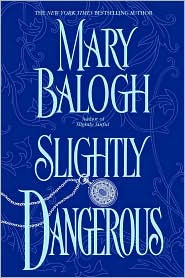
"Slightly Dangerous," by Mary Balogh

The Chick: Christine Derricks. Despite being an impoverished widow who's estranged from her bitter in-laws, she insists on looking on the brighter side of life.
The Rub: However, only a few interactions with the haughty Duke of Bedwyn convince her he's all cloud and no silver lining - so why is she so attracted to him?
Dream Casting: Kate Winslet.

The Dude: Wulfric Bedwyn, Duke of Bewcastle. Despite being rigid, proper, and supremely logical in all things, Wulfric's life hasn't been quite the same since all his siblings married and moved on with their lives.
The Rub: Surely his life could never be so empty that he'd need Mrs. Christine Derricks to fill the void - she's so uncouth and improper and unsuitable!
Dream Casting: Patrick Dempsey.

The Plot:

Christine: What a nice party.

Wulfric: What a dull affair.

Christine: What an arrogant prick!

Wulfric: What a vulgar young woman!

Christine: I don't like you.

Wulfric: I find myself in complete agreement. Sex?

Christine: Sure, why not?

Wulfric and Christine: *SexyTimes*

Wulfric and Christine: Goodbye and good riddance!

Wulfric and Christine: *invited to same wedding* DAMMIT!

Wulfric: Well, I suppose, if you were amenable, we could be married.

Christine: Oh hell no.

Wulfric: .... *sniffle*

Christine: Emotions! Oh, alright, I'll marry you!

Wulfric: Quite. *In private* HOORAY!

Romance Convention Checklist

1 Haughty Aristocrat

1 Wary Widow

2 Nasty In-Laws

5 Smug Married Couples

1 Snake in the Grass Villain

1 Stolen Quizzing Glass

7 Spare Quizzing Glasses

1 Torn Dress

1 Barren Baby Epilogue

The Word: If I want to be completely honest, I didn't start reading this book with the highest of expectations. You see, Slightly Dangerous is not only a novel, but the final novel in the lengthy series concerning the Bedwyns. The final novels in romantic series with recurring characters tend to be more significant because in more cases than not, these are the novels reserved for the "most interesting" characters, that one rake who's just that much more brooding and troubled than the rest, that one female assassin whose past is just that much more mysterious, or that one couple whose vitriolic enmity is so very obviously hiding a secret attraction. Think of Villiers in Eloisa James' Desperate Duchesses series. Or Jesse (Sweet Trouble) in Susan Mallery's Bakery Sisters Trilogy.

Again, while the previous novels in the series revolve around their main characters, they also serve to hype up the mystery/angst/hate-love aspect of those special recurring characters, and these final novels in the series end up coming under especial scrutiny because of that build-up. However, truth be told, once the mystery is gone these characters rarely live up to the hype. Secret shames turn out to be run-of-the-mill Big Misunderstandings. Villainous rakes are neutered into vulnerable fluffy ducklings in disguise.

Frankly, I was expecting Slightly Dangerous to be more of the same. Wulfric Bedwyn, fondly dubbed "The Duke of Asshat" by yours truly, turns up in every Slightly book to make cold, asshat-y comments about propriety and respectability before inevitably surrendering to the romantic whims of the protagonists, with an occasional softened gaze or private crying jag to indicate he does have a heart underneath that formidably controlled exterior. How could the last book possibly do his character justice with any sort of narrative consistency?

To my delight, with Slightly Dangerous Mary Balogh manages to create a moving and realistic romance concerning Wulfric without retroactively rewriting his character into a secret cuddler.

At the beginning of the novel, Wulfric is feeling somewhat out of sorts, but he refuses to examine his feelings deeply enough to identify his problem for what it is: loneliness. His siblings have all absconded into their respective HEAs, his mistress of ten years has died, and his ginormous estate is empty. Thanks to this, he makes a rare impulsive decision to accept a friend's invitation to a houseparty. However, when he arrives, he is appalled to discover that instead of a gathering of intellectuals, it's a betrothal party for a very young couple whose equally young friends are eager to cause mischief.

However, he's not the only accidental outsider. Christine Derricks, a penniless widow, is browbeaten by her friend Lady Renable into attending the same house party as well, even though the two hostile siblings of her late husband will be there, too. She quickly achieves the dubious distinction of making two equally awful first impressions on Wulfric: the first when she accidentally drips searing lemonade into his eye (and he mistakes her for a servant), and the second when she meets him eye-to-eye in the drawing room and openly calls him on his asstastic attitude.

She succeeds both in discombobulating Wulfric and eliminating the rest of her social nervousness and she proceeds to have a lovely time. Her natural charm bubbles to the fore and she's soon the life of the party, even though her clumsiness and unladylike antics earn her the ire of Wulfric and her spiteful in-laws. Wulfric thinks Christine is a human trainwreck, but he can't look away, and his inability to curb his interest unsettles him deeply.

However, Mary Balogh knows just how to pace this romance. Wulfric and Christine don't tumble headfirst into love or even understanding during the two weeks of that houseparty. Wulfric is a thinker, a rationalizer, and the rules of the aristocracy are embedded in his very bones. He knows that Christine is completely unsuitable to be a duchess - she's vulgar, she's clumsy, she's low born, she's barren. He knows this from the outset. He can't stop watching her or feeling attracted to her, but by Nora he'll fight it as long as he can with every rationalization he can find.

However, as he and Christine keep running into each other despite their attempts to avoid each other, Wulfric eventually succumbs to the realization that he cares about her. However - he keeps rationalizing, only this time, in the opposite direction. When he finally does buckle down and decide to pursue Christine into marrying him, he goes at it with the same coolly strategic, logical, and rational determination he applies to everything else. He doesn't suddenly break into song or burst into tears or say the magically "right" thing. By wooing Christine as Wulfric, he doesn't transform into a completely different loving character - instead Mary Balogh shows us that aspect of his character's been a part of him all along.

And Christine's no slouch of a character, herself. While there's definitely a Pride & Prejudice vibe going on here, Mary Balogh deftly demonstrates how she's Wulfric's perfect match. Just as the Duke of Bewcastle is notorious for lowering the temperature of every room he enters with his chilling hauteur and intensely private nature, Christine can't help but bring light and happiness to everyone around her with her ability to laugh at herself as well as others. However, Christine's social ease in society and around other men turned into a double-edged sword when her husband's jealousy and insecurity eventually soured their marriage. She's conflicted - while at ease with herself, she does suffer moments of hyper-consciousness of how tawdry she looks in comparison to the perfection of the ton.

Thanks again the great characterization, the opposites-attract element of the romance also poses one of its most difficult obstacles. Christine has trouble reconciling her attraction to Wulfric with her perception of him as being cold and emotionless, and has trouble grasping how two people so different could make each other happy in the long run, especially considering her first marriage to a man who was also her vast superior in rank.

Even while reading this story, I had trouble with my emotional grade and my objective grade. Emotionally, I'd rate this book a B+, because I liked and appreciated it but didn't love it. Objectively, however, there's too much that's good about this book to let it lower the novel's grade. Objectively, I adored the characterization - not only of the protagonists, but also of the villain, a character who turned out to be a real surprise and one of the most subtle and insidious baddies I've ever read, which was pretty refreshing for a genre where the villains are usually telegraphed from the very beginning. As well, I liked how the other Bedwyns were included into the story without being intrusive.

Finally, I also took into account how Slightly Dangerous fits as a final chapter in the Bedwyn saga, and how it remain absolutely consistent with the character of Wulfric while also managing to be wholly and realistically romantic. I think in this case, it works beautifully as a final chapter - while his siblings do have parts in the story, they serve more as reminders of how each of their stories have helped shape and prepare Wulfric for his own. The way he stood up for Eve in Slightly Married, how he came to Judith's defense in Slightly Wicked, how his interference set the stage for Freya's romance in Slightly Scandalous, learning the truth behind his botched first engagement from Gervase in Slightly Tempted, to enduring the heartbreak of Alleyne's "death" and miraculous return in Slightly Sinful. They've all paved the way for him to finally realize that some things cannot be ruled or controlled - like love.
A

Tuesday, January 26, 2010

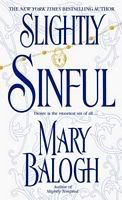
"Slightly Sinful," by Mary Balogh


The Chick: Rachel York. After a swindler makes off with her friends' life savings thanks to her naivete, she'll do anything to pay them back - even trick a distant relative into handing over her inheritance early. She just needs a man to pretend to be her husband.
The Rub: Amnesiac "Jonathan Smith" fits the bill, plus he owes her his life - but their enforced intimacy may have deeper consequences than she realized.
Dream Casting: Romola Garai.

The Dude: Alleyne Bedwyn, a.k.a. "Sir Jonathan Smith." After taking a fall from his horse, he wakes up in a brothel with no memory of who he is - but at least he's surrounded by pretty ladies, not least of whom is the lovely Rachel York.
The Rub: He rather enjoys playing the part of her loving husband - but he still has no memory of who he is, including whether or not he's already married.
Dream Casting: James McAvoy.

The Plot:
Alleyne: War sucks! *falls off horse, bonks head*

Rachel's Friends: *swindled* Poverty sucks!

Rachel: Guilt sucks! *rescues Alleyne*

Alleyne: Amnesia sucks!

Rachel: Virginity sucks.

Alleyne and Rachel: *SexyTimes*

Alleyne: You're right, virginity sucks. *glowers*

Rachel: Hmph. Wanna fake a marriage to get my inheritance?

Alleyne: What about your relative?

Rachel: Oh, don't worry, negligent uncles suck!

Uncle Richard: Being all alone and never getting to see my niece sucks.

Rachel: Utterly wrong first impressions suck. *tear*

Alleyne: Not being able to marry you sucks.

Rachel: Really? 'Cause I checked and you're single.

Alleyne: HOORAY!

Wulfric, Duke of Asshat: What about me?

Mary Balogh: Not until the next book!

Wulfric: Damn, that sucks.

Romance Convention Checklist

1 Amnesiac Hero

1 Guilt-Trippin' Heroine

1 Bad Childhood

1 Forgotten Childhood

1 Kindly Uncle

1 Traumatic Head Injury

1 Inconvenient Inheritance

4 Happy Hookers

2 Drunken Servants

2 Evil Con Artists

1 Unpleasant Deflowering

The Word:
In this penultimate volume of the Bedwyn series, we're dropped into Alleyne's story. During Slightly Tempted (Morgan's book), he went MIA during the Battle of Waterloo while delivering a letter from the Duke of Wellington and was believed to be dead. The Bedwyns held a memorial service, Morgan got some war-angst, and Wulfric, Duke of Asshat had a nice little scene where he cries his Asshat-y eyes out in the privacy of his study.

Of course, since the Bedwyn series is penned by Mary Balogh and not, say, Carolyn Jewel, Alleyne's status as a Hot Brother hands him a Get Out of Death Free Card. While galloping towards Brussels, he's shot in the thigh, knocked off his horse, bonked by a tree root, and stripped naked by war scavengers instead.

Meanwhile, in a brothel in Brussels, our heroine Rachel York tries to apologize to four whores (Geraldina, Flossie, Phyllis and Bridget - who was Rachel's childhood nurse) who have been swindled out of their retirement fund by a con artist Rachel unwittingly introduced them to. Rachel admired the Reverend Nigel Crawley for his supposed goodness, decency and tolerance and agreed to be his betrothed - and now she blames herself for her friends' misfortune.

While the kindhearted birds of paradise consider Rachel as much a victim of Crawley's deception as they are, Rachel still feels responsible and so she, Flossie and Geraldina form a half-baked plan to see what valuables can be found on the battlefield outside the city, in the hopes they'll at least make enough cash to hunt down Crawley for the rest. However, it takes about two minutes for them to realize they haven't the stones to rob the dead, but in the process Rachel discovers an unconscious Alleyne and brings him back to the brothel to recuperate.

What follows is an admittedly trite setup, in which Alleyne wakes up and panics over not remembering anything, the four painted ladies made an exhausting number of thinly-veiled references to how much they want to bang him three ways from Sunday, and Rachel intentionally allows Alleyne to infer she's a whore for some ridiculously martyrish reason. She also jumps into bed with him after knowing him for all of two weeks, then gets all huffy when Alleyne, discovering she's a virgin mid-thrust, is understandably too appalled to perform to her satisfaction.

Okay, so the set-up is tiresome, but it doesn't last for too long and it pays off in spades later. Rachel finally figures out a way to pay back her prostitute pals: while her gambling-addict father left her with nothing when he died, she still has a sizable inheritance of her mother's jewelery held in trust for her by an estranged uncle, to be doled out when she turns twenty-five (three years from now) or when she marries someone her uncle approves of.

Rachel figures if she and Alleyne can convince her uncle they're a happily married couple, he'll have no reason not to hand over her bling, which will restore the hookers' nest egg while leaving a hefty chunk for herself. Despite her tendency to guilt-trip, Rachel feels no qualms about deceiving an uncle who participated very little in her life after disowning her mother for her elopement.

Alleyne agrees to help in her scheme, partly because he owes her big time for saving his buck-naked ass, but partly due to his own cowardice. While in theory he wants to discover who he is and if he has any family, he's also terrified at the thought that his memories might never return. He'd much rather procrastinate for a while to see if his memory returns on its own and posing as Rachel's husband gives him an excellent excuse.

However, things are not so cut-and-dry: Alleyne (now called "Jonathan Smith"), Rachel, and the ladybirds head off to the cold-hearted uncle's impressive estate for a few days only to discover - a) the uncle isn't as cold-hearted as he seems, b) the estate's no longer so impressive thanks to its owner's debilitating illness, and c) the frail Uncle Richard declares that "Jonathan" and Rachel must stay with him for a month before he'll consider relinquishing her jewels.

And here is where the novel goes from pleasant to good, and from good to very, very good. Mary Balogh plays on some familiar themes - mainly, a deep and abiding love for the countryside and intense and understandable personal drama. Alleyne, much like his older brother Aidan from Slightly Married and the Marquess of Hallmere from Slightly Scandalous, discovers an affinity for Rachel's uncle's estate and how it's managed and run. In fact, all the Slightly books so far have taken place at lovingly-described country estates, with plenty of scenes where the characters grow to admire and appreciate the proximity to nature and its beauty (which, in itself, was a popular cultural theme during the Regency). Freed from social constraints and personal limitations that a knowledge of his specific identity might have placed on him, Alleyne pursues what naturally calls to him and uncovers the true essence of his identity.

As for Rachel, well, she's a very flawed character - and I mean flawed in the human way, and not in the badly-characterized way. While I didn't always like her or agree with her, thanks to Balogh's writing I almost always understood her. In many ways, she tries to feel the way she "ought" to feel, repressing her true emotions, and this is poignantly demonstrated in her relationship with her Uncle Richard. She wants to hate him and think the worst of him for not taking part in her life but she responds to the situation of his illness and his generous treatment of his guests nonetheless, and then she ends up resenting her feelings of sympathy as weakness.

Rachel is a woman who is very bound up in the past - she cannot forget her lonely and poverty-stricken childhood spent with a father who threw every penny away at the gaming tables, or her belief that Uncle Richard could have helped if he'd only forgiven her parents for their elopement. She can't overcome her memories of being alone in the world enough to stop taking responsibility for everything and misinterpreting what other people say to her (Alleyne in particular) as slights against her. Seen in this light, it makes perfect sense that it takes a man without memories and without a past to help awaken Rachel to the joys of the present and the possibilities of the future. Some people joke about how cliched the amnesia plotline is (especially in romance), but I'm always willing to suspend my disbelief in an overfamiliar or unrealistic plot device if it expresses an insightful theme or literary idea, and at the risk of repeating myself, Mary Balogh is a champion at this.

The secondary cast, primarily comprised of the four whores, are meant to be lively and humorous but their banter quickly becomes tiresome - however, even they start to grow and develop in pleasant (if predictable) ways. They seem surprisingly healthy and cheerful and well-adjusted for 19th-century prostitutes, which made me a little curious about their pasts and backstories, but otherwise they were harmless.

All in all, another thoroughly enjoyable Mary Balogh novel. You'll have to blame the predictability of my Balogh reviews on the fact that she is one of the most consistent novelists I've ever read - she's not always heart-stoppingly fabulous, but she is always good, and I have never not enjoyed reading her novels.
A-

Friday, August 28, 2009

"Slightly Tempted," by Mary Balogh

Alternate Title: All's Fair in Love and War

The Chick: Lady Morgan Bedwyn. The youngest of the Bedwyns, barely out of the schoolroom, she won't have anyone call her "naive" or "innocent." When her brother Alleyne's declared MIA at the Battle of Waterloo, she turns to a surprising source for comfort - the rakish Earl of Rosthorn.
The Rub: Her trust is shattered when she discovers the Earl of Rosthorn holds a bitter grudge against her brother Wulfric, and that his introduction to her had been motivated by vengeance. Does this mean their every tender moment since then was a lie?
Dream Casting: Michelle Trachtenberg.

The Dude: Gervase Ashford, Earl of Rosthorn. He spent nine years in exile for a crime he didn't commit, thanks in part to the Duke of Bewcastle's refusal to believe his side of the story. While in Brussels, when he spots Lady Morgan Bedwyn in a ballroom - he discovers a way to get revenge.
The Rub: Only trouble is, he doesn't spend that much time in her company before he falls head over heels. Will she still love him when the truth of their initial meeting comes out?
Dream Casting: Elliot Cowan.

The Plot:

In Brussels...
Gervase: I don't believe we've met. *in head* REVENGE! MUAHAHAHAHAHA!

Morgan: Whatevs. *in head* Loser.

Battle of Waterloo: *WAR! DEATH! INJURY!*

Alleyne, Morgan's Brother: *vanishes*

Gervase: I'm so sorry, let me help you. *in head* Muaha...ha ha...who am I kidding? She's amazing.

Morgan: You're such a dear, dear friend! *in head* A dear, dear, HAWT friend...

Morgan and Gervase: *sexx0r*

In England...

Wulfric: Sis, Gervase is only trying to get at me through you.

Morgan: Bro, you're hot, but not that hot - besides, don't you have a sequel coming up...

Wulfric: I mean Gervase is a rapist and a thief and I kicked his ass.

Morgan: GERVASE YOU SHITHEAD WE ARE DONE! AND BY DONE I MEAN BETROTHED.

Gervase: ...?

Morgan: YOU ARE GOING TO SHOWER ME WITH PRESENTS AND ATTENTION, AND THEN I'M GOING TO LEAVE AND HUMILIATE YOU, AND I'M TELLING YOU EVERYTHING I'M GOING TO DO BEFOREHAND, NOT SO THAT YOU CAN STOP ME WITH TENDER, PASSIONATE ROMANTIC GESTURES - BUT BECAUSE IT MAKES ME LOOK MORE BADASS.

Gervase: *tender, passionate romantic gestures*

Morgan: For the love of--FINE, I'll marry you for reals.

Gervase: Hooray!

Romance Convention Checklist

1 Wrongfully-Accused Man

9 Years of Exile

1 Inconvenient War

1 Inconveniently Dead Brother (or IS he?)

1 Age Gap (18-30, baby)

1 "Just Friends" Agreement Doomed to Failure

1 Lacklustre Romantic Rival

2 Surprise Lesbians

1 Fake Rape

1 Bitter Feud

The Word: I love Mary Balogh. Love love love. By the end of her books, I always feel completely swept away into the worlds she creates and the characters she's written. Mary Balogh: Warm Fuzzies Guaranteed.

That being said, of all the Balogh novels, Slightly Tempted had a pretty rocky start, with a heroine I found kind of annoying. However, by the end of the novel Balogh once again convinced me of the Warm Fuzzies - and at the same time of the consistency and depth (however annoying) of her female protagonist.

But I digress - the plot: Lady Morgan Bedwyn is partying hardy in Brussels. She's already bored with the Season even though she's been "out" for all of five minutes, but the excitement of being on the Continent at the same time Napoleon escapes from Elba gives her a measure of excitement. She wants to be a part of history, and engage in scintillating political dialogue, even as the atmosphere of impending doom and violence threatens to rain on her parade.

While she's dancing with a hot soldier, she's spotted by Gervase Ashford, Earl of Rosthorn. He's been partying hardy on the Continent for the last nine years, ever since his dad kicked him out of England for a crime he didn't commit. Wulfric, Duke of Asshat, whom Gervase had once called friend, eased him across the Channel with a firm boot to the ass, and Gervase has felt a consuming rage for the man ever since. Gervase sees Wulfric's fresh-faced 18-year-old sister and sees a way to exact revenge.

He succeeds in starting a public flirtation with her, hoping the gossips fleeing Brussels will carry the story back to Duke Asshat that his virginal lamb of a sister is hooking up with the Big Bad Wolf. However, the saucy Morgan holds her own against his insinuating charms, and his plans go further awry when French troops start marching on Brussels. While all this promises to lead up to some delightful drama, I found the writing in this first section of the book to do a lot of telling instead of showing - as I result, I was pretty bored for the first 60 pages. Could it be (gasp!) I might not like a Mary Balogh novel?

Morgan, thanks to a budding martyr complex and a rather contrived Burninating Righteousness for wounded soldiers, forces her fleeing chaperons to abandon her when she decides to stay in the city to tend the wounded and wait for her brother, Alleyne (a diplomat and messenger) to return from the front. This part of the book was initially hard to swallow - Morgan puts herself in danger, worries her family, and thinks very badly of her chaperons (who have wounded relatives of their own to get to safety), all the while shining with saintly courage and stamping her foot at Those Horrid Social Conventions. In hindsight, however, this passage really underlines just how young Morgan really is - she is full of saintly ideals and black-and-white righteousness at the start, and only through the rest of the book does she mature.

However, her stamping attracts Gervase's admiration, proving to him that she's not simply the Duke of Asshat's empty-headed social belle sister, but a woman in her own right. He stands by her side and offers comfort throughout this trying time, and when Alleyne is declared Missing in Action, he escorts the traumatized and grieving Morgan back to England.

However - the conflict takes a darker and much more delicious turn once Morgan and Gervase return to the motherland. Unfortunately for Gervase, his stalwort defence of Morgan in Brussels has unwittingly turned the harmless gossip surrounding them into full-blown scandal. While at one time Gervase might have delighted in bringing shame to the Bedwyn name, now that he's fallen in love with Morgan it becomes an impediment. Especially once Wulfric reveals to Morgan the nature of Gervase's bitter grudge against him.

While Morgan annoyed me at the start, both with her immaturity and the age gap between her and Gervase (she's 18, he's 30), her naivete and youth serve to buttress the novel's main theme: that of forgiveness, revenge, and trust. Revenge and forgiveness are obviously themes for Gervase's character: after spending nine years separated from his home and family, his schemes for the Bedwyns eventually prove an obstacle to obtaining a happy ending. Once he returns to England to resume his duties as Earl, he also has to confront the people who initially betrayed him - people who aren't dastardly moustache-twirling villains, but rather weak and cowardly people who made a foolish decision.

However, trust and forgiveness enter into Morgan's development, too. Morgan is the youngest Bedwyn, the baby, but she always craved to be taken seriously. I'm smart and capable and powerful! Age ain't nothing but a number! Why can't anyone else see that? Once she learns about Gervase and Wulfric's feud, her self-assuredness crumbles, and she has to confront the weaknesses of her youth and inexperience. For the rest of the novel, she has to learn to trust herself as well as Gervase again. Her attempts towards maturity redeem her character and develop the romance, so that by the end of it, the twelve-year age gap between Gervase and Morgan isn't so squicky as it seemed before.

Mary Balogh has a great talent for taking stock romance plots and character types and crafting them into something unique. Slightly Married had a Marriage of Convenience that actually made sense, Slightly Wicked had the Gorgeous Character Who Thinks She's Ugly who had realistic motivations other than Plot Contrivance for her distorted self-image, Slightly Scandalous had the Fake Betrothal Plotline that brought two great characters together, and now Slightly Tempted comes in with the Naive, Spunky Adolescent Heroine and actually makes her grow up! Better yet - we apparently get an Amnesia Plotline with the next book (Slightly Sinful). Can't wait to see what Balogh does with that one.

Forgive me for doubting your brilliance, Mary Balogh. I must seem horribly predictable, but Slightly Tempted is yet another lovely addition to the Slightly series, despite its slow start - with superb gradual character development, weighty themes, a heady sense of Regency atmosphere I could drown in, and most important of all: plenty of the Warm Fuzzies. That being said, after struggling over whether to give this book an A- or a B+, I settled on the latter: even though the book ended very satisfactorily, the first pages were a slog.
B+

Thursday, June 04, 2009

"Slightly Scandalous," by Mary Balogh

Alternate Title: A Very Long Engagement

The Chick:
Lady Freyja Bedwyn. The only man she ever loved broke her heart by marrying another. Now that their first child is about to arrive, Freyja flees to Bath to escape having to participate in the unbearably cheerful celebrations. Now she's bored out of her mind. When irrepressible scoundrel Joshua Moore asks her to fake a betrothal, she sees an excellent opportunity to take her mind off her troubles.
The Rub: She intends for it to be a brief, amusing affair - after all, Josh is fun, but far too infuriating and presumptuous. However, unforeseen events pop up all over the place that necessitate prolonging the charade, and Freyja fears she can't keep her heart guarded forever...
Dream Casting: Scarlett Johansson.

The Dude: Joshua Moore, Marquess of Hallmere. Formerly a poor relation in the house of Hallmere, he was treated cruelly by his vicious aunt and weak uncle until he was unexpectedly elevated to the title of Marquess. Now his aunt is determined to retain power by marrying him off to her daughter Constance. To evade her manipulations, he concocts a sham betrothal with the hot-headed Freyja Bedwyn.
The Rub: His aunt, used to having her own way, refuses to be driven off. If he won't give her daughter a title, she will use any means, fair or foul, to see him stripped of his own - even if it means dredging up old suspicions about the mysterious death of her son.
Dream Casting: Twilight's Cam Gigandet.

The Plot:

Freyja: Oh, Bath is going to be so boring.

Joshua: *runs into Freyja's room at the inn* HIDE ME!

Freyja: *punches Joshua in the face* Go to Hell!

Later, in Bath:

Joshua: Did you miss me, sweetheart?

Freyja: Go to HELL. The SEQUEL.

Joshua: Wanna fake a betrothal?

Freyja: Hell, why not? I'm bored.

Joshua: It'll just be a few days....

Joshua's Grandmother: Let's throw a party!

Joshua: I mean, a week...

Freyja's Duke Brother: We're making this official.

Joshua: Maybe several weeks....

Joshua's Evil Aunt: Hee hee hee, I'm going to secretly accuse you of murder!

Freyja: Oh Hell.

Joshua: Why don't we just get married for real?

Freyja: What the hell? Sure!

Joshua: Hooray!

Romance Convention Checklist

1 Former Poor Relation

1 Evil Aunt

1 Double-Evil Crazy Perverse Incestuous Rapist Pedophile Cousin (deceased, thank GOD)

Several Uses of the Hero as Human Punching Bag

1 False Accusation of Sexual Assault

2 True Accusations of Sexual Assault

1 Mysterious Death

2 Happenin' Betrothal Parties

1 Mentally Challenged but Definitely Not Evil Cousin

The Word: More than anything, reading this entry in Mary Balogh's consistently enjoyable Slightly series makes me want to read A Summer to Remember, a stand-alone book that apparently featured the Bedwyns before their own series came to be. Why? Because this book makes a lot of references to the events of that novel (although in a very well-written, unconfusing way that can still be easily understood even if you haven't read Summer), and they seem to have had an incredible effect on our protagonist, Freyja Bedwyn.

From what I can gather, Freyja was once in love with Kit (the hero of Summer), and kinda lost her shit when he ended up marrying Lauren (the heroine of Summer). At the beginning of Slightly Scandalous it is very clear that she still hasn't gotten over being spurned and has nothing but nasty backhanded things to say about Lauren, but is nonetheless still embarrassed at her own loss of control.

However, Kit and Lauren seem to have gotten along just fine, as Lauren is soon to give birth to their first child. As Kit and the Bedwyns are long-time neighbours, Freyja knows if she sticks around until the baby's born she'll be roped into the celebrations and she's absolutely certain she'll lose her shit all over again if she has to smile and simper and pretend to be ecstatic over Kit's boring-as-hell bride and her brand-new crying poop factory.

So she accepts a distant friend's invitation and hightails it over to Bath. While she's staying in an inn on the way to the spa town, a strange man bursts into her room and hides in her wardrobe to escape from a con artist who's attempted to trick him into marriage with his granddaughter. Freyja is a duke's daughter, she will have none of this, and when the stranger tries to charm and seduce her into complying she introduces his face to her fist and screams like a banshee until he jumps out the window.

She encounters him again in Bath, is somewhat less than pleased, but after a few misunderstandings and making a very public ass of herself, she admits that the stranger, Joshua Moore, Marquess of Hallmere, is a worthy opponent. She finds his manner infuriating and despises that he refuses to be bested (and frequently gets the best of her), but at least he's entertaining, which is more than she can say for the rest of Bath.

Joshua, however, is only in Bath to briefly visit his grandmother before he returns to his rogueish travels. While he is now the Marquess of Hallmere, as a child he was the abused orphan nephew of the previous Marquess, and has no desire to return to the ancestral estate or take up the reins beyond hiring a competent steward and answering a few letters. However, his past catches up with him when his aunt arrives in Bath with her eldest daughter in tow. Used to ruling her domain with an iron fist, the Marchionesse is determined to maintain her power by marrying Joshua to her daughter Constance. While Joshua is fond of Constance, he refuses his aunt point-blank.

His aunt is not one to be cowed, however, and he knows she'll just find some other way to enforce the desired marriage. Impulsively, he asks Freyja to join him in a sham betrothal. Freyja believes such a lark is just the thing to pluck her out of her doldrums, and accepts. They both take great delight in thwarting the manipulative, evil Marchionesse, but plan to break the betrothal as soon as the Marchionesse skips town.

Fate, however, has other plans - particularly when Joshua's grandmother and Freyja's brother Wulfric (the Duke of Asshat) find out about their betrothal and start making official plans, plans that require Joshua and Freyja to maintain the sham for just a little bit longer, a few days, a few weeks, in order to spare people's feelings and Freyja's reputation. And the longer they stay together, the harder it is for them to remember why their arrangement has to be temporary in the first place.

Now, while I enjoyed this romance as I inevitably end up enjoying all of Mary Balogh's novels, this one developed far more slowly than most and the first half of the novel was rather frustrating - the protagonists continue to bicker and banter but never really encounter or fight with any romantic feelings. While it's normal for many romance protagonists to refrain from admitting their feelings until later in the book, I'm used to protagonists at least experiencing some of the warm and fuzzies (even if they don't identify them as such) before the halfway mark. For a large chunk of the novel, Joshua and Freyja's relationship remained very shallow and flippant. While they eventually do thaw (and in very satisfying ways), this happens fairly late in the plot (as compared to other romance novels).

However, I never found this book boring or wholly unentertaining, and I attribute the bulk of this to Freyja. Her first scene with Joshua at the inn quickly bumped her up to the top of my list of favourite romance heroines - Joshua uses a mixture of seductive charm and rational thought to try and convince Freyja to keep quiet, but Freyja is the sister of a Duke! She doesn't have to be rational! And instead of simply fuming in silence like a lesser romance heroine, she shrieks like a demon and punches him in the face.

Now, on the occasions when I've compared my reviews of Mary Balogh's books with hilarious reviewer Mrs Giggles, I've often found her to lump most of Balogh's heroines into the Dreadful Martyr category. I don't think she would have any cause to label Freyja as a martyr in any way, shape, or form.

Why? Because Freyja is that rarest of romance heroines - she is a self-acknowledged, mostly unrepentant bitch. She is a blue-blooded aristocrat who expects the best of everything, and will fucking cut you if you ever insinuate she deserves less. Yes, she lost Kit to Lauren in A Summer To Remember, but she still believes (at least at the beginning of the novel), that Lauren is a prissy, dull-as-dirt and wholly uninteresting china doll who snuck under her defences and won Kit because she got lucky. When we do get to meet Lauren, she's all warmth and smiles and teddy bears but Freyja? So not falling for that sappy good-girl act. Take a long walk off a short pier, and take your perfectly-perfect womb-parasite with you, bitch!

Mostly, my adoration of Freyja comes from the fact that she's open and honest about what she feels, she doesn't cut herself down to size, and (with a few exceptions) she prefers to handle her problems by head-butting them straight on. She's not a doormat who feels sad about the bad things that happen to her because sad things will inevitably happen to her - she's a self-confident, remarkably self-aware woman who believes (rightly, for the most part), that's she awesome, and so she gets angry when sad things happen to her because awesome people deserve better, dammit! Damn right, I'm envious of Lauren's happy marriage, because I deserve a happy marriage! Damn right, I'm pissed Josh's aunt makes fun of my ugliness, because I deserve to be treated with respect! Damn right, I'm going to punch Josh in the face if he dares to pity me, because I don't deserve to be pitied! Seriously, I'm the daughter of a fucking duke, what part of that do you have trouble understanding???!!!

Joshua was a little harder to relate to. He (refreshingly) avoids the alpha-male route in dealing with the headstrong Freyja, and instead he reacts by making jokes, being flippant, and reacting to nearly everything with amusement and good humour. While there definitely is a darker, sadder aspect underneath his rakish grins, his instinctive oh-how-droll reactions to events occasionally become repetitive.

However, he is an excellent opponent for Freyja. While Freyja is open and forceful, Joshua's an artful dodger, a master of deflection and avoidance. Not just verbally. His wanderings and travels and reluctance to settle down are simply his ways of coping with his own problems and failures. He fiddles around with the idea of returning to Penhallow (the Hallmere ancestral seat) and taking up his full duties as Marquess because he's not ready to face the memories of the ill-treatment he endured, the obligations he shouldered, and the relatives he failed while he lived there. Freyja believes a problem punched hard enough in the nose will eventually go away - Joshua thinks dancing around a obstacle long enough will make it disappear.

I enjoyed watching these two slowly take lessons from each other, both of them benefiting from the process. And, yes, while I thought their relationship was slow to start, once it did really start it set a good pace. Freyja is such an extreme, headstrong, kneejerk character, but Balogh's masterful writing manages to make Freyja's acceptance of love a capitulation of sorts, without being a total surrender of her character.

As in the previous books, many of the Bedwyns show up again, and while they spent a little too much time explaining the married ones' backstories, their presence wasn't a total intrusion (like they were at the end of Slightly Wicked). There were a few pernickity things that bothered me - mainly Joshua's mentally-disabled cousin Prudence. While she demonstrates the mental capacity and attitude of a child, by the end of the novel she enters into a romantic relationship with a young man who is mentally an adult, and I wasn't sure what to feel about that. However, the secret about her past was subtly done - I truly didn't see it coming but reading back, the hints were all there.

All in all, though, I can't help but sigh over yet another lovely Mary Balogh novel. While they're not all equal (The Secret Pearl and "Spellbound" remains my favourites), I have yet to encounter a novel of hers that I didn't enjoy. She just creates such a vivid and wonderful Regency atmosphere, and characters you can believe in. With Slightly Married and Slightly Wicked we got nice-girl heroines, but in Scandalous we actually get to see into the mind of a less-than-nice girl, only to discover she's still an awesome person overall. And one as deserving of a happy ending.
B+