Wow! How could I forget that this blog has been around for more than two years - and been visited by more than 3000 people!
Thanks for sticking around and reading all about my doubts and bitching and personal problems, guys! That means a lot! ^_~
Friday, June 23, 2006

Okay, um, REHIRED!
Well, not exactly.
At my previous manager's suggestion, I sent in my resume to the large-format bookstore that is one floor below us in the same mall. To my luck, the two months I spent at the small-format bookstore counted as experience to the large-format, which motivated one very, very nice employee to boot it to front of the line and right under the LF manager's nose.
I was contacted very promptly, and I just had the interview today. The first question the manager asked was about what had happened that had made me leave the SF bookstore upstairs. I'd had to rehearse that line in my head, because there were several reasons I and my family members had concocted, out of spite, self-loathing, or too many idle hours watching House M.D., which, primarily, were:
-The SF manager hired me to take the place of an employee who went on an extended vacation, and just found an excuse to fire me once the employee returned: I definitely couldn't use this one - there was really no proof other than the fact that I was hired on the employee's first day off and fired on his first day back. Besides, both the LF store and the SF store were managed under the same umbrella company, and presumably their staff communicated with each other from time to time, so badmouthing the SF Manager would hardly go well with the LF one.
-I'm a social retard who lacked the necessary communication skills to get along with the rest of the team, and the attention span to multitask with my work: This was out as well - not only was it (mostly) the result of the dip in my self-esteemed caused by being let go from a job I genuinely thought I was good at, but it would hardly pursuade the LF manager to hire me on.
-The SF Store was very high pressure, and had extremely high standards that I couldn't match up to: While at first this seems like the best response, upon closer analysis it possessed the worst traits of the first two excuses - it portrayed my former manager as a hard-ass taskmaster, and me as a hapless underachiever.
The response I ended up settling on was this: the SF bookstore was a very high-pressure workplace, as it had to compete with the LF store with a staff of only eight or nine people. Thus, those eight or nine people had to be able to learn very quickly how to do all the tasks in the store, and learn how to do several of them at once. While I was passionate about my work, and learned how to do individual tasks without too much trouble, I was, in the end, too inexperienced with retail to learn quickly enough to be a contributing member of what had to be a very close-knit and communicative team, and led to my trouble with multitasking.
I also mentioned in the interview that I had trouble with my social skills. The manager's next question was for me to explain that. I replied very honestly - the SF store job had been my first job in retail, the first job I'd ever had where people came in not knowing exactly what they'd want (fries with your burger? Butter on your popcorn?), the first job where I had the chance to suggest and persuade people to buy something from the store. At McDonald's, and the Movie Theatre, very few people came up to the counter without being sure they were going to buy some food. People coming into bookstores, however, could go either way - they were just as likely to browse and leave empty-handed as they were to find a book they liked.
Well, that was where I aced my interview. The LF Manager revealed right then that she had had a talk with my SF manager beforehand, and that she had said pretty much the exact same thing. The LF Manager praised me for my honesty and my openness, which made me feel pretty damn good. A lot of times in interviews, I (and, I presume, lots of other people) have been tempted to fudge a few facts and accomplishments (especially if the interview questions are "situation" questions, i.e. - 'name a time when you had a problem with a customer and you went beyond the call of duty to solve it'. In those cases I twist up a real-life situation, if I don't outright make up an entire interaction, in the fear that if I confessed to not being able to remember such a situation, or worse - had never experienced such a situation, I was in some way losing points with the potential employer). I didn't during this interview - and that's a lucky thing. If I tried to smarm or gloss over or explain away the fact that I didn't leave my SF job voluntarily, the LF Manager would have called me on my bullshit and that would have been that.
But I didn't. Essentially, I was hired - or, to be more precise - "transferred". Considering that I'd only been off the SF job for about a week, the LF checked the paperwork to see if I couldn't just be seen as transferred from one job to another - essentially eliminated my termination from my record, and leaving me with the same seniority and position. So, I'm being "transferred", although I do have to come in next week to redo the paperwork for my file and get my new schedule.
But still - I'm employed! Back to the 30% discount! Back to "Free Books on Loan" - and in a store with infinitely better selection!
But I can't mess this up.
Not this time.
I really, really really am going to try to get along with everyone and to do the best job I can. No dawdling while shelving books - I don't have the luxury of stopping all the time to check the cash register, because now there are specific people assigned to the cash register. No more having to deal with only one or two staff members at a time - no, now I have to tone down my seemingly uncontrollable gift of inadvertantly annoying everyone in my presence, and try to make real friends.
Because I got lucky. I might not get another chance as good as this one.
At my previous manager's suggestion, I sent in my resume to the large-format bookstore that is one floor below us in the same mall. To my luck, the two months I spent at the small-format bookstore counted as experience to the large-format, which motivated one very, very nice employee to boot it to front of the line and right under the LF manager's nose.
I was contacted very promptly, and I just had the interview today. The first question the manager asked was about what had happened that had made me leave the SF bookstore upstairs. I'd had to rehearse that line in my head, because there were several reasons I and my family members had concocted, out of spite, self-loathing, or too many idle hours watching House M.D., which, primarily, were:
-The SF manager hired me to take the place of an employee who went on an extended vacation, and just found an excuse to fire me once the employee returned: I definitely couldn't use this one - there was really no proof other than the fact that I was hired on the employee's first day off and fired on his first day back. Besides, both the LF store and the SF store were managed under the same umbrella company, and presumably their staff communicated with each other from time to time, so badmouthing the SF Manager would hardly go well with the LF one.
-I'm a social retard who lacked the necessary communication skills to get along with the rest of the team, and the attention span to multitask with my work: This was out as well - not only was it (mostly) the result of the dip in my self-esteemed caused by being let go from a job I genuinely thought I was good at, but it would hardly pursuade the LF manager to hire me on.
-The SF Store was very high pressure, and had extremely high standards that I couldn't match up to: While at first this seems like the best response, upon closer analysis it possessed the worst traits of the first two excuses - it portrayed my former manager as a hard-ass taskmaster, and me as a hapless underachiever.
The response I ended up settling on was this: the SF bookstore was a very high-pressure workplace, as it had to compete with the LF store with a staff of only eight or nine people. Thus, those eight or nine people had to be able to learn very quickly how to do all the tasks in the store, and learn how to do several of them at once. While I was passionate about my work, and learned how to do individual tasks without too much trouble, I was, in the end, too inexperienced with retail to learn quickly enough to be a contributing member of what had to be a very close-knit and communicative team, and led to my trouble with multitasking.
I also mentioned in the interview that I had trouble with my social skills. The manager's next question was for me to explain that. I replied very honestly - the SF store job had been my first job in retail, the first job I'd ever had where people came in not knowing exactly what they'd want (fries with your burger? Butter on your popcorn?), the first job where I had the chance to suggest and persuade people to buy something from the store. At McDonald's, and the Movie Theatre, very few people came up to the counter without being sure they were going to buy some food. People coming into bookstores, however, could go either way - they were just as likely to browse and leave empty-handed as they were to find a book they liked.
Well, that was where I aced my interview. The LF Manager revealed right then that she had had a talk with my SF manager beforehand, and that she had said pretty much the exact same thing. The LF Manager praised me for my honesty and my openness, which made me feel pretty damn good. A lot of times in interviews, I (and, I presume, lots of other people) have been tempted to fudge a few facts and accomplishments (especially if the interview questions are "situation" questions, i.e. - 'name a time when you had a problem with a customer and you went beyond the call of duty to solve it'. In those cases I twist up a real-life situation, if I don't outright make up an entire interaction, in the fear that if I confessed to not being able to remember such a situation, or worse - had never experienced such a situation, I was in some way losing points with the potential employer). I didn't during this interview - and that's a lucky thing. If I tried to smarm or gloss over or explain away the fact that I didn't leave my SF job voluntarily, the LF Manager would have called me on my bullshit and that would have been that.
But I didn't. Essentially, I was hired - or, to be more precise - "transferred". Considering that I'd only been off the SF job for about a week, the LF checked the paperwork to see if I couldn't just be seen as transferred from one job to another - essentially eliminated my termination from my record, and leaving me with the same seniority and position. So, I'm being "transferred", although I do have to come in next week to redo the paperwork for my file and get my new schedule.
But still - I'm employed! Back to the 30% discount! Back to "Free Books on Loan" - and in a store with infinitely better selection!
But I can't mess this up.
Not this time.
I really, really really am going to try to get along with everyone and to do the best job I can. No dawdling while shelving books - I don't have the luxury of stopping all the time to check the cash register, because now there are specific people assigned to the cash register. No more having to deal with only one or two staff members at a time - no, now I have to tone down my seemingly uncontrollable gift of inadvertantly annoying everyone in my presence, and try to make real friends.
Because I got lucky. I might not get another chance as good as this one.
Friday, June 16, 2006
FIRED!
Wow - I have to say this has been one emotional rollercoaster of a week. I made my first professional sale for an absurdly high amount of money considering it's my first professional sale and it's the first story I ever wrote with the idea to publish it. The guy I'm currently dating (yes, dating), showed up with a mind-boggling amount of romantic spontaneity to drop off flowers (yay!), and the next day, I'm fired from the only paying job (save writing, of course ^_^) that I've ever truly enjoyed.
The manager told me that she usually "let people go" (she actually used that namby-pamby term) at the start of their shift, but instead, due to time constraints, she let me work for two hours in blissful ignorance before giving me "the talk" after my break. She gave me rather vague reasons, and I was too much in shock to actually ask her to give me something specific.
Basically, she let me know that in a small bookstore, the employees had to be part of a small, close-knit team, and they also had to handle all the different jobs at once. From what I gathered, I didn't fit into the team, and I was easily flustered. She suggested I work at a larger bookstore, i.e. Chapters, where one was hired to do a certain task and only a certain task. She then went on to describe how over the last few weeks the store had become a "disaster area" during closing, how not everything was being done. I found that hard to comprehend, seeing as I always made sure I did rounds and checked things, and I never closed alone - I always did so with a more experienced coworker.
I realize part of the firing had to have been my fault, but I can't help but harbour a few suspicions. I'd only been working there for about a month - what happened to my supposed three month probationary period? The reasons I was given seemed to be the mistakes of someone who is inexperienced, not stupid or deliberately destructive - they hardly seemed drastic enough for her to let me go this soon. I also happened to notice that the senior employee who went on the long vacation that required the manager to hire new people started work the day I was fired. Of course, the worst scenario I can come up with is that the manager was always planning on only hiring me for the short term but didn't have the decency to say it up front. The best scenario is simply this: she runs an extremely, extremely, EXTREMELY tight ship, and my square peg corners chafed in the round hole she needed filled.
To be honest, this "letting go" was the employment equivalent of the "just didn't do it for us" rejection letter - it lets me know I'm not good enough, but can't give me constructive reasons as to why I can't measure up, and it's very disheartening. At least I worked there long enough to get some free and discounted books out of it.
The manager told me that she usually "let people go" (she actually used that namby-pamby term) at the start of their shift, but instead, due to time constraints, she let me work for two hours in blissful ignorance before giving me "the talk" after my break. She gave me rather vague reasons, and I was too much in shock to actually ask her to give me something specific.
Basically, she let me know that in a small bookstore, the employees had to be part of a small, close-knit team, and they also had to handle all the different jobs at once. From what I gathered, I didn't fit into the team, and I was easily flustered. She suggested I work at a larger bookstore, i.e. Chapters, where one was hired to do a certain task and only a certain task. She then went on to describe how over the last few weeks the store had become a "disaster area" during closing, how not everything was being done. I found that hard to comprehend, seeing as I always made sure I did rounds and checked things, and I never closed alone - I always did so with a more experienced coworker.
I realize part of the firing had to have been my fault, but I can't help but harbour a few suspicions. I'd only been working there for about a month - what happened to my supposed three month probationary period? The reasons I was given seemed to be the mistakes of someone who is inexperienced, not stupid or deliberately destructive - they hardly seemed drastic enough for her to let me go this soon. I also happened to notice that the senior employee who went on the long vacation that required the manager to hire new people started work the day I was fired. Of course, the worst scenario I can come up with is that the manager was always planning on only hiring me for the short term but didn't have the decency to say it up front. The best scenario is simply this: she runs an extremely, extremely, EXTREMELY tight ship, and my square peg corners chafed in the round hole she needed filled.
To be honest, this "letting go" was the employment equivalent of the "just didn't do it for us" rejection letter - it lets me know I'm not good enough, but can't give me constructive reasons as to why I can't measure up, and it's very disheartening. At least I worked there long enough to get some free and discounted books out of it.
Monday, June 12, 2006
ACCEPTED!
I've been accepted.
Go on, check my sidebar. Yeah, there it is: "My Brother's Own Words", accepted, as in "not rejected". As in - I didn't get sent a mysterious and unsettling envelope addressed to me, in my own writing, with nothing inside and no return address.
Accepted.
Someone liked my story. Someone wants to publish my story. It's not published yet - it has to go through an editing process and contract stuff, but I've still been accepted! By a magazine! A big, paying magazine that people actually subscribe to, voluntarily, and not because they'll get a free coupon book if they do!
Accepted.
I have no idea how this will turn out, but it's certainly much more exciting then another rejection letter and another "it just didn't do it for me". I'm very excited and nervous and enthusiastic.
I've been jumping up and down. My mother's making calls to everybody. I have a chance to be a real, published author! An AUTHOR!
I wrote that story over three days while I was recovering from wisdom tooth removal, and I sent it in, in September. In January, I received a yellow postcard back, saying that they were looking at it. And now, I've received a letter that says they thought my story was "fresh, poignant, and endearing" and that they're willing to publish and pay for it. "My Brother's Own Words" has been on a nine-month journey, but by God, it was worth the wait!
Because I want to be a writer for a living, and this acceptance means that I am one step closer to getting my absolute dream job!
Go on, check my sidebar. Yeah, there it is: "My Brother's Own Words", accepted, as in "not rejected". As in - I didn't get sent a mysterious and unsettling envelope addressed to me, in my own writing, with nothing inside and no return address.
Accepted.
Someone liked my story. Someone wants to publish my story. It's not published yet - it has to go through an editing process and contract stuff, but I've still been accepted! By a magazine! A big, paying magazine that people actually subscribe to, voluntarily, and not because they'll get a free coupon book if they do!
Accepted.
I have no idea how this will turn out, but it's certainly much more exciting then another rejection letter and another "it just didn't do it for me". I'm very excited and nervous and enthusiastic.
I've been jumping up and down. My mother's making calls to everybody. I have a chance to be a real, published author! An AUTHOR!
I wrote that story over three days while I was recovering from wisdom tooth removal, and I sent it in, in September. In January, I received a yellow postcard back, saying that they were looking at it. And now, I've received a letter that says they thought my story was "fresh, poignant, and endearing" and that they're willing to publish and pay for it. "My Brother's Own Words" has been on a nine-month journey, but by God, it was worth the wait!
Because I want to be a writer for a living, and this acceptance means that I am one step closer to getting my absolute dream job!
Sunday, June 04, 2006
New books, and I'm finally writing!
I finished the first segment of Daniel Leon's storyline for the "Virtual Season of Heroes", and the creators really liked it. I'm still thinking about the next segment, and I hope it's just as good.
Also, I'm done with Theodore Judson's Fitzpatrick's War. I found myself really enjoying it. It has a fairly depressing premise (the book itself is said to be the "unabridged version" of the memoirs of Sir Robert Bruce, a former friend of Fitzpatrick, who is, in the time that this version of the memoir is published, a glorious war hero of times past), but it is stuffed with little bits of humour, most of it coming from the footnotes of the fictional "editor" of these memoirs, who occasionally fleshes out a point that Robert mentions, or discredits Robert's accounts of Fitzpatrick's mass-murdering deeds as wholely uncredited and spiteful lies.
The depressing aspect is that Robert writes his memoirs in order to show the world the truth about Fitzpatrick's rule, but in the future, he is still unbelieved.
The world itself is post-apocalyptic. All electricity is lost or banned by the usage of Storm Machines, weapons created during the Electronic Age (that is, our present age) that caused loads of suffering and death and allowed all of Canada and the United States to merge into a Christian fundamentalist confederacy known as the Yukon. So while medicine and weaponry have advanced, the social climate is very much like that of imperialist Britain.
The unique setting, a mixture of old-fashioned social beliefs and futuristic steam technology and feudal politics, creates a very interesting world that was intriguing enough to forgive the occasional info dump. On occasion, the author spends pages and pages on detailed descriptions of weapons and military manoeuvres, none of which is any interest to me, but if you can slog through that, the rest of the narrative is highly entertaining.
Also, I'm done with Theodore Judson's Fitzpatrick's War. I found myself really enjoying it. It has a fairly depressing premise (the book itself is said to be the "unabridged version" of the memoirs of Sir Robert Bruce, a former friend of Fitzpatrick, who is, in the time that this version of the memoir is published, a glorious war hero of times past), but it is stuffed with little bits of humour, most of it coming from the footnotes of the fictional "editor" of these memoirs, who occasionally fleshes out a point that Robert mentions, or discredits Robert's accounts of Fitzpatrick's mass-murdering deeds as wholely uncredited and spiteful lies.
The depressing aspect is that Robert writes his memoirs in order to show the world the truth about Fitzpatrick's rule, but in the future, he is still unbelieved.
The world itself is post-apocalyptic. All electricity is lost or banned by the usage of Storm Machines, weapons created during the Electronic Age (that is, our present age) that caused loads of suffering and death and allowed all of Canada and the United States to merge into a Christian fundamentalist confederacy known as the Yukon. So while medicine and weaponry have advanced, the social climate is very much like that of imperialist Britain.
The unique setting, a mixture of old-fashioned social beliefs and futuristic steam technology and feudal politics, creates a very interesting world that was intriguing enough to forgive the occasional info dump. On occasion, the author spends pages and pages on detailed descriptions of weapons and military manoeuvres, none of which is any interest to me, but if you can slog through that, the rest of the narrative is highly entertaining.
Sunday, May 28, 2006
Returning to the Fold
I'm sorry folks - I know I spent a lot of time not posting on this blog, or updating, or reviewing, or anything of the sort. Well, now I'm back, and I'll try to be a more diligent writer.
I'm enjoying my job at the bookstore. I've had my share of long, eight-hour shifts - and the fact that I still look forward to going to work is proof enough that I'll be able to handle this job for the long-run. I've already been rewarded for my superb membership-selling skills twice, and in three weeks I've already made more than a quarter of what I earned working at the movie theatre for two and half months.
I finished Prep, by Curtis Sittenfeld. It was not what I expected - it was more than I expected. It was very introspective, and the hero of the story, Lee Fiora is the type of person whose adventures related to me very closely. She is a scholarship student at Ault Preperatory School, and she finds that going to a boarding school was not even close to what she expected. She finds herself isolated, and is always worrying about every little move and decision she makes and what people might think about it - even though, as it turns out, not many people care. I've felt that way in high school - and while there were many parts of this novel that I didn't enjoy, there was a lot that I sympathized with, that I personally understand that Curtis Sittenfeld was able to describe so aptly.
Now, I've started reading Fitzpatrick's War, and it's off to a very good start - it's written like a pseudomemoir recovered by a scholar from the future, who makes a great deal of humorous footnotes.
Also, I've become involved with an internet writing project. My other efforts have stalled, for the most part - the main reason of that being laziness. Writing under a deadline, or at least for the scrutiny of large amounts of people, might inspire me to be more productive then I usually am. The internet project is located on the messageboards of SuperHeroHype.com, and it's a Virtual Season to coincide with the actual first season of Heroes, which premieres on NBC this fall. The premise of Heroes is that a small group of people spread out over the US suddenly develop superpowers - flight, foresight, magic mirror powers, etc. Well, for this project, each participant creates their own character and proceeds to write a script detailing their particular storyline in the Heroes mythos. I think it will be good - I'll be able to share my writing with people who share my interests, and I'll have the opportunity to try my hand at screenwriting, as all of our contributions will be in script format. Wish me luck!
I'm enjoying my job at the bookstore. I've had my share of long, eight-hour shifts - and the fact that I still look forward to going to work is proof enough that I'll be able to handle this job for the long-run. I've already been rewarded for my superb membership-selling skills twice, and in three weeks I've already made more than a quarter of what I earned working at the movie theatre for two and half months.
I finished Prep, by Curtis Sittenfeld. It was not what I expected - it was more than I expected. It was very introspective, and the hero of the story, Lee Fiora is the type of person whose adventures related to me very closely. She is a scholarship student at Ault Preperatory School, and she finds that going to a boarding school was not even close to what she expected. She finds herself isolated, and is always worrying about every little move and decision she makes and what people might think about it - even though, as it turns out, not many people care. I've felt that way in high school - and while there were many parts of this novel that I didn't enjoy, there was a lot that I sympathized with, that I personally understand that Curtis Sittenfeld was able to describe so aptly.
Now, I've started reading Fitzpatrick's War, and it's off to a very good start - it's written like a pseudomemoir recovered by a scholar from the future, who makes a great deal of humorous footnotes.
Also, I've become involved with an internet writing project. My other efforts have stalled, for the most part - the main reason of that being laziness. Writing under a deadline, or at least for the scrutiny of large amounts of people, might inspire me to be more productive then I usually am. The internet project is located on the messageboards of SuperHeroHype.com, and it's a Virtual Season to coincide with the actual first season of Heroes, which premieres on NBC this fall. The premise of Heroes is that a small group of people spread out over the US suddenly develop superpowers - flight, foresight, magic mirror powers, etc. Well, for this project, each participant creates their own character and proceeds to write a script detailing their particular storyline in the Heroes mythos. I think it will be good - I'll be able to share my writing with people who share my interests, and I'll have the opportunity to try my hand at screenwriting, as all of our contributions will be in script format. Wish me luck!
Tuesday, May 09, 2006
New Books!
As you can probably tell - my reading list has been interrupted by a new shipment of books for review, for The Green Man Review. Goodies! The pile of "books to be read" is getting so large (or tall, more accurately, as I stack them on my desk to provide visual encouragement to read faster) that I despair of ever finding the time to read them all, or to ever have the opportunity to make use of my bookstore's Books on Loan perk.
Saturday, May 06, 2006
It's Official! I Love My Job!
It's true!
I know what you may be thinking - oh, she's just started, she's liked all her jobs at the beginning, it'll only be a matter of time before she quits for the summer and blogs a hilarious "Things I Hate About the Customers at [My Job]" post. Well, that could be true, I suppose - but for now I am revelling in the glow of enjoyment I get from my employment (see that? I'm so happy I'm rhyming!).
For one thing, the store has a wonderful manager and a small, tightly-knit staff. The small staff is probably going to be actually beneficial for me - according to one of my coworkers, this means I'll be trained in everything, whereas in the bigger bookstores I'd only be trained in specific tasks. So, I'll be getting a more well-rounded training at this store.
I like it. It's quiet, and the customers are (for the most part) great. I like merchandising the books (a fancy word for "arranging them in pretty ways on the shelves"), and stocking out ("putting books on shelves"), and selling the books - we have a very cool, up-to-date computer till that makes everything very easy and fun to use.
Oh yeah, and did I mention the fact that I'm VERY GOOD at my job? All my other jobs were kind of banal - take the order, sling the popcorn, fry the fries, rip the tickets. Not a lot of room for improvisation. At the Bookstore, though, I've found I possess a near-miraculous talent at selling Membership cards. You know - those cards that give customers discounts on books in the store.
When I first arrived at the job, I was told that everyone had a quota to make regarding the number of Memberships they sold or renewed. On the day's Task Diary, beside the person's name would be a dollar amount of memberships that they had to sell. It usually came to about one Membership a day, but my coworkers said it was usually expected to be only two a week. Now, I was worried about this. It wasn't commission or anything, but it was a quota I would have to meet by SELLING it to customers. That meant I had to up my personal communication and social skills and sell people something very specific, instead of just suggesting books for them.
However, just like my fear of my Japanese classes that turned out to be extraordinarily easy, I appear to have an almost supernatural ability to sell Memberships, record amounts of them. Yesterday, I sold seven Memberships! In one day! A few days ago, as it happens, the VP of our Bookstore paid a visit to our branch in order to do an inspection, since our branch has been having great progress and tip-top sales despite being small and sharing a mall with a larger bookstore at the other end. And my manager complimented me to the VP on my great membership sales, and the VP also complimented me on the way I engaged customers.
My sales have resulted in me getting rewards at work, which is great, but I feel just a little nervous because I have no idea what I'm doing better than anyone else to get the Memberships, especially considering I've only been working here for a week. Yesterday, I tried to tell the Manager that I had no idea how I've managed to sell so well, but was interrupted when a few more customers came in, and I ended up selling two more memberships right in front of the Manager! -_-;; She laughed and said, "You should be teaching us!" or something to that effect, but I only felt embarassed, because I wouldn't know what to teach!
Anyway though, I'm come through several long shifts with a smile on my face. I spent the whole day at a job, and I've left it still happy about my job, and not dreading the next time I'd have to go and do it - unlike my jobs at the movie theatre and McDonald's. The only hitch in my whole plan was that my feet hurt like HELL during the eight-hour shifts. I wore these really comfortable heels. They hurt a little on a shorter shifts, but I just figured that was because I hadn't stood up for so long since working at the theatre a year ago.
Turns out, though, that spending eight hours with the majority of my considerable weight on the balls of my feet is almost enough to give me a stress fracture. Which means, I'm going to have to clean off my theatre all-black sneakers and give those a go instead. However, for now that is the ONLY hitch in my otherwise fantasic job.
I know what you may be thinking - oh, she's just started, she's liked all her jobs at the beginning, it'll only be a matter of time before she quits for the summer and blogs a hilarious "Things I Hate About the Customers at [My Job]" post. Well, that could be true, I suppose - but for now I am revelling in the glow of enjoyment I get from my employment (see that? I'm so happy I'm rhyming!).
For one thing, the store has a wonderful manager and a small, tightly-knit staff. The small staff is probably going to be actually beneficial for me - according to one of my coworkers, this means I'll be trained in everything, whereas in the bigger bookstores I'd only be trained in specific tasks. So, I'll be getting a more well-rounded training at this store.
I like it. It's quiet, and the customers are (for the most part) great. I like merchandising the books (a fancy word for "arranging them in pretty ways on the shelves"), and stocking out ("putting books on shelves"), and selling the books - we have a very cool, up-to-date computer till that makes everything very easy and fun to use.
Oh yeah, and did I mention the fact that I'm VERY GOOD at my job? All my other jobs were kind of banal - take the order, sling the popcorn, fry the fries, rip the tickets. Not a lot of room for improvisation. At the Bookstore, though, I've found I possess a near-miraculous talent at selling Membership cards. You know - those cards that give customers discounts on books in the store.
When I first arrived at the job, I was told that everyone had a quota to make regarding the number of Memberships they sold or renewed. On the day's Task Diary, beside the person's name would be a dollar amount of memberships that they had to sell. It usually came to about one Membership a day, but my coworkers said it was usually expected to be only two a week. Now, I was worried about this. It wasn't commission or anything, but it was a quota I would have to meet by SELLING it to customers. That meant I had to up my personal communication and social skills and sell people something very specific, instead of just suggesting books for them.
However, just like my fear of my Japanese classes that turned out to be extraordinarily easy, I appear to have an almost supernatural ability to sell Memberships, record amounts of them. Yesterday, I sold seven Memberships! In one day! A few days ago, as it happens, the VP of our Bookstore paid a visit to our branch in order to do an inspection, since our branch has been having great progress and tip-top sales despite being small and sharing a mall with a larger bookstore at the other end. And my manager complimented me to the VP on my great membership sales, and the VP also complimented me on the way I engaged customers.
My sales have resulted in me getting rewards at work, which is great, but I feel just a little nervous because I have no idea what I'm doing better than anyone else to get the Memberships, especially considering I've only been working here for a week. Yesterday, I tried to tell the Manager that I had no idea how I've managed to sell so well, but was interrupted when a few more customers came in, and I ended up selling two more memberships right in front of the Manager! -_-;; She laughed and said, "You should be teaching us!" or something to that effect, but I only felt embarassed, because I wouldn't know what to teach!
Anyway though, I'm come through several long shifts with a smile on my face. I spent the whole day at a job, and I've left it still happy about my job, and not dreading the next time I'd have to go and do it - unlike my jobs at the movie theatre and McDonald's. The only hitch in my whole plan was that my feet hurt like HELL during the eight-hour shifts. I wore these really comfortable heels. They hurt a little on a shorter shifts, but I just figured that was because I hadn't stood up for so long since working at the theatre a year ago.
Turns out, though, that spending eight hours with the majority of my considerable weight on the balls of my feet is almost enough to give me a stress fracture. Which means, I'm going to have to clean off my theatre all-black sneakers and give those a go instead. However, for now that is the ONLY hitch in my otherwise fantasic job.
Thursday, May 04, 2006
"Crown of Stars", by Kate Elliott. B-
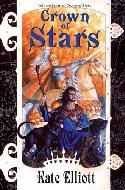
This is an interesting review in that half of what I find disappointing about this novel, I'm not sure whether it's because they were oversights on the author's part, or because I've forgotten something that's happened in previous books. It's been a while since I read the first five books of the Crown of Stars series, I remember the main plot points, but some of the tinier details do continue to escape me.
Either way, here goes - and as a warning: if you haven't read the first five books, go out and do so before reading this review, or else read on and be spoiled, or confused, because I don't have the space to explain every last detail to newcomers.
Anyhoo - continuing on. In the final novel, things come to a head. Sanglant and his army, Conrad and Sabella and their army, Stronghand and his warband, the evil Hugh of Austra all come to meet by the city of Kassel. Battle will be joined, and at long last the throne of Wendar will be decided. Allow me to list the things that disappointed me in this book:
1. What happened to the elf-like Ashioi? Under the banner of the new, warlike Feather Cloak (who happens to be Sanglant's mother), they have decided to wage a war of annihilation against mankind in retribution for all that they have suffered over the centuries. The Church of mankind doesn't like the Ashioi any better. However, after one Ashioi warcamp is decimated by Hugh's weather spells, their rampage is cut short. No more war parties, no more attacking with poisoned arrows and attempting to blame it on King Sanglant. I couldn't understand what made it stop so suddenly.
2. What happens to Queen Adelheid? She married Henry, plotted to have him controlled by a daimone (with Hugh's help), then moved to the background after Henry died and Sanglant claimed the crown. In the first half of the book, she's plotting to gather forces to her aid in order to press her claim and the claim of her children, but after she and her new husband kill the Biscop Antonia (which is, by the way = YAY!), she also abruptly vanishes as a threat.
3. A lot of the revelations that people have have no corporeal proof to support them, and are imparted by visions that, to me, seemed out of the blue. For instance, the idea of the Phoenix, of their religion's Redemption of Daisane (aka Jesus), is decided to be th real thing, without so large a religious debate, even though there's not a lot of proof on it. Same thing for the creatures - like lions - that just drop random objects at certain characters' feet, giving them visions about the truth about their ancestry or some such tidbid of information.
4. We never find out who, or what, Alain is. He's something special - perhaps even supernatural, given the way people react to him. He begins as a flawed, but pure-hearted character, but merges in these last two books into a kind of resigned, sad saint. The end of the book suggests that he spends his days wandering around like a kind of medieval superhero, righting wrongs and fighting injustice with kindness. Hmmm...also - the concept that the Lady of Battles (who started Alain on his journey in the first place) turns out to be Satan came WAY out of the blue for me. I thought she was a good guy! When did that change?
Still, the ending wasn't completely unsatisfactory. Happy endings were doled out all around, and the final chapter jumps ahead an astonishing forty years to show us a brief glimpse of how the children and grandchildren of the main characters are getting by in the new world order. The characters are the reason this book didn't get a C. Kate Elliott rights really well, and I enjoyed reading the book despite the number of questions and loose ends I was left with.
Sunday, April 30, 2006
"In the Ruins" by Kate Elliott. B+
 Aah, sweet relief. Comfort food. I'm not going to lie to you - part of this novel's high review is that, in comparison to the deadly boring Quicksilver, this is packed with action and good characters. The reason is doesn't get an A is mostly because of my forgetfulness. I haven't had the time to read the Crown of Stars series for at least a year, so jumping right into the penultimate volume left me with serious disorientation.
It took a long time to remember who Antonia (the eeeevil, fanatical biscop) was from the previous books, as well as her son Heribert. But anyway...
This book starts off in fine, if depressive form. For any of you who haven't read the Crown of Stars books, I'll try to explain things, but I can't let this review get too long, so read the first books if you can. No, really. They're good. They're chock full of intrigue and medieval detail and have one of the finest political systems I've ever read of. In this world, men and women are more or less equal, but are given different functions. Women are political - in this world, the eldest daughters inherit. So women get most of the position of power - plus, in a cool twist on Catholicism - they rule the Church! Only women can be biscops (bishops) or become Skopos (Pope). I loved this idea.
However, guys fight - while women can be military leaders as well, it's mostly men. Wives stay on their estates and govern them, while their husbands ride off and defend them. It's an interesting and highly effective system.
In In the Ruins, the world is once again in deep trouble. Anne, an evil Skopos, and her followers attempted to weave a giant spell that would keep the elven Ashioi's world from returning to their own, and failed. The resulting cataclysm of the two worlds joining to become one again creates unspeakable devastation - earthquakes, volcanos, floods, tidal waves, and a huge layer of ash that coats the sky and hides the sun. However, according to main character Liath, the destruction would have been much worse if Anne had succeeded, as it would have literally sundered the world in two.
Sanglant, bastard half-Ashioi son of King Henry, and husband to Liath, has been declared regnant by Henry's dying words. Always an obediant son, he takes the remnants of his father's great army, combines it with his own, and seeks to return home to his country in Wendar to help repair what damage has been done to his nation. While still faithful to Liath, their marriage hits an obstacle when the higher members of the Church urge him to put his wife aside, seeing as she comes from no great family, and was excommunicated in a previous book to boot!
Meanwhile, the evil Antonia (one of the few of Anne's followers to survive the backfiring of the spell) has been declared Skopos by Queen Adelheid - the wife of King Henry, and the one who orchestrated the plan to have him ensorcelled by magic in order to declare their daughter heir to Wendar (instead of Henry's older children), and forcing him to try and kill Sanglant. With Henry dead, she scrambles to set up a court of her own in order to challenge Sanglant for the throne.
And finally, the sundered Ashioi find themselves one big happy people again, but troubles arise regardless. During the original spell, thousands of years ago, that sent their half of the world into an exile in the aether, half of the people were exiled to eke out a starved existance on the dying fragment of their land, and the other half were suspended in time back on Earth. The poor, thin exiles must contend with the much more numerous, healthier Ashioi, who, as their humiliation is more recent in their minds, wish to wage war against all of humanity and destroy them forever.
That's basically the set-up of the book. Kate Elliott writes a great page-turner, although sometimes she's a little too heavy on the setting descriptions. Her characters are flawed, but fabulous, with solid pacing and a great story. Nothing goes right in this world - it keeps getting worse and worse, leaving me in greater suspense as I wait to see how the problems can possibly be resolved. Hopefully, unlike China Mieville, in her last volume she won't freeze everyone in time, but will actually come up with conclusion. I've trusted her this far.
Sunday, April 23, 2006
"Quicksilver" Book One of the Baroque Cycle, by Neal Stephenson. D+
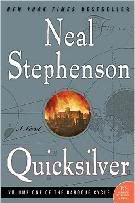 Free at last! Free at last! Those, attentive readers, were my thoughts at having finally, finally read though the 916th page of Neal Stephenson's Quicksilver. I will not be reading The Confusion, the second book in his trilogy, as you can tell from the Updating What I'm Reading section. I loathed this book, for so many reasons that I shall relate.
The first reason is that I wasted money on this book. Christmas money. I came across it at a bookstore, remembered the big deal reviewers made of it, and was attracted to its width, attributing said length to a wealth of content akin to the magnificient storylines in George R. R. Martin's Song of Ice and Fire series. My Mum warned me off the book - she said she'd already bought it, tried to read it, couldn't, and subsequently gave it away/sold it/threw it out/burned it - I don't really remember, except that she got rid of it. I should have listened to her -but noooo...I had to have it for myself, I couldn't just get it out for a free at a library.
The second reason is that it took so much time to finish this novel, time I could have spent reading better books, like the concluding volumes of Kate Elliott's Crown of Stars series, which are infinitely more entertaining.
Now, I'm not saying Neal Stephenson is a bad writer. Quite the opposite, in fact - he's a very good writer. I loved Snow Crash, and his style in Quicksilver was enough for me to buck up, and read it all the way through in respect for the fact that he knows what he is doing. If he'd been a bad, or worse, a repetitive writer, I would have put this volume down on page 200 (when 2 out of the 3 main characters still hadn't shown up yet!). I did as such to Robert Jordan, who dragged me though five and a half of his books in the Wheel of Time series before I came to my senses, realized that due to the prophesy in the first book I already knew what was going to happen, and goshdarnit, that I didn't need twelve novels of 600 pages or more to tell me as much.
The writing isn't what bothered me about the story, it was the way the story was told, and what happened in the story. The story itself hinges on the concepts of math, physics, and philosophy round the 17th century. I hate math, I failed physics, and the only philosophy class I've ever taken was Symbolic Logic, which was basically Math But With Words, but helped me get out of taking actual Math or Stats courses in University.
Most of the action concerned the discoveries and experiments performed by the members of the Royal Society, a club of eccentric British chaps who dissect dogs while they're alive and set off cannons to find out how they work. Nothing, to me, could be more boring. All of the action that occurs in this novel (and, on paper, it certain seems exciting - the London Fire, children out of wedlock, rebellions, espionage, mathematical discoveries, political hugger-mugger) is told to us third hand. The reader is never there to experience the majority of these things as they happen, we are told what has happened during dialogue. A great deal of the novel went something like this:
Royal Society Member (RSM) #1: By the way old chap, have you heard? The king is dead! *sips coffee*
RSM #2: Yes, I heard about that - it happened outside my window, in fact. Quite loud, actually. *adjusts his wig*
RSM #1: Awful luck, that.
RSM #2: Indeed. By the way, Isaac Newton's discovered this quaint thing about gravity.
RSM #1: Really? Extraordinary. *both take a shot of snuff* By the way, don't you just despise the French?
RSM #2: I do! Along with the Dutch, the Catholics, and James Duke of York!
RSM #1: I know - something's bound to happen. I can't wait until it does, because then we can talk about everything that happened, casually, over coffee!
RSM #2: I'm looking forward to it - it ought to be most pleasant. Unless, of course, I'm killed.
RSM #1: Well, in that case, I'll just have something to tell RSM #3.
RSM #2: Jolly good!
So, not only was the plot itself something that was the complete opposite of something that would interest me, but it was told in such a fashion that felt like nothing interesting happened - I only heard about the interesting things that happened. It distanced me from the story, made me feel like an interloper, someone without the authority to see things as they happened. I personally think the whole point of reading fantasy novels is to be put into fantastical events and experience them directly along with the characters - not to hear about it afterwards in a well-furnished parlour.
Also, if you're expecting this to have magic or fantasy in it, or anything out of the historically ordinary, expect to be disappointed. It might be speculative, although my knowledge of 17th century history is just this close to nonexistant so I can't tell if this is all invented by Neal Stephenson or not. Certainly some historical characters are mentioned (Isaac Newton is quite prominent, there are cameos by King Charles II and James II, and a boyish Benjamin Franklin gets a shout-out), but I was too confused to put a great deal of it together. Certainly the discussions of math and physics are entirely beyond me - but Stephenson is too good of a writer to let me get too mired in that - but the book is of such a disastrous length that I'd often forget about important people who'd turn up later in the novel without so much as a hint of their previous backstory.
There are a few humorous bits, normally pieces of ironic humour regarding linguistic differences between then and now (the origin of sabotage and dollars are thrown out), but when it came right down to it I was not engaged at all throughout this book's gargantuan length. Boring, tedious, long. Who knows - if you have a hankering for mathematics, physics, the Dutch stock market, and 17th century history, you might really enjoy this novel. But as a 20-year-old English Major who remembers Isaac Newton mainly as the villain from Vision of Escaflowne, this book was a colossal waste of time.
Saturday, April 22, 2006
Hired! Hired! Hired!
I got hired - on my second job interview - on the SPOT!
I now work for the Tiny Book Store (TBS). Easy to get to, adequate wages, the manager seems really nice, and while it can't guarantee full-time hours - I realize that, realistically, no job will be able to guarantee full-time hours until I've worked for them for longer then three months. I've never passed the probationary period for my jobs because they were only for the summer. With TBS though, I want to work for it part-time during the next school year as well, so I'll probably make enough money for tuition, eventually.
The interview went really well. The manager really enjoyed the part of my cover letter that said I had to pin my posters onto my ceiling because all the other wallspace was taken up with books, and I acquitted myself nicely. I think it was because this time, during this interview, I was more honest in the answers. I don't mean to say that I've lied during other interviews, but when they would ask a question like "Do you recall a time in your other jobs when you went beyond the call the duty?" , I'd always assume that if there were no such time, I wasn't good enough to be hired. So naturally, instead of saying most of my jobs were cut-and-dry and didn't have a whole lot of opportunity for improvisation, I'd fudge a response.
I'm terrible at improv, so most fudged answers come across badly. Here I actually told her that I didn't have a lot of opportunities to do more than was strictly required, because I was working in the food service industry, and only to get money for tuition. I wanted to work for TBS because I loved books, and yes, I did need a little extra cash to take the pressure off of my parents for next year's tuition payments. Also, when she asked in team situations, whether I was a leader or a follower, I honestly said, "follower", even though alarms bells were going off in my head saying "Don't be a sheep! Sheep don't get hired! Innovators get hired!"
Well, it must have worked, because she hired me on the spot. I start Monday, actually. I still have my last exam on Wednesday, and a movie screening for SEE Magazine on Friday, but I don't need to study for the exam (it's for comparative lit, so all I need to have done is the reading, which I have), and my shift on Friday is hours away from the movie screening.
So, I'm excited. The manager said that a lot of the people in the store (TBS has a staff of, erm, about six people) loved my resume (I stated how I reviewed books and freelanced), and the benefits of this job are great. Working for Cineplex Odeon, I got free movies all summer, which was a blast during a year that had Batman Begins and The 40-Year-Old Virgin. But working for TBS, I can take out any book in the store on loan for two weeks, for free, as long as I return it in pristine condition. And even if it's not, I get a 30% discount when I buy it! So, YAY!
However, now that a day full of thinking and hoping and planning has passed, my glee has been chilled slightly by nerves. This is a job where I will have to perform, to sell things. I have to help people find what books they want, and provide good customer service. I love books, though, so I'll try to hold onto that passion so that it will help me deal with people, who tend to scare me sometimes.
I now work for the Tiny Book Store (TBS). Easy to get to, adequate wages, the manager seems really nice, and while it can't guarantee full-time hours - I realize that, realistically, no job will be able to guarantee full-time hours until I've worked for them for longer then three months. I've never passed the probationary period for my jobs because they were only for the summer. With TBS though, I want to work for it part-time during the next school year as well, so I'll probably make enough money for tuition, eventually.
The interview went really well. The manager really enjoyed the part of my cover letter that said I had to pin my posters onto my ceiling because all the other wallspace was taken up with books, and I acquitted myself nicely. I think it was because this time, during this interview, I was more honest in the answers. I don't mean to say that I've lied during other interviews, but when they would ask a question like "Do you recall a time in your other jobs when you went beyond the call the duty?" , I'd always assume that if there were no such time, I wasn't good enough to be hired. So naturally, instead of saying most of my jobs were cut-and-dry and didn't have a whole lot of opportunity for improvisation, I'd fudge a response.
I'm terrible at improv, so most fudged answers come across badly. Here I actually told her that I didn't have a lot of opportunities to do more than was strictly required, because I was working in the food service industry, and only to get money for tuition. I wanted to work for TBS because I loved books, and yes, I did need a little extra cash to take the pressure off of my parents for next year's tuition payments. Also, when she asked in team situations, whether I was a leader or a follower, I honestly said, "follower", even though alarms bells were going off in my head saying "Don't be a sheep! Sheep don't get hired! Innovators get hired!"
Well, it must have worked, because she hired me on the spot. I start Monday, actually. I still have my last exam on Wednesday, and a movie screening for SEE Magazine on Friday, but I don't need to study for the exam (it's for comparative lit, so all I need to have done is the reading, which I have), and my shift on Friday is hours away from the movie screening.
So, I'm excited. The manager said that a lot of the people in the store (TBS has a staff of, erm, about six people) loved my resume (I stated how I reviewed books and freelanced), and the benefits of this job are great. Working for Cineplex Odeon, I got free movies all summer, which was a blast during a year that had Batman Begins and The 40-Year-Old Virgin. But working for TBS, I can take out any book in the store on loan for two weeks, for free, as long as I return it in pristine condition. And even if it's not, I get a 30% discount when I buy it! So, YAY!
However, now that a day full of thinking and hoping and planning has passed, my glee has been chilled slightly by nerves. This is a job where I will have to perform, to sell things. I have to help people find what books they want, and provide good customer service. I love books, though, so I'll try to hold onto that passion so that it will help me deal with people, who tend to scare me sometimes.
Wednesday, April 19, 2006
Interviews! Marvellous Job Interviews!
'Tis finally spring - and it sure came quickly. Right before we got yummy golden heat, we had record-setting spring snows that had buses spinning their wheels in giant white drifts. But now spring is here, the snow is gone, and the only thing that really reminds me I'm in Canada is all the yellow grass and trees that are still bare (in April). Oh yeah, and the job search.
Regular readers of my blog know what happened to me last year - when I was laid off my lazy job at Second Cup in the second week of May, and the ensuing failure to find a better job ended with my coronation as the Butter Queen of Cineplex Odeon. This year, considering the misery of last summer cleaning popcorn kettles and cheese buckets, the pressure has been on to find a job, a GOOD JOB, preferably clerical, governmental, or in entertainment retail (ie: book, music, or movie stores).
Looking for summer employment is killer on me and my self-esteem, for several reasons, which I shall relate:
1) I have to learn to sell myself, and I always tend to sell myself rather short. Past a typing speed of 85 words per minute and a talent in writing, I often draw a blank. So, by the end of the day, I end up feeling like I have absolutely nothing to offer...
2)...Not even experience. Other than The Green Man Review and SEE Magazine, all of my other jobs have been entry-level, two-month, food-service industry jobs like Safeway, McDonald's, and Second Cup. No clerical experience. No retail experience. No customer service experience without a counter getting in the way.
3) I can't drive, so I always have to figure out how to get to certain places by bus. Some areas are just about damn impossible to get to, so I might have a dream job, but no way to get there, or it's in a scary part of town, or whatever. My parents, who are fully aware of the debacle last summer was, have agreed to offer some help in transportation, but it can't be every day.
Well, I've sent in dozens of resumes and coverletters early this year, and as my parents have advised me, I'm going to go with the first employer who offers me full-time summer work. The first one - no waiting for the dream job this time. No gambling. Well, my spirits have risen, because my numerous lines have brought up three possible fish, er, interviews. I shall relate to you the bare details:
Job #1 - Governmental
Ironically enough, I've been considered a candidate for a governmental program that actually HELPS students find employment. How cool is that?
Pros: Close to the LRT route. Regular work. Great pay. Might be able to use my writing. Also - I had this interview the other day, and it went really well. I had to bring a written letter advertising the program, a PowerPoint presentation on Employment standards, and answer questions. I actually think I did really well - which is rare. Most interviews I come out of feeling incredibly stupid. Plus - one of the senior employees recognized me from The Gateway where she works too, but in News, while I'm in Arts and Entertainment.
Cons: Well, it's a damn fine job. It'll pay my tuition and books besides, they offer regular hours, and since it's a summer program there's a great chance they'll rehire me next summer. But will it be a fun job? Naturally, that's not going to stop me from accepting, should they ask. But still...
Job #2: Book Retail - big store.
Pros: It's a big store. And did I mention they sell books? And there just might be a STAFF DISCOUNT? I'm very nervous when actually talking to people, except when I'm talking about thinks I KNOW ABOUT and LIKE. I know and like books. This would be an extremely fun job!
Cons: It's a pain in the ass and a half to get there. I'm talking an hour long bus ride, there and back, and not past 10pm! Plus, they'll probably pay less then the government job. Still - if I get full-time hours I can still make tuition, and it's right across the street from the beautiful big movie theatre. I'm going to have an interview with them in about a week, though, so I can't blow it.
Job #3: Book Retail - tiny store.
Pros: Easy as pie to get there - it's in a mall, by a bus hub, and because it's part of a mall it doesn't have wonky hours. Plus, the manager was really nice when I handed in my resume and asked me serious questions straight off. Also, given the location, ease of which to get there from University, and my interest in books, this could very well be the job I hold throughout the school year as well, part-time of course.
Cons: It's a tiny, tiny store, and it shares the mall with a much larger, more popular bookstore. On the one hand, it means I have less competition as, judging from the manager's tone of voice on the phone, more students tend to apply to the large store and forget all about the bitty one. On the other hand, I'm guessing this bookstore can be kind of quiet, all tucked away.
I've already had the Job #1 Interview, which went swimmingly, I think. The other two interviews are coming up later in the week. I know, I know, some of you are thinking "Whaaat? This crazy girl would rather tell a lower-paying bookstore job because it's fun than work a regular government job that just might mean she'll never have to look for a summer job again?" But the point is this - whoever offers me a full-time summer job first, gets me. No questions. I can't take a risk this time. All of these jobs have really great benefits, so I'll consider myself lucky if even one offers me a job. I really hope one of them does - because if they don't then I'm really in trouble.
Regular readers of my blog know what happened to me last year - when I was laid off my lazy job at Second Cup in the second week of May, and the ensuing failure to find a better job ended with my coronation as the Butter Queen of Cineplex Odeon. This year, considering the misery of last summer cleaning popcorn kettles and cheese buckets, the pressure has been on to find a job, a GOOD JOB, preferably clerical, governmental, or in entertainment retail (ie: book, music, or movie stores).
Looking for summer employment is killer on me and my self-esteem, for several reasons, which I shall relate:
1) I have to learn to sell myself, and I always tend to sell myself rather short. Past a typing speed of 85 words per minute and a talent in writing, I often draw a blank. So, by the end of the day, I end up feeling like I have absolutely nothing to offer...
2)...Not even experience. Other than The Green Man Review and SEE Magazine, all of my other jobs have been entry-level, two-month, food-service industry jobs like Safeway, McDonald's, and Second Cup. No clerical experience. No retail experience. No customer service experience without a counter getting in the way.
3) I can't drive, so I always have to figure out how to get to certain places by bus. Some areas are just about damn impossible to get to, so I might have a dream job, but no way to get there, or it's in a scary part of town, or whatever. My parents, who are fully aware of the debacle last summer was, have agreed to offer some help in transportation, but it can't be every day.
Well, I've sent in dozens of resumes and coverletters early this year, and as my parents have advised me, I'm going to go with the first employer who offers me full-time summer work. The first one - no waiting for the dream job this time. No gambling. Well, my spirits have risen, because my numerous lines have brought up three possible fish, er, interviews. I shall relate to you the bare details:
Job #1 - Governmental
Ironically enough, I've been considered a candidate for a governmental program that actually HELPS students find employment. How cool is that?
Pros: Close to the LRT route. Regular work. Great pay. Might be able to use my writing. Also - I had this interview the other day, and it went really well. I had to bring a written letter advertising the program, a PowerPoint presentation on Employment standards, and answer questions. I actually think I did really well - which is rare. Most interviews I come out of feeling incredibly stupid. Plus - one of the senior employees recognized me from The Gateway where she works too, but in News, while I'm in Arts and Entertainment.
Cons: Well, it's a damn fine job. It'll pay my tuition and books besides, they offer regular hours, and since it's a summer program there's a great chance they'll rehire me next summer. But will it be a fun job? Naturally, that's not going to stop me from accepting, should they ask. But still...
Job #2: Book Retail - big store.
Pros: It's a big store. And did I mention they sell books? And there just might be a STAFF DISCOUNT? I'm very nervous when actually talking to people, except when I'm talking about thinks I KNOW ABOUT and LIKE. I know and like books. This would be an extremely fun job!
Cons: It's a pain in the ass and a half to get there. I'm talking an hour long bus ride, there and back, and not past 10pm! Plus, they'll probably pay less then the government job. Still - if I get full-time hours I can still make tuition, and it's right across the street from the beautiful big movie theatre. I'm going to have an interview with them in about a week, though, so I can't blow it.
Job #3: Book Retail - tiny store.
Pros: Easy as pie to get there - it's in a mall, by a bus hub, and because it's part of a mall it doesn't have wonky hours. Plus, the manager was really nice when I handed in my resume and asked me serious questions straight off. Also, given the location, ease of which to get there from University, and my interest in books, this could very well be the job I hold throughout the school year as well, part-time of course.
Cons: It's a tiny, tiny store, and it shares the mall with a much larger, more popular bookstore. On the one hand, it means I have less competition as, judging from the manager's tone of voice on the phone, more students tend to apply to the large store and forget all about the bitty one. On the other hand, I'm guessing this bookstore can be kind of quiet, all tucked away.
I've already had the Job #1 Interview, which went swimmingly, I think. The other two interviews are coming up later in the week. I know, I know, some of you are thinking "Whaaat? This crazy girl would rather tell a lower-paying bookstore job because it's fun than work a regular government job that just might mean she'll never have to look for a summer job again?" But the point is this - whoever offers me a full-time summer job first, gets me. No questions. I can't take a risk this time. All of these jobs have really great benefits, so I'll consider myself lucky if even one offers me a job. I really hope one of them does - because if they don't then I'm really in trouble.
Tuesday, April 18, 2006
"Iron Council" by China Mieville. C+
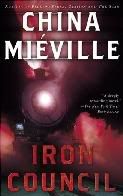
Uh - this post may contain spoilers. So you've been warned, alright?
An awful ending can ruin a movie. I know this from personal experience. You know the film Down With Love? Well, I loved it, until the end when it revealed a twisty I-invented-this-whole-Down-with-love-book-to-gain-your-affection-after-being-spurned-in-your-past plot that had more holes in it than Swiss cheese, and put a big, crushing, damp weight on what had been an otherwise light and fluffy movie.
Or the Irish tearjerker Millions which began as an adorable morality movie about a boy obsessed with saints who finds a duffel bag full of stolen cash, and wants to give it to the poor. The ending - the robber looking for his dough ransacks the boy's house on Christmas Eve, so the family ends up using Stolen Money to give themselves a Merry Christmas - disarmed the moral centre of the film! Using stolen cash is wrong! Wasn't morality like, the whole point of the film?
And don't even mention A.I.: Artificial Intelligence. Aliens? Puh-leeze.
This is what happened to China Mieville's Iron Council. It started off as a wonderful, insanely inventive novel about a rebellion against a violent government, but ended up at a stand-still with nothing resolved. Nothing. Now, if you haven't read Iron Council but, as a China Mieville fan or whatever, are planning to read it anyways, stop right here. I'm going to go into detail about the end, only because I found it so disappointing and anti-climactic compared to the first part of the novel.
The first three quarters, or more accurately, the first nine tenths of the novel concern runaway Cutter and his friends who are looking for their leader Judah Low, a talented golem-maker who vanished from the city of New Crobuzon in order to search for the mythical Iron Council. Judah, having been one of the people who helped to start the Iron Council - a group of abused railway workers who absconded with a train and several sections of rail years ago - knows that the militia of New Crobuzon have discovered the Council's position and are planning to eliminate them as quickly and violently as possible. He feels it's his job to warn the Iron Council to flee. Their act of rebellion against New Crobuzon became a symbol of freedom in the face of oppression, and Judah has no intention of seeing it snuffed out by New Crobuzon's vengeful army.
The story contains a wide variety of original creatures beautiful, grotesque, or just plain weird (how about a type of boar that's raised by wine-makers because it grows grapes on its flanks? Cool, eh?) - but Mieville never info dumps. He mentions them in passing because they're freaky or cool or help to build the vastly detailed setting, but without drowning us in information because they're not relevant to the story.
The characters are all finely tuned, although at times they do become almost static symbols of themselves. There's Ann-Hari - the de facto leader of the Iron Council and Judah's erstwhile lover, Judah himself, Cutter - a man desperate for Judah's affection, and hundreds of others. Some are human, some are vodyanoi (frog-people), some are Cactus people (I'm not kidding - I kept being reminded of the Cactuars from the Final Fantasy videogame series who'd kill you with the move "10 000 Needles").
Upon reaching the place where the Iron Council have settled, Judah and Cutter try to convince the Councillors to flee away from New Crobuzon, but instead, the Iron Council decides it's high time to come back to New Crobuzon, arrive in an inspiring blaze of glory, and defeat the evil government once and for all. So here they are, chugging on their giant train closer and closer to New Crobuzon (once they clear a section of track, Councillors left behind tear it up and build it again in front of the train to keep it moving) - where, as the spies report, thousands are militia are waiting to take them out on sight. Here is the kicker that ruined the book for me - Judah creates a very powerful and difficult time golem that grabs the train, and freezes it in time. Well, halfof it - the other half crashes into it and explodes, killing the rest.
So the Iron Council, instead of reaching the city, is frozen in time. That's the ending. Ann-Hari (who was thrown clear, and thus is NOT trapped in time), kills Judah for doing it (she rightly claims "Iron Council was never yours, Judah, you had no right", whereas Judah, formerly sound of mind, blathers on about how "He's saved them, they're safe now..."). Of course, Judah can't dismantle it, his death doesn't dismantle it, there's no telling WHAT will dismantle this spell. No one can touch the frozen train, so technically the militia can't reach it, but nothing happens. The militia are still there, death and chaos reign, there's no resolution - just a train (half of it, anyway) stuck in time. WHAT THE HELL?
Gah! Maybe, I might understand it later, in that nebulous time when I am considered "to be older and wiser", but right now it seems to me like the author created this impossible situation (one train with hundreds of rebels vs. 1000s of trained soldiers) and then froze time so he wouldn't have to go through with it. The rest of the book, however, is marvellous. So my suggestion would be to read through most of it, or at least until Cutter and the others manage to defeat a magician attempting to call a death-god on New Crobuzon, and then close the book there and imagine that the Iron Council arrived to save the say, or went out fighting in a blaze of martyrdom.
Monday, April 17, 2006
"The Stupidest Angel: Version 2.0" By Christopher Moore
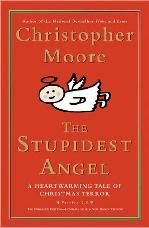
When I first picked up this book, I thought there might be negative repurcussions in reading a Christmas book in March. I mean, it's hard to get into the Christmas spirit when everything outside is the dreary grey-brown sludge of not-quite-winter and not-yet-spring.
However, I found it enjoyable, if a little silly - but then again, that's the point, is it not? Angels, Zombies, graveyard sex, lasagna, and donkeys with dicks like wiffle bats. They're all mentioned in here.
The Stupidest Angel takes place in Pine Cove, California, one of those ultra-cozy towns that thrive mostly on tourism and nothing else. The kooky inhabitants have their Christmas plans ruffled when an accident occurs, the titular dim-witted Heavenly messenger intervenes, and everything goes to Hell in a mistletoe-decorated handbasket.
Dale is the resident Scrooge of the town, a big, fat rich bastard who in any normal story would be visited by the Ghosts of Christmas Past, Present, and Future. Instead, his neck meets the pointy end of a shovel wielded by his ex-wife Lena. A seven-year-old boy witnesses the accidental murder, and as Dale is wearing a Santa suit, the boy mistakes him for the real deal and makes a wish that Santa would come back to life. Raziel, the angel, takes it literally but goes about doing it rather sloppily, as he's busy enjoying the wonders of Snickers bars and minimarshmellows.
Meanwhile, dysfunctional-but-still-functional couple Theo (the town's resident cop and former pot addict) and Molly (the town's resident crazy lady and former cult movie babe) are experiencing their own gift-of-the-Magi story: Theo, who gave up pot years ago on the condition that Molly stay on her meds, has started growing the stuff commercially in order to afford his wife a expensive Japanese sword to practice with. Molly, in the meantime, has given up her meds for the last month in order to afford her Christmas present to Theo - a hand-crafted glass bong. Their frustration with each other has Theo go back to smoking pot on the job and Molly to confusing herself with her on-screen persona the Warrior Babe. Sure, their troubles are exaggerated, but Christopher Moore does a good job of giving them a very affectionate, if off-kilter, relationship.
Add to that problem zombies, a handsome stranger with a talking Micronesian fruit bat who wears miniature Ray-Bans sunglasses, an elderly nymphmaniac bartender who mixes booze and prescription drugs into her Yuletide fruitcake, and a heartbroken biologist attempting to program himself to resist lust by attaching electrodes to his genitals, and you have a crazy, funny, and very quick read.
Christopher Moore packs it in with a lot of humour, much of it very obvious and slapstick-y, but with a few subtle zingers that came in from under the radar. The ending was a little unsatisfying, and the additional "extra" chapter added in the "2.0 Version" is a rather pointless escapade involving a very drunk Lena being threatened by a bumbling serial killer, but otherwise, it's an entertaining read that doesn't require one to think to much in order to enjoy it.
Monday, April 10, 2006
Unknown Territory
Now, I'm guilty of using a variety of metaphors when it comes to reading. There is the metaphor of eating, which I usually apply when I mention my penchant for really thick fantasy novels - I liken them to slabs of meat that can satisfy my appetite the way no skinny chapbook or hors d'oeuvre short story can.
There is the metaphor of digging, usually used negatively to books that were too light and fluffy (they flew away like light sand from my preverbial shovel, shattering in the wind) or too turgid and slow (think thick, gravelly mud mixed with molasses) that need to be "slogged" through until I finally reach the door at the end and can run away to a better book.
Today, though, when I am dealing with starting a new book by a new author, I'll deal with the road metaphor. You've all heard the cliche: "It's the journey that counts, not the destination" (which is what they usually tell you when you lose something you've worked really hard on). Well, it's actually pretty accurate when dealing with books.
I'm reading a new book now, Neal Stephenson's Quicksilver, a massive 800+ page tome that I picked up after finishing China Mieville's Iron Council which had one of the laziest, least satisfying endings of any book I've ever read (but more on that once I catch up with my book reviews). By the end of Iron Council, and by "end", I mean when I was reaching the last pages of the novel before The Lamest Conclusion of All Time, the track was pretty straight - a sidewalk, actually, that I would walk down comfortably and with some speed without having to double back and re-read passages just to make sure I read them correctly.
That's what reading new books by different authors is like - it ends as a sidewalk, but it begins as something different. Manoeuvering through Quicksilver, the path of the narrative is cluttered and treacherous - I could turn an ankle or trip, and often I've come to a confusing bend and have found myself reading back to figure out what's going on. I've acclimatised myself to China Mieville's unique style of writing, and now that I'm on to Neal Stephenson, I have to wade through unfamiliar turns of phrase in order to comfortably navigate the narrative again.
So it's slow going, but once I'm through the first 150 pages or so the path will smoothen out until I get to the end. And if the book turns out to be good, and I move on to The Confusion, then I won't have to go through another brambling path, because it's the same author.
I know, I kinda pointless post - but I thought it'd be could to try and describe my process of reading.
There is the metaphor of digging, usually used negatively to books that were too light and fluffy (they flew away like light sand from my preverbial shovel, shattering in the wind) or too turgid and slow (think thick, gravelly mud mixed with molasses) that need to be "slogged" through until I finally reach the door at the end and can run away to a better book.
Today, though, when I am dealing with starting a new book by a new author, I'll deal with the road metaphor. You've all heard the cliche: "It's the journey that counts, not the destination" (which is what they usually tell you when you lose something you've worked really hard on). Well, it's actually pretty accurate when dealing with books.
I'm reading a new book now, Neal Stephenson's Quicksilver, a massive 800+ page tome that I picked up after finishing China Mieville's Iron Council which had one of the laziest, least satisfying endings of any book I've ever read (but more on that once I catch up with my book reviews). By the end of Iron Council, and by "end", I mean when I was reaching the last pages of the novel before The Lamest Conclusion of All Time, the track was pretty straight - a sidewalk, actually, that I would walk down comfortably and with some speed without having to double back and re-read passages just to make sure I read them correctly.
That's what reading new books by different authors is like - it ends as a sidewalk, but it begins as something different. Manoeuvering through Quicksilver, the path of the narrative is cluttered and treacherous - I could turn an ankle or trip, and often I've come to a confusing bend and have found myself reading back to figure out what's going on. I've acclimatised myself to China Mieville's unique style of writing, and now that I'm on to Neal Stephenson, I have to wade through unfamiliar turns of phrase in order to comfortably navigate the narrative again.
So it's slow going, but once I'm through the first 150 pages or so the path will smoothen out until I get to the end. And if the book turns out to be good, and I move on to The Confusion, then I won't have to go through another brambling path, because it's the same author.
I know, I kinda pointless post - but I thought it'd be could to try and describe my process of reading.
Wednesday, April 05, 2006
Wonderfully Bad Movies
Now, when I first set out to do a blog entry dedicated to notoriously bad films that I enjoyed watching, I realized there would be a little ambiguity to the purpose of my entry. Would it be about films that were notoriously bad, and that I knew were bad, but liked anyway? Or would it be about films that were soundly panned by critics, but that I thought were actually good? Well, I've decided to do both. There are a lot of critically butchered movies that I've loved, and have helped to influence the way I look at film, but there have also been films that tickle my funnybone even as I acknowledge that they make no sense. Some of my ramblings may also contain movie spoilers - so you've been warned.
If you have "wonderfully bad movies" that you think I've missed, feel free to contribute in the Comments section.
Forever Young, 1992, starring Mel Gibson, Jamie Lee Curtis, and Elijah Wood.
I just rented this movie the other day, because as a burgeoning sci-fi devotee I thought the premise sounded cool. Mel plays Daniel McCormick, a daredevil test pilot in 1939 whose girlfriend Helen falls into a coma following a horrible accident. Daniel can't stand to watch her die, so he volunteers to be a guinea pig for his best friend Harry's top-secret cryogenics experiment. He plans to sleep in suspended animation for a year, presumably so that when he wakes up his lady love will be either better or dead, so he won't have to go through the agonized process of waiting.
Unfortunately, Harry dies in an accident two months after Daniel's put in the deep-freeze, World War II starts, and the experiment is forgotten. The cool-looking cryogenic coffin containing the frosty pilot is ironically mislabeled as a water heater and buried in storage until 1992, when two boys (Elijah Wood and Robert Hy Gorman) mess around with some of the wheels and gears and wake him up. Whoa! Culture shock!
First of all, there are HUGE plot holes in the story - like, how did the cryogenic tube remain fully powered and frozen for fifty years? And parts of the film just seemed superfluous. The wonderful Joe Morton is mentioned in top billing, but he has, like five minutes of screentime as a scientist who has discovered what's happened to Daniel and wants to find him for further scientific research. Or something. Anyhoo - it seems like they added his character at the last minute, when they realised, "Oh crap! We need a character to care about Daniel, because all the other ones are dead!" So in comes Morton, who's all brassy and in-your-face about finding Daniel RIGHT NOW because he's a freaking MIRACLE OF SCIENCE, but is instantly placated by a set of journals by the late Harry Finley.
Now, you may ask, why did I like this movie? Well - for one thing, Mel Gibson at 36 is, as the teenagers might say, OMG DAMN HAWT. He's very easy to watch in this movie, even when the wonders of movie makeup transform him into an 85-year-old at the end when his natural age catches up with him. Sure, at 85 he's not exactly George Clooney, but if I was a woman of lesser morals, and he had tons of money, I'd consider shacking up with him. Back on topic, he had a lot of good scenes - like the Essential Scene Where the Two Adult Leads Have To Kiss, which ended up being a protacted make-out session with Jamie Lee Curtis which ends with them apologising, realizing that Jamie Lee's character already has a boyfriend. Oh! And the Gentlemanly Scum-Ass-Kicking Scene, where Mel proceeds to rescue Jamie Lee from an abusive former boyfriend and punch him several times in the face. Gentlemanly Scum-Ass-Kicking Scenes always make me feel warm and fuzzy inside.
Plus, after some research, I found out the script was written by none other than JJ Abrams, the same JJ Abrams who created Alias and Lost. Wow. Dude likes his sci-fi.
The Faculty, 1998, starring Elijah Wood, Josh Hartnett, and about a million other ridiculously famous people.
This movie, on the surface, is just another silly sci-fi horror film about body-snatching slug-parasite aliens who try to take over the world, one small football-town at a time. However, this movie has attained a bit of a cult status because of all the famous people who turned up to be in this film, even if only for a few minutes.
First off, it's directed by Robert Rodriguez - you know, Robert "Sin City", "Spy Kids", "El Mariachi" Rodriguez. The story is hilarious, but it's sometimes a problem to decide whether it's being stupid on purpose, or just to be campy, but it's directed with flair.
Elijah Wood's in it, as a bullied photographer teen who can't seem spend a day at school without having the jock-thugs bash his nuts into the flagpole. He saves the day by eliminating the Queen alien, who was mascarading as twee Southern new girl Marybeth Louise Hutchinson.
Josh Hartnett's in it, as the school's resident drug-dealer and contraband salesman who has to repeat the 12th grade, not because he's not smart (because he is), but because he just doesn't try hard enough. Also, he has a meth lab to run. Helps save the day when he discovers his homemade narcotics make the aliens wig out.
Salma Hayek's in it, for about five minutes, as the cold-suffering school nurse who gets bugged by a parasite.
The wonderful Jon Stewart is in it, as the science teacher who, when he attacks our heroes in an alien-manipulated rage, is incapacitated when he gets stabbed in the eye with a pen full of home-made crack. Returns for the end credits wearing an eyepatch.
Robert Patrick (Terminator 2) stars as the foulmouthed football coach who is the first to be alien-ed. Stabs Bebe Neuwirth through the hand with a pencil, then helps to enslave the rest of the student body. The jock-who-just-wants-to-be-smart, Stan (Shawn Hatosy) is clued in to coach's otherworldiness when he announces he's quitting the football team right before the big game, and the alien-coach responds in a new-agey, hippie-dippie fashion by giving him permission to go "find himself" and "work out his problems".
Bebe Neuwirth is the school's miserly principal. Not very popular - she's attacked by two members of the faculty, both of whom say "I've always wanted to do that" before they stab her with a pencil/pair of shears. She, alien-ed, gets shot in the head, comes back to life, gets hit by a whole jar full of narcotics and dissolves into dust.
Famke Janssen (X-Men's Jean Grey) is the mousy English teacher whose parasite alien master goes all Extreme Makeover on her ass, turning her from the shy prof easily cowed by Josh Hartnett's taunts to a super-sexy, super-foul-mouthed bitch queen. She ends up cured in the end, and promptly goes back to being mousy.
Piper Laurie, Usher "Yeah! Yeah!" Raymond, and Clea DuVall also star. Wow - this movie was fun to watch. It wasn't just the insane list of celebrities who show up for ten minutes to get iced, or the plot-twist that Hartnett's drugs kill the aliens so the teen group of heroes have to regularly snort the stuff to prove they're human, and spend the latter half of the movie high as kites. Or the fact that all the characters fit into a precise niche (the outcast loner girl suspected of being a lesbian, the jock-who-just-wants-to-be smart, the bullied nerd, etc.). It was just plain, campy fun. I can only hope Snakes on a Plane will be as entertaining.
Hook, 1991, Robin Williams, Julia Roberts, Dustin Hoffman.
This was a film that was panned (if you'll pardon the pun) as being one of Spielburg's worst movies, but a film that I adored and helped influence my imagination as a child. I love this film - not in the so-bad-it's-funny love, but the I-genuinely-think-it's-brilliant love. This is one of those films that I could watch a hundred times over without getting board of it.
In a continuation of the "Peter Pan" story - Robin Williams is Peter Panning, a cut-throat lawyer with a fear of heights who's indifferent to his family. He, his wife and kids head off to Britain to visit the greatly-aged Aunt Wendy (Maggie Smith), yes, that Wendy, who became a champion of orphans - including Peter himself, who can't remember anything before the age of twelve. However, after going to a party celebrating the dedication of a children's hospital wing to the woman, Peter comes back to find Wendy's house ransacked, servants hysterical, and his children missing - with a note signed by a certain Captain James Hook.
Wendy reveals to Peter that he is fact Peter Pan, high-flying-happy-thought-holding-green-leotard-wearing Peter Pan, who has forgotten his mythical past as a result of growing up. Peter, justifiably, believes Wendy is insane, but Tinkerbell (Julia Roberts) shows up soon after to drag him back to Neverland to rescue his children. Hook (a fantastic Dustin Hoffman), upon discovering that his fiesty enemy has been reduced to a paunchy, snide adult terrified of flying, is dissuaded from killing him straight off - it would hardly be satisfying. He gives Peter and Tinkerbell three days to get him back into shape, and during those days attempts to gain the affections of Peter's ignored son Jack.
The idea of Peter choosing to grow up (when he falls in love with his wife-to-be, Wendy's granddaughter Moira) was a wonderful idea, and I can think of no one who could have played the adult Pan better than Robin Williams. The society of Lost Boys was also highly entertaining, with "Pan" becoming the name of the leader - hence, mohawked Lost Boy Rufio (as in, "Rufi-OOOOOOOOOOOH!") treats Peter with contempt, maintaining that "I am the Pan!" There was magic and laughter and foodfights and fistfights and flying and Smee, there was a pirate baseball game (where an unlucky buckaneer gets shot for stealing second base), there was Peter's new Happy Thought (the birth of his son Jack), and finally, finally, Tinkerbell gets the chance to reveal to Peter how much in love with him she was.
I could watch this movie a hundred times. I'll never grow up so much that I won't love this film.
So there you have it - three "Wonderfully Bad Films". I could add more, I suppose, but I don't want this post to be too long. Feel free to comment on your own choices, and I might make a new post extending the subject, later on.
If you have "wonderfully bad movies" that you think I've missed, feel free to contribute in the Comments section.
Forever Young, 1992, starring Mel Gibson, Jamie Lee Curtis, and Elijah Wood.
I just rented this movie the other day, because as a burgeoning sci-fi devotee I thought the premise sounded cool. Mel plays Daniel McCormick, a daredevil test pilot in 1939 whose girlfriend Helen falls into a coma following a horrible accident. Daniel can't stand to watch her die, so he volunteers to be a guinea pig for his best friend Harry's top-secret cryogenics experiment. He plans to sleep in suspended animation for a year, presumably so that when he wakes up his lady love will be either better or dead, so he won't have to go through the agonized process of waiting.
Unfortunately, Harry dies in an accident two months after Daniel's put in the deep-freeze, World War II starts, and the experiment is forgotten. The cool-looking cryogenic coffin containing the frosty pilot is ironically mislabeled as a water heater and buried in storage until 1992, when two boys (Elijah Wood and Robert Hy Gorman) mess around with some of the wheels and gears and wake him up. Whoa! Culture shock!
First of all, there are HUGE plot holes in the story - like, how did the cryogenic tube remain fully powered and frozen for fifty years? And parts of the film just seemed superfluous. The wonderful Joe Morton is mentioned in top billing, but he has, like five minutes of screentime as a scientist who has discovered what's happened to Daniel and wants to find him for further scientific research. Or something. Anyhoo - it seems like they added his character at the last minute, when they realised, "Oh crap! We need a character to care about Daniel, because all the other ones are dead!" So in comes Morton, who's all brassy and in-your-face about finding Daniel RIGHT NOW because he's a freaking MIRACLE OF SCIENCE, but is instantly placated by a set of journals by the late Harry Finley.
Now, you may ask, why did I like this movie? Well - for one thing, Mel Gibson at 36 is, as the teenagers might say, OMG DAMN HAWT. He's very easy to watch in this movie, even when the wonders of movie makeup transform him into an 85-year-old at the end when his natural age catches up with him. Sure, at 85 he's not exactly George Clooney, but if I was a woman of lesser morals, and he had tons of money, I'd consider shacking up with him. Back on topic, he had a lot of good scenes - like the Essential Scene Where the Two Adult Leads Have To Kiss, which ended up being a protacted make-out session with Jamie Lee Curtis which ends with them apologising, realizing that Jamie Lee's character already has a boyfriend. Oh! And the Gentlemanly Scum-Ass-Kicking Scene, where Mel proceeds to rescue Jamie Lee from an abusive former boyfriend and punch him several times in the face. Gentlemanly Scum-Ass-Kicking Scenes always make me feel warm and fuzzy inside.
Plus, after some research, I found out the script was written by none other than JJ Abrams, the same JJ Abrams who created Alias and Lost. Wow. Dude likes his sci-fi.
The Faculty, 1998, starring Elijah Wood, Josh Hartnett, and about a million other ridiculously famous people.
This movie, on the surface, is just another silly sci-fi horror film about body-snatching slug-parasite aliens who try to take over the world, one small football-town at a time. However, this movie has attained a bit of a cult status because of all the famous people who turned up to be in this film, even if only for a few minutes.
First off, it's directed by Robert Rodriguez - you know, Robert "Sin City", "Spy Kids", "El Mariachi" Rodriguez. The story is hilarious, but it's sometimes a problem to decide whether it's being stupid on purpose, or just to be campy, but it's directed with flair.
Elijah Wood's in it, as a bullied photographer teen who can't seem spend a day at school without having the jock-thugs bash his nuts into the flagpole. He saves the day by eliminating the Queen alien, who was mascarading as twee Southern new girl Marybeth Louise Hutchinson.
Josh Hartnett's in it, as the school's resident drug-dealer and contraband salesman who has to repeat the 12th grade, not because he's not smart (because he is), but because he just doesn't try hard enough. Also, he has a meth lab to run. Helps save the day when he discovers his homemade narcotics make the aliens wig out.
Salma Hayek's in it, for about five minutes, as the cold-suffering school nurse who gets bugged by a parasite.
The wonderful Jon Stewart is in it, as the science teacher who, when he attacks our heroes in an alien-manipulated rage, is incapacitated when he gets stabbed in the eye with a pen full of home-made crack. Returns for the end credits wearing an eyepatch.
Robert Patrick (Terminator 2) stars as the foulmouthed football coach who is the first to be alien-ed. Stabs Bebe Neuwirth through the hand with a pencil, then helps to enslave the rest of the student body. The jock-who-just-wants-to-be-smart, Stan (Shawn Hatosy) is clued in to coach's otherworldiness when he announces he's quitting the football team right before the big game, and the alien-coach responds in a new-agey, hippie-dippie fashion by giving him permission to go "find himself" and "work out his problems".
Bebe Neuwirth is the school's miserly principal. Not very popular - she's attacked by two members of the faculty, both of whom say "I've always wanted to do that" before they stab her with a pencil/pair of shears. She, alien-ed, gets shot in the head, comes back to life, gets hit by a whole jar full of narcotics and dissolves into dust.
Famke Janssen (X-Men's Jean Grey) is the mousy English teacher whose parasite alien master goes all Extreme Makeover on her ass, turning her from the shy prof easily cowed by Josh Hartnett's taunts to a super-sexy, super-foul-mouthed bitch queen. She ends up cured in the end, and promptly goes back to being mousy.
Piper Laurie, Usher "Yeah! Yeah!" Raymond, and Clea DuVall also star. Wow - this movie was fun to watch. It wasn't just the insane list of celebrities who show up for ten minutes to get iced, or the plot-twist that Hartnett's drugs kill the aliens so the teen group of heroes have to regularly snort the stuff to prove they're human, and spend the latter half of the movie high as kites. Or the fact that all the characters fit into a precise niche (the outcast loner girl suspected of being a lesbian, the jock-who-just-wants-to-be smart, the bullied nerd, etc.). It was just plain, campy fun. I can only hope Snakes on a Plane will be as entertaining.
Hook, 1991, Robin Williams, Julia Roberts, Dustin Hoffman.
This was a film that was panned (if you'll pardon the pun) as being one of Spielburg's worst movies, but a film that I adored and helped influence my imagination as a child. I love this film - not in the so-bad-it's-funny love, but the I-genuinely-think-it's-brilliant love. This is one of those films that I could watch a hundred times over without getting board of it.
In a continuation of the "Peter Pan" story - Robin Williams is Peter Panning, a cut-throat lawyer with a fear of heights who's indifferent to his family. He, his wife and kids head off to Britain to visit the greatly-aged Aunt Wendy (Maggie Smith), yes, that Wendy, who became a champion of orphans - including Peter himself, who can't remember anything before the age of twelve. However, after going to a party celebrating the dedication of a children's hospital wing to the woman, Peter comes back to find Wendy's house ransacked, servants hysterical, and his children missing - with a note signed by a certain Captain James Hook.
Wendy reveals to Peter that he is fact Peter Pan, high-flying-happy-thought-holding-green-leotard-wearing Peter Pan, who has forgotten his mythical past as a result of growing up. Peter, justifiably, believes Wendy is insane, but Tinkerbell (Julia Roberts) shows up soon after to drag him back to Neverland to rescue his children. Hook (a fantastic Dustin Hoffman), upon discovering that his fiesty enemy has been reduced to a paunchy, snide adult terrified of flying, is dissuaded from killing him straight off - it would hardly be satisfying. He gives Peter and Tinkerbell three days to get him back into shape, and during those days attempts to gain the affections of Peter's ignored son Jack.
The idea of Peter choosing to grow up (when he falls in love with his wife-to-be, Wendy's granddaughter Moira) was a wonderful idea, and I can think of no one who could have played the adult Pan better than Robin Williams. The society of Lost Boys was also highly entertaining, with "Pan" becoming the name of the leader - hence, mohawked Lost Boy Rufio (as in, "Rufi-OOOOOOOOOOOH!") treats Peter with contempt, maintaining that "I am the Pan!" There was magic and laughter and foodfights and fistfights and flying and Smee, there was a pirate baseball game (where an unlucky buckaneer gets shot for stealing second base), there was Peter's new Happy Thought (the birth of his son Jack), and finally, finally, Tinkerbell gets the chance to reveal to Peter how much in love with him she was.
I could watch this movie a hundred times. I'll never grow up so much that I won't love this film.
So there you have it - three "Wonderfully Bad Films". I could add more, I suppose, but I don't want this post to be too long. Feel free to comment on your own choices, and I might make a new post extending the subject, later on.
"B" is the loneliest letter that I'll ever knooooooow....
I worked my butt of on my final Shakespeare essay, and I get a B. I suppose, grade-wise, it's better than the B- that I got on my previous essay - and I could see that I just barely escaped getting the minus mark on my final, because I scraped away at the white-out next to the penned grade and found a wretched minus sign underneath the liquid paper. Did the prof recognize her error, or was it only out of mercy to show that, by some infintessimal scale, I was slightly improving?
So, I feel like crap. I lost out on a good grade because all of the niggling, minor details I tried to fix on my last essay turned out to be the only thing that distracted the prof from seeing the entirely new host of niggling, minor details that were all pointed out in this one. I didn't get a good grade because of a misplaced comma, some personal pronouns that rendered some quotes "badly integrated", and the structural error that my thesis was on a second paragraph instead of the first. I made two paragraphs of my intro because it was friggin' huge paragraph all by itself! Did I lose out on an A- because I didn't press the "Delete" key?
At least in Canadian English I'm doing better. I haven't got my final essay from that class back yet, but the prof from that one mentioned one of the sources I used. I replied that I'd tried really hard on that particular essay because I never got higher than a B+. He said that that was about to change. So, I'm assuming I got my FIRST A on an essay, so that's some comfort.
It makes no sense - I love Shakespeare English, I participate like crazy, come to every class, pay attention, and I get crappy grades on my essays. I'm indifferent towards Canadian English, I don't always pay attention (or come) to class, but I'm getting stellar marks. That's English for you - everything hinges on my writing, and opinions on writing are entirly subjective.
So, I feel like crap. I lost out on a good grade because all of the niggling, minor details I tried to fix on my last essay turned out to be the only thing that distracted the prof from seeing the entirely new host of niggling, minor details that were all pointed out in this one. I didn't get a good grade because of a misplaced comma, some personal pronouns that rendered some quotes "badly integrated", and the structural error that my thesis was on a second paragraph instead of the first. I made two paragraphs of my intro because it was friggin' huge paragraph all by itself! Did I lose out on an A- because I didn't press the "Delete" key?
At least in Canadian English I'm doing better. I haven't got my final essay from that class back yet, but the prof from that one mentioned one of the sources I used. I replied that I'd tried really hard on that particular essay because I never got higher than a B+. He said that that was about to change. So, I'm assuming I got my FIRST A on an essay, so that's some comfort.
It makes no sense - I love Shakespeare English, I participate like crazy, come to every class, pay attention, and I get crappy grades on my essays. I'm indifferent towards Canadian English, I don't always pay attention (or come) to class, but I'm getting stellar marks. That's English for you - everything hinges on my writing, and opinions on writing are entirly subjective.
Monday, April 03, 2006
"Storyteller" by Kate Wilhelm
This book was very slim, but took me a surprisingly long time to get through. For most of it I was just slogging through it, because a lot of it was simply the same ol' writing advice that I've read before. I find that a writer should only have five, six books on how to write, tops, because sooner or later they all start to say the same things.
Storyteller's brief moments of interest came from discussing what was done at Clarion, the workshop for science fiction and fantasy writers that is taught by experienced sci-fi and fantasy writers. That's what this book was about: writing lessons from Clarion. I've heard all the lessons before, but I guess now I know what to expect if I apply for a Clarion workshop - lots of watergun fights, bitching, harsh criticism, and virgin sacrificing.
There was an interesting part where Kate Wilhelm talked about being clear about who the characters are at the beginning - the readers get this image of the character in their heads pretty quickly, and they don't like being deceived. So, she discourages stories about characters who turn out to be dogs or lampshades, or dead. That's actually quite funny, because in the Creative Writing class I've been taking, SO MANY of the stories have little twists like that - one started out like a woman who's brutally abused by her controlling husband, but turns out to be a cat who bitches about not getting fed all the time. Two stories were about depressed girls who turn out to be suicides at the very end. One was about a rock star who discovers the girl of his dreams but then gets hit by a car out of the blue and dies. One story was about a guy studying for a Ph.D studying Margaret Atwood, who's visited by a psychotic delusion of Margaret Atwood, who tells him in no uncertain terms that he shouldn't be studying her books because he hates them and should get on with his life.
My only guess as to the frequency of the "twist ending" in our stories (and I'm no exception - "Whiff" is supposed to have a jump at the end, but in my defense I do leave clues and it IS supposed to be a sci-fi mystery) is that many of us don't know how to make short stories interesting with the little space we are allowed, so a twist at the end is devised to give a giant boost to the Cool-O-Meter. Hmmm...
One awesome point made by Storyteller is that there are two kinds of writers: there are wordsmiths, who focus on beautiful, poetic sentences and creative language but can have trouble with plotting and narrative; and there are storytellers - who focus on the narrative, sometimes to the detriment of their language. The best writers are a little bit of both.
I think I'm more of a storyteller, I like cool plots and interesting problems and characters. I also read books and stories for plots, and become frustrated if a story doesn't have a narrative I can make out. However, there is a bit of a wordsmith in me - after reading almost nothing but epic fantasies trilogies, I was bored reading Charles De Lint's Moonheart because I found the language dull compared to the flowery stuff I was used to.
Still, I find I can apply the "wordsmith" and "storyteller" label to the other students in my class. There's this one guy who gets on my nerves - he has long hair that is a surprisingly natural and bright gold colour that I've rarely seen on real people, and gives off a deceptively hippie-slacker vibe. He's always talking about reading Kerouac and listening to Bob Dylan, and handed in a story where nothing happened. Well, that's not true - "stuff" happened. But that was all it was - "stuff". He used very beautiful and interesting figures of speech, but his story went nowhere.
A guy gets a call from a friend, goes driving, bitches about traffic laws, goes to a bar and talks pseudo-intellectually about drunken behaviour, shacks up with a girl he likes, and goes home. That's it. I did not like his story at all - the Storyteller deeply ingrained in the Writing portion of my brain was offended by it, was angry at having to read it without the pay-off of a climax or a relevation or an exciting event. The Storyteller in me felt cheated. This isn't a story! It's only half a story - what was so relevant about this one night at a bar that it got a whole 2500 words devoted to it?
The other students said positive thing about it being "a slice of life", and "so real" and "this is how real life is like", and "real life doesn't have conflicts like stories do". Where the hell do you live, people? I live in a sheltered upperclass suburb, and I can find conflict! There's a reason stories aren't written about people making toast because they love toast, and then they eat the toast and they're happy. There's a reason stories are written about people who make toast because eating it with jam reminds them of a dead girlfriend, or they have to make toast because they have four kids to feed before they all rush off to school or work or whatever. Gah! I was angry at this guy for wasting my time with a story that, he claimed, was about the character's "duality" between art and real life (*cough*pretentious*cough*), and I was angry that all other students were nodding their heads and telling him how good it was. Fine, write that way, if it makes you happy. But good luck finding a guy who'll publish it! I mean, the thought going through my head at the time was He's a good writer, but he's never going to learn and become a great writer if people let him get away with pieces of crap like that!
I learned later from another fellow classmate that this same guy writes really, really good poetry. Well then - he's a wordsmith. Of course he doesn't focus on the narrative, because he doesn't give a crap about narrative - he cares about words. He cares about language. He constructs metaphors about hurricanes and keys to lost doors, and the Wordsmith in his brain is satified by it. The Storyteller in my brain eats through the varnish of his prose and finds nothing behind it, and goes away hungry and complaining. I guess we'll have to agree to disagree.
Storyteller's brief moments of interest came from discussing what was done at Clarion, the workshop for science fiction and fantasy writers that is taught by experienced sci-fi and fantasy writers. That's what this book was about: writing lessons from Clarion. I've heard all the lessons before, but I guess now I know what to expect if I apply for a Clarion workshop - lots of watergun fights, bitching, harsh criticism, and virgin sacrificing.
There was an interesting part where Kate Wilhelm talked about being clear about who the characters are at the beginning - the readers get this image of the character in their heads pretty quickly, and they don't like being deceived. So, she discourages stories about characters who turn out to be dogs or lampshades, or dead. That's actually quite funny, because in the Creative Writing class I've been taking, SO MANY of the stories have little twists like that - one started out like a woman who's brutally abused by her controlling husband, but turns out to be a cat who bitches about not getting fed all the time. Two stories were about depressed girls who turn out to be suicides at the very end. One was about a rock star who discovers the girl of his dreams but then gets hit by a car out of the blue and dies. One story was about a guy studying for a Ph.D studying Margaret Atwood, who's visited by a psychotic delusion of Margaret Atwood, who tells him in no uncertain terms that he shouldn't be studying her books because he hates them and should get on with his life.
My only guess as to the frequency of the "twist ending" in our stories (and I'm no exception - "Whiff" is supposed to have a jump at the end, but in my defense I do leave clues and it IS supposed to be a sci-fi mystery) is that many of us don't know how to make short stories interesting with the little space we are allowed, so a twist at the end is devised to give a giant boost to the Cool-O-Meter. Hmmm...
One awesome point made by Storyteller is that there are two kinds of writers: there are wordsmiths, who focus on beautiful, poetic sentences and creative language but can have trouble with plotting and narrative; and there are storytellers - who focus on the narrative, sometimes to the detriment of their language. The best writers are a little bit of both.
I think I'm more of a storyteller, I like cool plots and interesting problems and characters. I also read books and stories for plots, and become frustrated if a story doesn't have a narrative I can make out. However, there is a bit of a wordsmith in me - after reading almost nothing but epic fantasies trilogies, I was bored reading Charles De Lint's Moonheart because I found the language dull compared to the flowery stuff I was used to.
Still, I find I can apply the "wordsmith" and "storyteller" label to the other students in my class. There's this one guy who gets on my nerves - he has long hair that is a surprisingly natural and bright gold colour that I've rarely seen on real people, and gives off a deceptively hippie-slacker vibe. He's always talking about reading Kerouac and listening to Bob Dylan, and handed in a story where nothing happened. Well, that's not true - "stuff" happened. But that was all it was - "stuff". He used very beautiful and interesting figures of speech, but his story went nowhere.
A guy gets a call from a friend, goes driving, bitches about traffic laws, goes to a bar and talks pseudo-intellectually about drunken behaviour, shacks up with a girl he likes, and goes home. That's it. I did not like his story at all - the Storyteller deeply ingrained in the Writing portion of my brain was offended by it, was angry at having to read it without the pay-off of a climax or a relevation or an exciting event. The Storyteller in me felt cheated. This isn't a story! It's only half a story - what was so relevant about this one night at a bar that it got a whole 2500 words devoted to it?
The other students said positive thing about it being "a slice of life", and "so real" and "this is how real life is like", and "real life doesn't have conflicts like stories do". Where the hell do you live, people? I live in a sheltered upperclass suburb, and I can find conflict! There's a reason stories aren't written about people making toast because they love toast, and then they eat the toast and they're happy. There's a reason stories are written about people who make toast because eating it with jam reminds them of a dead girlfriend, or they have to make toast because they have four kids to feed before they all rush off to school or work or whatever. Gah! I was angry at this guy for wasting my time with a story that, he claimed, was about the character's "duality" between art and real life (*cough*pretentious*cough*), and I was angry that all other students were nodding their heads and telling him how good it was. Fine, write that way, if it makes you happy. But good luck finding a guy who'll publish it! I mean, the thought going through my head at the time was He's a good writer, but he's never going to learn and become a great writer if people let him get away with pieces of crap like that!
I learned later from another fellow classmate that this same guy writes really, really good poetry. Well then - he's a wordsmith. Of course he doesn't focus on the narrative, because he doesn't give a crap about narrative - he cares about words. He cares about language. He constructs metaphors about hurricanes and keys to lost doors, and the Wordsmith in his brain is satified by it. The Storyteller in my brain eats through the varnish of his prose and finds nothing behind it, and goes away hungry and complaining. I guess we'll have to agree to disagree.
Friday, March 31, 2006
Animated Nostalgia
I've always been very interested in cartoons. To my parents' embarassment, I still watch a select few, although I have narrowed the field if that makes them feel any better. I've grown up with cartoons, and it's always fun to look back at them all and commiserate with other University students on the old, cheesy ones we all watched when we were kids, the surprisingly adult ones we'd all like to see again now, and the ones we just hated. Here's a few that I remember:
Barbie:
I barely remember this show, which is a good thing. This was the one based on the dolls, and I can't even find it on TV.com so good luck trying to find an episode guide. I have foggy memories of the opening sequence, which had Barbie riding a sparkling dolphin, if I remember correctly. Anyway, the only episode I can remember was, in hindsight, so repulsive I'm not surprised I never watched any more. It concerned one of Barbie's friends who thought she was fat, and had a nightmare about being morbidly obese (and the size of Godzilla), and had her knocking down buildings and eating planes. Who in their right minds would show this to children?
My Little Pony:
Again, based on a line of toys that are currently enjoying a resurgence in popularity, despite the logistical redundance of having ponies ride scooters and bikes, when, they're ponies, for Pete's sake, they're a source of transportation! Anyway, again, I only remember one episode - where one of the ponies cheats on a test by writing the answers beforehand on her pink hoof. I can't remember how they were able to hold pencils in their hooves, but I don't think that problem would have concerned the producers overmuch.
Captain Planet:
I loved this show, and a lot of other students my age remember it with a mixture of fondness and ruefulness. It was sort of like the Cartoon UN, with representatives from five of the seven continents - all teenagers who were given special magic rings that gave them power over Earth (the guy from Africa had that one), Fire (North America's contribution: a red-headed New Yorker who, hilariously, is the oblivious jerk/asshole of the show and keeps trying to hit on the Russian chick, what, five, ten years after the Cold War ended?), Wind (the Russian girl, although the show said she was from "The Soviet Union", that's how old the show is), Water (a girl from China who has a thing for marine biology, go figure), and the rather lame-ass Heart (given to the South American representative, the youngest boy in the group, who has a thing for animals).
I must have really loved the show, because I remember a lot of it - how Whoopie Goldberg played the voice of Mother Nature for the first few seasons, the episode where the American gets amnesia and lives like a Squigee kid, or goes back in time so that he doesn't accept the ring and become a Planeteer, or accidently uses his fire powers while he and his buds are Fantastic Voyageing it through the African's body to stop a virus ("It feels like my insides are on FIRE!" screams the African) or hits on the Russian girl and she almost accepts because they think they're both going to die but then they get saved at the last minute which, apparently, is a total bonerkill.
However, the episode that stuck the most in my mind was the one they did about AIDS - a kid gets diagnosed as HIV positive, and suddenly people don't want him drinking from their water fountain or playing on their basketball team, and Captain Planet has to come and set the record straight about AIDS and HIV. Wow - I mean, this show was made in the early '90s, and they were showing it to kids. Brave stuff.
Thundercats:
I saw one episode, and kept hearing it wrong because I remember wondering why everyone was refering to them as the "hat people".
The Mighty Ducks:
This was a far cry crom the actual movie - this one was about not only ducks, but alien ducks from another planet where they played nothing but hockey, so they came to Earth to be the best anthropomorphic duck hockey team EVAR!!1! Ahem.
Darkwing Duck:
This, like The Mighty Ducks, is another Disney TV cartoon. Sure, he's a bumbling superhero duck, but that's easier to swallow than alien ducks from Planet Hockey Puck. Plus, his theme song is still catchy today. "Dark-wing DUCK! When there's trouble you / call D.W.!" He also had an episode that spoofed Spider-Man, where he gets bitten by an irradiated spider, grows eight arms, and becomes, temporarily, Arachno-Duck. I kid you not.
Chip n'Dale, Rescue Rangers:
It's the same Disney Chip n' Dale, only this time they wear clothes (Chip wears the fedora and leather jacket Indiana-Jones-Style, Dale prefers Hawaiian shirts, neither wear pants)! And solve mysteries, along with a fly, and two mice, one of whom has to battle a serious addiction to cheese.
Bonkers:
This was a weird show, as it seemed to be an animated spin-off of the film Who Framed Roger Rabbit?, only with Bonkers the wildcat instead of Roger, or Jessica, or anyone from the actual movie. Bonkers is a 'toon, and Police Officer Pickle (pronounced Pick-el) is, supposedly, not. The show wasn't all that entertaining, and also somewhat weird, seeing as they refer to 'toons as different people even though the whole show is a cartoon, so you can't really tell the difference.
Reboot:
This is one of those shows that has gained a HUGE cult following, and in subsequent seasons became aimed more at adults and teens then children. This show was special for two reasons. 1) It was the first completely computer-animated television show. 2) It was Canadian. It was all about the inner workings of a computer, where the "inhabitants" (with names like Enzo, Dot, and Bob the "guardian") have to play games against the "user" (the guy who's using the computer). If the user wins, then the citizens who are stuck in the game get "nullified", which is a bad thing. Bob is a "Guardian" whose job it is to get into the games and help the Mainframers win, so that no one gets "nullified" and, presumably, the dude on the computer gets laughed at by his friends for totally sucking at computer games.
There were so many injokes in this show, which explains why it garnered such a cult following. I mean, they started out by making fun of computer games, then went into making fun of Bugs Bunny, Austin Powers, Star Wars, James Bond, Pokemon, Braveheart, Sailor Moon, The X-Files (where they actually snagged Gillian Anderson as a guest star!) and more. It was an excellent show, but it did get kind of weird and complicated near the end, but I guess that's only to be expected.
Animaniacs:
This was another show that was aimed primarily at kids, but was full of adult in-jokes to entertain the parents watching the show. I mean, they had the requisite anvil-dropping and mallet-smashing, but also an episode where a retired cartoon squirrel blows up Siskel and Ebert's house, Bill Clinton references, Citizen Kane jokes, and LOTS of digs towards characters and films made by Warner Brothers (technically, the Animaniacs are the Warner Brothers Yakko and Wakko, and Dot, the Warner sister).
Gargoyles:
This was a dark little cartoon, another one that became more aimed at adults as it continued. It was all about gargoyles (who are the stone statues everyone recognizes by day, but living creatures by night), who, thanks to a curse by an apprentice wizard, are frozen in stone for 2000 years until an insanely wealthy man named Xanatos breaks the spell by transplanting their entire castle onto the top of his skyscraper. They go through the necessary culture shock, and (other than Goliath), proceed to name themselves after parts of NY: Brooklyn is the rebellious second-in-command, Broadway the gentle giant, Lexington the technogeek, Bronx is their, er, gargoyle dog, and Hudson is the retired old fogey who still has some guff left in him.
There were no holds barred in this show, which mixed sci-fi technology with fantasy myth. We had human cyborgs, gargoyle cyborgs, Arthurian myth, African myth, evil scientists, werewolves, flying mutant cats, time travel (backwards AND forewards), Norse gods, robots, Shakespearan troublemakers MacBeth (whose preferred method of fighting is shooting people from a flying jet-glider), Oberon, Titania, and Puck, retired TV stars hoping to make some extra cash, Coyote the Trickster, aliens who inspired the statues of Easter Island, gangsters, the FBI, and an alternate dimension with gargoyles both male AND female - so Brooklyn, Lexington, and Broadway don't have to worry about nookie anymore. Also, this show got points for having a multi-racial heroine named Elisa, who's half American Indian, half Ethiopian, and has a thing for gargoyles named Goliath. Rowr.
There other cartoons I remember watching - Gummi Bears (where bears drink a juice that makes them bouncy, and makes humans who drink it super-strong), Teddy Ruxpin (I remember when he finds his long-lost dad, and the alchemist who longs to be able to turn things into gold), The Raccoons (said animals who try to protect their forest from, I dunno what they are, pink anteaters? They had funny noses...), Care Bears (*sigh*...), and others. But I don't have the space to list them all.
Do you remember old, cheesy cartoons you used to watch? Post them in comments!
Barbie:
I barely remember this show, which is a good thing. This was the one based on the dolls, and I can't even find it on TV.com so good luck trying to find an episode guide. I have foggy memories of the opening sequence, which had Barbie riding a sparkling dolphin, if I remember correctly. Anyway, the only episode I can remember was, in hindsight, so repulsive I'm not surprised I never watched any more. It concerned one of Barbie's friends who thought she was fat, and had a nightmare about being morbidly obese (and the size of Godzilla), and had her knocking down buildings and eating planes. Who in their right minds would show this to children?
My Little Pony:
Again, based on a line of toys that are currently enjoying a resurgence in popularity, despite the logistical redundance of having ponies ride scooters and bikes, when, they're ponies, for Pete's sake, they're a source of transportation! Anyway, again, I only remember one episode - where one of the ponies cheats on a test by writing the answers beforehand on her pink hoof. I can't remember how they were able to hold pencils in their hooves, but I don't think that problem would have concerned the producers overmuch.
Captain Planet:
I loved this show, and a lot of other students my age remember it with a mixture of fondness and ruefulness. It was sort of like the Cartoon UN, with representatives from five of the seven continents - all teenagers who were given special magic rings that gave them power over Earth (the guy from Africa had that one), Fire (North America's contribution: a red-headed New Yorker who, hilariously, is the oblivious jerk/asshole of the show and keeps trying to hit on the Russian chick, what, five, ten years after the Cold War ended?), Wind (the Russian girl, although the show said she was from "The Soviet Union", that's how old the show is), Water (a girl from China who has a thing for marine biology, go figure), and the rather lame-ass Heart (given to the South American representative, the youngest boy in the group, who has a thing for animals).
I must have really loved the show, because I remember a lot of it - how Whoopie Goldberg played the voice of Mother Nature for the first few seasons, the episode where the American gets amnesia and lives like a Squigee kid, or goes back in time so that he doesn't accept the ring and become a Planeteer, or accidently uses his fire powers while he and his buds are Fantastic Voyageing it through the African's body to stop a virus ("It feels like my insides are on FIRE!" screams the African) or hits on the Russian girl and she almost accepts because they think they're both going to die but then they get saved at the last minute which, apparently, is a total bonerkill.
However, the episode that stuck the most in my mind was the one they did about AIDS - a kid gets diagnosed as HIV positive, and suddenly people don't want him drinking from their water fountain or playing on their basketball team, and Captain Planet has to come and set the record straight about AIDS and HIV. Wow - I mean, this show was made in the early '90s, and they were showing it to kids. Brave stuff.
Thundercats:
I saw one episode, and kept hearing it wrong because I remember wondering why everyone was refering to them as the "hat people".
The Mighty Ducks:
This was a far cry crom the actual movie - this one was about not only ducks, but alien ducks from another planet where they played nothing but hockey, so they came to Earth to be the best anthropomorphic duck hockey team EVAR!!1! Ahem.
Darkwing Duck:
This, like The Mighty Ducks, is another Disney TV cartoon. Sure, he's a bumbling superhero duck, but that's easier to swallow than alien ducks from Planet Hockey Puck. Plus, his theme song is still catchy today. "Dark-wing DUCK! When there's trouble you / call D.W.!" He also had an episode that spoofed Spider-Man, where he gets bitten by an irradiated spider, grows eight arms, and becomes, temporarily, Arachno-Duck. I kid you not.
Chip n'Dale, Rescue Rangers:
It's the same Disney Chip n' Dale, only this time they wear clothes (Chip wears the fedora and leather jacket Indiana-Jones-Style, Dale prefers Hawaiian shirts, neither wear pants)! And solve mysteries, along with a fly, and two mice, one of whom has to battle a serious addiction to cheese.
Bonkers:
This was a weird show, as it seemed to be an animated spin-off of the film Who Framed Roger Rabbit?, only with Bonkers the wildcat instead of Roger, or Jessica, or anyone from the actual movie. Bonkers is a 'toon, and Police Officer Pickle (pronounced Pick-el) is, supposedly, not. The show wasn't all that entertaining, and also somewhat weird, seeing as they refer to 'toons as different people even though the whole show is a cartoon, so you can't really tell the difference.
Reboot:
This is one of those shows that has gained a HUGE cult following, and in subsequent seasons became aimed more at adults and teens then children. This show was special for two reasons. 1) It was the first completely computer-animated television show. 2) It was Canadian. It was all about the inner workings of a computer, where the "inhabitants" (with names like Enzo, Dot, and Bob the "guardian") have to play games against the "user" (the guy who's using the computer). If the user wins, then the citizens who are stuck in the game get "nullified", which is a bad thing. Bob is a "Guardian" whose job it is to get into the games and help the Mainframers win, so that no one gets "nullified" and, presumably, the dude on the computer gets laughed at by his friends for totally sucking at computer games.
There were so many injokes in this show, which explains why it garnered such a cult following. I mean, they started out by making fun of computer games, then went into making fun of Bugs Bunny, Austin Powers, Star Wars, James Bond, Pokemon, Braveheart, Sailor Moon, The X-Files (where they actually snagged Gillian Anderson as a guest star!) and more. It was an excellent show, but it did get kind of weird and complicated near the end, but I guess that's only to be expected.
Animaniacs:
This was another show that was aimed primarily at kids, but was full of adult in-jokes to entertain the parents watching the show. I mean, they had the requisite anvil-dropping and mallet-smashing, but also an episode where a retired cartoon squirrel blows up Siskel and Ebert's house, Bill Clinton references, Citizen Kane jokes, and LOTS of digs towards characters and films made by Warner Brothers (technically, the Animaniacs are the Warner Brothers Yakko and Wakko, and Dot, the Warner sister).
Gargoyles:
This was a dark little cartoon, another one that became more aimed at adults as it continued. It was all about gargoyles (who are the stone statues everyone recognizes by day, but living creatures by night), who, thanks to a curse by an apprentice wizard, are frozen in stone for 2000 years until an insanely wealthy man named Xanatos breaks the spell by transplanting their entire castle onto the top of his skyscraper. They go through the necessary culture shock, and (other than Goliath), proceed to name themselves after parts of NY: Brooklyn is the rebellious second-in-command, Broadway the gentle giant, Lexington the technogeek, Bronx is their, er, gargoyle dog, and Hudson is the retired old fogey who still has some guff left in him.
There were no holds barred in this show, which mixed sci-fi technology with fantasy myth. We had human cyborgs, gargoyle cyborgs, Arthurian myth, African myth, evil scientists, werewolves, flying mutant cats, time travel (backwards AND forewards), Norse gods, robots, Shakespearan troublemakers MacBeth (whose preferred method of fighting is shooting people from a flying jet-glider), Oberon, Titania, and Puck, retired TV stars hoping to make some extra cash, Coyote the Trickster, aliens who inspired the statues of Easter Island, gangsters, the FBI, and an alternate dimension with gargoyles both male AND female - so Brooklyn, Lexington, and Broadway don't have to worry about nookie anymore. Also, this show got points for having a multi-racial heroine named Elisa, who's half American Indian, half Ethiopian, and has a thing for gargoyles named Goliath. Rowr.
There other cartoons I remember watching - Gummi Bears (where bears drink a juice that makes them bouncy, and makes humans who drink it super-strong), Teddy Ruxpin (I remember when he finds his long-lost dad, and the alchemist who longs to be able to turn things into gold), The Raccoons (said animals who try to protect their forest from, I dunno what they are, pink anteaters? They had funny noses...), Care Bears (*sigh*...), and others. But I don't have the space to list them all.
Do you remember old, cheesy cartoons you used to watch? Post them in comments!
Subscribe to:
Posts (Atom)